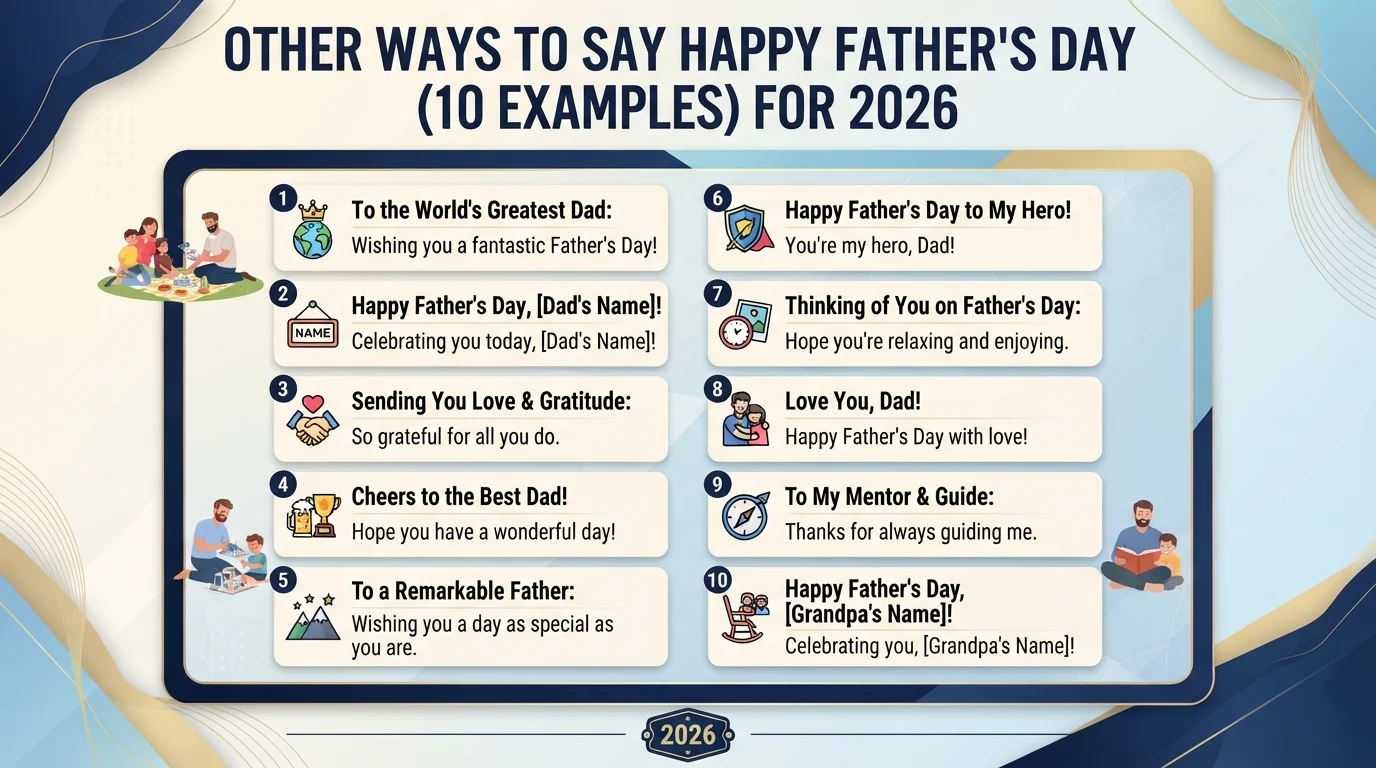
Other ways to say Happy Father’s Day include Wishing You a Wonderful Father’s Day, Enjoy Your Special Day, Celebrating You Today, Best Wishes on Father’s Day, and Thank You for Everything, Dad. Each expression adds a different personal touch.
Father’s Day is a wonderful opportunity to celebrate fathers, grandfathers, stepfathers, and other important father figures. Although “Happy Father’s Day” is a familiar greeting, using different expressions can make your message feel more thoughtful and personal.
Choosing the right words helps you communicate appreciation, respect, and affection naturally. Whether you’re writing a greeting card, sending a text, preparing a social media caption, or greeting someone at work, the right expression makes your message more meaningful.
Learning alternative greetings also improves your English vocabulary. It helps you understand tone, formality, and context while making everyday communication more expressive.
Quick Category: Different Ways to Wish Someone a Happy Father’s Day
Here are some useful alternatives organized by communication style.
1. Formal Alternatives
- Warmest wishes on Father’s Day.
- Best wishes for Father’s Day.
- Wishing you a memorable Father’s Day.
- With sincere appreciation this Father’s Day.
Pro Tip: Choose respectful, complete expressions when writing to someone you don’t know particularly well.
2. Professional Alternatives
- Wishing you a wonderful Father’s Day.
- Enjoy a special Father’s Day celebration.
- Best wishes to you and your family.
- Sending warm wishes on Father’s Day.
Pro Tip: Keep workplace greetings friendly and respectful without assuming how someone celebrates the occasion.
3. Business Email Alternatives
- Best wishes on Father’s Day.
- Wishing you and your family a lovely day.
- Warm regards on this special occasion.
- Enjoy the Father’s Day celebrations.
Pro Tip: A short, considerate greeting is usually more appropriate than an emotional personal message in a business email.
4. Academic Alternatives
- Recognizing the importance of father figures.
- Celebrating the contributions of fathers.
- Acknowledging the influence of fatherhood.
- Honoring the role of fathers in families.
Pro Tip: These are descriptive expressions for essays and presentations, not direct substitutes for a personal holiday greeting.
5. Casual Alternatives
- Have an amazing Father’s Day!
- Enjoy your special day, Dad!
- Cheers to you, Dad!
- Hope you have a fantastic day!
Pro Tip: Use these expressions with relatives, friends, and people you know comfortably.
6. Informal Expressions
- Happy Dad’s Day!
- Big cheers to you, Dad!
- Have the best day, Pops!
- You’re the best, Dad!
Pro Tip: Informal expressions work particularly well in text messages and family group chats.
What Does “Other Ways to Say Happy Father’s Day” Mean?
The expression “other ways to say Happy Father’s Day” refers to alternative greetings that communicate good wishes, appreciation, and recognition during Father’s Day celebrations.
The original greeting is a complete expression rather than a single vocabulary word. Therefore, its alternatives are better understood as equivalent messages, not exact synonyms.
Simple explanation: These are different ways to tell a father or father figure that you appreciate and celebrate them.
Example:
- Standard: Happy Father’s Day, Dad!
- Alternative: Wishing you a wonderful Father’s Day, Dad!
Grammar explanation: “Father’s Day” is a possessive noun phrase. The apostrophe before the s indicates the day associated with fathers. In the greeting, “Happy” functions as an adjective expressing a positive wish.
When Should You Use These Father’s Day Greetings?
Different situations require different expressions. Consider the relationship, communication channel, and level of formality before choosing your words.
Business communication: Use respectful greetings when acknowledging colleagues who celebrate Father’s Day.
Example: Wishing you a wonderful Father’s Day and a relaxing weekend.
Emails: Keep your greeting brief and considerate, particularly when writing to clients or managers.
Example: Best wishes on Father’s Day. I hope you enjoy the celebrations.
Meetings: A simple greeting works better than a long personal message.
Example: I hope you have a lovely Father’s Day this weekend.
Presentations: Use descriptive expressions when discussing family celebrations or the importance of father figures.
Example: Today, we recognize the contributions of fathers and father figures.
Academic writing: Avoid conversational greetings in formal essays. Instead, use phrases such as “the importance of fatherhood” or “the influence of paternal figures.”
Interviews: If the occasion naturally comes up, a polite greeting is enough. Avoid asking personal family questions unless the other person introduces the subject.
Daily conversations: Choose warm, natural expressions that match your relationship.
Example: Have an amazing Father’s Day, Dad!
Professional vs. Polite: What’s the Difference?
These expressions can overlap, but they serve slightly different purposes.
| Style | Meaning | Example |
|---|---|---|
| Polite | Respectful and considerate | Best wishes on Father’s Day. |
| Professional | Appropriate for workplace communication | Wishing you a wonderful Father’s Day. |
| Formal | More reserved and traditional | Warmest wishes on this special occasion. |
| Natural | Comfortable everyday English | Hope you have a great day, Dad! |
A professional greeting doesn’t need complicated vocabulary. In most workplace situations, a short and sincere message is the best choice.
Pros and Cons of Using Alternative Father’s Day Greetings
Pros
- Improved vocabulary: You learn different ways to communicate the same general intention.
- Personal expression: You can choose words that reflect your relationship.
- Better communication: Different tones help you adapt greetings to different audiences.
- Creative messages: Alternative expressions make cards and captions less repetitive.
- Greater confidence: Practicing different expressions improves your everyday English.
Cons
- Wrong tone: An informal greeting might not suit a professional relationship.
- Unnatural wording: Some creative expressions may sound awkward in conversation.
- Overly emotional messages: Excessive compliments may feel uncomfortable in formal settings.
- Context problems: Not everyone celebrates Father’s Day or has a positive relationship with a father figure.
- Repetition: Changing a few words without adding meaning can make messages feel generic.
Other Ways to Say “Happy Father’s Day” (With Examples)
Here are ten useful alternatives, arranged from broadly useful greetings to more specialized expressions.
1. Phrase: Wishing You a Wonderful Father’s Day
Meaning: Expressing hope that someone enjoys a happy and memorable Father’s Day.
Explanation: This is one of the most versatile alternatives. It sounds warm, respectful, and natural in personal messages and greeting cards.
Example Sentence: Wishing you a wonderful Father’s Day filled with happiness, laughter, and beautiful family memories.
Best Use: Cards and messages.
Avoid Using In: Academic essays.
Tone: Warm and respectful.
Formality Level: ⭐⭐⭐⭐
Usage Frequency: Very Common
CEFR Level: B1 (approximate)
Common Collocations: Wonderful day, warm wishes, family memories, special celebration.
Context Examples:
- Spoken English: Wishing you a wonderful Father’s Day!
- Professional English: Wishing you a wonderful Father’s Day and a relaxing weekend.
- Casual Conversation: Hope you have a wonderful day, Dad!
2. Phrase: Best Wishes on Father’s Day
Meaning: Sending someone sincere and respectful greetings for Father’s Day.
Explanation: This expression is slightly more reserved than an emotional family greeting. It works well in professional messages, greeting cards, and conversations with acquaintances.
Example Sentence: Best wishes on Father’s Day. I hope you enjoy a peaceful and memorable celebration.
Best Use: Professional greetings.
Avoid Using In: Very intimate messages.
Tone: Polite and respectful.
Formality Level: ⭐⭐⭐⭐⭐
Usage Frequency: Common
CEFR Level: B1 (approximate)
Common Collocations: Best wishes, special occasion, warm regards, family celebration.
Context Examples:
- Spoken English: Best wishes on Father’s Day!
- Professional English: Best wishes on Father’s Day to you and your family.
- Casual Conversation: Sending you my best wishes, Dad!
3. Phrase: Enjoy Your Special Day, Dad!
Meaning: Encouraging your father to enjoy his celebration.
Explanation: This expression feels personal, cheerful, and conversational. It is especially suitable for family conversations, greeting cards, and short text messages.
Example Sentence: You’ve worked hard all year, Dad. Enjoy your special day!
Best Use: Family conversations.
Avoid Using In: Formal business letters.
Tone: Friendly and cheerful.
Formality Level: ⭐⭐
Usage Frequency: Very Common
CEFR Level: A2 (approximate)
Common Collocations: Special day, enjoy yourself, family time, lovely celebration.
Context Examples:
- Spoken English: Enjoy your special day, Dad!
- Professional English: I hope you enjoy your special day.
- Casual Conversation: Have fun today, Pops!
4. Phrase: Celebrating You and All You Do
Meaning: Recognizing someone’s efforts, contributions, and importance.
Explanation: This expression goes beyond a simple holiday greeting. It communicates appreciation for someone’s everyday actions and the positive influence they have on others.
Example Sentence: Today, we’re celebrating you and all you do for our family.
Best Use: Heartfelt cards.
Avoid Using In: Formal reports.
Tone: Appreciative and heartfelt.
Formality Level: ⭐⭐⭐
Usage Frequency: Common
CEFR Level: B2 (approximate)
Common Collocations: Celebrate your achievements, everyday efforts, loving support, positive influence.
Context Examples:
- Spoken English: We’re celebrating you today, Dad!
- Professional English: Today is an opportunity to recognize and appreciate father figures.
- Casual Conversation: Celebrating you and everything you do!
5. Phrase: Thank You for Being an Amazing Father
Meaning: Expressing gratitude for someone’s care, guidance, and support.
Explanation: This is a meaningful alternative when you want to focus on appreciation rather than simply wishing someone a happy day. It feels especially natural in personal letters and heartfelt messages.
Example Sentence: Thank you for being an amazing father and always encouraging me to do my best.
Best Use: Personal letters.
Avoid Using In: Unfamiliar business relationships.
Tone: Grateful and affectionate.
Formality Level: ⭐⭐⭐
Usage Frequency: Common
CEFR Level: B1 (approximate)
Common Collocations: Amazing father, loving support, helpful advice, lifelong guidance.
Context Examples:
- Spoken English: Thank you for being such an amazing dad.
- Professional English: Thank you for the positive example you set as a father.
- Casual Conversation: You’re an amazing dad. Thanks for everything!
Native Speaker Tip: Choosing Your First Five Alternatives
For everyday English, “Wishing You a Wonderful Father’s Day” is a particularly natural choice. It sounds complete without being overly emotional.
“Best Wishes on Father’s Day” is more appropriate for professional acquaintances. Meanwhile, “Celebrating You and All You Do” is less conversational and works better in written messages.
A useful rule is to choose familiar wording over complicated expressions. Native English speakers commonly use straightforward greetings because sincerity matters more than impressive vocabulary.
6. Phrase: Sending Warm Wishes on Father’s Day
Meaning: Communicating kind thoughts and positive feelings on Father’s Day.
Explanation: This expression is gentle and considerate. It works well in greeting cards, social media captions, and messages to relatives or acquaintances.
Example Sentence: Sending warm wishes on Father’s Day to all the wonderful fathers in our community.
Best Use: Greeting cards.
Avoid Using In: Casual jokes.
Tone: Warm and considerate.
Formality Level: ⭐⭐⭐⭐
Usage Frequency: Common
CEFR Level: B2 (approximate)
Common Collocations: Warm wishes, kind thoughts, special occasion, heartfelt message.
Context Examples:
- Spoken English: Sending you warm wishes today!
- Professional English: Sending warm wishes to you and your family this Father’s Day.
- Casual Conversation: Lots of warm wishes, Dad!
7. Phrase: Honoring You on Father’s Day
Meaning: Showing respect and appreciation for someone’s role as a father.
Explanation: This expression has a respectful, slightly formal tone. It is suitable for speeches, public tributes, and messages recognizing a father’s contributions.
Example Sentence: Today, we’re honoring you for your patience, kindness, and dedication to our family.
Best Use: Formal tributes.
Avoid Using In: Casual texting.
Tone: Respectful and sincere.
Formality Level: ⭐⭐⭐⭐⭐
Usage Frequency: Occasional
CEFR Level: B2 (approximate)
Common Collocations: Honor your contributions, lasting influence, family dedication, meaningful legacy.
Context Examples:
- Spoken English: We’re honoring you today, Dad.
- Professional English: We recognize and honor the contributions of fathers in our community.
- Casual Conversation: Today is all about you, Dad!
8. Phrase: Cheers to You on Father’s Day
Meaning: Celebrating someone and expressing positive wishes.
Explanation: This expression sounds upbeat and friendly. It is particularly useful in informal conversations, family celebrations, and social media captions.
Example Sentence: Cheers to you on Father’s Day, Dad! Thank you for making every family gathering special.
Best Use: Casual celebrations.
Avoid Using In: Formal correspondence.
Tone: Cheerful and relaxed.
Formality Level: ⭐⭐
Usage Frequency: Occasional
CEFR Level: B2 (approximate)
Common Collocations: Cheers to you, family celebration, special memories, wonderful father.
Context Examples:
- Spoken English: Cheers to you, Dad!
- Professional English: Wishing you a lovely Father’s Day celebration.
- Casual Conversation: Cheers, Pops! Enjoy your day!
9. Phrase: Wishing You a Meaningful Father’s Day
Meaning: Hoping someone experiences a memorable and personally significant celebration.
Explanation: This expression feels thoughtful and mature. It is useful when you want to recognize the occasion without making assumptions about how someone plans to celebrate.
Example Sentence: Wishing you a meaningful Father’s Day filled with special moments and happy memories.
Best Use: Thoughtful messages.
Avoid Using In: Playful greetings.
Tone: Thoughtful and respectful.
Formality Level: ⭐⭐⭐⭐
Usage Frequency: Occasional
CEFR Level: B2 (approximate)
Common Collocations: Meaningful experience, special moments, lasting memories, personal appreciation.
Context Examples:
- Spoken English: I hope you have a meaningful Father’s Day.
- Professional English: Wishing you a meaningful Father’s Day and a pleasant weekend.
- Casual Conversation: Hope today brings you some lovely memories!
10. Phrase: Happy Dad’s Day!
Meaning: A relaxed and friendly way to celebrate Father’s Day.
Explanation: This is a playful variation of the traditional greeting. It works best with close relatives, family members, and friends who enjoy informal language.
Example Sentence: Happy Dad’s Day, Pops! Hope you get to relax and enjoy your favorite activities.
Best Use: Family group chats.
Avoid Using In: Formal business emails.
Tone: Playful and affectionate.
Formality Level: ⭐
Usage Frequency: Occasional
CEFR Level: A2 (approximate)
Common Collocations: Dad’s Day, best dad, family fun, special treat.
Context Examples:
- Spoken English: Happy Dad’s Day!
- Professional English: Best wishes on Father’s Day.
- Casual Conversation: Happy Dad’s Day, Pops!
Native Speaker Tip: Choosing Alternatives Six to Ten
“Sending Warm Wishes on Father’s Day” is suitable for thoughtful written messages. “Honoring You on Father’s Day” is more formal and ceremonial.
“Cheers to You” sounds conversational, while “Happy Dad’s Day” is playful. “Wishing You a Meaningful Father’s Day” is a thoughtful option when you want to avoid overly familiar language.
Remember that these expressions are not interchangeable in every situation. Your relationship with the recipient should guide your choice.
Expert Insight: How to Choose the Right Father’s Day Greeting
Workplace communication: Keep greetings respectful and brief. A colleague may appreciate a simple acknowledgment without wanting to discuss personal family matters.
Email writing: Choose a complete sentence with a warm but neutral tone. “Best wishes on Father’s Day” works well for professional acquaintances.
Academic English: Use descriptive expressions instead of conversational greetings. For example, “the importance of father figures in family life” suits an academic discussion better.
Personal communication: Specific appreciation makes a greeting more meaningful. Mention a helpful lesson, shared memory, or quality you genuinely admire.
The best expression is not necessarily the longest or most formal. It is the one that suits the recipient and sounds natural in context.
Quick Recap: Best Father’s Day Greetings
| Category | Best Choice |
|---|---|
| Best Professional Choice | Best Wishes on Father’s Day |
| Best Casual Choice | Enjoy Your Special Day, Dad! |
| Best Formal Choice | Honoring You on Father’s Day |
| Most Natural Choice | Wishing You a Wonderful Father’s Day |
| Most Polite Choice | Sending Warm Wishes on Father’s Day |
Comparison Table: 10 Alternatives at a Glance
| Phrase | Tone | Formality | Best Use | Frequency |
|---|---|---|---|---|
| Wishing You a Wonderful Father’s Day | Warm | Medium | Cards | Very Common |
| Best Wishes on Father’s Day | Respectful | High | Work messages | Common |
| Enjoy Your Special Day, Dad! | Cheerful | Low | Family | Very Common |
| Celebrating You and All You Do | Heartfelt | Medium | Tributes | Common |
| Thank You for Being an Amazing Father | Grateful | Medium | Personal notes | Common |
| Sending Warm Wishes on Father’s Day | Thoughtful | High | Greetings | Common |
| Honoring You on Father’s Day | Respectful | High | Formal tributes | Occasional |
| Cheers to You on Father’s Day | Friendly | Low | Celebrations | Occasional |
| Wishing You a Meaningful Father’s Day | Thoughtful | Medium | Personal messages | Occasional |
| Happy Dad’s Day! | Playful | Low | Text messages | Occasional |
Formality and frequency ratings are editorial guidance, not measured language-corpus statistics.
Best Choice: Which Father’s Day Greeting Should You Use?
Best Overall: Wishing You a Wonderful Father’s Day
This is an adaptable greeting that works in personal messages, cards, and many professional situations.
Best Professional: Best Wishes on Father’s Day
Its respectful tone makes it suitable for colleagues, managers, and professional acquaintances.
Best Academic: Celebrating the Contributions of Fathers
This descriptive expression is better for essays, presentations, and educational discussions than a conversational greeting.
Best Business Email: Sending Warm Wishes on Father’s Day
It sounds courteous and considerate without becoming overly personal.
Best Everyday Conversation: Enjoy Your Special Day, Dad!
It feels friendly, natural, and appropriate for a direct conversation with your father.
Most Natural: Wishing You a Wonderful Father’s Day
It communicates a complete, familiar greeting without unnecessary complexity.
Most Polite: Best Wishes on Father’s Day
It offers good wishes without assuming a close personal relationship.
Commonly Confused Father’s Day Expressions
Some greetings look similar but communicate slightly different feelings.
1. Happy Father’s Day vs. Happy Dad’s Day
“Happy Father’s Day” is the standard greeting for the occasion. “Happy Dad’s Day” is an informal, playful variation that sounds more personal.
2. Best Wishes vs. Warm Wishes
“Best wishes” is a general expression of goodwill. “Warm wishes” adds a slightly more affectionate and considerate feeling.
3. Celebrating You vs. Honoring You
“Celebrating you” focuses on happiness and appreciation. “Honoring you” emphasizes respect, recognition, and admiration.
4. Enjoy Your Day vs. Wishing You a Wonderful Day
“Enjoy your day” is direct and conversational. “Wishing you a wonderful day” sounds more complete and works in both personal and professional messages.
5. Thank You for Everything vs. Happy Father’s Day
“Thank you for everything” expresses gratitude for someone’s actions. “Happy Father’s Day” is a holiday greeting. Combining both makes your message more personal.
Scenario Practice: Choose the Right Expression
Test your understanding with these five real-life situations.
Situation 1: Business Meeting
You want to greet a colleague who has mentioned celebrating Father’s Day.
Which phrase would you choose?
Answer: Best wishes on Father’s Day.
Explanation: It is polite, professional, and doesn’t assume a close personal relationship.
Situation 2: Interview
Your interviewer mentions that Father’s Day is coming up and says they have plans with their children.
Which phrase would you choose?
Answer: I hope you have a wonderful Father’s Day.
Explanation: This is a natural, friendly response that maintains professional boundaries.
Situation 3: Presentation
You’re discussing the importance of fathers in family life.
Which phrase would you choose?
Answer: Celebrating the contributions of fathers.
Explanation: This descriptive expression suits an educational presentation better than an informal holiday greeting.
Situation 4: Classroom Discussion
Your teacher asks you to explain why father figures deserve recognition.
Which phrase would you choose?
Answer: Honoring the role of fathers in families.
Explanation: It communicates the subject clearly and uses appropriate academic vocabulary.
Situation 5: Email Reply
A colleague wishes you a happy Father’s Day.
Which phrase would you choose in response?
Answer: Thank you for your kind wishes. I hope you have a wonderful weekend too.
Explanation: Acknowledging the original greeting before returning the good wishes makes your response polite and natural.
Mini Quiz: Test Your Father’s Day Vocabulary
Choose the most appropriate answer for each question.
1. Which expression is most suitable for a professional acquaintance?
A. Happy Dad’s Day, Pops!
B. Best wishes on Father’s Day.
C. You’re the best, Dad!
2. Which expression sounds most casual?
A. Enjoy your special day, Dad!
B. Honoring you on Father’s Day.
C. Warmest wishes on this occasion.
3. Which phrase emphasizes gratitude?
A. Cheers to you!
B. Happy Dad’s Day!
C. Thank you for being an amazing father.
4. Which expression is more suitable for a formal tribute?
A. Honoring you on Father’s Day.
B. Have fun today, Pops!
C. Happy Dad’s Day!
5. Which expression is appropriate for an academic presentation?
A. Cheers to the best dad!
B. The contributions of fathers to family life.
C. Enjoy your special day!
Answer Key
- B – It is respectful and professional.
- A – It is friendly and conversational.
- C – It directly communicates appreciation.
- A – It emphasizes respect and recognition.
- B – It uses descriptive, academic language.
FAQs
1. What are other ways to say Happy Father’s Day?
You can say “Wishing You a Wonderful Father’s Day,” “Best Wishes on Father’s Day,” or “Enjoy Your Special Day, Dad.” These alternatives help you express appreciation with different levels of warmth and formality.
2. What is a more formal way to say Happy Father’s Day?
“Best wishes on Father’s Day” is a respectful alternative. You can also write “Warmest wishes on this special occasion.” Both expressions work well in professional messages, greeting cards, and communications with acquaintances.
3. How do you wish someone a Happy Father’s Day professionally?
Keep your greeting brief, considerate, and friendly. For example, write “Wishing you a wonderful Father’s Day and a relaxing weekend.” Avoid overly personal comments unless you have an established relationship.
4. What can I write instead of Happy Father’s Day in a card?
Try “Thank You for Being an Amazing Father,” “Celebrating You and All You Do,” or “Sending Warm Wishes on Father’s Day.” Adding a personal memory makes your greeting more meaningful.
5. How do you wish a father figure a Happy Father’s Day?
Choose a thoughtful expression such as “Wishing You a Wonderful Father’s Day” or “Thank You for Your Guidance and Support.” These greetings recognize someone’s positive influence without assuming a particular family relationship.
Conclusion
Learning other ways to say Happy Father’s Day helps you express appreciation with greater confidence and creativity. From professional greetings to heartfelt family messages, each expression offers a different way to recognize someone special. Understanding tone and context also makes your English communication more natural and effective.
Practice these ten alternatives in cards, conversations, and everyday messages. Choose expressions that reflect your genuine feelings rather than using complicated vocabulary. With regular practice, you’ll develop a richer vocabulary and communicate thoughtful wishes more confidently.