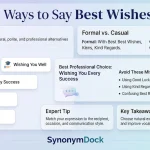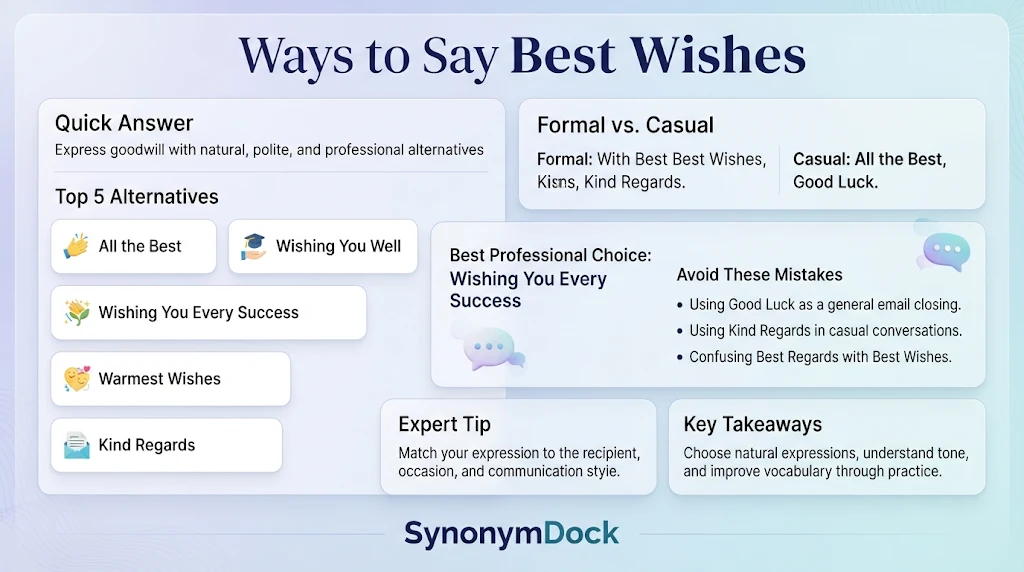
Other ways to say best wishes include all the best, wishing you well, warmest wishes, wishing you every success, and sending you my best. These alternatives help you express kindness, encouragement, and professionalism in emails, cards, conversations, and special occasions.
The phrase best wishes is a friendly and polite way to express goodwill, happiness, and encouragement. It works in professional emails, greeting cards, farewell messages, celebrations, and everyday conversations. However, repeating the same expression can sometimes make your writing feel less personal.
Learning other ways to say best wishes helps you communicate with greater variety and confidence. Whether you’re congratulating a colleague, encouraging a friend, or ending a professional email, choosing the right expression makes your message more meaningful.
In this guide, you’ll discover 10 useful alternatives, including formal expressions, workplace English phrases, academic options, and casual messages. Each phrase includes its meaning, tone, examples, and practical usage advice.
SERP Analysis: What Searchers Need
Current search results commonly organize this topic around synonym lists, professional email closings, formal expressions, and occasion-based examples. Many competing articles also include quick answers and comparison tables. grammarflows.com+3
Content opportunities for SynonymDock:
- Explain which alternatives are genuine expressions of goodwill and which are primarily email sign-offs.
- Separate formal, professional, academic, and casual usage.
- Provide original examples instead of repeating generic synonym lists.
- Explain differences between good luck, best regards, and all the best.
- Include common mistakes, practical exercises, and a phrase-selection guide.
Featured snippet opportunity: A concise answer followed by a comparison table makes it easier to identify the right phrase quickly.
Quick Category Guide: Best Wishes Alternatives
Here are useful expressions organized by communication style.
1. Formal Alternatives
- With best wishes
- Wishing you every success
- Please accept my best wishes
- My sincere wishes
Pro Tip: Choose complete, respectful expressions when writing formal letters or communicating with someone you do not know well.
2. Professional Alternatives
- Wishing you continued success
- Best regards
- Kind regards
- All the best
Pro Tip: Match your closing to your relationship with the recipient. Professional communication should sound courteous without becoming unnecessarily complicated.
3. Business Email Alternatives
- Best regards
- Kind regards
- Warm regards
- All the best
Pro Tip: Use Best regards for a standard business email and All the best when you have a friendly professional relationship.
4. Academic Alternatives
- Wishing you academic success
- Wishing you every success
- All the best with your studies
- Good luck with your examinations
Pro Tip: Mention the actual academic goal to make your message more encouraging and specific.
5. Casual Alternatives
- All the best
- Wishing you well
- Sending you my best
- Hope everything goes well
Pro Tip: Simple expressions usually sound more natural in everyday conversations.
6. Informal Expressions
- You’ve got this!
- I’m rooting for you!
- Hope everything goes great!
- Take care!
Pro Tip: Use relaxed expressions with friends, classmates, and people you know comfortably.
What Does “Best Wishes” Mean?
Best wishes is an expression of goodwill that communicates your hope for someone’s happiness, success, health, or positive future.
In simple English, it means:
I hope good things happen to you.
The expression contains two words:
- Best: The most positive or favorable.
- Wishes: Hopes or desires for something good to happen.
Grammatically, best wishes is a plural noun phrase. It can appear in a complete sentence or independently as an email or letter closing.
Examples:
- Best wishes for your new job.
- Sending you my best wishes for the future.
- Best wishes, Daniel.
The meaning changes slightly with context. In a farewell message, it expresses goodwill for someone’s next chapter. In a greeting card, it communicates warmth and happiness.
When Should You Use Other Ways to Say Best Wishes?
Different communication situations require different expressions. Consider these examples.
| Situation | Recommended Phrase |
|---|---|
| Business communication | Wishing you continued success |
| Professional emails | Best regards |
| Meetings | All the best |
| Presentations | Wishing you every success |
| Academic writing | Wishing you academic success |
| Interviews | Good luck |
| Daily conversations | Wishing you well |
Business communication: Use professional expressions when congratulating colleagues, clients, or business partners.
Emails: Choose Kind regards or Best regards as email closings. Use All the best for a slightly warmer ending.
Meetings: All the best works naturally when encouraging someone before an important discussion.
Presentations: Wishing you every success communicates encouragement without sounding overly casual.
Academic writing: Wishing you success with your studies works in supportive messages to students and classmates.
Interviews: Good luck is a natural expression before an interview or selection process.
Daily conversations: Wishing you well and All the best are friendly, flexible choices.
Professional vs. Polite vs. Formal vs. Natural
These communication styles are related, but they are not identical.
| Style | Meaning | Example |
|---|---|---|
| Polite | Respectful and considerate | Wishing you well |
| Professional | Appropriate for work | Wishing you continued success |
| Formal | Respectful and traditional | With best wishes |
| Natural | Comfortable everyday English | All the best |
A professional phrase does not always need to sound formal. For example, All the best is natural in many workplace conversations, while Kind regards is a more conventional email closing.
The best expression depends on your relationship, message purpose, and communication setting.
Pros and Cons of Using Alternatives
Pros
- Better vocabulary: You learn expressions beyond familiar phrases.
- Clearer communication: Specific wishes explain what you hope for someone.
- Professional writing: Appropriate expressions improve workplace correspondence.
- Natural conversations: Different phrases help you avoid repetitive language.
Cons
- Wrong tone: An overly formal phrase may sound distant among friends.
- Incorrect context: Good luck is not always suitable for a general farewell.
- Unnatural wording: Complicated expressions can make simple messages awkward.
- Misunderstood meaning: Email closings and congratulatory expressions do not always serve the same purpose.
Other Ways to Say “Best Wishes” (With Examples)
Below are 10 practical alternatives, arranged from versatile everyday expressions to more context-specific choices. Some are direct replacements, while others work best for particular situations.
1. All the Best
Meaning: A general expression of goodwill and positive hopes for someone’s future.
Explanation: This is one of the most natural alternatives to best wishes. It works in friendly conversations, professional emails, farewell messages, and congratulations.
- Formal: Suitable for moderately formal correspondence.
- Neutral: A safe choice for general communication.
- Professional: Appropriate for colleagues and workplace contacts.
- Casual: Excellent for friends and acquaintances.
Example Sentence: All the best with your new position. I hope you enjoy every opportunity ahead.
- Best Use: General messages
- Avoid Using In: Highly formal documents
- Tone: Warm, friendly
- Formality Level: ⭐⭐⭐⭐☆
- Usage Frequency: Very Common
- CEFR Level: B1
- Common Collocations: All the best for the future, all the best with your studies, all the best in your career, all the best to you.
Context Examples:
- Spoken English: All the best with your presentation tomorrow!
- Professional English: All the best in your new role.
- Casual Conversation: All the best! Let me know how everything goes.
2. Wishing You Well
Meaning: Expressing hope that someone remains happy, healthy, or successful.
Explanation: This phrase sounds thoughtful and sincere. It is particularly suitable for farewells, personal messages, and situations involving a life change.
- Formal: Appropriate for respectful personal correspondence.
- Neutral: Suitable for general messages.
- Professional: Works with colleagues and professional contacts.
- Casual: Sounds gentle and friendly.
Example Sentence: As you begin this exciting chapter, I’m wishing you well in everything ahead.
- Best Use: Farewell messages
- Avoid Using In: Technical reports
- Tone: Gentle, supportive
- Formality Level: ⭐⭐⭐⭐☆
- Usage Frequency: Common
- CEFR Level: B1
- Common Collocations: Wishing you well always, wishing you well ahead, wishing you well in life, wishing you well in your journey.
Context Examples:
- Spoken English: I’m wishing you well with your new plans.
- Professional English: Wishing you well as you transition into your new position.
- Casual Conversation: Just wishing you well and hoping everything works out!
3. Wishing You Every Success
Meaning: Expressing a sincere hope that someone achieves their goals.
Explanation: This is a polished expression for professional and academic communication. It works particularly well when someone starts a new position, launches a project, or pursues an important opportunity.
- Formal: Suitable for official messages.
- Neutral: Positive but slightly elevated.
- Professional: Excellent for workplace communication.
- Casual: Less common in relaxed conversations.
Example Sentence: Congratulations on your promotion. Wishing you every success in your new leadership position.
- Best Use: Career milestones
- Avoid Using In: Casual small talk
- Tone: Encouraging, professional
- Formality Level: ⭐⭐⭐⭐⭐
- Usage Frequency: Common
- CEFR Level: B2
- Common Collocations: Every success in your career, every success in your studies, every success in your future, every success with your project.
Context Examples:
- Spoken English: Wishing you every success with your upcoming interview.
- Professional English: Wishing you every success in your new responsibilities.
- Casual Conversation: Wishing you every success with that exciting project!
4. Warmest Wishes
Meaning: A heartfelt expression of kindness, affection, and goodwill.
Explanation: Warmest wishes communicates more emotion than a simple professional closing. It is particularly appropriate for greeting cards, celebrations, personal letters, and friendly messages.
- Formal: Appropriate for traditional personal correspondence.
- Neutral: More emotional than neutral.
- Professional: Suitable for familiar professional relationships.
- Casual: Natural in friendly messages.
Example Sentence: Warmest wishes to you and your family as you celebrate this wonderful occasion.
- Best Use: Special occasions
- Avoid Using In: Strictly formal reports
- Tone: Warm, heartfelt
- Formality Level: ⭐⭐⭐☆☆
- Usage Frequency: Common
- CEFR Level: B2
- Common Collocations: Warmest wishes always, warmest wishes for happiness, warmest wishes for success, warmest wishes to your family.
Context Examples:
- Spoken English: Sending you my warmest wishes for the celebration.
- Professional English: Warmest wishes for your continued achievements.
- Casual Conversation: Warmest wishes! Hope you have a fantastic day.
5. With Best Wishes
Meaning: A polite expression of goodwill, often used to finish written messages.
Explanation: This expression is slightly more traditional than All the best. It works well in letters, greeting cards, formal notes, and professional correspondence.
- Formal: Suitable for traditional letters.
- Neutral: Appropriate for general written communication.
- Professional: Works in courteous correspondence.
- Casual: Less common in everyday speech.
Example Sentence: Thank you for your support throughout the project. With best wishes for your future success.
- Best Use: Formal correspondence
- Avoid Using In: Casual texting
- Tone: Respectful, traditional
- Formality Level: ⭐⭐⭐⭐⭐
- Usage Frequency: Common
- CEFR Level: B2
- Common Collocations: With best wishes for success, with best wishes always, with best wishes for the future, with best wishes to you.
Context Examples:
- Spoken English: I wish you success with your next opportunity.
- Professional English: With best wishes for your continued professional growth.
- Casual Conversation: With best wishes on your special day!
NATIVE SPEAKER TIP: Alternatives 1–5
- Most natural: All the best. It fits a wide range of everyday situations.
- Most professional: Wishing you every success. It works especially well for career milestones.
- Less common: With best wishes. It has a more traditional written style.
- Native preference: English speakers often choose All the best for general messages because it sounds simple, friendly, and effortless.
6. Kind Regards
Meaning: A polite and respectful expression commonly used to close professional emails.
Explanation: Kind regards is primarily an email sign-off, rather than a direct replacement for every use of best wishes. It is especially useful when communicating with colleagues, teachers, clients, and business contacts.
- Formal: Suitable for professional correspondence.
- Neutral: Respectful and straightforward.
- Professional: Excellent for workplace emails.
- Casual: Can sound slightly formal among close friends.
Example Sentence: Thank you for reviewing my application. Kind regards, Daniel.
- Best Use: Professional emails
- Avoid Using In: Friendly spoken wishes
- Tone: Polite, professional
- Formality Level: ⭐⭐⭐⭐⭐
- Usage Frequency: Very Common
- CEFR Level: B2
- Common Collocations: Kind regards, best kind regards (avoid), kind regards to you, kind regards from our team.
Context Examples:
- Spoken English: Thank you for your help.
- Professional English: Kind regards, Sarah.
- Casual Conversation: Thanks again! Take care.
7. Best Regards
Meaning: A courteous expression used to finish professional letters and emails.
Explanation: Best regards is a reliable business communication phrase. It sounds professional without being excessively formal and is especially useful when writing to clients, managers, or colleagues.
- Formal: Suitable for business correspondence.
- Neutral: Courteous and balanced.
- Professional: Excellent for workplace emails.
- Casual: Less suitable for personal conversations.
Example Sentence: Thank you for your time and consideration. Best regards, Emily.
- Best Use: Business email closings
- Avoid Using In: Personal celebrations
- Tone: Courteous, professional
- Formality Level: ⭐⭐⭐⭐⭐
- Usage Frequency: Very Common
- CEFR Level: B2
- Common Collocations: Best regards, warm regards, kind regards, regards from our team.
Context Examples:
- Spoken English: Thank you for meeting with me.
- Professional English: Best regards, Michael.
- Casual Conversation: All the best with everything!
8. Good Luck
Meaning: Expressing hope that someone succeeds in an upcoming activity or challenge.
Explanation: Good luck is more specific than best wishes. It is most natural before examinations, interviews, competitions, presentations, and important events.
- Formal: Acceptable in many professional situations.
- Neutral: Simple and encouraging.
- Professional: Useful before important workplace events.
- Casual: Very natural with friends.
Example Sentence: Good luck with your final examinations. I’m sure your preparation will help.
- Best Use: Upcoming challenges
- Avoid Using In: General email closings
- Tone: Encouraging, friendly
- Formality Level: ⭐⭐⭐☆☆
- Usage Frequency: Very Common
- CEFR Level: A2
- Common Collocations: Good luck with your exam, good luck on your interview, good luck in your new job, good luck with your presentation.
Context Examples:
- Spoken English: Good luck with your interview!
- Professional English: Good luck with the presentation tomorrow.
- Casual Conversation: Good luck! You’ve got this.
9. Wishing You Happiness
Meaning: Expressing hope that someone experiences joy and satisfaction in life.
Explanation: This phrase is especially appropriate for weddings, birthdays, anniversaries, family celebrations, and personal milestones. It sounds more heartfelt than a general professional closing.
- Formal: Suitable for celebratory messages.
- Neutral: Positive and considerate.
- Professional: Appropriate for personal milestones.
- Casual: Warm and friendly.
Example Sentence: Wishing you happiness, success, and wonderful memories in this exciting new chapter.
- Best Use: Personal celebrations
- Avoid Using In: Routine business emails
- Tone: Heartfelt, positive
- Formality Level: ⭐⭐⭐☆☆
- Usage Frequency: Common
- CEFR Level: B1
- Common Collocations: Wishing you lasting happiness, wishing you happiness always, wishing you happiness together, wishing you happiness and success.
Context Examples:
- Spoken English: Wishing you happiness in your new home.
- Professional English: Wishing you happiness and fulfillment in your retirement.
- Casual Conversation: Hope life brings you lots of happiness!
10. Sending You My Best
Meaning: Communicating personal goodwill, support, and positive thoughts.
Explanation: Sending you my best feels friendly and personal. It works well in texts, informal emails, farewell messages, and conversations with people you already know.
- Formal: Less suitable for very formal correspondence.
- Neutral: Appropriate for friendly messages.
- Professional: Works with familiar colleagues.
- Casual: Very natural in personal communication.
Example Sentence: I’m glad to hear about your new opportunity. Sending you my best for everything ahead.
- Best Use: Personal messages
- Avoid Using In: Official applications
- Tone: Warm, personal
- Formality Level: ⭐⭐⭐☆☆
- Usage Frequency: Common
- CEFR Level: B2
- Common Collocations: Sending you my best wishes, sending you my best regards, sending you my best thoughts, sending you my best for the future.
Context Examples:
- Spoken English: I’m thinking of you and sending you my best.
- Professional English: Sending you my best as you begin your new role.
- Casual Conversation: Sending you my best! Hope it all goes wonderfully.
NATIVE SPEAKER TIP: Alternatives 6–10
- Most natural: Good luck when referring to a specific upcoming challenge.
- Most professional: Kind regards or Best regards for email closings.
- Less common: Wishing you happiness in routine workplace communication.
- Native preference: English speakers distinguish between wishing someone success and signing off an email. They do not treat every expression as interchangeable.
Expert Insight: Choosing the Right Expression
The difference between a natural message and an awkward one often comes down to context.
Workplace communication: Use Wishing you every success when congratulating someone professionally. Choose All the best for friendly workplace farewells.
Email writing: Kind regards and Best regards are established sign-offs. Wishing you well is better when your sentence expresses a personal hope.
Academic English: Good luck with your examinations is direct and encouraging. Wishing you every success is more polished for academic congratulations.
Professional tone: Avoid unnecessarily complicated expressions. Clear, specific language usually sounds more sincere than an elaborate collection of formal words.
Quick Recap: Best Alternatives to Best Wishes
Best Professional Choice
Recommended
Wishing you continued success
Best Casual Choice
All the best
Best Formal Choice
With best wishes
Most Natural Choice
Wishing you well
Most Polite Choice
Kind regards
Comparison Table: 10 Alternatives to Best Wishes
Use this table to compare the tone, formality, and most appropriate situation for each expression.
| Phrase | Tone | Formality | Best Use | Frequency |
|---|---|---|---|---|
| All the best | Friendly | Medium | General messages | Very Common |
| Wishing you well | Warm | Medium | Farewells | Common |
| Wishing you every success | Professional | High | Career goals | Common |
| Warmest wishes | Heartfelt | Medium | Celebrations | Common |
| With best wishes | Respectful | High | Formal letters | Common |
| Kind regards | Polite | High | Business emails | Very Common |
| Best regards | Professional | High | Email closings | Very Common |
| Good luck | Encouraging | Low | Exams and interviews | Very Common |
| Wishing you happiness | Heartfelt | Medium | Special occasions | Common |
| Sending you my best | Personal | Medium | Friendly messages | Common |
Frequency labels are practical editorial estimates, not measured search statistics.
Which Best Wishes Alternative Should You Choose?
The right expression depends on what you want to communicate and who will receive your message.
Best Overall: All the Best
Choose All the best when you need a versatile expression. It works for colleagues, friends, acquaintances, and general farewell messages.
Best Professional: Wishing You Every Success
This phrase communicates encouragement and confidence. It is particularly useful for promotions, new responsibilities, and professional achievements.
Best Academic: Good Luck With Your Studies
This is a straightforward expression for students preparing for examinations, starting courses, or working toward academic goals.
Best Business Email: Kind Regards
Kind regards is a polite and widely used email closing. It is suitable for clients, managers, teachers, and professional contacts.
Best Everyday Conversation: Wishing You Well
This expression sounds considerate without being overly formal. Use it when someone is moving forward with a new opportunity or personal change.
Most Natural: All the Best
Its simple structure makes it easy to use in spoken English and everyday writing.
Most Polite: With Best Wishes
This traditional expression works well in formal letters, respectful messages, and personal correspondence.
Commonly Confused Phrases: Best Wishes and Similar Expressions
Some English expressions look interchangeable but communicate slightly different ideas.
Best Wishes vs. All the Best
Both communicate goodwill, but All the best often sounds more conversational.
- Best wishes for your graduation.
- All the best with your new job.
Difference: Best wishes can feel slightly more traditional, while All the best is flexible and relaxed.
Best Wishes vs. Good Luck
Best wishes expresses general goodwill, while Good luck usually refers to an upcoming challenge.
- Best wishes for your future.
- Good luck with your interview.
Difference: Use Good luck when someone is about to do something important.
Best Wishes vs. Best Regards
Best wishes communicates goodwill, while Best regards is primarily an email or letter closing.
- Best wishes for your new position.
- Best regards, Alex.
Difference: One expresses a positive hope; the other closes correspondence politely.
Best Wishes vs. Kind Regards
Both can close emails, but Kind regards emphasizes courtesy and professionalism.
- Best wishes, Sarah.
- Kind regards, Sarah.
Difference: Kind regards is generally more businesslike, while Best wishes can sound warmer.
Best Wishes vs. Warmest Wishes
Warmest wishes expresses stronger personal warmth and affection.
- Best wishes on your achievement.
- Warmest wishes to you and your family.
Difference: Choose Warmest wishes for celebrations and personal relationships.
Scenario Practice: Choose the Right Expression
Test your understanding with five everyday communication situations.
Situation 1: Business Meeting
Your colleague is preparing to lead an important client meeting tomorrow. What should you say?
Best Answer: Wishing you every success.
Explanation: This expression sounds encouraging and professional without becoming too casual.
Situation 2: Job Interview
Your friend has an interview in the morning. Which phrase sounds most natural?
Best Answer: Good luck with your interview!
Explanation: Good luck is especially appropriate before an important challenge or opportunity.
Situation 3: Presentation
A classmate is presenting a project at an upcoming event. What would you say?
Best Answer: All the best with your presentation!
Explanation: It is friendly, simple, and appropriate for both academic and everyday communication.
Situation 4: Classroom Discussion
A fellow student is beginning an important academic project. Which phrase fits?
Best Answer: Wishing you every success with your project.
Explanation: This phrase communicates encouragement while maintaining a respectful academic tone.
Situation 5: Email Reply
You are ending a professional email after thanking a colleague for their assistance. Which closing works best?
Best Answer: Kind regards.
Explanation: Kind regards is a polite, conventional email sign-off that suits professional communication.
Mini Quiz: Test Your English Vocabulary
Choose the most appropriate expression for each situation.
English Practice
0/5 answered
1. Which expression is most suitable for a professional email closing?Good luckKind regardsYou’ve got this!Warmest wishes
2. Which phrase is most appropriate before an examination?Good luckBest regardsWith best wishesSending you my best
3. Which expression sounds most natural for a friendly farewell?Respectfully yoursAll the bestSincerelyYours faithfully
4. Which phrase communicates professional encouragement for a promotion?Take careWarmest wishesWishing you every successCheers
5. Which expression is warmer and more personal for a celebration?Best regardsKind regardsWarmest wishesRespectfully
Check My Answers
FAQs
1. What is another way to say best wishes professionally?
Professional alternatives include Wishing you continued success, Wishing you every success, Best regards, and Kind regards. Choose an expression that matches your relationship with the recipient and the purpose of your message.
2. What is the most natural alternative to best wishes?
All the best is one of the most natural alternatives. It works in everyday conversations, friendly emails, farewell messages, and workplace communication without sounding overly formal or emotional.
3. How do you say best wishes in a formal email?
You can use With best wishes, Kind regards, or Best regards. Kind regards and Best regards are particularly suitable as email closings when communicating with clients, managers, teachers, or professional contacts.
4. Can I use all the best instead of best wishes?
Yes. All the best is a natural alternative in most everyday situations. It works especially well for farewells, congratulations, and friendly professional messages, although it may sound less traditional in formal letters.
5. What is the difference between best wishes and good luck?
Best wishes expresses general goodwill for someone’s happiness or future, whereas good luck usually relates to a particular upcoming event. Use best wishes for general encouragement and good luck before interviews or examinations.
Conclusion
Learning other ways to say best wishes helps you express kindness, encouragement, and professionalism in different situations. From All the best and Wishing you well to Kind regards and Wishing you every success, each expression offers a slightly different tone. Choosing the right phrase makes your emails, conversations, and personal messages more meaningful.
The best way to improve your English vocabulary is to practice these expressions in real situations. Try using different alternatives in emails, classroom discussions, and everyday conversations. With regular practice, you’ll communicate more naturally, confidently, and effectively.