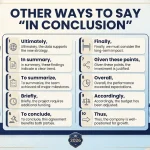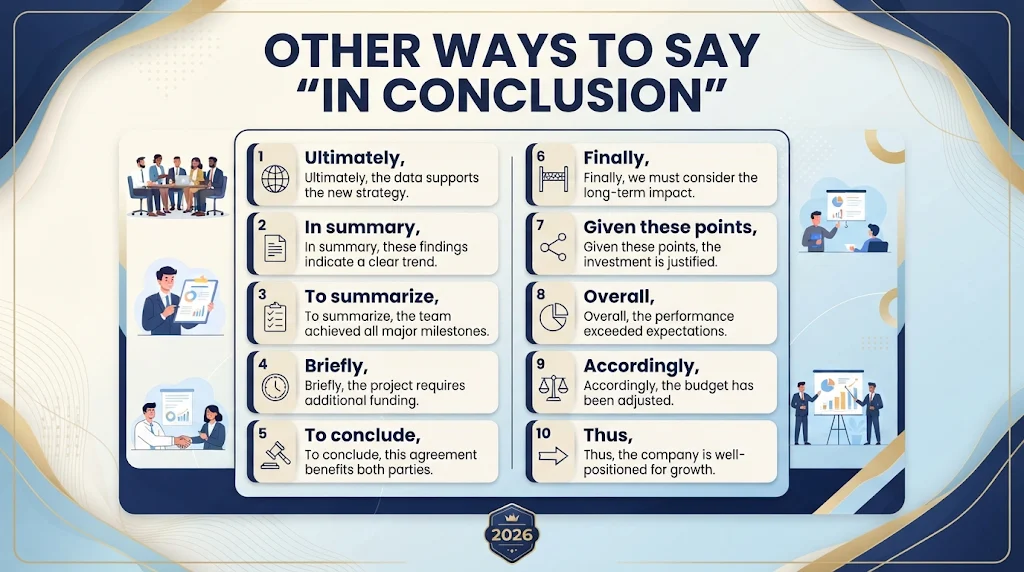
Other ways to say in conclusion include in summary, to conclude, to sum up, overall, and ultimately. These alternatives help you finish essays, emails, reports, presentations, and conversations with clear, natural, and professional language.
Have you ever finished an essay, email, or presentation and realized you have used the phrase in conclusion too many times? Although this expression is correct, repeating it can make your writing sound predictable. Fortunately, English offers several natural alternatives that make your final thoughts more engaging.
Learning other ways to say in conclusion helps you communicate with greater confidence. Whether you are writing an academic paper, preparing a business report, or ending a friendly conversation, the right expression makes your message clearer.
In this guide, SynonymDock explores 10 useful alternatives, explains their meanings, and provides practical examples. You will also discover which expressions work best in professional English, academic writing, and everyday conversations.
Quick Categories: Alternatives to In Conclusion
Different situations require different expressions. Here are useful phrases organized by tone and purpose.
1. Formal Alternatives
- To conclude
- In summary
- In closing
- In the final analysis
Pro Tip: Use these expressions in academic papers, formal reports, and professional presentations. Avoid overly casual expressions in formal documents.
2. Professional Alternatives
- Overall
- To sum up
- All things considered
- Ultimately
Pro Tip: Choose an expression that reflects your actual message. For example, use overall to summarize results rather than simply announce the final paragraph.
3. Business Email Alternatives
- In summary
- To summarize
- In closing
- To wrap up
Pro Tip: Keep email endings short and meaningful. You can often replace a transition phrase with a direct final recommendation.
4. Academic Alternatives
- To conclude
- In summary
- On the whole
- All things considered
Pro Tip: Academic conclusions should connect your findings to your central argument. Avoid introducing completely new evidence in the final paragraph.
5. Casual Alternatives
- All in all
- To sum it up
- Overall
- At the end of the day
Pro Tip: These expressions work well in blogs, friendly discussions, and informal presentations.
6. Informal Expressions
- To wrap things up
- Long story short
- That’s about it
- So, basically
Pro Tip: Informal expressions are useful in conversations, but they may sound out of place in research papers or official reports.
What Does Other Ways to Say In Conclusion Mean?
The phrase other ways to say in conclusion refers to alternative expressions that introduce a final thought, summarize important information, or bring a discussion to an end.
The original expression, in conclusion, is a transitional phrase. It helps readers recognize that the writer is moving toward the final part of an argument or discussion.
Simple explanation: Instead of repeating in conclusion, you can use another phrase that communicates the same general purpose while matching your tone and audience.
Example:
- Original: In conclusion, regular reading improves vocabulary.
- Alternative: To sum up, regular reading improves vocabulary.
Grammar Explanation
In conclusion, in summary, and overall often function as introductory transition phrases. They are commonly followed by commas when placed at the beginning of a sentence.
Correct: In summary, the research supports our original findings.
Incorrect: In summary the research supports our original findings.
Remember that not every alternative has exactly the same meaning. Ultimately emphasizes a final judgment, while in summary introduces a brief review.
When Should You Use Alternatives to In Conclusion?
Choosing the right expression depends on your audience, purpose, and communication setting.
Business Communication
Use expressions such as overall and to summarize when discussing project results, decisions, or recommendations.
Example: Overall, the new strategy has improved team communication.
Professional Emails
In summary and in closing work well when reviewing information or finishing formal correspondence.
Example: In summary, we have agreed on the revised project schedule.
Meetings
To wrap up and to sum up sound natural when bringing a meeting to an end.
Example: To wrap up, let’s review our next steps.
Presentations
To conclude and overall help introduce final observations without unnecessary repetition.
Example: Overall, these findings demonstrate the importance of customer feedback.
Academic Writing
In summary, to conclude, and on the whole are useful for essays and research discussions.
Example: To conclude, the evidence supports the importance of environmental education.
Interviews
Ultimately can introduce a final judgment, while overall can summarize your experience.
Example: Overall, my previous experience has prepared me for this opportunity.
Daily Conversations
All in all and to sum it up sound relaxed and natural.
Example: All in all, we had a productive afternoon.
Professional vs. Polite: What’s the Difference?
Professional, polite, and formal expressions are related, but they serve different purposes.
| Style | Purpose | Example |
|---|---|---|
| Polite | Sounds considerate and respectful | All things considered, I appreciate your suggestions. |
| Professional | Communicates clearly at work | Overall, the results meet our expectations. |
| Formal | Maintains an academic or official tone | To conclude, the evidence supports this position. |
| Natural | Sounds comfortable and conversational | All in all, everything went well. |
Important distinction: Professional language does not always need to sound extremely formal. A simple, clear expression often works better than complicated vocabulary.
Pros and Cons of Using Alternative Expressions
Pros
- Improves vocabulary: You learn different ways to express final thoughts.
- Reduces repetition: Your essays and reports become less predictable.
- Improves communication: Appropriate transitions help readers follow your ideas.
- Creates the right tone: You can adjust your language for different audiences.
- Strengthens writing: Better transitions make paragraphs feel more connected.
Cons
- Wrong context: Some informal expressions do not suit academic writing.
- Meaning differences: Not every alternative communicates exactly the same idea.
- Unnecessary complexity: Unusual expressions can make simple writing harder to understand.
- Overuse: Replacing one repeated phrase with another does not solve repetition.
- Awkward transitions: A phrase may interrupt the natural flow of your final paragraph.
Other Ways to Say In Conclusion (With Examples)
Here are 10 useful alternatives, arranged from broadly useful formal expressions to more conversational choices.
1. In Summary
Meaning: A short review of the most important points.
Explanation: In summary is one of the most versatile alternatives to in conclusion. It works particularly well when you want to bring several ideas together without repeating every detail.
- Formal: Yes
- Neutral: Yes
- Professional: Yes
- Casual: Sometimes
Example Sentence: In summary, the research highlights the importance of effective communication in the workplace.
Best Use: Reports and essays
Avoid Using In: Very casual chats
Tone: Clear and professional
Formality Level: ⭐⭐⭐⭐⭐
Usage Frequency: Very Common
CEFR Level: B2
Common Collocations:
- In summary of the findings
- In summary, the results
- In summary, we can say
- In summary, the report shows
Context Examples:
- Spoken English: In summary, we need better teamwork.
- Professional English: In summary, the project achieved its primary objectives.
- Casual Conversation: In summary, we had a great day.
2. To Conclude
Meaning: To introduce the final statement or judgment.
Explanation: To conclude is a direct and formal expression. It works especially well in academic essays, speeches, and professional presentations.
- Formal: Yes
- Neutral: Sometimes
- Professional: Yes
- Casual: Rarely
Example Sentence: To conclude, renewable energy can play an important role in protecting the environment.
Best Use: Academic writing
Avoid Using In: Friendly texting
Tone: Formal and direct
Formality Level: ⭐⭐⭐⭐⭐
Usage Frequency: Very Common
CEFR Level: B2
Common Collocations:
- To conclude the discussion
- To conclude, the evidence
- To conclude this report
- To conclude, we believe
Context Examples:
- Spoken English: To conclude, education opens new opportunities.
- Professional English: To conclude, our proposal offers a practical solution.
- Casual Conversation: To conclude, that was a good weekend.
3. To Sum Up
Meaning: To express the main points briefly.
Explanation: To sum up is a natural alternative for speaking and writing. It sounds slightly less formal than to conclude but remains appropriate in many professional situations.
- Formal: Sometimes
- Neutral: Yes
- Professional: Yes
- Casual: Yes
Example Sentence: To sum up, our team needs better planning and clearer communication.
Best Use: Meetings and presentations
Avoid Using In: Highly formal reports
Tone: Friendly and clear
Formality Level: ⭐⭐⭐⭐
Usage Frequency: Very Common
CEFR Level: B1
Common Collocations:
- To sum up the discussion
- To sum up briefly
- To sum up the results
- To sum up our findings
Context Examples:
- Spoken English: To sum up, practice makes progress.
- Professional English: To sum up, we have completed the first project phase.
- Casual Conversation: To sum up, it was a fun experience.
4. Overall
Meaning: Considering everything together.
Explanation: Overall is short, flexible, and widely useful. It introduces a general judgment after considering different points, results, or experiences.
- Formal: Yes
- Neutral: Yes
- Professional: Yes
- Casual: Yes
Example Sentence: Overall, the training program improved employee confidence and productivity.
Best Use: Reports and reviews
Avoid Using In: Unsupported conclusions
Tone: Neutral and natural
Formality Level: ⭐⭐⭐⭐
Usage Frequency: Very Common
CEFR Level: B1
Common Collocations:
- Overall performance
- Overall results
- Overall impression
- Overall conclusion
Context Examples:
- Spoken English: Overall, I think the event went well.
- Professional English: Overall, customer satisfaction increased this quarter.
- Casual Conversation: Overall, the movie was enjoyable.
5. All Things Considered
Meaning: After examining all relevant facts and viewpoints.
Explanation: This expression shows that you have considered different factors before reaching a judgment. It is useful for balanced arguments and professional discussions.
- Formal: Yes
- Neutral: Yes
- Professional: Yes
- Casual: Sometimes
Example Sentence: All things considered, the proposed changes offer the best long-term solution.
Best Use: Balanced arguments
Avoid Using In: Short text messages
Tone: Thoughtful and measured
Formality Level: ⭐⭐⭐⭐⭐
Usage Frequency: Common
CEFR Level: C1
Common Collocations:
- All things considered, the decision
- All things considered, it seems
- All things considered, the results
- All things considered, we agree
Context Examples:
- Spoken English: All things considered, it was a good choice.
- Professional English: All things considered, the investment offers practical benefits.
- Casual Conversation: All things considered, we enjoyed our trip.
Native Speaker Tip: After the first five alternatives
The most natural everyday choices are overall and in summary. For professional communication, in summary is especially reliable, while all things considered sounds more reflective.
To conclude is a familiar academic expression, but using it in every essay can sound repetitive. Native English speakers usually choose a transition based on what they want to communicate, not simply because they need a replacement.
6. Ultimately
Meaning: When everything has been considered, this is the final result or judgment.
Explanation: Ultimately emphasizes the final outcome, most important factor, or central conclusion. It does not always mean that you are summarizing the previous points.
- Formal: Yes
- Neutral: Yes
- Professional: Yes
- Casual: Yes
Example Sentence: Ultimately, successful teamwork depends on trust and consistent communication.
Best Use: Final judgments
Avoid Using In: Simple point lists
Tone: Confident and thoughtful
Formality Level: ⭐⭐⭐⭐
Usage Frequency: Very Common
CEFR Level: B2
Common Collocations:
- Ultimately responsible
- Ultimately important
- Ultimately depends on
- Ultimately leads to
Context Examples:
- Spoken English: Ultimately, the choice is yours.
- Professional English: Ultimately, customer satisfaction remains our priority.
- Casual Conversation: Ultimately, we just wanted to enjoy ourselves.
7. In Closing
Meaning: Introducing the final remarks or last part of a discussion.
Explanation: In closing is a polished expression that works particularly well in speeches, formal letters, and presentations. It emphasizes that the speaker or writer is finishing.
- Formal: Yes
- Neutral: Sometimes
- Professional: Yes
- Casual: Rarely
Example Sentence: In closing, I would like to thank everyone for their valuable contributions.
Best Use: Speeches and letters
Avoid Using In: Casual conversations
Tone: Respectful and formal
Formality Level: ⭐⭐⭐⭐⭐
Usage Frequency: Common
CEFR Level: B2
Common Collocations:
- In closing remarks
- In closing, I thank
- In closing, we recommend
- In closing, let me say
Context Examples:
- Spoken English: In closing, thank you for listening.
- Professional English: In closing, we appreciate your continued support.
- Casual Conversation: In closing, thanks for making today special.
8. On the Whole
Meaning: Considering the general situation rather than individual details.
Explanation: On the whole is useful when giving a general assessment after considering several aspects. It is particularly suitable for reviews, essays, and balanced discussions.
- Formal: Yes
- Neutral: Yes
- Professional: Yes
- Casual: Sometimes
Example Sentence: On the whole, the new learning system has benefited students.
Best Use: General evaluations
Avoid Using In: Highly direct instructions
Tone: Balanced and thoughtful
Formality Level: ⭐⭐⭐⭐
Usage Frequency: Common
CEFR Level: B2
Common Collocations:
- On the whole, successful
- On the whole, effective
- On the whole, positive
- On the whole, the results
Context Examples:
- Spoken English: On the whole, the experience was positive.
- Professional English: On the whole, the department achieved its objectives.
- Casual Conversation: On the whole, the party was enjoyable.
9. In Brief
Meaning: Expressing something in a short and concise way.
Explanation: In brief is a useful expression when you want to communicate the essential message without unnecessary details. It works well in reports, summaries, and professional discussions.
- Formal: Yes
- Neutral: Yes
- Professional: Yes
- Casual: Sometimes
Example Sentence: In brief, the proposal aims to reduce costs while improving service quality.
Best Use: Short summaries
Avoid Using In: Detailed storytelling
Tone: Concise and professional
Formality Level: ⭐⭐⭐⭐
Usage Frequency: Common
CEFR Level: B2
Common Collocations:
- In brief, the findings
- In brief, the proposal
- In brief, the report
- Explain in brief
Context Examples:
- Spoken English: In brief, we need more time.
- Professional English: In brief, the project requires additional resources.
- Casual Conversation: In brief, everything went smoothly.
10. To Wrap Up
Meaning: To finish a discussion or activity by reviewing its main points.
Explanation: To wrap up is a relaxed, conversational expression. It is especially useful in meetings, presentations, informal writing, and everyday communication.
- Formal: Rarely
- Neutral: Yes
- Professional: Yes
- Casual: Yes
Example Sentence: To wrap up, let’s review the three main goals for next week.
Best Use: Meetings and discussions
Avoid Using In: Formal academic papers
Tone: Friendly and conversational
Formality Level: ⭐⭐⭐
Usage Frequency: Very Common
CEFR Level: B1
Common Collocations:
- To wrap up the meeting
- To wrap up the discussion
- To wrap up the presentation
- To wrap things up
Context Examples:
- Spoken English: To wrap up, remember to practice every day.
- Professional English: To wrap up, we have three actions to complete.
- Casual Conversation: To wrap up, let’s order some food.
Native Speaker Tip: After the final five alternatives
Overall is one of the most flexible expressions in everyday and professional English. Ultimately is better when emphasizing a final judgment, while in closing is more appropriate for formal remarks.
For natural conversations, native speakers often prefer to wrap up or to sum up. They generally avoid forcing formal academic expressions into relaxed discussions.
Expert Insight: Choosing the Right Expression
Understanding the difference between these phrases helps you communicate more effectively.
Workplace Communication: Choose overall, in summary, or ultimately when discussing results, decisions, and business performance. These expressions sound clear without making your communication unnecessarily complicated.
Email Writing: In summary works well when reviewing important details. In closing is suitable for formal correspondence, although a direct final sentence is often better.
Academic English: To conclude, in summary, and on the whole are useful for academic arguments. Choose a phrase that accurately reflects your final point instead of adding a transition automatically.
Professional Tone: Avoid complicated expressions just to sound intelligent. Clear vocabulary, accurate meaning, and appropriate context matter more than formality alone.
Quick Recap: Best Alternatives to In Conclusion
| Category | Best Choice |
|---|---|
| Best Professional Choice | In summary |
| Best Casual Choice | To wrap up |
| Best Formal Choice | To conclude |
| Most Natural Choice | Overall |
| Most Polite Choice | All things considered |
Comparison Table: 10 Alternatives to In Conclusion
| Phrase | Tone | Formality | Best Use | Frequency |
|---|---|---|---|---|
| In summary | Professional | Very High | Reports | Very Common |
| To conclude | Formal | Very High | Essays | Very Common |
| To sum up | Friendly | Medium-High | Meetings | Very Common |
| Overall | Neutral | High | Reviews | Very Common |
| All things considered | Thoughtful | Very High | Arguments | Common |
| Ultimately | Confident | High | Final judgments | Very Common |
| In closing | Respectful | Very High | Speeches | Common |
| On the whole | Balanced | High | Evaluations | Common |
| In brief | Concise | High | Short summaries | Common |
| To wrap up | Conversational | Medium | Discussions | Very Common |
Formality and frequency labels are practical editorial guidance, not measured corpus statistics.
Best Choice: Which Alternative Should You Use?
There is no single expression that works perfectly in every situation. Here are the best choices based on communication needs.
Best Overall: Overall
Overall is flexible and natural. It works in essays, reports, presentations, and conversations.
Best Professional: In Summary
In summary is an excellent choice for workplace communication because it introduces a clear review of important information.
Best Academic: To Conclude
To conclude is a suitable academic transition when introducing your final argument or judgment.
Best Business Email: In Summary
Use in summary when reviewing decisions, project updates, or important details before your closing sentence.
Best Everyday Conversation: To Sum Up
To sum up sounds friendly and clear without being too informal.
Most Natural: Overall
Overall is short, familiar, and easy to use in both spoken and written English.
Most Polite: All Things Considered
All things considered communicates a thoughtful judgment and acknowledges that different factors matter.
Commonly Confused Phrases
Some expressions look similar but communicate slightly different ideas. Understanding these differences helps you avoid awkward transitions.
In Summary vs. Overall
- In summary: Introduces a review of important points.
- Overall: Gives a general judgment after considering different details.
Example:
- In summary, the report identifies three major problems.
- Overall, the report provides useful recommendations.
Ultimately vs. In the End
- Ultimately: Emphasizes the final result or most important consideration.
- In the end: Refers to what finally happened after a process or period.
Example:
- Ultimately, education improves opportunities.
- In the end, we decided to postpone the event.
To Conclude vs. To Sum Up
- To conclude: Introduces a final statement and sounds more formal.
- To sum up: Briefly reviews the main points and sounds more conversational.
Example:
- To conclude, the findings support our argument.
- To sum up, we need better planning.
In Closing vs. In Conclusion
- In closing: Introduces final remarks, especially in speeches or letters.
- In conclusion: Signals the final part of an essay or discussion.
Example:
- In closing, thank you for your cooperation.
- In conclusion, the evidence supports the proposed solution.
Common Mistakes When Using Alternatives
Learning synonyms is useful, but using them incorrectly can affect your writing. Avoid these five mistakes.
Mistake 1: Using Casual Expressions in Academic Essays
Wrong usage: Long story short, climate change affects the environment.
Why incorrect: Long story short is conversational and may sound too informal for academic writing.
Correct phrase: In summary, climate change affects the environment.
Mistake 2: Treating Every Alternative as Identical
Wrong usage: Ultimately, the report contains five sections.
Why incorrect: Ultimately usually introduces a final judgment or outcome, not simply a list of contents.
Correct phrase: In summary, the report contains five sections.
Mistake 3: Forgetting the Comma
Wrong usage: Overall the results were positive.
Why incorrect: An introductory transition phrase should normally be followed by a comma.
Correct phrase: Overall, the results were positive.
Mistake 4: Repeating the Same Transition
Wrong usage: In summary, we need better planning. In summary, communication is also important.
Why incorrect: Repeating the same expression makes writing sound mechanical.
Correct phrase: Overall, we need better planning. Clear communication is equally important.
Mistake 5: Introducing New Arguments in the Conclusion
Wrong usage: To conclude, another important issue is the cost of a completely different solution.
Why incorrect: A conclusion should bring together the discussion rather than suddenly introduce an unrelated argument.
Correct phrase: To conclude, the findings support the original recommendation.
Scenario Practice: Choose the Right Expression
Test your understanding with these five practical situations.
Situation 1: Business Meeting
You are finishing a meeting and want to review the main action points.
Question: Which phrase would you choose?
Answer: To wrap up.
Explanation: It sounds natural in meetings and clearly signals that the discussion is ending.
Situation 2: Job Interview
The interviewer asks you to summarize your professional experience.
Question: Which phrase would you choose?
Answer: Overall.
Explanation: It introduces a general assessment of your skills and experience without sounding unnecessarily formal.
Situation 3: Academic Presentation
You are presenting research findings and need a formal final statement.
Question: Which phrase would you choose?
Answer: To conclude.
Explanation: It provides a clear transition into your final academic point.
Situation 4: Classroom Discussion
Your teacher asks you to explain the main lesson from a discussion.
Question: Which phrase would you choose?
Answer: To sum up.
Explanation: It is clear, easy to understand, and appropriate for spoken English.
Situation 5: Professional Email Reply
You need to review several agreed decisions before ending an email.
Question: Which phrase would you choose?
Answer: In summary.
Explanation: It introduces a concise review and maintains a professional tone.
Mini Quiz: Test Your English Vocabulary
Choose the best answer for each question.
1. Which phrase is most suitable for a formal academic essay?
A. Long story short
B. To conclude
C. That’s about it
D. To wrap things up
2. Which expression is especially natural for ending a casual meeting?
A. To wrap up
B. In summation
C. In the final analysis
D. It can be concluded that
3. Which phrase emphasizes a final judgment after considering different factors?
A. In brief
B. Ultimately
C. To begin with
D. For example
4. Which expression introduces a short review of the main points?
A. In summary
B. On the contrary
C. Meanwhile
D. In addition
5. Which sentence uses the introductory phrase correctly?
A. Overall the project was successful.
B. Overall, the project was successful.
C. Overall the project, was successful.
D. The project overall, was successful.
Answer Key
- B. To conclude – A suitable formal academic expression.
- A. To wrap up – Natural for meetings and discussions.
- B. Ultimately – Emphasizes the final outcome or judgment.
- A. In summary – Introduces a review of key points.
- B. Overall, the project was successful. – Correct introductory punctuation.
FAQs
1. What are the best other ways to say in conclusion?
Some of the best alternatives include in summary, to conclude, to sum up, overall, and ultimately. Each expression serves a slightly different purpose, so choose according to your audience and writing style.
2. What is a professional way to say in conclusion?
In summary is an excellent professional alternative. It works in business emails, reports, meetings, and presentations because it introduces a clear review without sounding overly complicated or unnecessarily formal.
3. What can I use instead of in conclusion in an essay?
You can use to conclude, in summary, on the whole, or all things considered. These expressions help introduce your final argument while maintaining an appropriate academic tone.
4. Is overall a synonym for in conclusion?
Overall can replace in conclusion when introducing a general assessment. However, overall emphasizes the complete picture, while in conclusion specifically signals the final part of a discussion or piece of writing.
5. Is to sum up formal or informal?
To sum up is generally neutral to moderately informal. It works well in presentations, discussions, and everyday professional communication, although to conclude may be preferable in highly formal academic writing.
Conclusion
Learning other ways to say in conclusion can make your English more natural, professional, and engaging. Expressions such as in summary, overall, to conclude, and to sum up help you communicate final thoughts without repeating the same words. The best choice depends on your audience, purpose, and situation.
Practice these alternatives in essays, emails, presentations, and everyday conversations. Pay attention to their meanings and levels of formality before using them. With regular practice, you will develop stronger vocabulary, write more confidently, and express your final thoughts with clarity. SynonymDock makes discovering better English expressions easier, one phrase at a time.