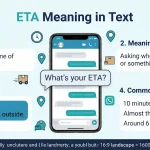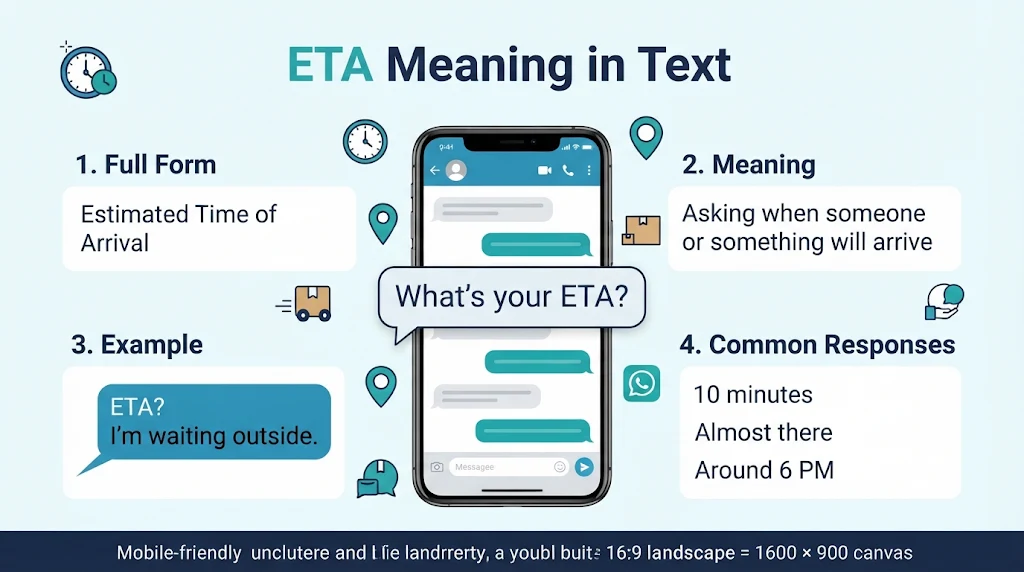
ETA means Estimated Time of Arrival. In text messages, people use it to ask when someone will arrive, finish a task, or become available. It is common in everyday texting, Snapchat, Instagram, group chats, and workplace conversations.
The eta meaning in text is simple, but this three letter abbreviation can make everyday conversations much quicker. When someone sends you ETA, they usually want to know when you will arrive or how much longer something will take.
You might see it in a message from a friend waiting outside. Furthermore, a family member might use it to check when you will get home. Even coworkers use it when they need an update on a task or meeting.
However, ETA is not limited to travel conversations. Its meaning can change slightly depending on the situation. For example, someone might ask for your ETA before a video call, a delivery, or a planned meetup.
This guide explains what the abbreviation means, where it comes from, and how people use it across popular messaging platforms. You will also find realistic conversation examples, alternative interpretations, and simple responses you can use naturally.
Quick Answer Box
| Category | Explanation |
|---|---|
| Meaning | Estimated Time of Arrival |
| Context | Asking when someone or something will arrive or be ready |
| Primary Platforms | Snapchat, TikTok, Instagram, WhatsApp, iMessage, and SMS |
| Example | ETA? I am waiting outside. |
| Tone | Casual, direct, practical, and sometimes professional |
What Does eta meaning in text Mean?
ETA stands for Estimated Time of Arrival. People use it in digital conversations to ask when someone expects to reach a particular destination.
For example, imagine your friend is driving to your house. You have been waiting for 20 minutes, but they have not arrived yet. You might send:
You: Hey, what’s your ETA?
Your friend might respond:
Friend: Around 10 minutes.
This exchange shows the abbreviation’s main purpose. It helps people communicate timing without writing a long question.
Breaking Down the Abbreviation
Each letter in ETA represents a word.
| Letter | Word | Explanation |
|---|---|---|
| E | Estimated | An approximate calculation or prediction |
| T | Time | The expected time |
| A | Arrival | Reaching a destination or endpoint |
Together, these words describe the predicted time when a person, vehicle, package, or other expected item will arrive.
Is ETA Slang or an Acronym?
ETA is an abbreviation formed from the initial letters of three words. More precisely, it is an initialism because people generally pronounce each letter separately.
It is not originally internet slang. Instead, it comes from transportation, travel, logistics, and scheduling.
Over time, people adopted it in everyday conversations. Consequently, it became a familiar expression in texting and online communication.
Today, someone can send three simple letters instead of asking, “How much longer until you get here?”
What Does ETA Mean in Everyday Conversations?
The intended meaning depends on what people are discussing.
Here are some common situations:
| Situation | What ETA Means |
|---|---|
| Meeting a friend | When will you arrive? |
| Waiting for a ride | How soon will the driver get here? |
| Ordering food | When will the delivery arrive? |
| Completing homework | When will the work be ready? |
| Attending a meeting | When will you join? |
| Waiting for a reply | When do you expect to respond? |
Notice that ETA does not always refer to physical travel. People sometimes use it more broadly to ask when something will be ready or completed.
However, the central idea remains the same: an expected time.
Contextual Dynamics and Nuances of the Term
Although the abbreviation has one established meaning, its conversational purpose can change with context.
Understanding that difference helps you avoid confusion.
1. Asking About Someone’s Arrival
This is the most common use in everyday texting.
A person might send ETA when they are waiting for someone to arrive.
Example:
Friend: Are you close?
You: Almost there.
Friend: ETA?
You: Five minutes!
Here, the sender wants an approximate arrival time.
2. Asking When Something Will Be Ready
People also use the abbreviation when they are waiting for a completed task.
For example:
Coworker: Do you have an ETA on the presentation?
You: I should finish it by 3 PM.
In this situation, the question concerns a completion deadline rather than physical arrival.
3. Checking Delivery Times
Online shopping and food delivery have made ETA especially useful.
A customer might ask:
Customer: What’s the ETA for my order?
Support Agent: Your package is expected to arrive tomorrow.
Similarly, friends might ask each other when food will arrive during a group gathering.
4. Coordinating Plans
ETA can make group planning easier.
Suppose several friends plan to meet at a restaurant. One person has already arrived, while another is still traveling.
The first person might write:
Anyone know the ETA?
This message asks when the remaining people expect to arrive.
5. Requesting a Quick Update
Sometimes, people use the abbreviation because they want a short progress update.
For example:
Manager: What’s your ETA for the report?
Employee: I’ll send it before lunch.
The sender wants a realistic estimate. Therefore, an accurate response matters more than a vague promise.
Does ETA Sound Rude?
No. ETA is generally neutral and practical.
However, the tone depends on the surrounding message, relationship, and timing.
| Message | Possible Tone |
|---|---|
| ETA? | Direct and casual |
| Hey, what’s your ETA? | Friendly |
| Just checking your ETA. | Polite |
| Need an ETA ASAP. | Urgent |
| What’s taking so long? ETA? | Potentially impatient |
A short message does not automatically sound unfriendly. Nevertheless, adding a few polite words can make a request feel warmer.
Real-Life Conversation Examples Using ETA
The easiest way to understand an abbreviation is to see how people use it in everyday situations.
These five conversations show different ways ETA appears in casual messages, social plans, and professional communication.
Example 1: Asking a Friend When They Will Arrive
Situation: You are waiting for your friend at a coffee shop.
You: Hey, are you coming?
Friend: Yes, I’m on my way.
You: Great! What’s your ETA?
Friend: About 15 minutes.
Explanation: Here, ETA asks how long the friend needs to reach the coffee shop. The response gives an approximate arrival time.
Example 2: Checking on a Food Delivery
Situation: You ordered dinner and want to know when it will arrive.
You: Hey, did the food arrive yet?
Friend: Not yet. The driver is nearby.
You: What’s the ETA?
Friend: The app says 8 minutes.
Explanation: The abbreviation refers to the expected delivery time. It helps everyone know when the food should arrive.
Example 3: Planning a Group Meetup
Situation: Your friends are meeting at a shopping mall.
Alex: I’m already here!
Jordan: Leaving home now.
You: What’s everyone’s ETA?
Alex: Already arrived.
Jordan: Around 20 minutes.
Explanation: In group conversations, ETA helps people coordinate their arrival times. Consequently, everyone can plan around the expected schedule.
Example 4: Asking About a Work Assignment
Situation: A teammate is preparing a document.
Manager: How is the report coming along?
Employee: Almost finished.
Manager: Great. What’s your ETA?
Employee: I’ll share it by 2 PM.
Explanation: In workplace communication, ETA can refer to the expected completion time of a task. It does not necessarily involve traveling.
Example 5: Checking When Someone Will Join a Call
Situation: Your friend has not joined an online meeting.
You: We’re waiting for you!
Friend: Sorry, my internet is acting up.
You: No worries. What’s your ETA?
Friend: Give me five minutes.
Explanation: Here, ETA asks when the person expects to become available and join the call.
Platform-Specific Breakdown
The abbreviation appears across many digital platforms. However, people use it differently depending on the conversation.
Some platforms encourage quick personal messages. Others feature public discussions, comments, and professional updates.
Let’s explore how it works across popular social media platforms.
How It Is Used on Snapchat
Snapchat encourages quick conversations through direct messages and disappearing chats. Therefore, short abbreviations fit naturally into its communication style.
Someone might send ETA when they are waiting for a friend to meet them.
Example conversation:
Friend: Where are you?
You: Walking over now.
Friend: ETA?
You: 7 minutes.
People may also use it when organizing parties, meeting friends, or coordinating rides.
Common Snapchat Situations
| Situation | Example Message |
|---|---|
| Meeting friends | ETA? We’re outside. |
| Planning a hangout | What’s your ETA? |
| Waiting for someone | How far away are you? ETA? |
| Organizing a ride | What’s the driver’s ETA? |
| Joining a group | ETA for everyone? |
Snapchat tip: If someone sends only ETA, you do not need to overthink it. Check the conversation and provide an approximate time.
The Role of ETA on TikTok
TikTok is popular for short videos, comments, trends, and creator discussions. Although the abbreviation is not a TikTok-exclusive expression, users can encounter it in comments and messages.
For example, someone might comment:
What’s the ETA for part two?
This question asks when the creator expects to upload the next video.
Another example:
Any ETA on the new video?
Here, the viewer wants an estimated publishing time.
Common TikTok Examples
| TikTok Context | Meaning |
|---|---|
| Video updates | When will the next video appear? |
| Part two requests | When will the next installment arrive? |
| Creator announcements | When will the content be ready? |
| Live sessions | When will the creator go live? |
| Event discussions | When will someone arrive? |
TikTok users also encounter ETA in discussions about product launches, livestreams, and upcoming events.
However, context matters. A comment asking for the ETA of a video is about its expected release, not someone’s travel plans.
Instagram and Texting Dynamics
Instagram users communicate through direct messages, group chats, comments, and Stories.
ETA fits naturally into these conversations because people often make quick plans through the platform.
Example 1: Direct Message
Friend: Are we still meeting today?
You: Definitely!
Friend: What’s your ETA?
You: Around 6:30.
Example 2: Group Chat
Friend 1: I’m at the restaurant.
Friend 2: Parking now.
Friend 3: ETA?
Friend 2: Five minutes.
ETA in Regular SMS and iMessage
Traditional text messaging is another common place to see the abbreviation.
People use it when coordinating everyday activities, including:
- Picking someone up from school or work.
- Meeting friends for lunch.
- Arranging transportation.
- Sharing delivery updates.
- Planning family gatherings.
- Confirming arrival times.
For example:
Mom: What time will you get home?
You: Probably around 7.
Mom: Okay, thanks!
A person might also write ETA when they want a shorter version of the same question.
ETA on WhatsApp and Other Messaging Apps
WhatsApp, Telegram, and similar messaging apps support individual and group conversations.
As a result, ETA can help people coordinate plans without sending several long messages.
Example:
Sam: Everyone ready for the trip?
Chris: Almost packed.
Taylor: Leaving in 10 minutes.
Sam: Great. What’s your ETA?
Taylor: Around 30 minutes.
In group chats, the abbreviation is particularly useful because everyone can share a quick timing update.
Professional Communication and Workplace Chats
ETA is also common in business communication.
Employees use it in email, project management tools, and workplace messaging platforms.
For instance, a teammate might ask:
Could you share an ETA for the updated spreadsheet?
A suitable response would be:
I’ll have the updated version ready by 4 PM.
In professional settings, provide a realistic estimate rather than an uncertain guess.
| Workplace Situation | Example |
|---|---|
| Project update | What’s the ETA for the project? |
| File delivery | Can you share an ETA for the file? |
| Meeting attendance | What’s your ETA for the meeting? |
| Technical support | Do we have an ETA for the fix? |
| Client communication | The expected delivery ETA is Friday. |
Furthermore, professional communication often benefits from a complete sentence instead of a one-word reply.
Alternative Meanings and NLP Variations of the Phrase
ETA has a well-established meaning in everyday messaging. However, its interpretation can vary across industries and specialized conversations.
Understanding these differences helps you identify the intended meaning.
Common Meanings of ETA
| Term | Meaning | Where You Might See It |
|---|---|---|
| ETA | Estimated Time of Arrival | Texting and transportation |
| ETA | Estimated Time of Arrival | Delivery tracking |
| ETA | Estimated Time of Arrival | Workplace scheduling |
| ETA | Electronic Travel Authorization | International travel |
| ETA | Greek letter Eta | Mathematics and science |
The first meaning is the one people generally intend in ordinary text messages.
The other meanings require specific subject matter. For example, Electronic Travel Authorization appears in immigration and travel discussions, not typical conversations about meeting friends.
ETA vs. ETD
ETA and ETD are closely related abbreviations.
However, they describe different points in a journey.
| Abbreviation | Full Form | Meaning |
|---|---|---|
| ETA | Estimated Time of Arrival | Expected arrival time |
| ETD | Estimated Time of Departure | Expected departure time |
Example:
The bus has an ETD of 9 AM and an ETA of 11 AM.
This means the bus is expected to leave at 9 AM and arrive at 11 AM.
ETA vs. EOD
EOD means End of Day.
People frequently use it in workplace conversations to describe a deadline.
For example:
Manager: Can you finish the document today?
Employee: Yes, I’ll send it by EOD.
Unlike ETA, EOD does not usually ask when someone will arrive. It identifies the expected end of the working day.
ETA vs. ASAP
ASAP means As Soon As Possible.
Both expressions involve timing. Nevertheless, they serve different purposes.
| Abbreviation | Meaning | Purpose |
|---|---|---|
| ETA | Estimated Time of Arrival | Requests an expected time |
| ASAP | As Soon As Possible | Requests quick action |
| EOD | End of Day | Identifies a daily deadline |
| ETD | Estimated Time of Departure | Gives an expected departure time |
| TBD | To Be Determined | Shows that a detail is undecided |
For example:
ETA: When will you arrive?
ASAP: Please complete this as soon as possible.
These expressions are not interchangeable.
Common Synonyms and Related Expressions
You can replace the abbreviation with several natural questions.
Here are useful alternatives:
- When will you arrive?
- How long until you get here?
- How far away are you?
- When should I expect you?
- What time will you be here?
- How much longer will it take?
- When do you think you’ll finish?
- When will the delivery arrive?
- What time should we expect you?
- Do you have an estimated arrival time?
These alternatives work in different situations.
For example, use “How far away are you?” when someone is traveling. Meanwhile, “When do you think you’ll finish?” works better for a task.
Related Linguistic Variations
People often write ETA in different ways depending on their communication style.
| Variation | Meaning |
|---|---|
| ETA? | Asking for an estimated arrival time |
| What’s your ETA? | Requesting someone’s expected arrival |
| Any ETA? | Asking whether an estimate is available |
| ETA please | Politely requesting a time estimate |
| Updated ETA | A revised arrival estimate |
| Estimated ETA | An estimate of expected arrival |
| No ETA yet | No reliable time estimate is available |
| ETA TBD | The expected time has not been decided |
Some expressions are more natural than others.
For example, “ETA?” is perfectly normal in casual messages. However, “estimated ETA” can sound repetitive because the A already stands for Arrival within the original abbreviation.
Does ETA Have Different Meanings for Different Generations?
ETA is not limited to Gen Z, Millennials, or older generations.
It is a widely recognized abbreviation that appears in everyday communication across age groups.
Younger users might send it in a quick group chat. Meanwhile, professionals might use it in project updates or business emails.
The main difference is usually the communication style, not the meaning.
Misinterpretations: When NOT to Use ETA
Although ETA is easy to understand, some situations require more specific wording.
Using it incorrectly can create confusion, especially when people discuss deadlines, appointments, or technical problems.
1. Do Not Confuse Arrival With Departure
ETA refers to an expected arrival time.
If you want to know when someone will leave, ETD is the more appropriate abbreviation.
Incorrect: What’s your ETA for leaving?
Better: What’s your ETD?
2. Do Not Treat an ETA as a Guaranteed Promise
An estimated time is a prediction, not a guarantee.
Traffic, weather, unexpected delays, and other problems can change someone’s arrival time.
For example:
Friend: ETA is 20 minutes.
You: Great!
The friend might still arrive later if something unexpected happens.
3. Avoid Using It Without Enough Context
Imagine someone sends you only:
ETA?
If you have been discussing a delivery, they probably want to know when it will arrive.
However, if you have been discussing homework, they probably want to know when you will finish.
The previous messages usually explain the intended meaning.
4. Avoid Overusing Abbreviations in Formal Writing
ETA is acceptable in many professional situations. However, some formal documents benefit from complete wording.
For example:
Casual: What’s the ETA for the report?
More formal: Could you provide the expected completion time for the report?
Choose your wording based on the audience and purpose.
5. Do Not Assume Everyone Understands It
Although ETA is widely recognized, some readers might not know the abbreviation.
When communicating with someone unfamiliar with it, write the complete phrase.
This small adjustment makes your message clearer.
How to Respond in Chat Comfortably
Now that you understand the eta meaning in text, the next step is learning how to respond naturally.
Your reply should provide the information the other person needs.
You do not need a complicated explanation. A short, accurate time estimate usually works perfectly.
1. Give a Specific Time
If you know approximately when you will arrive, provide a clear estimate.
Message: What’s your ETA?
Response: I’ll be there in 15 minutes.
This is one of the simplest and most useful responses.
2. Provide an Approximate Arrival Time
Sometimes, you cannot predict the exact minute.
In that situation, use an approximate time.
Message: ETA?
Response: Around 6:30 PM.
You can also say:
- Probably around 7.
- About 20 minutes.
- Somewhere between 5 and 5:30.
- Hopefully before 8 PM.
3. Explain That You Are Delayed
If something changes your schedule, update the other person.
Message: What’s your ETA?
Response: Running a little late. I’ll be there in 25 minutes.
Furthermore, providing an updated estimate helps prevent unnecessary waiting.
4. Say That You Do Not Know Yet
You do not need to invent a time when you are uncertain.
Try these responses:
- Not sure yet, I’ll update you.
- I haven’t checked the time.
- Still figuring that out.
- I’ll let you know shortly.
- I don’t have a confirmed ETA yet.
Honest communication is better than promising a time you cannot meet.
5. Ask for Clarification
Sometimes, you might receive the abbreviation without understanding what the sender means.
You can politely ask:
- Do you mean when I’ll arrive?
- Are you asking about the delivery?
- Do you need a time estimate?
- Are you asking when the task will be finished?
These questions help clarify the conversation.
10 Natural Responses to ETA
Here are ten ready-to-use replies for everyday conversations.
| Response | Best Situation |
|---|---|
| Be there in 5! | Very close to arrival |
| About 10 minutes. | Short journey |
| Around 6 PM. | Planned arrival |
| Almost there! | Near the destination |
| Leaving now! | Just starting the journey |
| Probably 20 minutes. | Approximate estimate |
| Running a little late. | Unexpected delay |
| I’ll update you soon. | Uncertain timing |
| Not sure yet. | No available estimate |
| Should be there before 8. | Wider arrival window |
How to Make Your Response Sound Polite
Your wording can change the overall tone of a conversation.
For example:
Direct: 10 minutes.
Friendly: Just 10 more minutes!
Polite: I should arrive in approximately 10 minutes.
Professional: My estimated arrival time is 10:30 AM.
Apologetic: Sorry for the delay. I’ll be there in about 15 minutes.
The best response depends on your relationship with the sender and the situation.
FAQs
1. What Is the eta meaning in text?
ETA stands for Estimated Time of Arrival. People use it to ask when someone or something is expected to arrive. It can also refer to when a task or activity will be completed.
2. What Does ETA Stand For?
ETA stands for Estimated Time of Arrival. The abbreviation originally relates to transportation and scheduling. Today, people also use it in everyday digital conversations.
3. Is ETA Slang or an Abbreviation?
ETA is an abbreviation, specifically an initialism. It is not originally internet slang. However, its widespread use in messaging has made it a familiar part of online communication.
4. What Does ETA Mean on Snapchat?
On Snapchat, ETA generally asks when someone expects to arrive. A friend might send it when waiting for you at a restaurant, shopping mall, or another meeting place.
5. What Does ETA Mean on Instagram?
On Instagram, ETA usually has the same meaning as in regular texting. Someone might ask when you will arrive, when a delivery will come, or when new content will become available.
6. How Do You Reply When Someone Asks for Your ETA?
Give an approximate time. For example, you can say “Around 15 minutes” or “I’ll be there by 7 PM.” If you are uncertain, explain that you will provide an update later.
7. Does ETA Mean the Same Thing in Work Messages?
Yes. In workplace communication, it usually refers to an expected arrival or completion time. For example, a manager might request an ETA for a report or project update.
8. What Is the Difference Between ETA and ETD?
ETA means Estimated Time of Arrival, while ETD means Estimated Time of Departure. ETA describes when someone expects to arrive. ETD describes when they expect to leave.
9. Can ETA Mean When Something Will Be Finished?
Yes. People often use it informally to ask when a task, document, video, or other activity will be ready. For example, “What’s the ETA on the presentation?” requests an estimated completion time.
10. Is ETA Appropriate for Professional Emails?
Yes. ETA is common in professional emails and workplace messaging. However, write out “estimated time of arrival” when communicating with readers who might not recognize the abbreviation or when additional clarity is necessary.
Conclusion
Understanding the eta meaning in text makes everyday digital conversations easier. Although ETA originally comes from transportation and scheduling, people now use it across messaging apps, social media, and professional communication.
Its main purpose remains simple: asking when someone or something is expected to arrive or become ready.
You might see it in a Snapchat message, an Instagram group chat, a WhatsApp conversation, or a workplace email. Furthermore, its meaning usually becomes clear from the surrounding discussion.