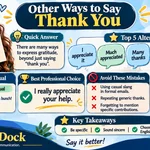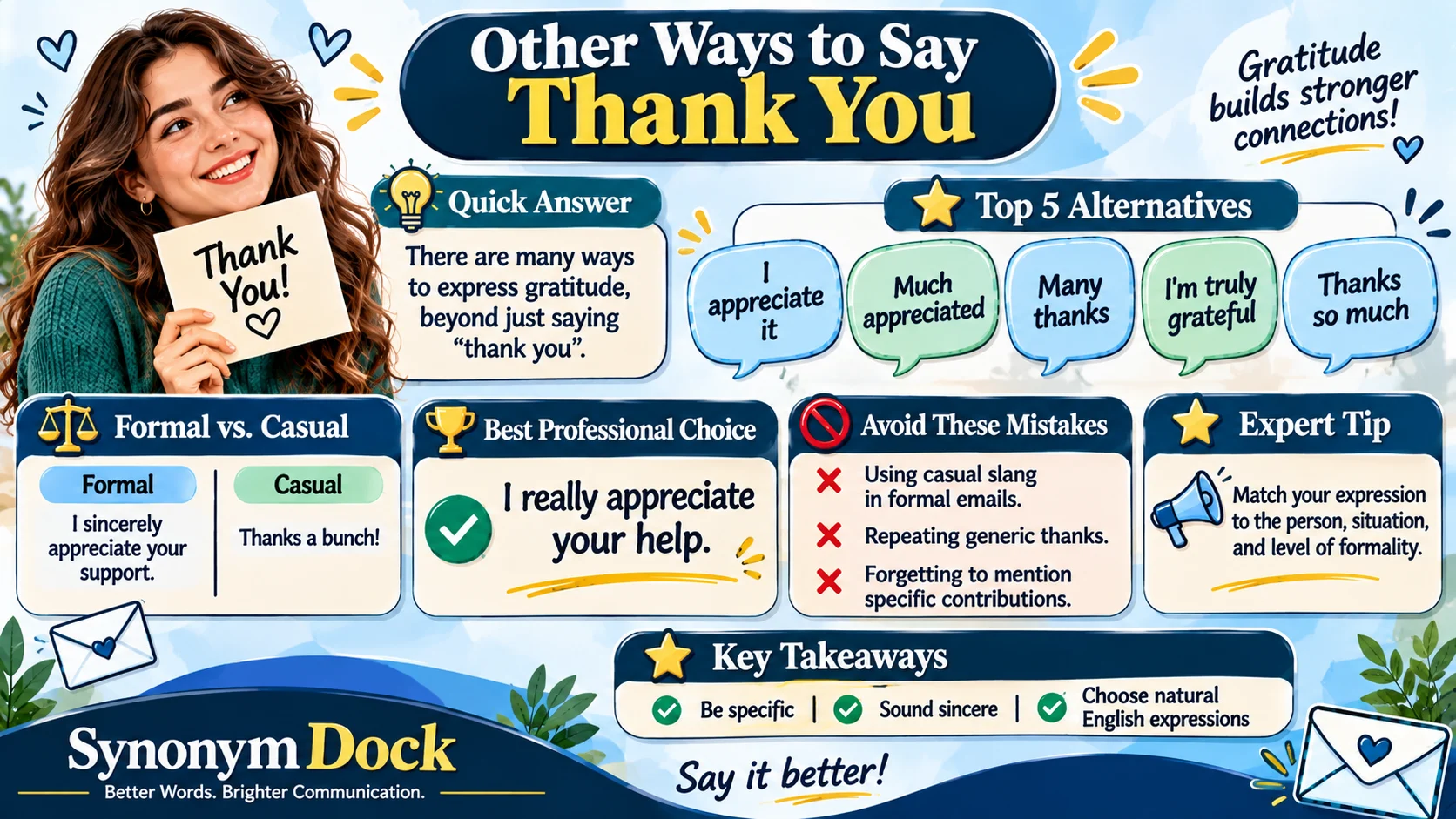
Other ways to say thank you include I appreciate it, much appreciated, many thanks, I’m truly grateful, and I sincerely appreciate your help. These expressions make everyday, academic, and professional communication more natural and meaningful.
Saying thank you is one of the simplest ways to show kindness, respect, and appreciation. However, repeating the same expression can sometimes make your conversations and messages sound less personal.
Learning other ways to say thank you helps you communicate more naturally in different situations. Whether you’re writing a business email, speaking with a teacher, thanking a colleague, or replying to a friend, choosing the right words makes your message more meaningful.
In this guide, you’ll discover 10 useful alternatives, their meanings, examples, and appropriate contexts. You’ll also learn which expressions work best in professional English, academic writing, and everyday conversations.
Quick Categories: Different Ways to Say Thank You
1. Formal Alternatives
- I sincerely appreciate your assistance.
- Please accept my gratitude.
- I’m truly grateful.
- My sincere thanks to you.
Pro Tip: Use these expressions when addressing senior colleagues, clients, teachers, or people you don’t know well.
2. Professional Alternatives
- I appreciate your support.
- Much appreciated.
- Thank you for your assistance.
- I value your contribution.
Pro Tip: Mention the specific help someone provided to make your professional message sound more genuine.
3. Business Email Alternatives
- Many thanks for your time.
- I appreciate your prompt response.
- Thank you for your cooperation.
- I’m grateful for your guidance.
Pro Tip: Choose clear, respectful expressions that recognize the recipient’s time and effort.
4. Academic Alternatives
- I appreciate your valuable feedback.
- I’m grateful for your guidance.
- Thank you for sharing your knowledge.
- I sincerely appreciate your support.
Pro Tip: Use specific expressions when thanking teachers, professors, classmates, or academic supervisors.
5. Casual Alternatives
- Thanks so much!
- I really appreciate it!
- You’re the best!
- Thanks a ton!
Pro Tip: These expressions work naturally with friends, family, and people you know well.
6. Informal Expressions
- Cheers!
- I owe you one!
- You’re a lifesaver!
- Big thanks!
Pro Tip: Keep these expressions for relaxed conversations and familiar relationships.
What Does “Other Ways to Say Thank You” Mean?
Other ways to say thank you are alternative expressions used to communicate gratitude, appreciation, and recognition for someone’s kindness, assistance, time, or support.
The expression “thank you” is a polite phrase used to acknowledge something positive that another person has done.
Simple explanation: Instead of repeating thank you, you can choose another expression that better matches your feelings and the situation.
Grammar explanation: “Thank you” functions as a fixed expression of gratitude. Many alternatives use verbs such as appreciate, value, and acknowledge, or adjectives such as grateful and thankful.
Example:
- Basic: Thank you for helping me.
- Alternative: I really appreciate your help.
Both sentences communicate gratitude, but the second sounds more personal.
When Should You Use Different Ways to Say Thank You?
Choosing the right expression depends on your relationship with the recipient and the communication setting.
| Situation | Recommended Expression |
|---|---|
| Business communication | I appreciate your support. |
| Professional emails | Many thanks for your assistance. |
| Meetings | I appreciate your valuable input. |
| Presentations | Thank you for your attention. |
| Academic writing | I sincerely appreciate your guidance. |
| Job interviews | Thank you for your time and consideration. |
| Daily conversations | Thanks so much! |
Important: Professional communication doesn’t always require complicated vocabulary. A short, sincere expression is often more effective than an unnecessarily elaborate sentence.
Professional vs. Polite: What’s the Difference?
These expressions may overlap, but they communicate slightly different tones.
- Polite: Shows good manners and consideration. Example: I appreciate your kindness.
- Professional: Maintains respect while recognizing someone’s contribution. Example: I appreciate your assistance with the project.
- Formal: Uses more traditional language for official situations. Example: Please accept my sincere gratitude.
- Natural: Sounds comfortable in everyday communication. Example: Thanks so much for helping me!
The best expression is one that sounds sincere without feeling forced.
Pros and Cons of Using Thank You Alternatives
Pros
- Improved vocabulary: Helps you learn more useful English expressions.
- Better communication: Makes messages clearer and more personal.
- Professional confidence: Helps you communicate respectfully at work.
- Natural conversations: Reduces repetitive language and improves fluency.
- Stronger relationships: Shows people that you recognize their efforts.
Cons
- Wrong tone: An informal phrase may seem inappropriate in official communication.
- Overcomplicated writing: Unusual expressions can make simple messages confusing.
- Regional differences: Some expressions are more common in certain English-speaking regions.
- Unnatural repetition: Using too many alternatives in one message can sound forced.
Other Ways to Say Thank You (With Examples)
Here are 10 useful alternatives arranged by everyday usefulness and communication context.
1. I Appreciate It
Meaning: Expresses genuine gratitude for someone’s help, effort, or kindness.
Explanation: This is a natural, flexible expression that works in spoken English and professional communication. It sounds friendly without being overly casual.
- Formality: Neutral to professional
- Example Sentence: I appreciate it; your advice helped me understand the assignment.
- Best Use: Everyday appreciation
- Avoid Using In: Highly ceremonial writing
- Tone: Warm, respectful
- Formality Level: ⭐⭐⭐⭐
- Usage Frequency: Very Common
- CEFR Level: B1 (approximate)
- Common Collocations: Really appreciate it, genuinely appreciate it, deeply appreciate it, sincerely appreciate it.
Context Examples:
- Spoken English: I appreciate it. Thanks for helping!
- Professional English: I appreciate your support during the project.
- Casual Conversation: I appreciate you picking that up for me!
2. I Really Appreciate Your Help
Meaning: Shows that you genuinely value someone’s assistance.
Explanation: This phrase is especially useful when you want to recognize a person’s specific contribution. It sounds sincere and professional without being excessively formal.
- Formality: Professional and neutral
- Example Sentence: I really appreciate your help with preparing the presentation.
- Best Use: Workplace communication
- Avoid Using In: Extremely casual banter
- Tone: Sincere, appreciative
- Formality Level: ⭐⭐⭐⭐
- Usage Frequency: Very Common
- CEFR Level: B1 (approximate)
- Common Collocations: Appreciate your help, appreciate your time, appreciate your effort, appreciate your support.
Context Examples:
- Spoken English: I really appreciate your help today.
- Professional English: I really appreciate your help completing the report.
- Casual Conversation: I really appreciate you helping me out!
3. Much Appreciated
Meaning: A short expression acknowledging someone’s helpful action or effort.
Explanation: This phrase is popular in workplace messages, emails, and everyday exchanges. It is concise and polite, although it can sound slightly abrupt without additional context.
- Formality: Neutral to professional
- Example Sentence: Your quick response is much appreciated.
- Best Use: Short work messages
- Avoid Using In: Emotional personal messages
- Tone: Polite, concise
- Formality Level: ⭐⭐⭐⭐
- Usage Frequency: Very Common
- CEFR Level: B2 (approximate)
- Common Collocations: Much appreciated, greatly appreciated, highly appreciated, help much appreciated.
Context Examples:
- Spoken English: Much appreciated! Thanks for that.
- Professional English: Your continued cooperation is much appreciated.
- Casual Conversation: Much appreciated for the lift!
4. Many Thanks
Meaning: A polite expression of gratitude, especially in written communication.
Explanation: Many thanks is a convenient alternative for emails, letters, and professional messages. It communicates appreciation without making the message sound overly emotional.
- Formality: Neutral to formal
- Example Sentence: Many thanks for sharing the updated documents.
- Best Use: Business email writing
- Avoid Using In: Deep emotional situations
- Tone: Courteous, friendly
- Formality Level: ⭐⭐⭐⭐
- Usage Frequency: Very Common
- CEFR Level: B1 (approximate)
- Common Collocations: Many thanks for your help, many thanks for your time, many thanks in advance, many thanks again.
Context Examples:
- Spoken English: Many thanks for your assistance.
- Professional English: Many thanks for reviewing my application.
- Casual Conversation: Many thanks for bringing snacks!
5. I’m Truly Grateful
Meaning: Communicates sincere appreciation for something meaningful.
Explanation: This expression carries more emotional weight than a simple thank you. Use it when someone has offered important support, guidance, or kindness.
- Formality: Formal and heartfelt
- Example Sentence: I’m truly grateful for your encouragement throughout my studies.
- Best Use: Meaningful appreciation
- Avoid Using In: Tiny routine favors
- Tone: Heartfelt, sincere
- Formality Level: ⭐⭐⭐⭐
- Usage Frequency: Common
- CEFR Level: B2 (approximate)
- Common Collocations: Truly grateful for, deeply grateful for, forever grateful, grateful for your support.
Context Examples:
- Spoken English: I’m truly grateful for everything you’ve done.
- Professional English: I’m truly grateful for your continued guidance.
- Casual Conversation: I’m truly grateful you remembered!
Native Speaker Tip:
The first five expressions are especially useful because they sound natural across many everyday and professional situations.
- Most natural: I appreciate it.
- Most professional: I really appreciate your help.
- Less common in casual speech: Much appreciated.
- Native preference: Short, specific expressions often sound more natural than complicated alternatives.
6. Thank You for Your Assistance
Meaning: Formally recognizes someone’s help or service.
Explanation: This expression is particularly appropriate in customer service, official correspondence, and professional emails. Assistance sounds slightly more formal than help.
- Formality: Formal and professional
- Example Sentence: Thank you for your assistance in resolving the scheduling issue.
- Best Use: Official communication
- Avoid Using In: Friendly text messages
- Tone: Respectful, polished
- Formality Level: ⭐⭐⭐⭐⭐
- Usage Frequency: Common
- CEFR Level: B2 (approximate)
- Common Collocations: Assistance with the project, valuable assistance, technical assistance, prompt assistance.
Context Examples:
- Spoken English: Thank you for your assistance today.
- Professional English: Thank you for your assistance with the client request.
- Casual Conversation: Thanks for helping me with that!
7. I Sincerely Appreciate It
Meaning: Expresses honest and respectful gratitude.
Explanation: Adding sincerely makes your appreciation sound more deliberate and heartfelt. It works well in formal emails, professional letters, and important conversations.
- Formality: Formal and professional
- Example Sentence: I sincerely appreciate your thoughtful feedback on my proposal.
- Best Use: Formal correspondence
- Avoid Using In: Casual group chats
- Tone: Respectful, genuine
- Formality Level: ⭐⭐⭐⭐⭐
- Usage Frequency: Common
- CEFR Level: C1 (approximate)
- Common Collocations: Sincerely appreciate your support, sincerely appreciate your time, sincerely appreciate your feedback, sincerely appreciate your consideration.
Context Examples:
- Spoken English: I sincerely appreciate your kindness.
- Professional English: I sincerely appreciate your consideration of my application.
- Casual Conversation: I really appreciate that!
8. Thanks So Much
Meaning: A friendly and enthusiastic way to express gratitude.
Explanation: This phrase is common in everyday spoken English, text messages, and relaxed workplace conversations. It adds warmth while keeping communication simple.
- Formality: Casual to neutral
- Example Sentence: Thanks so much for saving me a seat.
- Best Use: Friendly conversations
- Avoid Using In: Highly formal letters
- Tone: Warm, cheerful
- Formality Level: ⭐⭐⭐
- Usage Frequency: Very Common
- CEFR Level: A2–B1 (approximate)
- Common Collocations: Thanks so much for helping, thanks so much again, thanks so much for everything, thanks so much for your time.
Context Examples:
- Spoken English: Thanks so much for explaining that.
- Professional English: Thanks so much for your quick response.
- Casual Conversation: Thanks so much! You’re awesome.
9. I Can’t Thank You Enough
Meaning: Expresses deep gratitude when someone’s help means a great deal.
Explanation: This phrase communicates strong appreciation and suggests that ordinary words cannot fully express your feelings. It is suitable for significant personal or professional support.
- Formality: Neutral to formal
- Example Sentence: I can’t thank you enough for helping me prepare for the interview.
- Best Use: Significant support
- Avoid Using In: Minor routine favors
- Tone: Deeply appreciative
- Formality Level: ⭐⭐⭐⭐
- Usage Frequency: Common
- CEFR Level: B2 (approximate)
- Common Collocations: Can’t thank you enough for your help, kindness, support, generosity.
Context Examples:
- Spoken English: I can’t thank you enough for your guidance.
- Professional English: I can’t thank you enough for your contribution to this project.
- Casual Conversation: I can’t thank you enough for covering for me!
10. Cheers
Meaning: An informal expression used to show thanks in certain English-speaking communities.
Explanation: Cheers is especially common as a casual expression of thanks in British, Australian, and some other varieties of English. Its use can vary by region, so consider your audience.
- Formality: Informal
- Example Sentence: Cheers for sending me the notes!
- Best Use: Friendly exchanges
- Avoid Using In: Formal applications
- Tone: Relaxed, friendly
- Formality Level: ⭐⭐
- Usage Frequency: Common (region-dependent)
- CEFR Level: B1 (approximate)
- Common Collocations: Cheers for your help, cheers for that, cheers mate, cheers for the update.
Context Examples:
- Spoken English: Cheers for your help today.
- Professional English: Many thanks for the update. (A safer professional alternative.)
- Casual Conversation: Cheers! That was really helpful.
Native Speaker Tip:
The last five alternatives offer more specific tones and situations.
- Most natural: Thanks so much.
- Most professional: Thank you for your assistance.
- Less common in some regions: Cheers.
- Native preference: Match the expression to the situation rather than choosing the longest phrase.
Note: CEFR levels above are approximate learning guides, not official ratings for individual expressions.
Expert Insight: Choosing the Right Thank You Expression
Workplace Communication
Recognize the person’s actual contribution instead of relying on generic appreciation.
Example: I appreciate your detailed feedback on the quarterly report.
Email Writing
Many thanks and I sincerely appreciate your assistance are useful choices for professional correspondence.
Example: Many thanks for reviewing the proposal. Your suggestions were helpful.
Academic English
When thanking a teacher or academic supervisor, mention the specific guidance you received.
Example: I’m truly grateful for your guidance throughout this research project.
The key lesson is simple: specific gratitude sounds more meaningful than repeated generic expressions.
Quick Recap: Best Alternatives at a Glance
| Category | Best Expression |
|---|---|
| Best Professional Choice | I really appreciate your help. |
| Best Casual Choice | Thanks so much! |
| Best Formal Choice | I sincerely appreciate it. |
| Most Natural Choice | I appreciate it. |
| Most Polite Choice | Thank you for your assistance. |
Comparison Table: 10 Ways to Say Thank You
| Phrase | Tone | Formality | Best Use | Frequency |
|---|---|---|---|---|
| I appreciate it | Warm | Neutral | Daily communication | Very Common |
| I really appreciate your help | Sincere | Professional | Workplace | Very Common |
| Much appreciated | Polite | Neutral | Short messages | Very Common |
| Many thanks | Friendly | Formal | Emails | Very Common |
| I’m truly grateful | Heartfelt | Formal | Meaningful support | Common |
| Thank you for your assistance | Respectful | Formal | Official messages | Common |
| I sincerely appreciate it | Genuine | Formal | Professional letters | Common |
| Thanks so much | Cheerful | Casual | Daily conversations | Very Common |
| I can’t thank you enough | Emotional | Neutral | Significant help | Common |
| Cheers | Relaxed | Informal | Friendly exchanges | Region-dependent |
Best Choice: Which Thank You Expression Should You Use?
Best Overall: I appreciate it. This expression works in many everyday and professional situations without sounding complicated.
Best Professional: I really appreciate your help. It recognizes someone’s contribution while maintaining a respectful tone.
Best Academic: I’m truly grateful for your guidance. It is appropriate when acknowledging meaningful educational support.
Best Business Email: Many thanks. It is concise, polite, and convenient for written communication.
Best Everyday Conversation: Thanks so much! It sounds friendly and natural when speaking with people you know.
Most Natural: I appreciate it. It is a flexible expression that fits many situations.
Most Polite: Thank you for your assistance. It maintains a respectful tone in formal exchanges.
Commonly Confused Thank You Expressions
Some expressions communicate similar feelings but have different meanings and levels of formality.
| Expression | Meaning | Best Context |
|---|---|---|
| Thank you | General appreciation | Almost any situation |
| I appreciate it | Personal recognition | Everyday and workplace |
| I’m grateful | Stronger personal gratitude | Meaningful support |
| Much appreciated | Brief acknowledgment | Work messages |
| Cheers | Casual thanks | Informal conversations |
| Many thanks | Polite written gratitude | Emails and letters |
Remember: I appreciate it usually focuses on the helpful action, while I’m grateful often communicates a deeper personal feeling.
Also, cheers can mean something other than thanks in different contexts, including a toast or a friendly farewell.
Scenario Practice: Which Phrase Would You Choose?
Test your understanding with these five everyday situations.
1. Business Meeting
Your colleague shares useful information that improves your project.
Which phrase would you choose?
Answer: I appreciate your valuable input.
Why: It recognizes their contribution while maintaining a professional tone.
2. Job Interview
An interviewer spends time discussing a potential position with you.
Which phrase would you choose?
Answer: Thank you for your time and consideration.
Why: This expression sounds respectful and appropriate for professional communication.
3. Presentation
Your audience listens carefully to your presentation.
Which phrase would you choose?
Answer: Thank you for your attention.
Why: It is a natural and widely understood presentation closing.
4. Classroom Discussion
Your teacher explains a difficult topic clearly.
Which phrase would you choose?
Answer: I’m truly grateful for your guidance.
Why: It recognizes the teacher’s effort and communicates sincere appreciation.
5. Email Reply
A colleague sends you an important document you requested.
Which phrase would you choose?
Answer: Many thanks for sharing the document.
Why: It is concise, polite, and appropriate for workplace emails.
Mini Quiz: Test Your English Vocabulary
Choose the best answer for each question.
1. Which expression is most suitable for a formal business email?
A. You’re the best!
B. Cheers!
C. Thank you for your assistance.
D. I owe you one!
2. Which phrase communicates deep gratitude?
A. I can’t thank you enough.
B. Okay, thanks.
C. Cheers.
D. No worries.
3. Which expression is especially common in casual British English?
A. Please accept my gratitude.
B. Cheers.
C. I sincerely appreciate your assistance.
D. With deepest appreciation.
4. Which phrase is appropriate when thanking a colleague for helpful feedback?
A. I appreciate your valuable feedback.
B. Whatever, thanks.
C. I owe you one, boss.
D. You’re a lifesaver, mate!
5. Which expression is friendly and suitable for everyday conversations?
A. Please accept my deepest gratitude.
B. Thanks so much!
C. I hereby express my appreciation.
D. I wish to acknowledge your assistance.
Mini Quiz Answer Key
- C: Thank you for your assistance is professional and respectful.
- A: I can’t thank you enough expresses strong gratitude.
- B: Cheers is a common informal British expression.
- A: It recognizes the colleague’s specific contribution.
- B: Thanks so much is friendly and natural.
FAQs
1. What are the best other ways to say thank you?
Some of the best alternatives include I appreciate it, much appreciated, many thanks, I’m truly grateful, and thanks so much. Choose an expression based on your relationship with the recipient and the situation.
2. How do you say thank you professionally?
You can say I appreciate your support, thank you for your assistance, or many thanks for your time. These expressions communicate respect and gratitude while maintaining an appropriate professional tone.
3. What is a more formal way to say thank you?
I sincerely appreciate your assistance and please accept my gratitude are more formal alternatives. They work particularly well in official correspondence, business letters, academic communication, and situations involving senior professionals.
4. How can I say thank you without using those exact words?
Try expressions such as I appreciate it, I’m truly grateful, much appreciated, or I value your support. These alternatives communicate appreciation while making your everyday conversations and written messages more varied.
5. What is the most natural way to express gratitude in English?
I appreciate it and thanks so much are natural expressions in everyday English. For professional communication, I really appreciate your help is another comfortable choice that sounds sincere without being overly formal.
Conclusion
Learning other ways to say thank you helps you become a more confident and effective English communicator. From professional emails to friendly conversations, the right expression makes your appreciation sound more natural and meaningful. Each alternative has its own tone, purpose, and level of formality, so understanding these differences matters.
Start practicing a few expressions from this guide in your daily conversations and writing. Remember to keep your words genuine, choose phrases that fit the situation, and recognize the kindness of others. With regular practice, expressing gratitude in English will become easier and more natural.