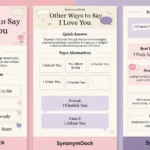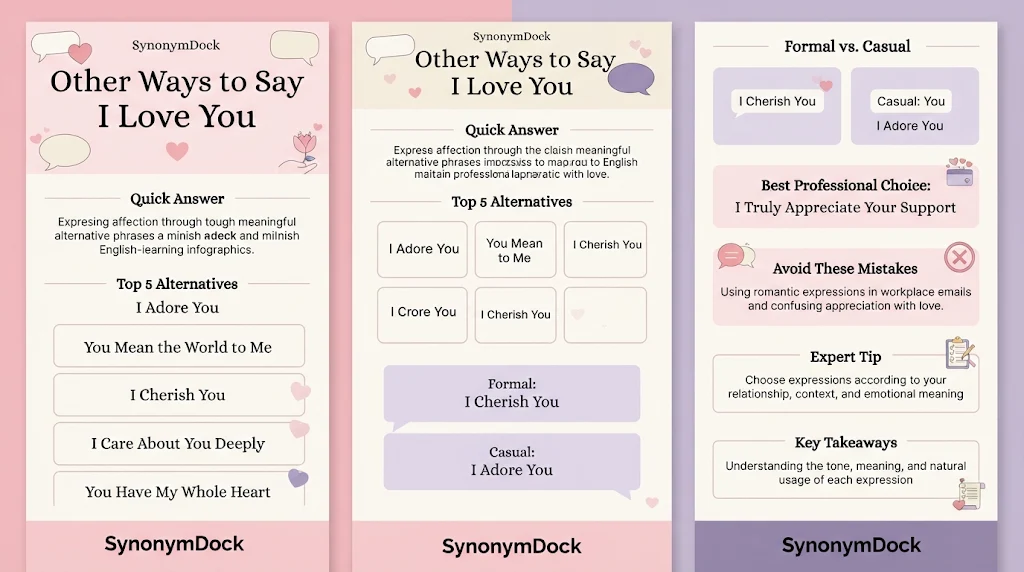
Other ways to say I love you include I adore you, I cherish you, you mean the world to me, I care about you deeply, and you have my whole heart. Each expression communicates affection with a different emotional tone.
Sometimes, three simple words cannot express everything you feel. Whether you’re writing a heartfelt message, appreciating someone special, or improving your English vocabulary, finding the right expression makes communication more meaningful.
Learning other ways to say I love you helps you express affection, admiration, gratitude, and emotional connection. Different expressions work better for romantic relationships, family conversations, close friendships, and personal letters.
Quick Categories: Different Ways to Express Love
Choosing an expression depends on your relationship and the message you want to communicate. Here are useful alternatives organized by situation.
Formal Alternatives
- I hold you dear.
- I cherish you deeply.
- I have great affection for you.
- You hold a special place in my heart.
Pro Tip: Formal expressions work particularly well in heartfelt letters, wedding speeches, and meaningful written messages.
Professional Alternatives
- I genuinely appreciate you.
- I value your contribution.
- I deeply respect you.
- I’m grateful for your support.
Pro Tip: These phrases communicate appreciation rather than romantic love. Choose them when expressing professional respect or gratitude.
Business Email Alternatives
- I truly appreciate your assistance.
- I’m grateful for your continued support.
- I sincerely value your guidance.
- Your help means a great deal to me.
Pro Tip: Focus on appreciation and respect in business emails instead of using personal declarations of love.
Academic Alternatives
- I greatly appreciate your guidance.
- I’m thankful for your encouragement.
- I deeply value your mentorship.
- Your support has meant a lot to me.
Pro Tip: Use these expressions in acknowledgments, thank-you messages, and respectful communication with teachers or mentors.
Casual Alternatives
- You mean so much to me.
- You’re my favorite person.
- I adore you.
- You’re incredibly special to me.
Pro Tip: Casual expressions are ideal for relaxed conversations with close friends, family members, and people you trust.
Informal Expressions
- Love you!
- You’re the best.
- I’m so lucky to have you.
- You make my day better.
Pro Tip: Keep informal expressions for friendly conversations, personal messages, and relaxed texting.
What Does “I Love You” Mean?
“I love you” is an expression of deep affection, emotional attachment, and genuine care for another person.
The phrase can communicate different feelings depending on the relationship. Romantic partners may use it to express romantic commitment, while family members and close friends use it to show affection and appreciation.
Grammar Explanation
The expression contains three words:
- I: Subject pronoun.
- Love: Verb expressing affection.
- You: Object pronoun receiving the affection.
The verb love is commonly used with a person, activity, or thing.
Example: I love you because you always support me.
Simple Explanation: Saying “I love you” means someone is important to you and holds a special place in your life.
When Should You Use Other Ways to Say I Love You?
Different communication situations require different expressions. Understanding the context helps you avoid misunderstandings.
1. Business Communication
In professional environments, expressions of appreciation and respect are more suitable than personal declarations.
Example: I genuinely appreciate your dedication to this project.
2. Emails
When writing professional emails, choose warm but appropriate expressions.
Example: I’m grateful for your continued support and guidance.
3. Meetings
During meetings, communicate appreciation without introducing unnecessary personal language.
Example: I truly value your contribution to this discussion.
4. Presentations
When recognizing a mentor, colleague, or team, use expressions that communicate gratitude.
Example: I’m thankful for everyone who helped make this achievement possible.
5. Academic Writing
Academic communication generally favors precise expressions of appreciation rather than emotional declarations.
Example: I sincerely appreciate my professor’s valuable guidance.
6. Interviews
Professional interviews require respectful and confident language.
Example: I really admire the company’s commitment to innovation.
7. Daily Conversations
Personal conversations allow more affectionate and natural expressions.
Example: You mean the world to me, and I’m grateful to have you in my life.
Professional vs. Polite: What’s the Difference?
Professional and polite expressions can overlap, but they serve different purposes.
| Communication Style | Meaning | Example |
|---|---|---|
| Polite | Shows kindness and consideration | I truly appreciate you. |
| Professional | Communicates respect at work | I value your contribution. |
| Formal | Uses refined, thoughtful language | I hold you in high regard. |
| Natural | Sounds relaxed and conversational | You mean so much to me. |
Important distinction: None of these expressions automatically means romantic love. Choose language that accurately represents your feelings.
Pros and Cons of Using Alternatives
Pros
- Improves vocabulary: You learn different expressions for affection, gratitude, and admiration.
- Creates variety: Different phrases prevent personal messages from sounding repetitive.
- Improves communication: You can express feelings more precisely.
- Supports language learning: Understanding tone and context helps you develop natural English.
Cons
- Possible misunderstanding: Some expressions may sound romantic when you intend friendship.
- Different emotional meanings: Appreciation does not always communicate love.
- Context matters: A heartfelt expression may feel inappropriate in professional communication.
- Overly dramatic wording: Poetic expressions can sound unnatural in everyday conversations.
Other Ways to Say I Love You (With Examples)
Here are 10 meaningful alternatives, arranged from widely useful expressions to more specific or less common choices.
1. I Adore You
Meaning: To love someone deeply while also admiring them.
Explanation: This expression communicates strong affection and admiration. It sounds warm, natural, and slightly more expressive than the usual declaration.
Formality: Neutral, romantic, and personal.
Example Sentence: I adore you because you always bring happiness into my life.
Best Use: Personal conversations.
Avoid Using In: Formal business emails.
Tone: Warm and affectionate.
Formality Level: ⭐⭐⭐
Usage Frequency: Common
CEFR Level: B1
Common Collocations:
- Absolutely adore you
- Truly adore someone
- Adore every moment
- Adore your personality
Context Examples:
- Spoken English: I adore you, and I hope you know that.
- Professional English: I adore this approach to solving problems. (Refers to an idea, not a colleague.)
- Casual Conversation: You’re wonderful. I adore you!
2. You Mean the World to Me
Meaning: Someone is extremely important in your life.
Explanation: This phrase expresses emotional importance and appreciation. It works naturally for romantic partners, family members, and close friends.
Formality: Neutral and heartfelt.
Example Sentence: You’ve supported me through everything, and you mean the world to me.
Best Use: Heartfelt messages.
Avoid Using In: Formal workplace discussions.
Tone: Deep and sincere.
Formality Level: ⭐⭐⭐
Usage Frequency: Very Common
CEFR Level: B1
Common Collocations:
- Mean the world to me
- Mean so much
- Mean everything to me
- Mean more than words
Context Examples:
- Spoken English: You mean the world to me.
- Professional English: Your guidance means a great deal to me.
- Casual Conversation: You’re my favorite person. You mean so much to me!
3. I Cherish You
Meaning: To value someone deeply and hold them close to your heart.
Explanation: This expression communicates lasting affection, tenderness, and appreciation. It has a thoughtful quality that suits meaningful letters and special occasions.
Formality: Formal-leaning and personal.
Example Sentence: I cherish you and every beautiful memory we’ve created together.
Best Use: Personal letters.
Avoid Using In: Routine business emails.
Tone: Tender and meaningful.
Formality Level: ⭐⭐⭐⭐
Usage Frequency: Common
CEFR Level: B2
Common Collocations:
- Cherish every moment
- Cherish our friendship
- Cherish the memories
- Truly cherish someone
Context Examples:
- Spoken English: I cherish having you in my life.
- Professional English: I cherish the opportunity to learn from experienced educators. (Refers to an opportunity.)
- Casual Conversation: I cherish all our memories together.
4. I Care About You Deeply
Meaning: To have strong feelings of concern, affection, and emotional connection.
Explanation: This phrase communicates genuine care without necessarily making a romantic declaration. It is particularly useful when someone needs reassurance or emotional support.
Formality: Neutral.
Example Sentence: I care about you deeply, and I want you to know you’re important to me.
Best Use: Supportive conversations.
Avoid Using In: Formal academic essays.
Tone: Caring and sincere.
Formality Level: ⭐⭐⭐
Usage Frequency: Very Common
CEFR Level: B1
Common Collocations:
- Care deeply about someone
- Genuinely care for someone
- Care about your feelings
- Care about your happiness
Context Examples:
- Spoken English: I care about you deeply.
- Professional English: I care about the quality of our team’s work.
- Casual Conversation: Just remember that I really care about you.
5. You Have My Whole Heart
Meaning: Someone receives your complete affection and emotional commitment.
Explanation: This is a poetic expression that communicates deep romantic affection. It feels more emotional than ordinary everyday language.
Formality: Literary and personal.
Example Sentence: No matter where life takes us, you have my whole heart.
Best Use: Heartfelt letters.
Avoid Using In: Professional communication.
Tone: Romantic and poetic.
Formality Level: ⭐⭐⭐
Usage Frequency: Occasional
CEFR Level: C1
Common Collocations:
- Give someone your heart
- Have my whole heart
- Hold my heart
- Keep my heart
Context Examples:
- Spoken English: You have my whole heart.
- Professional English: This phrase is generally unsuitable for workplace communication.
- Casual Conversation: You’ve always had my whole heart.
Native Speaker Tip: Choosing Your First Five Alternatives
Native English speakers generally choose expressions according to the relationship and emotional situation.
- Most natural: I adore you.
- Most heartfelt: You mean the world to me.
- Most thoughtful: I cherish you.
- Most supportive: I care about you deeply.
- Most poetic: You have my whole heart.
For everyday conversation, shorter expressions usually sound more natural. Save poetic expressions for meaningful moments.
6. I Treasure You
Meaning: To consider someone extremely valuable and special.
Explanation: This expression emphasizes how much you value someone’s presence. It sounds thoughtful and affectionate, particularly in personal letters and meaningful conversations.
Formality: Neutral to formal.
Example Sentence: I treasure you and feel grateful for every moment we share.
Best Use: Personal letters.
Avoid Using In: Casual workplace chats.
Tone: Gentle and appreciative.
Formality Level: ⭐⭐⭐⭐
Usage Frequency: Occasional
CEFR Level: B2
Common Collocations:
- Treasure our friendship
- Treasure every moment
- Treasure your memories
- Truly treasure someone
Context Examples:
- Spoken English: I treasure having you in my life.
- Professional English: We treasure the opportunity to work with dedicated educators.
- Casual Conversation: You’re someone I’ll always treasure.
7. I’m Devoted to You
Meaning: To show strong loyalty, commitment, and dedication toward someone.
Explanation: This phrase communicates a serious emotional connection. It can sound traditional or formal, making it more appropriate for established relationships and meaningful written expressions.
Formality: Formal-leaning and personal.
Example Sentence: I’m devoted to you and the life we’ve built together.
Best Use: Commitment statements.
Avoid Using In: Professional introductions.
Tone: Serious and committed.
Formality Level: ⭐⭐⭐⭐
Usage Frequency: Occasional
CEFR Level: C1
Common Collocations:
- Completely devoted to you
- Devoted to family
- Deeply devoted
- Devoted to a relationship
Context Examples:
- Spoken English: I’m devoted to you.
- Professional English: I’m devoted to improving my professional skills.
- Casual Conversation: You know how devoted I am to our friendship.
8. I’m Deeply in Love With You
Meaning: To experience very strong romantic affection for someone.
Explanation: This is a direct and emotionally powerful expression. It clearly communicates romantic feelings rather than general friendship or appreciation.
Formality: Neutral and personal.
Example Sentence: I want you to know that I’m deeply in love with you.
Best Use: Romantic conversations.
Avoid Using In: Workplace emails.
Tone: Romantic and intense.
Formality Level: ⭐⭐⭐
Usage Frequency: Common
CEFR Level: B2
Common Collocations:
- Deeply in love
- Fall in love
- Truly in love
- Completely in love
Context Examples:
- Spoken English: I’m deeply in love with you.
- Professional English: This expression is not suitable for ordinary professional communication.
- Casual Conversation: I’ve realized how deeply in love I am with you.
9. I’m Grateful to Have You in My Life
Meaning: To feel thankful because someone is part of your life.
Explanation: This expression combines affection with gratitude. It is especially useful for appreciating friends, family members, mentors, and people who provide meaningful support.
Formality: Neutral and polite.
Example Sentence: I’m grateful to have you in my life because your kindness makes every day better.
Best Use: Thank-you messages.
Avoid Using In: Short formal reports.
Tone: Grateful and heartfelt.
Formality Level: ⭐⭐⭐⭐
Usage Frequency: Very Common
CEFR Level: B2
Common Collocations:
- Grateful to have you
- Truly grateful
- Grateful for your support
- Deeply grateful
Context Examples:
- Spoken English: I’m so grateful to have you in my life.
- Professional English: I’m grateful to have such supportive colleagues.
- Casual Conversation: Life is better with you around. I’m grateful for you!
10. I Appreciate You
Meaning: To recognize someone’s kindness, effort, presence, or positive qualities.
Explanation: This is a versatile expression that works in everyday and professional communication. However, appreciation is not identical to romantic love. Use it when gratitude or recognition is your intended message.
Formality: Neutral and professional-friendly.
Example Sentence: I appreciate you for always listening and making time for me.
Best Use: Everyday appreciation.
Avoid Using In: Romantic declarations requiring clarity.
Tone: Warm and respectful.
Formality Level: ⭐⭐⭐⭐
Usage Frequency: Very Common
CEFR Level: B1
Common Collocations:
- Truly appreciate you
- Deeply appreciate your support
- Appreciate your kindness
- Really appreciate your help
Context Examples:
- Spoken English: I really appreciate you.
- Professional English: I sincerely appreciate your valuable contribution.
- Casual Conversation: Thanks for always being there. I appreciate you!
Native Speaker Tip: Choosing Alternatives Six to Ten
These expressions are useful when you want to communicate commitment, gratitude, or lasting affection.
- Most professional-friendly: I appreciate you.
- Most grateful: I’m grateful to have you in my life.
- Most committed: I’m devoted to you.
- Most romantic: I’m deeply in love with you.
- Less common: I treasure you.
Remember that natural English depends on meaning, not simply choosing the longest or most impressive expression.
Expert Insight: Using These Expressions Naturally
Workplace Communication
Avoid romantic declarations when addressing colleagues or managers. Expressions such as “I appreciate your support” and “I value your contribution” communicate respect more clearly.
Email Writing
Professional emails should focus on the specific reason for appreciation. For example, “I’m grateful for your guidance” sounds more natural than a personal declaration of affection.
Academic English
In academic acknowledgments, expressions such as “I sincerely appreciate your guidance” are appropriate. They communicate gratitude without creating unnecessary emotional ambiguity.
English teacher’s tip: Before replacing a phrase, identify its actual meaning. Love, gratitude, admiration, and respect are related feelings, but they are not interchangeable.
Quick Recap: Best Alternatives at a Glance
| Category | Best Expression |
|---|---|
| Best Professional Choice | I appreciate you |
| Best Casual Choice | I adore you |
| Best Formal Choice | I cherish you |
| Most Natural Choice | You mean the world to me |
| Most Polite Choice | I’m grateful to have you in my life |
Comparison Table: All 10 Alternatives
| Phrase | Tone | Formality | Best Use | Frequency |
|---|---|---|---|---|
| I adore you | Affectionate | Neutral | Personal conversations | Common |
| You mean the world to me | Heartfelt | Neutral | Close relationships | Very Common |
| I cherish you | Tender | Formal-leaning | Personal letters | Common |
| I care about you deeply | Caring | Neutral | Emotional support | Very Common |
| You have my whole heart | Poetic | Personal | Romantic messages | Occasional |
| I treasure you | Appreciative | Formal-leaning | Meaningful letters | Occasional |
| I’m devoted to you | Committed | Formal-leaning | Established relationships | Occasional |
| I’m deeply in love with you | Romantic | Neutral | Romantic conversations | Common |
| I’m grateful to have you in my life | Grateful | Neutral | Personal appreciation | Very Common |
| I appreciate you | Respectful | Neutral | Everyday and workplace | Very Common |
Frequency labels are practical usage estimates, not measured statistical rankings. CEFR levels are approximate learning guidance.
How to Choose the Best Expression
Not every alternative communicates the same emotion. Here are the best choices for different situations.
Best Overall: You Mean the World to Me
This expression communicates deep affection without sounding overly complicated. It works naturally with partners, close friends, and family members.
Best Professional: I Appreciate You
Choose this expression when recognizing someone’s effort, kindness, or contribution. It communicates warmth while maintaining workplace boundaries.
Best Academic: I’m Grateful for Your Guidance
This phrase is appropriate for thanking teachers, supervisors, and academic mentors. It sounds respectful and clear.
Best Business Email: I Truly Appreciate Your Support
This is a natural way to recognize someone’s assistance in professional correspondence. It keeps the message warm and focused.
Best Everyday Conversation: I Adore You
This short expression communicates affection and admiration. It works well in relaxed personal conversations.
Most Natural: I Care About You Deeply
This expression sounds sincere and straightforward. It is particularly useful when you want to communicate genuine concern.
Most Polite: I’m Grateful to Have You in My Life
This phrase combines gratitude with personal appreciation. It works well in thoughtful messages and conversations.
Commonly Confused Phrases: What’s the Difference?
Some expressions appear similar but communicate different emotions. Understanding these distinctions helps you choose accurately.
1. I Love You vs. I Like You
I love you: Expresses deep affection or emotional attachment.
I like you: Communicates positive feelings or attraction, usually with less emotional intensity.
Example:
- I love you and value our relationship.
- I like you and enjoy spending time with you.
2. I Adore You vs. I Admire You
I adore you: Expresses affection combined with admiration.
I admire you: Expresses respect for someone’s qualities, achievements, or behavior.
Example:
- I adore you for your kindness.
- I admire you for your dedication.
3. I Cherish You vs. I Appreciate You
I cherish you: Communicates deep personal affection and emotional value.
I appreciate you: Recognizes someone’s kindness, effort, or contribution.
Example:
- I cherish our friendship.
- I appreciate your continued support.
4. I’m Fond of You vs. I Care About You
I’m fond of you: Expresses warm affection, often with a gentler emotional intensity.
I care about you: Communicates concern, affection, and emotional consideration.
Example:
- I’m very fond of you.
- I care about your happiness.
5. You Mean the World to Me vs. You’re My Everything
You mean the world to me: Communicates that someone is extremely important.
You’re my everything: Expresses intense emotional importance, usually in romantic contexts.
Example:
- You mean the world to me, and I’m grateful for your friendship.
- You’re my everything, and I treasure our relationship.
Scenario Practice: Choose the Right Expression
Test your understanding with these five everyday situations.
Situation 1: Business Meeting
Your colleague has helped you complete an important project. Which expression is most appropriate?
Question: Which phrase would you choose?
A. You have my whole heart.
B. I truly appreciate your contribution.
C. I’m deeply in love with you.
Correct Answer: B.
Explanation: Appreciation is appropriate in workplace communication. It recognizes professional effort without introducing personal or romantic meaning.
Situation 2: Interview
You want to explain why you respect a professional mentor.
Question: Which phrase would you choose?
A. I deeply admire my mentor.
B. You mean the world to me.
C. I adore you.
Correct Answer: A.
Explanation: Admiration communicates professional respect and recognition of someone’s positive qualities.
Situation 3: Presentation
You are thanking your team for helping you prepare a presentation.
Question: Which phrase would you choose?
A. You have my whole heart.
B. I’m grateful for everyone’s support.
C. I’m devoted to you.
Correct Answer: B.
Explanation: Gratitude is the clearest and most suitable way to recognize teamwork in a professional presentation.
Situation 4: Classroom Discussion
You want to thank your teacher for providing helpful guidance.
Question: Which phrase would you choose?
A. I sincerely appreciate your guidance.
B. I’m deeply in love with you.
C. You’re my everything.
Correct Answer: A.
Explanation: This expression communicates respect and appreciation in an academic setting.
Situation 5: Personal Message
You want to tell a close family member how important they are to you.
Question: Which phrase would you choose?
A. I value your contribution.
B. You mean the world to me.
C. I admire your professional skills.
Correct Answer: B.
Explanation: This heartfelt expression communicates personal affection and emotional importance.
Mini Quiz: Test Your English Vocabulary
Choose the correct answer for each question.
1. Which expression communicates deep affection and admiration?
A. I appreciate your assistance.
B. I adore you.
C. I value your contribution.
2. Which phrase is most appropriate for a professional email?
A. You have my whole heart.
B. I’m deeply in love with you.
C. I truly appreciate your support.
3. What does “I cherish you” communicate?
A. Deep affection and personal value.
B. Professional disagreement.
C. Casual interest.
4. Which expression is most suitable for thanking an academic mentor?
A. You’re my everything.
B. I’m grateful for your guidance.
C. I have my whole heart.
5. Which expression is more romantic and emotionally intense?
A. I appreciate you.
B. I value your work.
C. I’m deeply in love with you.
Mini Quiz Answer Key
| Question | Correct Answer | Skill Tested |
|---|---|---|
| 1 | B | Meaning and tone |
| 2 | C | Professional context |
| 3 | A | Vocabulary understanding |
| 4 | B | Academic communication |
| 5 | C | Emotional intensity |
Learning Tip: Practice creating one original sentence with each expression. This will help you remember its meaning and use it naturally.
FAQs
1. What are the best other ways to say I love you?
Some of the best alternatives include I adore you, I cherish you, you mean the world to me, I care about you deeply, and you have my whole heart. Each expression communicates affection differently.
2. How can I say I love you without using those exact words?
You can express affection by saying you mean so much to me, I’m grateful to have you, or I cherish every moment together. Choose an expression that genuinely reflects your feelings and relationship.
3. What is a more formal way to say I love you?
I cherish you and I hold you dear are thoughtful expressions for personal letters and meaningful speeches. For professional situations, use I appreciate you or I value your contribution instead.
4. How do you say I love you professionally?
Professional communication usually requires appreciation rather than romantic affection. Expressions such as I sincerely appreciate your support, I value your contribution, and I’m grateful for your guidance sound respectful and appropriate.
5. What is the most natural alternative to I love you?
You mean the world to me is a natural, heartfelt alternative for close relationships. I adore you also sounds conversational. The best choice depends on the relationship and the emotion you want to communicate.
Conclusion
Learning other ways to say I love you helps you communicate affection, gratitude, admiration, and appreciation with greater confidence. Each expression has its own meaning, tone, and appropriate situation. Whether you’re writing a personal message, thanking someone, or improving your English vocabulary, choosing the right words makes your communication more natural and meaningful.
Keep practicing these expressions in conversations, messages, and everyday writing. Pay attention to context and emotional meaning before choosing an alternative. With SynonymDock, you can continue discovering useful English expressions and develop a vocabulary that makes every message clearer, warmer, and more expressive.