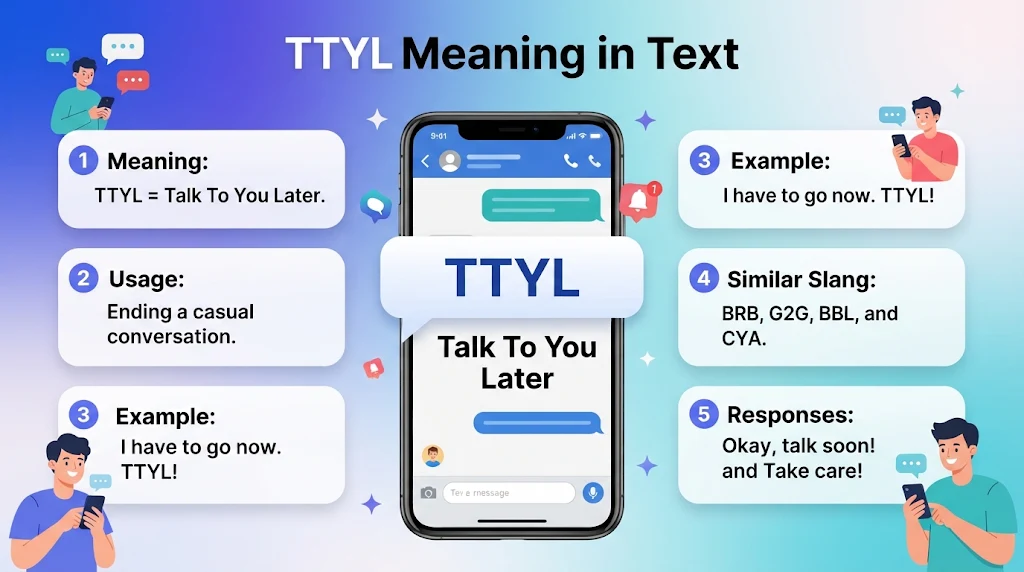
TTYL stands for Talk To You Later. People use this popular texting abbreviation to end a conversation politely without saying a formal goodbye. It appears in text messages, Snapchat, Instagram, TikTok, and online chats when someone plans to reconnect later.
ttyl meaning in text is one of the most common things people search for when they encounter this abbreviation in a message or social media conversation. If someone sends you TTYL, they usually mean they need to leave the conversation but expect to talk again later.
However, understanding internet slang involves more than memorizing abbreviations. The situation, relationship, and tone can influence how a message feels. For example, a friend might send TTYL before going to class, while a coworker might use it to end an informal workplace chat.
Furthermore, this abbreviation has remained popular because it makes everyday communication faster. Instead of typing a complete goodbye, someone can use four simple letters. It works particularly well in casual conversations, where short and friendly messages feel natural.
Whether you discovered it on Snapchat, received it in a text, or noticed it in an Instagram conversation, this guide explains its meaning, usage, examples, and possible misunderstandings. You’ll also learn how to respond naturally without making the conversation awkward.
Quick Answer
| Category | Explanation |
|---|---|
| Meaning | Talk To You Later |
| Context | Ending a conversation temporarily |
| Primary Platforms | Text messages, Snapchat, Instagram, TikTok |
| Example | I have to leave for class. TTYL! |
| Tone | Casual, friendly, and conversational |
What Does TTYL Mean in Text? Definition and Origin
The abbreviation TTYL means Talk To You Later. It is a casual expression people use when they want to end a conversation while suggesting they may communicate again.
For example:
Person A: I need to finish my homework now.
Person B: No worries! TTYL.
In this situation, the second person acknowledges the conversation’s ending without making it sound permanent.
Unlike a formal goodbye, this expression feels relaxed and suitable for everyday digital communication.
Breaking Down the Four Letters
Each letter represents a word in the original expression.
| Letter | Word | Meaning |
|---|---|---|
| T | Talk | Have a conversation |
| T | To | Indicates the purpose |
| Y | You | The person receiving the message |
| L | Later | At another time |
Together, these letters create a short farewell that people can type quickly.
Where Did This Abbreviation Come From?
This expression became popular during the early days of internet communication.
Before modern messaging applications, people frequently used chat rooms, instant messaging services, and online discussion platforms. Typing shorter expressions helped users communicate quickly.
As mobile phones and text messaging became more common, abbreviations such as LOL, BRB, BTW, and TTYL entered everyday digital conversations.
Eventually, social media platforms helped spread these expressions to wider audiences.
Today, people continue using the abbreviation because it remains recognizable and convenient. Although communication habits have changed, the basic meaning has stayed consistent.
Is It an Acronym or an Abbreviation?
TTYL is commonly described as an initialism because people pronounce its individual letters rather than saying it like a normal word.
It is also broadly called a texting abbreviation or internet acronym in everyday discussions.
Both descriptions help explain its role in digital communication. However, initialism is the more technically precise linguistic term.
Contextual Dynamics and Nuances of the Term
Although the basic definition remains the same, the context can influence how someone interprets this expression.
For instance, a message between close friends may feel different from one exchanged between classmates or coworkers.
Understanding these differences helps prevent unnecessary confusion.
1. Friendly Conversations
Friends often use this abbreviation when they need to leave a conversation temporarily.
Example:
I’m heading out with my family. TTYL!
Here, the message sounds relaxed and friendly. It communicates that the person is leaving without suggesting anything negative.
2. Busy Schedules
People sometimes use it when they cannot continue chatting because of other responsibilities.
Example:
I have a meeting starting in five minutes. TTYL!
The sender is simply explaining that they need to focus on something else.
3. Temporary Goodbyes
This expression usually communicates a temporary goodbye rather than a permanent farewell.
For example, someone might send it before going to school, attending an appointment, or starting a work shift.
However, it does not guarantee that another conversation will happen at a specific time.
4. Casual Digital Etiquette
Short expressions can make online conversations feel more natural.
Instead of sending a lengthy explanation, someone can communicate their intention with a familiar abbreviation.
Nevertheless, using complete sentences may be better in formal situations.
5. Friendly but Not Necessarily Affectionate
One important distinction is that TTYL does not automatically communicate romantic interest or strong emotional attachment.
Someone can use it with friends, relatives, classmates, colleagues, or online acquaintances.
Therefore, avoid interpreting the abbreviation as a special emotional signal without considering the wider conversation.
6. Does Capitalization Change Its Meaning?
No. The meaning generally remains the same regardless of capitalization.
| Version | Meaning | Typical Style |
|---|---|---|
| TTYL | Talk To You Later | Standard abbreviation |
| ttyl | Talk to you later | Casual texting |
| Ttyl | Talk to you later | Mixed capitalization |
| ttyl! | Talk to you later! | Friendly ending |
| ttyl 🙂 | Talk to you later | Warm and relaxed |
Capitalization and punctuation can change the visual tone slightly, but they do not create a different definition.
Real-Life Conversation Examples Using TTYL
The easiest way to understand internet slang is to see how people use it in everyday situations.
Below are five realistic conversations showing different ways this abbreviation fits into digital communication.
Example 1: Talking to a Friend
Alex: Are you coming to the basketball game tomorrow?
Jordan: Definitely! I’ll confirm the time later.
Alex: Sounds good. I need to help my brother now.
Jordan: Okay, ttyl!
Meaning: Jordan uses the abbreviation to end the conversation naturally. The message keeps the discussion friendly and leaves room for another conversation.
Example 2: School Conversation
Mia: Did you finish the science assignment?
Emma: Almost. I still have two questions left.
Mia: Same here. I’m going to study now.
Emma: Good luck! TTYL.
Meaning: Emma uses the expression as a casual goodbye. Both students understand that they can continue chatting another time.
Example 3: Family Group Chat
Dad: What time are you coming home?
Sam: Around 6 PM.
Dad: Okay, drive safely.
Sam: Thanks! I have to go now. TTYL.
Meaning: Sam ends the conversation politely. The abbreviation makes the message short while keeping its friendly tone.
Example 4: Social Media Conversation
Taylor: Did you see the photos from yesterday?
Chris: Yes! They turned out really well.
Taylor: I’ll send you the rest later.
Chris: Perfect. TTYL!
Meaning: Chris acknowledges the message and ends the current exchange without closing the possibility of future communication.
Example 5: Informal Workplace Chat
Morgan: Can you review the presentation this afternoon?
Jamie: Sure. I’ll check it after lunch.
Morgan: Great. I have another call now.
Jamie: No problem. TTYL!
Meaning: Jamie uses the abbreviation in an informal professional conversation. It works because the exchange has a relaxed tone. A more formal workplace message might use a complete sentence instead.
What Do These Examples Have in Common?
Each conversation demonstrates the same basic communication pattern:
- Someone needs to stop chatting.
- They communicate that they are leaving.
- The other person acknowledges the temporary goodbye.
- Both understand that future communication remains possible.
Consequently, the abbreviation works as a convenient conversational ending rather than a complicated expression.
Platform-Specific Breakdown
Internet slang travels between messaging services and social media platforms. However, people may use the same abbreviation differently depending on the platform.
Here is how it fits into some of the most popular digital spaces.
How It Is Used on Snapchat
<USER>
Snapchat focuses on quick conversations, disappearing messages, photos, and short videos. Therefore, brief expressions are common in everyday interactions.
People may use TTYL when they want to stop replying temporarily.
Snapchat example:
Friend: Send me that picture when you get home.
You: Sure! Leaving now, ttyl.
Friend: Okay!
This exchange demonstrates a straightforward use of the abbreviation.
Common Snapchat Situations
People might use it when:
- Ending a conversation before leaving home.
- Going offline for a while.
- Switching from chatting to another activity.
- Pausing a conversation during school or work.
- Saying goodbye after exchanging snaps.
However, receiving this message does not automatically mean someone has lost interest in talking.
Snapchat users often send short replies because the platform encourages quick communication.
The Role of TTYL on TikTok
TikTok is primarily known for short videos, entertainment, trends, and creator communities. Nevertheless, its messaging features also support everyday conversations.
People may use this expression when ending a direct message exchange.
TikTok example:
User A: Did you watch the new video I shared?
User B: Yes! That was hilarious.
User A: I’m going to watch more videos now.
User B: Haha, okay. TTYL!
In this conversation, the abbreviation simply ends the exchange.
Why Short Slang Fits TikTok Communication
TikTok users frequently interact through short comments and messages. As a result, familiar abbreviations help keep conversations brief.
Other expressions that may appear in similar conversations include:
| Slang | Full Meaning |
|---|---|
| LOL | Laughing Out Loud |
| BRB | Be Right Back |
| BTW | By The Way |
| IDK | I Don’t Know |
| TBH | To Be Honest |
| TTYL | Talk To You Later |
Although these expressions share a similar texting style, each communicates a different idea.
Instagram and Texting Dynamics
Instagram supports direct messages, group conversations, story replies, and social interactions.
People commonly use short abbreviations when chatting with friends or responding to messages.
Instagram example:
Person A: Are you going to post those vacation pictures?
Person B: Yes, probably tonight.
Person A: Nice! I have to finish something first.
Person B: No worries, ttyl!
The expression works as a relaxed farewell.
Using It in Instagram DMs
Here are a few natural situations:
- Ending a conversation after replying to a story.
- Pausing a discussion about a shared post.
- Leaving a group conversation.
- Telling someone you need to finish another activity.
- Ending a casual conversation without sounding overly formal.
Using It in Regular Text Messages
Traditional SMS and modern messaging apps also support this abbreviation.
For example:
Friend: Are you free to talk?
You: Not right now. I’m helping my mom with something. TTYL!
This response communicates your availability without sounding unfriendly.
Does the Platform Change the Definition?
No. The meaning stays the same across Snapchat, TikTok, Instagram, and regular messaging.
What changes is the communication style surrounding it.
For example, a Snapchat conversation might include emojis, while an informal workplace message might use fewer decorative elements.
Alternative Meanings and NLP Variations of the Phrase
Understanding similar expressions helps readers recognize the difference between temporary goodbyes, immediate departures, and promises to reconnect.
TTYL belongs to a broader family of internet expressions that simplify everyday communication.
Similar Texting Abbreviations
| Abbreviation | Full Meaning | Main Purpose |
|---|---|---|
| BRB | Be Right Back | Temporarily leaving |
| G2G | Got To Go | Needing to leave |
| GTG | Got To Go | Ending a conversation |
| CYA | See You | Casual farewell |
| BBL | Be Back Later | Returning after a break |
| TTYL | Talk To You Later | Talking again later |
| TTFN | Ta-Ta For Now | Informal goodbye |
| AFK | Away From Keyboard | Temporarily unavailable |
| L8R | Later | Informal farewell |
| CU | See You | Short goodbye |
These expressions are related because they often appear when conversations pause or end.
However, their meanings are not identical.
TTYL vs. BRB
These two abbreviations are easy to confuse because both involve temporarily leaving a conversation.
Nevertheless, they communicate different expectations.
| Feature | TTYL | BRB |
|---|---|---|
| Full Meaning | Talk To You Later | Be Right Back |
| Main Purpose | Ending the current exchange | Briefly stepping away |
| Expected Return | No exact time | Usually soon |
| Typical Situation | Leaving for class | Answering the door |
Example of TTYL:
I need to go to practice. TTYL!
Example of BRB:
Someone is calling me. BRB!
The first suggests a later conversation, while the second suggests a short interruption.
TTYL vs. G2G
G2G means Got To Go.
People use it when they need to leave a conversation or activity.
For example:
Person A: Want to keep chatting?
Person B: I can’t. G2G!
Unlike the other expression, G2G focuses on the need to leave rather than explicitly suggesting another conversation.
TTYL vs. BBL
BBL stands for Be Back Later.
It suggests that someone expects to return after being away.
For example:
Friend: Are you still online?
You: I need to eat dinner. BBL!
The difference is subtle but useful. One emphasizes talking later, while the other emphasizes coming back later.
Other Ways to Say Talk to You Later
Sometimes, using complete words makes a conversation feel more natural.
Here are several alternatives:
| Alternative | Tone |
|---|---|
| Talk soon | Friendly |
| Catch you later | Casual |
| See you later | Neutral |
| Chat with you soon | Friendly |
| Speak soon | Polite |
| I’ll talk to you later | Direct |
| See you around | Casual |
| Until next time | Slightly formal |
| I’ll message you later | Clear |
| Have a good one | Friendly |
These alternatives work in different situations.
For example, Talk soon sounds friendly, while I’ll message you later communicates a more specific intention.
Related NLP and Semantic Terms
From a language-processing perspective, the expression belongs to several connected semantic categories.
Conversational closure: Language used to finish an ongoing interaction.
Digital shorthand: Abbreviated language used in electronic communication.
Informal farewell: A casual expression used when leaving a conversation.
Temporary disengagement: A pause in communication without necessarily ending the relationship or interaction.
Future-oriented communication: Language that refers to a possible interaction at a later time.
These concepts help explain why the abbreviation appears in different online environments.
Misinterpretations: When NOT to Use TTYL
Although the expression is widely recognized, it does not fit every communication situation.
Knowing when to avoid it can help you communicate more clearly.
1. Formal Business Emails
Avoid using casual texting abbreviations in professional emails unless the workplace culture clearly supports them.
For example:
Less appropriate:
Thanks for the update. TTYL!
More appropriate:
Thank you for the update. I’ll follow up with you later.
The second option communicates the same general intention in a more professional way.
2. Serious Conversations
If someone is discussing an important or sensitive issue, a short abbreviation may seem dismissive.
Instead, acknowledge the conversation before leaving.
For example:
I understand. I need to take care of something right now, but I’ll respond when I can.
This communicates your situation more clearly.
3. When You Mean Goodbye Permanently
This expression generally suggests that another conversation may happen later.
Therefore, it may create confusion if you intend to end communication permanently.
A direct and respectful message is more appropriate when a clear ending matters.
4. When You Promise a Specific Time
The abbreviation does not establish an exact return time.
For example, sending TTYL does not tell someone whether you will return in five minutes or several hours.
If timing matters, provide additional information.
Better example:
I’ll finish my appointment around 4 PM. Let’s talk afterward.
5. When the Other Person Does Not Understand Texting Slang
Not everyone recognizes online abbreviations.
Older relatives, new internet users, and people who prefer traditional communication may appreciate complete sentences.
In such cases, writing Talk to you later is clearer.
6. When Communication Requires Immediate Attention
If someone needs urgent information, a casual farewell may not answer their question.
Instead, respond directly and explain when you can provide the information.
7. When You Want a Formal or Respectful Tone
Some professional relationships require more polished language.
Consider alternatives such as:
- I’ll speak with you soon.
- I’ll follow up later.
- Thank you for your time.
- I’ll be in touch.
- Have a wonderful afternoon.
The best choice depends on the relationship and communication setting.
How to Respond in Chat Comfortably
Receiving an unfamiliar abbreviation can make you wonder what to say next.
Fortunately, responding is simple. You do not need a complicated reply.
Your response should match the original conversation’s tone.
1. Simple and Friendly Responses
These replies work well with friends and classmates.
- Okay, talk soon!
- Sure, see you later!
- Sounds good!
- No problem!
- Catch you later!
- Alright, take care!
Example:
Friend: I have to go now. TTYL!
You: Okay, talk soon!
2. Polite Responses
When speaking with someone you do not know very well, a polite reply is a good option.
- Sure, have a great day!
- No worries. Talk soon.
- Alright, take care.
- Thanks for letting me know.
- Speak with you later!
These responses sound natural without being overly casual.
3. Short Texting Responses
Sometimes, a short answer is enough.
| Reply | Tone |
|---|---|
| Okay! | Neutral |
| Sure! | Friendly |
| Later! | Casual |
| TTYL! | Matching |
| See ya! | Relaxed |
| Take care! | Warm |
| Sounds good! | Positive |
Short replies are particularly useful when the conversation is already winding down.
4. Responses With Emojis
Emojis can add a little personality to casual conversations.
For example:
- Okay, see you later! 😊
- TTYL! 👋
- Sure, take care! 🙂
- Talk soon! ✨
- Later! 😄
However, use emojis according to the conversation’s tone.
A simple farewell does not need several emojis.
5. What If You Don’t Understand the Abbreviation?
There is nothing wrong with asking someone to explain unfamiliar slang.
Try these natural responses:
- What does that mean?
- Does that mean talk later?
- Just checking, are you leaving for now?
- Got it! Talk later.
Asking for clarification is often better than guessing.
6. Should You Reply Immediately?
Not necessarily.
If someone sends this abbreviation as a conversation ending, you can respond when convenient.
A simple acknowledgment is enough.
You also do not need to continue the discussion after the other person has indicated that they are leaving.
7. Should You Use the Same Abbreviation Back?
Yes, if the conversation is casual and you understand the expression.
For example:
Person A: I need to finish my assignment. TTYL!
Person B: Good luck! TTYL!
Matching the other person’s communication style can make the exchange feel natural.
FAQs
1. What Is the Meaning of TTYL in Text Messages?
TTYL means Talk To You Later. People use it to end a conversation casually while suggesting they may communicate again at another time. It is common in text messages, social media chats, and instant messaging.
2. Is TTYL a Friendly Way to Say Goodbye?
Yes. It is generally a friendly and casual way to end a conversation. It works well with friends, classmates, relatives, and people you know online. However, a more formal farewell may be better in professional communication.
3. What Does TTYL Mean From a Girl or Guy?
The expression has the same basic meaning regardless of who sends it. It usually indicates that the person needs to leave the conversation and may talk again later. It does not automatically communicate romantic interest, annoyance, or rejection.
4. What Does TTYL Mean on Snapchat?
On Snapchat, it means Talk To You Later. Someone might send it when they need to leave the app, stop chatting, or focus on another activity. Its definition does not change because of the platform.
5. What Is the Difference Between TTYL and BRB?
TTYL means Talk To You Later, while BRB means Be Right Back. The first generally ends the current conversation, whereas the second suggests a brief interruption before returning.
6. Does TTYL Mean Someone Will Definitely Message Again?
No. It suggests that another conversation is possible, but it is not a guarantee. Someone might genuinely intend to reconnect, or they might simply be using a familiar casual farewell.
7. Can You Use This Abbreviation With Friends?
Absolutely. Friends commonly use it when ending conversations, leaving group chats, going to school, or starting another activity. It is particularly suitable for informal digital communication.
8. Is TTYL Still Used in 2026?
Yes. The expression remains recognizable in modern digital communication. Although newer slang continues to appear, familiar abbreviations remain useful because people already understand them.
9. Is TTYL Appropriate for Professional Messages?
It depends on the workplace and relationship. It may work in an informal team chat, but complete expressions such as Talk to you later or I’ll follow up later are usually safer in formal emails.
10. What Are Some Alternatives to TTYL?
Popular alternatives include Talk soon, Catch you later, See you later, Speak soon, and Take care. Each option communicates a slightly different tone, so choose one that fits your conversation.
Conclusion
Understanding ttyl meaning in text makes everyday digital communication easier. The abbreviation stands for Talk To You Later and serves as a simple way to end an informal conversation.
From traditional text messages to Snapchat, TikTok, and Instagram, this expression continues to provide a convenient alternative to longer goodbyes.
Furthermore, understanding related abbreviations such as BRB, G2G, and BBL helps you recognize different conversational situations. Each expression has its own purpose, even though they often appear in similar messages.
Remember that context matters. A casual abbreviation works well with friends and familiar contacts. However, complete sentences are usually better for formal emails and important conversations.
Ultimately, internet slang makes communication shorter and more convenient. Once you understand these expressions, recognizing and responding to everyday digital messages becomes much easier.