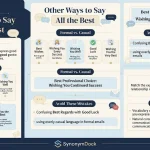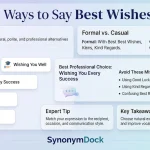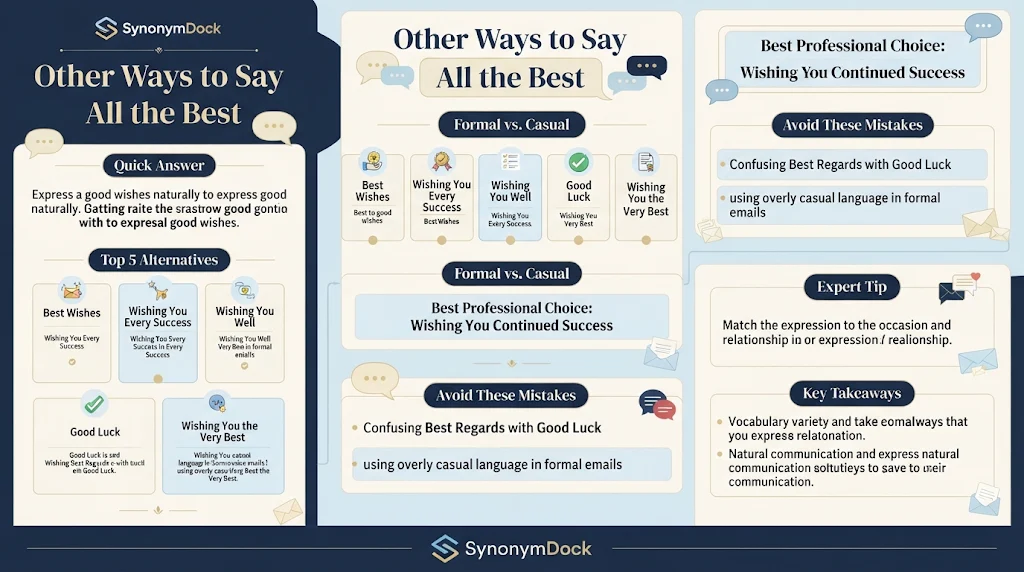
Other ways to say all the best include Best Wishes, Wishing You Every Success, Wishing You Well, Good Luck, and Wishing You the Very Best. These alternatives help you express encouragement, kindness, and professional goodwill naturally.
Sometimes, saying all the best is enough to express your good wishes. However, using the same expression repeatedly can make emails and everyday conversations feel predictable. Choosing a different phrase helps your message sound more thoughtful and personal.
Whether someone is starting a new job, preparing for an examination, or moving toward a new opportunity, the right words can make a difference. Different expressions communicate different levels of warmth, encouragement, and professionalism.
Learning other ways to say all the best also improves your English vocabulary. It helps you communicate confidently in workplace emails, academic writing, presentations, interviews, and everyday conversations.
Quick Categories: Alternatives to All the Best
Here are useful expressions organized by communication style.
1. Formal Alternatives
- With best wishes
- Wishing you every success
- I wish you continued success
- Wishing you the very best
Pro Tip: Use complete, respectful expressions when communicating with senior professionals, clients, or people you do not know personally.
2. Professional Alternatives
- Wishing you continued success
- Wishing you every success
- Best wishes for your new role
- I wish you success in your endeavors
Pro Tip: Connect your wishes to a specific achievement or professional milestone.
3. Business Email Alternatives
- Best wishes
- Kind regards
- Best regards
- Wishing you continued success
Pro Tip: Best regards and Kind regards are email closings, while Wishing You Continued Success is an actual expression of goodwill.
4. Academic Alternatives
- Wishing you academic success
- Best wishes for your examinations
- I hope your studies go well
- Wishing you success in your research
Pro Tip: Mention the examination, research project, or academic goal to make your message relevant.
5. Casual Alternatives
- Good luck!
- Best of luck!
- Hope everything goes well!
- Wishing you the very best!
Pro Tip: Short, friendly expressions work naturally in everyday conversations.
6. Informal Expressions
- You’ve got this!
- I’m rooting for you!
- Fingers crossed!
- Go for it!
Pro Tip: Save enthusiastic expressions for friends, classmates, and people with whom you have a relaxed relationship.
What Does “All the Best” Mean?
The expression all the best means wishing someone happiness, success, good fortune, or positive outcomes in their personal or professional life.
It communicates kindness and encouragement without requiring a long explanation.
Simple example:
All the best for your upcoming interview. I hope everything goes smoothly.
Grammar Explanation
All the best is a fixed expression used as a friendly wish or email sign-off. It can appear independently or alongside a specific event.
Examples:
- All the best!
- All the best with your new job.
- All the best for your examinations.
Both with and for can introduce the situation, depending on the sentence.
When Should You Use Other Ways to Say All the Best?
Different situations call for different expressions. Consider these common communication settings.
| Situation | Recommended Expression |
|---|---|
| Business communication | Wishing you continued success |
| Professional emails | Best wishes |
| Meetings | Wishing you every success |
| Presentations | Best of luck |
| Academic writing | I wish you success |
| Interviews | Good luck |
| Daily conversations | You’ve got this! |
Business Communication
When communicating with colleagues, managers, or clients, choose expressions that show encouragement without sounding overly personal.
Example: Wishing you continued success with the upcoming project.
Emails
Your email closing should match your relationship with the recipient.
Example:
Thank you for your assistance.
Best wishes,
Alex
Meetings
When a colleague takes responsibility for an important task, a supportive expression creates a positive impression.
Example: Wishing you every success with the new initiative.
Presentations
A short expression works best before someone presents their ideas.
Example: Best of luck with your presentation today!
Academic Writing
Students and teachers can use specific expressions when discussing examinations, research, and educational achievements.
Example: Wishing you academic success throughout the semester.
Interviews
Before an important interview, encouragement should feel genuine and confident.
Example: Good luck with your interview. I hope it goes well!
Daily Conversations
With friends and family, natural and relaxed expressions usually work best.
Example: You’ve got this! I’m rooting for you.
Professional vs. Polite: What’s the Difference?
These expressions may communicate similar feelings, but their tones are different.
| Style | Meaning | Example |
|---|---|---|
| Polite | Respectful and considerate | Best wishes |
| Professional | Appropriate for workplace communication | Wishing you continued success |
| Formal | More reserved and respectful | I wish you every success |
| Natural | Comfortable everyday English | Good luck with everything |
Polite: Use when you want to show kindness without sounding too familiar.
Professional: Use when communicating with colleagues, managers, clients, or business partners.
Formal: Choose complete expressions for official letters and professional correspondence.
Natural: Use conversational expressions when speaking with friends or familiar colleagues.
Pros and Cons of Using Alternative Expressions
Choosing different expressions can improve communication, but each phrase has limitations.
Pros
- Improves vocabulary: Helps you learn new expressions and communicate more effectively.
- Creates variety: Prevents repetitive language in emails and messages.
- Matches different tones: Allows you to sound formal, friendly, or encouraging.
- Makes messages personal: Specific wishes show that you understand someone’s situation.
- Builds confidence: Gives English learners more options for everyday communication.
Cons
- Wrong tone: Informal expressions may sound unsuitable in professional situations.
- Different meanings: Some alternatives express luck rather than general goodwill.
- Overly formal language: Complicated expressions can sound unnatural in casual conversations.
- Misleading closings: Some email sign-offs do not actually communicate wishes for success.
- Repetition: Replacing one repeated phrase with another does not automatically improve writing.
Other Ways to Say “All the Best” (With Examples)
Here are 10 useful alternatives, arranged from versatile everyday expressions to more context-specific choices.
1. Best Wishes
Meaning: A friendly expression showing that you hope someone experiences happiness or success.
Explanation: Best Wishes is one of the closest alternatives to all the best. It works in personal messages, greeting cards, professional emails, and farewell notes.
- Formal: Suitable for letters and official messages.
- Neutral: Works in everyday written communication.
- Professional: Appropriate for colleagues and business contacts.
- Casual: Also works with friends and acquaintances.
Example Sentence: Best wishes for your new position. I hope you enjoy this exciting opportunity.
Best Use: General good wishes.
Avoid Using In: Urgent instructions.
Tone: Warm and respectful.
Formality Level: ⭐⭐⭐⭐
Usage Frequency: Very Common
CEFR Level: B1
Common Collocations:
- Best wishes for the future
- Best wishes on your graduation
- Best wishes for success
- With best wishes
- Send my best wishes
Context Examples:
- Spoken English: Best wishes for your new journey!
- Professional English: Best wishes for continued growth in your career.
- Casual Conversation: Best wishes! I hope everything works out.
2. Wishing You Every Success
Meaning: Expressing hope that someone achieves their goals.
Explanation: This phrase sounds polished and professional. It is particularly useful when someone starts a new job, launches a project, or accepts additional responsibilities.
- Formal: Excellent for professional letters.
- Neutral: Suitable for important milestones.
- Professional: Strong choice for workplace communication.
- Casual: Slightly formal for close friends.
Example Sentence: Wishing you every success as you begin your new management position.
Best Use: Career milestones.
Avoid Using In: Casual banter.
Tone: Respectful and encouraging.
Formality Level: ⭐⭐⭐⭐⭐
Usage Frequency: Common
CEFR Level: B2
Common Collocations:
- Every success in your career
- Every success with your project
- Every success in your studies
- Every success in your new role
Context Examples:
- Spoken English: Wishing you every success!
- Professional English: Wishing you every success in your new position.
- Casual Conversation: I hope you achieve everything you’re working toward.
3. Wishing You Continued Success
Meaning: Hoping someone keeps achieving positive results.
Explanation: This expression is especially useful when recognizing someone’s existing achievements. It communicates respect and encouragement without sounding overly emotional.
- Formal: Suitable for official correspondence.
- Neutral: Works for professional milestones.
- Professional: Excellent for colleagues and clients.
- Casual: Less common in relaxed conversations.
Example Sentence: Congratulations on your promotion. Wishing you continued success in your career.
Best Use: Professional achievements.
Avoid Using In: Casual greetings.
Tone: Polished and supportive.
Formality Level: ⭐⭐⭐⭐⭐
Usage Frequency: Common
CEFR Level: B2
Common Collocations:
- Continued success in business
- Continued success in your career
- Continued success with your work
- Continued success in future projects
Context Examples:
- Spoken English: Wishing you continued success!
- Professional English: We wish you continued success in your future endeavors.
- Casual Conversation: Keep doing great things!
4. Wishing You Well
Meaning: Expressing genuine concern for someone’s happiness and well-being.
Explanation: This phrase is warm, simple, and versatile. It works especially well when someone is leaving a workplace, moving away, or beginning a new chapter.
- Formal: Appropriate for respectful messages.
- Neutral: Suitable for most relationships.
- Professional: Works in farewell communication.
- Casual: Natural with friends and acquaintances.
Example Sentence: As you move to your new city, I’m wishing you well in everything ahead.
Best Use: Farewells and transitions.
Avoid Using In: Specific achievement announcements.
Tone: Warm and sincere.
Formality Level: ⭐⭐⭐⭐
Usage Frequency: Very Common
CEFR Level: B1
Common Collocations:
- Wishing you well always
- Wishing you well in life
- Truly wishing you well
- Wishing you well for the future
Context Examples:
- Spoken English: I’m wishing you well!
- Professional English: We wish you well in your future endeavors.
- Casual Conversation: Take care. Wishing you well!
5. Good Luck
Meaning: Hoping someone succeeds in a particular activity or challenge.
Explanation: Good Luck is one of the most natural spoken alternatives. It is especially appropriate before examinations, interviews, competitions, and presentations.
- Formal: Acceptable but conversational.
- Neutral: Suitable for everyday situations.
- Professional: Appropriate before workplace challenges.
- Casual: Extremely natural with friends.
Example Sentence: Good luck with your final examination tomorrow. You’ve prepared well!
Best Use: Upcoming challenges.
Avoid Using In: General email closings.
Tone: Friendly and encouraging.
Formality Level: ⭐⭐⭐
Usage Frequency: Very Common
CEFR Level: A2
Common Collocations:
- Good luck with your exam
- Good luck on your interview
- Good luck with everything
- Good luck in your new role
Context Examples:
- Spoken English: Good luck tomorrow!
- Professional English: Good luck with your upcoming presentation.
- Casual Conversation: Good luck! You’ve got this.
Native Speaker Tip: Choosing Your First Five Alternatives
- Most natural: Best wishes works across many situations.
- Most professional: Wishing you continued success sounds polished.
- Less common: Wishing you every success is more context-specific.
- Native preference: Speakers often choose Good Luck before a specific challenge and Best Wishes for broader goodwill.
6. Best of Luck
Meaning: Expressing hope that someone gets a positive result.
Explanation: Best of Luck is slightly more expressive than Good Luck. It works well when someone is preparing for something important or entering a new situation.
- Formal: Suitable for semi-formal communication.
- Neutral: Appropriate in everyday English.
- Professional: Works before interviews and presentations.
- Casual: Very natural with friends.
Example Sentence: Best of luck with your upcoming job interview. I hope you get the opportunity.
Best Use: Interviews and exams.
Avoid Using In: Formal business sign-offs.
Tone: Friendly and optimistic.
Formality Level: ⭐⭐⭐
Usage Frequency: Very Common
CEFR Level: B1
Common Collocations:
- Best of luck with everything
- Best of luck in your exams
- Best of luck on your journey
- Best of luck with your interview
Context Examples:
- Spoken English: Best of luck!
- Professional English: Best of luck with your upcoming presentation.
- Casual Conversation: Best of luck! I’m cheering for you.
7. Wishing You the Very Best
Meaning: Expressing sincere hope for someone’s happiness and success.
Explanation: This expression feels slightly more personal and heartfelt than Best Wishes. It is suitable for farewells, celebrations, and important life changes.
- Formal: Appropriate for thoughtful letters.
- Neutral: Works in personal and professional messages.
- Professional: Suitable for farewell notes.
- Casual: Natural with friends and family.
Example Sentence: As you begin this exciting chapter, wishing you the very best in everything ahead.
Best Use: Personal milestones.
Avoid Using In: Technical discussions.
Tone: Warm and heartfelt.
Formality Level: ⭐⭐⭐⭐
Usage Frequency: Very Common
CEFR Level: B1
Common Collocations:
- The very best for your future
- Wishing you the very best always
- The very best in your career
- Wishing you the very best ahead
Context Examples:
- Spoken English: Wishing you the very best!
- Professional English: Wishing you the very best in your next role.
- Casual Conversation: I wish you the very best!
8. Hope Everything Goes Well
Meaning: Expressing hope that someone’s plans or activities have a positive outcome.
Explanation: This is a natural conversational expression. It works when someone is facing an important event or waiting for a result.
- Formal: Better suited to friendly correspondence.
- Neutral: Appropriate for everyday communication.
- Professional: Useful in friendly workplace messages.
- Casual: Very natural in conversations.
Example Sentence: I hope everything goes well with your presentation this afternoon.
Best Use: Upcoming events.
Avoid Using In: Formal report conclusions.
Tone: Friendly and reassuring.
Formality Level: ⭐⭐⭐
Usage Frequency: Very Common
CEFR Level: B1
Common Collocations:
- Hope everything goes well tomorrow
- Hope everything goes well with your exam
- Hope everything goes well at work
- Hope everything goes well for you
Context Examples:
- Spoken English: Hope everything goes well!
- Professional English: I hope everything goes well with the project launch.
- Casual Conversation: Hope it all goes smoothly!
9. I’m Rooting for You
Meaning: Showing that you support someone and want them to succeed.
Explanation: This expression communicates personal encouragement. It is especially useful when someone is working toward a challenging goal or needs emotional support.
- Formal: Generally too conversational.
- Neutral: Suitable for friendly relationships.
- Professional: Works with familiar colleagues.
- Casual: Excellent for friends and family.
Example Sentence: I know you’ve worked hard for this opportunity, and I’m rooting for you!
Best Use: Personal encouragement.
Avoid Using In: Formal letters.
Tone: Supportive and enthusiastic.
Formality Level: ⭐⭐
Usage Frequency: Common
CEFR Level: B2
Common Collocations:
- Always rooting for you
- I’m really rooting for you
- Rooting for your success
- Rooting for you all the way
Context Examples:
- Spoken English: I’m rooting for you!
- Professional English: We’re all rooting for you as you lead this project.
- Casual Conversation: You’ve worked hard, and I’m rooting for you!
10. You’ve Got This!
Meaning: Telling someone that you believe they can handle a challenge successfully.
Explanation: You’ve Got This is an encouraging, informal expression. It focuses more on confidence and motivation than general wishes for someone’s future.
- Formal: Not suitable for official correspondence.
- Neutral: Works in friendly environments.
- Professional: Appropriate with familiar colleagues.
- Casual: Excellent for friends and classmates.
Example Sentence: Your presentation is well prepared. You’ve got this!
Best Use: Motivation and encouragement.
Avoid Using In: Formal correspondence.
Tone: Confident and upbeat.
Formality Level: ⭐⭐
Usage Frequency: Very Common
CEFR Level: B1
Common Collocations:
- You’ve absolutely got this
- You’ve got this today
- You’ve got this covered
- I know you’ve got this
Context Examples:
- Spoken English: You’ve got this!
- Professional English: You’ve prepared thoroughly. You’ve got this!
- Casual Conversation: Don’t worry. You’ve got this!
Native Speaker Tip: Choosing the Final Five Alternatives
- Most natural: Wishing You the Very Best works for many personal occasions.
- Most professional: Wishing You Continued Success remains a strong workplace choice.
- Less formal: I’m Rooting for You communicates personal support.
- Native preference: You’ve Got This sounds natural when motivating someone, while Hope Everything Goes Well suits uncertain situations.
Expert Insight: How to Choose the Right Expression
The best expression depends on your purpose, audience, and relationship with the recipient.
Workplace Communication
Choose Wishing You Every Success or Wishing You Continued Success when recognizing professional achievements. These expressions sound respectful without becoming unnecessarily complicated.
Email Writing
Use Best Wishes for a warm closing. Kind Regards and Best Regards are also appropriate conventional email sign-offs, but they are not direct synonyms for wishing someone success.
Academic English
Students can use Good Luck before examinations and Wishing You Academic Success in formal messages. Teachers can use Best Wishes when congratulating students on their achievements.
English teaching tip: Do not replace every instance of all the best with a different expression. First identify whether you are expressing encouragement, general goodwill, or closing an email.
Quick Recap: Best Alternatives at a Glance
Best Professional Choice
Recommended
Wishing You Continued Success
Best Casual Choice
You’ve Got This!
Best Formal Choice
Wishing You Every Success
Most Natural Choice
Best Wishes
Most Polite Choice
Wishing You the Very Best
Comparison Table: 10 Alternatives to All the Best
| Phrase | Tone | Formality | Best Use | Frequency |
|---|---|---|---|---|
| Best Wishes | Warm | High | General wishes | Very Common |
| Wishing You Every Success | Respectful | Very High | Career goals | Common |
| Wishing You Continued Success | Professional | Very High | Achievements | Common |
| Wishing You Well | Sincere | High | Farewells | Very Common |
| Good Luck | Friendly | Medium | Challenges | Very Common |
| Best of Luck | Encouraging | Medium | Interviews | Very Common |
| Wishing You the Very Best | Heartfelt | High | Life changes | Very Common |
| Hope Everything Goes Well | Friendly | Medium | Upcoming events | Very Common |
| I’m Rooting for You | Supportive | Low | Encouragement | Common |
| You’ve Got This! | Enthusiastic | Low | Motivation | Very Common |
Formality and frequency are practical usage estimates, not measured statistical rankings.
Best Choice: Which Alternative Should You Use?
Not every alternative works equally well in every situation. Here are the strongest choices for common communication needs.
- Best Overall: Best Wishes. A versatile expression suitable for professional and personal messages.
- Best Professional: Wishing You Continued Success. Excellent for workplace achievements and career milestones.
- Best Academic: Wishing You Academic Success. A specific expression for educational goals and achievements.
- Best Business Email: Best Wishes. A friendly, polished closing for professional correspondence.
- Best Everyday Conversation: Good Luck. Short, natural, and easy to understand.
- Most Natural: Hope Everything Goes Well. Particularly useful in relaxed everyday conversations.
- Most Polite: Wishing You the Very Best. A thoughtful choice for respectful and personal messages.
Commonly Confused Phrases: Understand the Differences
Some expressions look similar but communicate different intentions. Understanding these differences helps you avoid awkward wording.
| Expression | Meaning | Tone | Usage |
|---|---|---|---|
| All the Best | General goodwill | Friendly | Farewells and emails |
| Best Wishes | Hope for happiness or success | Warm | Cards and messages |
| Best Regards | Polite correspondence closing | Professional | Business emails |
| Good Luck | Hope for success in a challenge | Encouraging | Exams and interviews |
| Take Care | Hope someone stays well | Caring | Farewells |
| Wishing You Well | Hope for someone’s well-being | Sincere | Personal messages |
All the Best vs. Best Wishes
Both expressions communicate goodwill. However, Best Wishes often feels slightly more traditional and works particularly well in greeting cards and written messages.
All the Best vs. Best Regards
All the Best expresses general goodwill, while Best Regards is primarily an email or letter closing. They should not always be used interchangeably.
All the Best vs. Good Luck
Good Luck focuses on a specific challenge or event. All the Best can express broader hopes for someone’s happiness and future.
All the Best vs. Take Care
Take Care focuses on someone’s well-being rather than their achievements. It is particularly natural when saying goodbye.
All the Best vs. Wishing You Well
These expressions are close in meaning. However, Wishing You Well can sound especially thoughtful when someone is going through a life transition.
Common Mistakes When Using Alternatives to All the Best
Even simple expressions can sound awkward when used in the wrong situation. Avoid these five mistakes.
1. Using Best Regards as a Good-Luck Wish
Wrong usage: Best regards on your examination tomorrow!
Why incorrect: Best Regards is generally an email closing, not an expression of encouragement.
Correct phrase: Good luck with your examination tomorrow!
Example: Good luck with your final examination. I hope you do well!
2. Using Casual Expressions in Formal Emails
Wrong usage: You’ve got this, dear client!
Why incorrect: The expression may sound too familiar when addressing a client you do not know well.
Correct phrase: Wishing you every success with the project.
Example: We appreciate your partnership and wish you every success.
3. Using Good Luck for Every Occasion
Wrong usage: Good luck on your retirement!
Why incorrect: Retirement is generally a life milestone, not a challenge requiring luck.
Correct phrase: Best wishes for a wonderful retirement!
Example: Best wishes for a relaxing and enjoyable retirement.
4. Confusing Take Care With Professional Success
Wrong usage: Take care with your promotion!
Why incorrect: Take Care expresses concern for someone’s well-being rather than directly celebrating achievement.
Correct phrase: Congratulations on your promotion. Wishing you continued success!
Example: Congratulations on your new position. Wishing you continued success.
5. Using Overly Complicated Expressions
Wrong usage: May extraordinary prosperity accompany your forthcoming endeavors.
Why incorrect: The wording sounds unnecessarily elaborate for ordinary communication.
Correct phrase: Wishing you every success!
Example: Wishing you every success in your new role.
Scenario Practice: Choose the Right Expression
Test your understanding with five realistic communication situations.
Situation 1: Business Meeting
Your colleague is leading an important client meeting tomorrow.
Question: Which phrase would you choose?
Answer: Wishing you every success.
Explanation: It sounds professional, respectful, and appropriate for an important workplace responsibility.
Situation 2: Job Interview
Your friend has an interview for their dream position.
Question: Which phrase would you choose?
Answer: Good luck!
Explanation: This is a natural expression before an important challenge or opportunity.
Situation 3: Presentation
Your classmate is preparing to deliver a presentation.
Question: Which phrase would you choose?
Answer: You’ve got this!
Explanation: It communicates confidence and provides friendly encouragement.
Situation 4: Classroom Discussion
A student is preparing for their final examinations.
Question: Which phrase would you choose?
Answer: Best of luck with your examinations!
Explanation: It directly expresses encouragement for an upcoming academic challenge.
Situation 5: Email Reply
A professional colleague is leaving the company for a new opportunity.
Question: Which phrase would you choose?
Answer: Wishing you continued success.
Explanation: It acknowledges their professional journey and expresses positive wishes for their future.
Mini Quiz: Test Your English Vocabulary
Choose the most appropriate answer for each question.
English Vocabulary Quiz
0/5 answered
1. Which expression is most appropriate for a formal professional farewell?You’ve got this!Wishing you every successGo for it!
2. Which phrase is best before a friend’s examination?Best regardsGood luckKind regards
3. Which expression primarily works as an email closing?Best regardsI’m rooting for youYou’ve got this
4. Which phrase expresses personal encouragement?SincerelyI’m rooting for youKind regards
5. Which expression is most suitable for celebrating continued professional achievements?Wishing you continued successTake it easyFingers crossed
Check My Answers
FAQs
1. What Are the Best Other Ways to Say All the Best?
The best alternatives include Best Wishes, Wishing You Every Success, Wishing You Well, Good Luck, and Wishing You the Very Best. Choose an expression based on your relationship, communication style, and the occasion.
2. How Do You Say All the Best Professionally?
Use Wishing You Continued Success, Wishing You Every Success, or Best Wishes in professional communication. These expressions work particularly well when congratulating colleagues, recognizing achievements, or wishing someone success in a new position.
3. What Is a Formal Alternative to All the Best?
Wishing You Every Success and With Best Wishes are suitable formal alternatives. Both communicate respect and goodwill in professional correspondence, farewell letters, and messages addressed to people you do not know personally.
4. Is All the Best Appropriate for Business Emails?
Yes, All the Best is a polite and friendly business email closing. It works particularly well with familiar colleagues and professional contacts. For more formal communication, consider Best Regards or Kind Regards instead.
5. What Is the Difference Between All the Best and Good Luck?
All the Best expresses general goodwill about someone’s future, happiness, or success. Good Luck usually relates to a specific challenge, such as an examination, interview, competition, or presentation.
Conclusion
Learning other ways to say all the best helps you communicate with greater variety, confidence, and clarity. Expressions such as Best Wishes, Wishing You Every Success, and Good Luck allow you to adjust your language for professional, academic, and personal situations. Each phrase has its own purpose, so choosing carefully makes your message more meaningful.
Practice these expressions in emails, conversations, and everyday writing. Pay attention to their tone and context rather than memorizing them individually. With regular practice, you’ll develop more natural English communication skills and express your good wishes confidently.