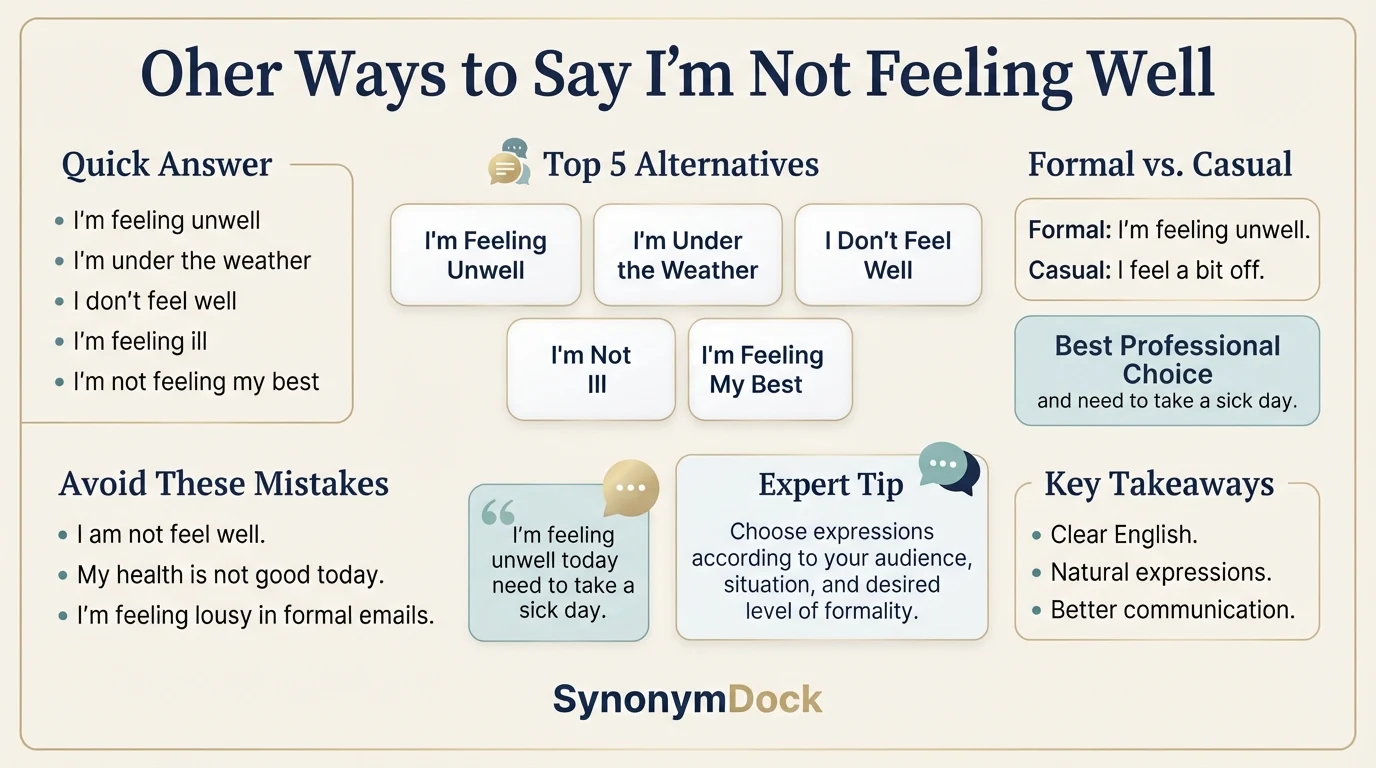
Other ways to say I’m not feeling well include I’m feeling unwell, I’m under the weather, I feel a bit off, I’m feeling ill, and I’m not at my best. Choose an expression based on your audience and situation.
Sometimes, saying “I’m not feeling well” feels too repetitive, especially when communicating with colleagues, teachers, friends, or family. Fortunately, English offers several natural alternatives that express the same message with different levels of politeness and formality. Choosing the right expression helps you communicate clearly without sharing unnecessary personal details.
Learning other ways to say I’m not feeling well can improve your everyday vocabulary and professional communication. Whether you’re writing a sick-day email, explaining your absence from a meeting, or talking with friends, these expressions help you sound more natural and confident.
1. Formal Alternatives
These expressions work when speaking respectfully or communicating in formal situations.
- I am feeling unwell.
- I am experiencing illness.
- I am not in good health today.
- I am feeling physically unwell.
Pro Tip: Choose “I am feeling unwell” when communicating with someone you don’t know well. It sounds respectful without being unnecessarily complicated.
2. Professional Alternatives
Use these expressions when communicating with managers, colleagues, or supervisors.
- I’m feeling unwell today.
- I’m not feeling my best.
- I’m dealing with a minor illness.
- I’m unable to work due to illness.
Pro Tip: Keep workplace updates brief and explain how your availability will change.
3. Business Email Alternatives
These phrases are useful for workplace messages and professional correspondence.
- Unfortunately, I’m feeling unwell today.
- I’m unable to attend today’s meeting due to illness.
- I’m not well enough to work today.
- I need to take a sick day.
Pro Tip: Clearly mention whether you’re requesting leave, missing a meeting, or postponing a task.
4. Academic Alternatives
Students and teachers can use these expressions in educational settings.
- I’m feeling unwell and cannot attend class.
- I’m unable to participate today.
- I’m not feeling well enough to attend.
- I’m experiencing some discomfort.
Pro Tip: When contacting a teacher, explain your absence politely without including unnecessary personal information.
5. Casual Alternatives
These expressions sound natural with friends and familiar people.
- I’m feeling a little off.
- I’m under the weather.
- I don’t feel great.
- I’m feeling a bit rough.
Pro Tip: Use these phrases in everyday conversations when you want to sound relaxed and friendly.
6. Informal Expressions
These expressions are more conversational and suit relaxed situations.
- I’m not quite myself today.
- I’m feeling lousy.
- I’m a little out of sorts.
- I’m feeling pretty rough.
Pro Tip: Save expressions like “feeling lousy” for people who understand your casual speaking style.
Common Mistakes to Avoid
Using an alternative incorrectly can make your message confusing. Here are five mistakes English learners should understand.
Mistake 1: Saying “My health is not good today”
Why it’s incorrect: The sentence is understandable, but it sounds unnatural when describing temporary discomfort.
Better phrase: I’m not feeling well today.
Example: I’m not feeling well today, so I’ll stay home.
Mistake 2: Using “I’m under the weather” for every situation
Why it’s incorrect: This idiom usually suggests mild illness. It may sound too casual for serious or formal announcements.
Better phrase: I’m feeling unwell.
Example: I’m feeling unwell and won’t be able to attend today’s meeting.
Mistake 3: Saying “I am not feel well”
Why it’s incorrect: After the auxiliary verb “am,” use the present participle in this continuous construction.
Better phrase: I am not feeling well.
Example: I am not feeling well this morning.
Mistake 4: Using “I’m feeling lousy” in formal emails
Why it’s incorrect: “Lousy” is an informal expression that may sound inappropriate in professional correspondence.
Better phrase: I’m feeling unwell.
Example: Unfortunately, I’m feeling unwell and need to take the day off.
Mistake 5: Confusing “I feel sick” with “I’m feeling down”
Why it’s incorrect: “Feeling sick” usually refers to physical illness, while “feeling down” describes sadness or low mood.
Better phrase: I’m feeling physically unwell.
Example: I’m feeling physically unwell and need some rest.
What Does “Other Ways to Say I’m Not Feeling Well” Mean?
The expression “I’m not feeling well” communicates that someone is experiencing physical discomfort, illness, or generally poor health.
It is a polite and relatively neutral expression. People often use it when they want to explain why they cannot attend an event, complete an activity, or participate in a conversation.
Simple example:
“I’m not feeling well today, so I won’t be attending class.”
Grammar Explanation
The expression uses the present continuous tense:
- I = Subject
- Am = Auxiliary verb
- Not = Negative word
- Feeling = Present participle
- Well = Adverb describing how someone feels
You can also say “I don’t feel well.” Both expressions are grammatically correct and commonly used.
When Should You Use These Expressions?
Different situations require different communication styles.
Business Communication
When informing a manager about your health, choose a direct and respectful expression.
Example: “I’m feeling unwell today and won’t be able to work.”
Professional Emails
Use complete sentences and communicate your availability clearly.
Example: “Unfortunately, I’m not feeling well today and need to take a sick day.”
Meetings
If you cannot participate, explain your situation politely.
Example: “I’m feeling a little unwell and won’t be able to join today’s meeting.”
Presentations
If illness affects your ability to present, communicate the issue and request another arrangement.
Example: “I’m not feeling well enough to deliver my presentation today. Could we reschedule?”
Academic Writing
In academic writing, avoid conversational idioms when discussing health formally.
Example: “The student reported feeling unwell and was unable to participate.”
Interviews
If you need to rearrange an interview, remain respectful and professional.
Example: “Unfortunately, I’m feeling unwell and would appreciate the opportunity to reschedule.”
Daily Conversations
With friends and family, natural expressions are usually best.
Example: “I’m feeling a bit off today, so I’m going to take it easy.”
Professional vs. Polite: What’s the Difference?
These expressions may communicate the same situation, but their tones are different.
Polite: “I’m feeling a little unwell today.”
This sounds considerate and gentle. It works with teachers, colleagues, and acquaintances.
Professional: “I’m unable to attend work today due to illness.”
This is direct and appropriate for workplace communication.
Formal: “I am currently experiencing an illness and will be unable to attend.”
This sounds more official and suits formal notifications.
Natural: “I don’t feel great today.”
This sounds relaxed and conversational.
Expert Tip: Professional English doesn’t require complicated vocabulary. Clear, respectful language is usually more effective than unnecessarily formal wording.
Pros and Cons of Using Alternatives
Pros
- Better vocabulary: You learn different expressions for everyday communication.
- Natural conversations: You can avoid repeating the same sentence.
- Professional communication: You can choose appropriate workplace language.
- Improved clarity: Different expressions communicate different levels of discomfort.
Cons
- Tone confusion: Some expressions may sound too casual in formal situations.
- Meaning differences: Certain phrases suggest mild illness rather than serious discomfort.
- Incorrect context: An informal idiom may not suit academic writing.
- Overcomplication: Unusual expressions can make simple messages harder to understand.
Other Ways to Say “I’m Not Feeling Well” (With Examples)
Here are ten natural alternatives, arranged by usefulness and suitability.
1. Phrase: I’m Feeling Unwell
Meaning: You are experiencing physical discomfort or illness.
Explanation: This is one of the most useful alternatives. It sounds polite, clear, and suitable for professional conversations.
Example Sentence: I’m feeling unwell today, so I’ll need to take the afternoon off.
Best Use: Workplace communication.
Avoid Using In: Very playful conversations.
Tone: Polite and neutral.
Formality Level: ⭐⭐⭐⭐
Usage Frequency: Very Common
CEFR Level: B1 (approximate)
Common Collocations:
- Feeling unwell today
- Suddenly feeling unwell
- Slightly unwell
- Unwell this morning
Context Examples:
- Spoken English: I’m feeling unwell today.
- Professional English: I’m feeling unwell and cannot attend the meeting.
- Casual Conversation: I’m a little unwell today.
2. Phrase: I’m Under the Weather
Meaning: You are feeling slightly sick or physically uncomfortable.
Explanation: This common English idiom is friendly and conversational. It generally suggests a mild illness rather than a serious condition.
Example Sentence: I’m a little under the weather, so I’ll stay home today.
Best Use: Casual workplace conversations.
Avoid Using In: Formal academic writing.
Tone: Friendly and relaxed.
Formality Level: ⭐⭐⭐
Usage Frequency: Very Common
CEFR Level: B2 (approximate)
Common Collocations:
- A bit under the weather
- Feeling under the weather
- Slightly under the weather
Context Examples:
- Spoken English: I’m feeling under the weather.
- Professional English: I’m a little under the weather today.
- Casual Conversation: I’ve been under the weather lately.
3. Phrase: I Don’t Feel Well
Meaning: You are experiencing discomfort or illness.
Explanation: This is a simple, natural alternative used in everyday English. It communicates your condition without adding unnecessary information.
Example Sentence: I don’t feel well enough to attend the event today.
Best Use: Everyday communication.
Avoid Using In: Situations requiring detailed explanations.
Tone: Direct and neutral.
Formality Level: ⭐⭐⭐⭐
Usage Frequency: Very Common
CEFR Level: A2–B1 (approximate)
Common Collocations:
- Don’t feel well today
- Don’t feel well enough
- Don’t feel well after lunch
- Really don’t feel well
Context Examples:
- Spoken English: I don’t feel well today.
- Professional English: I don’t feel well enough to attend work.
- Casual Conversation: I don’t feel well, so I’m staying home.
4. Phrase: I’m Feeling Ill
Meaning: You are experiencing an illness or physical discomfort.
Explanation: This expression is more direct than “I’m under the weather.” It works in everyday and formal conversations.
Example Sentence: I’m feeling ill and won’t be able to attend class today.
Best Use: Formal communication.
Avoid Using In: Lighthearted conversations.
Tone: Serious and neutral.
Formality Level: ⭐⭐⭐⭐
Usage Frequency: Common
CEFR Level: B1 (approximate)
Common Collocations:
- Feeling seriously ill
- Suddenly feeling ill
- Feeling slightly ill
- Become ill
Context Examples:
- Spoken English: I’m feeling ill today.
- Professional English: I’m feeling ill and need to take leave.
- Casual Conversation: I think I’m getting ill.
5. Phrase: I’m Not Feeling My Best
Meaning: You are not feeling as healthy or comfortable as usual.
Explanation: This is a gentle expression that avoids making your condition sound overly serious. It works particularly well when you want to remain polite.
Example Sentence: I’m not feeling my best today, so I may leave early.
Best Use: Polite conversations.
Avoid Using In: Urgent notifications.
Tone: Gentle and considerate.
Formality Level: ⭐⭐⭐⭐
Usage Frequency: Common
CEFR Level: B2 (approximate)
Common Collocations:
- Not feeling my best today
- Not at my best
- Feeling my best
- Not feeling quite myself
Context Examples:
- Spoken English: I’m not feeling my best.
- Professional English: I’m not feeling my best and may need some time off.
- Casual Conversation: I’m not at my best today.
Native Speaker Tip: Alternatives 1–5
For everyday communication, “I’m feeling unwell” and “I don’t feel well” are particularly natural choices. “I’m under the weather” is popular for mild illness and relaxed conversations.
For professional messages, “I’m feeling unwell” is usually the safest choice. Avoid choosing an idiom simply because it sounds more interesting.
6. Phrase: I’m Feeling a Bit Off
Meaning: Something doesn’t feel quite right physically or emotionally.
Explanation: This informal expression is useful when describing general discomfort without identifying a specific problem.
Example Sentence: I’m feeling a bit off today, so I might skip the gathering.
Best Use: Casual conversations.
Avoid Using In: Formal business emails.
Tone: Relaxed and conversational.
Formality Level: ⭐⭐
Usage Frequency: Common
CEFR Level: B2 (approximate)
Common Collocations:
- Feeling a bit off
- A little off today
- Something feels off
- Not quite right
Context Examples:
- Spoken English: I’m feeling a bit off.
- Professional English: I’m not feeling quite myself today.
- Casual Conversation: I feel a little off this morning.
7. Phrase: I’ve Come Down With Something
Meaning: You have started experiencing an illness.
Explanation: This expression suggests that an illness has recently developed. It is useful when you don’t know exactly what is making you sick.
Example Sentence: I’ve come down with something and won’t be attending the gathering.
Best Use: Explaining sudden illness.
Avoid Using In: Formal academic writing.
Tone: Conversational and neutral.
Formality Level: ⭐⭐⭐
Usage Frequency: Common
CEFR Level: B2 (approximate)
Common Collocations:
- Come down with a cold
- Come down with the flu
- Come down with something
- Recently come down with
Context Examples:
- Spoken English: I think I’ve come down with something.
- Professional English: I’ve come down with an illness and need to take leave.
- Casual Conversation: I’ve come down with something, unfortunately.
8. Phrase: I’m Feeling Poorly
Meaning: You are feeling sick or physically unwell.
Explanation: This expression is especially familiar in British English. It sounds gentle and conversational, although it is less common in some varieties of English.
Example Sentence: I’m feeling poorly today, so I’ll take some time to rest.
Best Use: British English conversations.
Avoid Using In: Very formal reports.
Tone: Gentle and informal.
Formality Level: ⭐⭐⭐
Usage Frequency: Occasional
CEFR Level: B2 (approximate)
Common Collocations:
- Feeling poorly today
- Feeling rather poorly
- Quite poorly
- A little poorly
Context Examples:
- Spoken English: I’m feeling poorly today.
- Professional English: I’m feeling unwell and cannot attend.
- Casual Conversation: I’ve been feeling poorly lately.
9. Phrase: I’m Not Quite Myself Today
Meaning: You don’t feel or behave as you normally do.
Explanation: This expression can describe physical discomfort, tiredness, or an unusual emotional state. It is indirect and polite.
Example Sentence: I’m not quite myself today, so I’d prefer to rest.
Best Use: Personal conversations.
Avoid Using In: Urgent absence notices.
Tone: Gentle and indirect.
Formality Level: ⭐⭐⭐
Usage Frequency: Common
CEFR Level: B2 (approximate)
Common Collocations:
- Not quite myself today
- Not feeling myself
- Back to myself
- Feel like myself again
Context Examples:
- Spoken English: I’m not quite myself today.
- Professional English: I’m not feeling quite myself and may need to leave early.
- Casual Conversation: I’m just not myself today.
10. Phrase: I’m Feeling Pretty Rough
Meaning: You are feeling noticeably unwell or uncomfortable.
Explanation: This expression is informal and emphasizes that you’re having a difficult day physically. It is more conversational than professional.
Example Sentence: I’m feeling pretty rough today, so I’ll stay home and rest.
Best Use: Informal conversations.
Avoid Using In: Formal workplace emails.
Tone: Casual and expressive.
Formality Level: ⭐⭐
Usage Frequency: Common
CEFR Level: B2 (approximate)
Common Collocations:
- Feeling pretty rough
- Feeling rough today
- A rough morning
- Looking rough
Context Examples:
- Spoken English: I’m feeling pretty rough today.
- Professional English: I’m feeling unwell and cannot attend.
- Casual Conversation: I feel pretty rough this morning.
Native Speaker Tip: Alternatives 6–10
“I’m feeling a bit off” is useful when you cannot describe exactly what’s wrong. “I’m not quite myself today” is more indirect and can refer to emotional or physical discomfort.
“I’m feeling pretty rough” is casual, while “I’ve come down with something” suggests a developing illness. Choose according to your actual meaning.
Expert Insight: Choosing the Right Expression
Workplace Communication
Managers and colleagues generally need clear information about your availability. “I’m feeling unwell today” communicates the situation without unnecessary personal details.
Email Writing
A professional email should explain the practical impact of your illness.
Example: “Unfortunately, I’m feeling unwell today and need to take a sick day. Thank you for your understanding.”
Academic English
In academic settings, use neutral expressions instead of conversational idioms. “The student is feeling unwell” is more suitable for formal educational communication.
Professional Tone
Avoid exaggerating your condition or using complicated expressions. A short, honest sentence usually communicates your situation effectively.
Quick Recap: Best Alternatives
- Best Professional Choice: I’m feeling unwell.
- Best Casual Choice: I don’t feel well.
- Best Formal Choice: I am unwell.
- Most Natural Choice: I’m not feeling well.
- Most Polite Choice: I’m not feeling my best.
Comparison Table: 10 Alternatives
| Phrase | Tone | Formality | Best Use | Frequency |
|---|---|---|---|---|
| I’m feeling unwell | Neutral | High | Workplace | Very Common |
| I’m under the weather | Friendly | Medium | Casual work | Very Common |
| I don’t feel well | Neutral | Medium | Everyday | Very Common |
| I’m feeling ill | Serious | High | Formal communication | Common |
| I’m not feeling my best | Gentle | High | Polite conversations | Common |
| I’m feeling a bit off | Relaxed | Low | Casual conversations | Common |
| I’ve come down with something | Conversational | Medium | Recent illness | Common |
| I’m feeling poorly | Gentle | Medium | British English | Occasional |
| I’m not quite myself today | Indirect | Medium | Personal conversations | Common |
| I’m feeling pretty rough | Casual | Low | Informal conversations | Common |
Formality and frequency ratings are practical editorial guidance, not official language-test classifications.
Which Alternative Is the Best Choice?
Best Overall: I’m Feeling Unwell
This expression is clear, polite, and suitable for most situations. It works in professional messages and everyday conversations.
Best Professional: I’m Unable to Work Due to Illness
This is a practical workplace expression because it communicates both your condition and its effect on your availability.
Best Academic: I’m Feeling Unwell
It is neutral and appropriate when communicating with teachers, classmates, or educational staff.
Best Business Email: Unfortunately, I’m Feeling Unwell Today
It sounds respectful and provides a natural opening for explaining an absence.
Best Everyday Conversation: I Don’t Feel Well
This is simple, natural, and easy to understand.
Most Natural: I’m Not Feeling My Best
It communicates mild discomfort without sounding overly serious.
Most Polite: I’m Not Feeling Quite Myself Today
This expression sounds considerate and avoids sharing unnecessary details.
Commonly Confused Phrases
Understanding similar expressions helps you communicate more accurately.
1. I’m Feeling Unwell vs. I’m Feeling Sick
Both describe physical discomfort. However, “feeling sick” can also specifically suggest nausea, while “feeling unwell” is broader.
2. I’m Under the Weather vs. I’m Feeling Ill
“Under the weather” is a conversational idiom often associated with mild illness. “Feeling ill” is more direct and can sound more serious.
3. I’m Feeling Down vs. I’m Feeling Unwell
“Feeling down” generally describes sadness or low mood. “Feeling unwell” usually describes physical illness or discomfort.
4. I’m Not Feeling My Best vs. I’m Not Quite Myself
The first generally describes not feeling physically well. The second can describe changes in mood, behavior, or physical condition.
5. I Don’t Feel Well vs. I Didn’t Feel Well
“I don’t feel well” describes your present condition. “I didn’t feel well” describes how you felt in the past.
Scenario Practice: Choose the Right Expression
Practice choosing an appropriate phrase for different situations.
Situation 1: Business Meeting
You are unable to attend an important meeting because you’re unwell.
Which phrase would you choose?
Answer: I’m feeling unwell and won’t be able to attend today’s meeting.
Explanation: This expression is professional, clear, and respectful.
Situation 2: Job Interview
You need to request another interview date because you are sick.
Which phrase would you choose?
Answer: Unfortunately, I’m feeling unwell and would appreciate the opportunity to reschedule.
Explanation: This communicates the situation politely while showing consideration.
Situation 3: Presentation
You cannot deliver your scheduled presentation.
Which phrase would you choose?
Answer: I’m not feeling well enough to deliver my presentation today.
Explanation: This directly explains why you cannot complete the scheduled activity.
Situation 4: Classroom Discussion
You need to tell your teacher why you cannot participate.
Which phrase would you choose?
Answer: I’m feeling a little unwell and won’t be able to participate today.
Explanation: It sounds respectful and appropriate for an educational setting.
Situation 5: Email Reply
A colleague asks why you are unavailable today.
Which phrase would you choose?
Answer: I’m feeling under the weather today, so I’ll be taking some time to rest.
Explanation: This is friendly and natural when communicating with familiar colleagues.
Mini Quiz: Test Your English Vocabulary
Choose the most appropriate answer for each question.
1. Which expression is best for a professional sick-day email?
A. I’m feeling lousy.
B. I’m feeling unwell.
C. I’m pretty rough.
D. I’m a bit off.
2. What does “under the weather” usually mean?
A. Feeling physically unwell.
B. Enjoying rainy weather.
C. Feeling extremely excited.
D. Working outdoors.
3. Which expression is more suitable for casual conversations?
A. I am experiencing illness.
B. I’m feeling pretty rough.
C. I am medically unwell.
D. I am unable to attend.
4. Which sentence is grammatically correct?
A. I am not feel well.
B. I not feeling well.
C. I am not feeling well.
D. I am not feels well.
5. What does “I’m not quite myself today” communicate?
A. You are feeling unusually different.
B. You are introducing yourself.
C. You are feeling excited.
D. You are discussing someone else.
Answer Key
- B — I’m feeling unwell.
- A — Feeling physically unwell.
- B — I’m feeling pretty rough.
- C — I am not feeling well.
- A — You are feeling unusually different.
FAQs
1. What are the most common other ways to say I’m not feeling well?
Common alternatives include “I’m feeling unwell,” “I don’t feel well,” “I’m under the weather,” and “I’m not feeling my best.” Each expression communicates discomfort while offering a slightly different tone.
2. How do I professionally say I’m not feeling well?
Use expressions such as “I’m feeling unwell today” or “I’m unable to work due to illness.” These phrases communicate your situation clearly while maintaining a respectful and professional tone.
3. What is a polite way to tell someone you’re sick?
“I’m not feeling my best today” is a gentle and polite expression. You can also say “I’m feeling a little unwell” when speaking with friends, teachers, or colleagues.
4. Is “I’m under the weather” formal or informal?
“I’m under the weather” is generally informal or conversational. It describes feeling slightly unwell and works naturally with friends and familiar colleagues, but a direct expression is better for formal correspondence.
5. What is the difference between “I feel unwell” and “I feel sick”?
“I feel unwell” broadly describes poor physical health or discomfort. “I feel sick” can also refer specifically to nausea. Both expressions are natural, but their meanings depend on context.
Conclusion
Learning other ways to say I’m not feeling well helps you communicate more naturally in professional, academic, and everyday situations. Expressions like “I’m feeling unwell,” “I’m under the weather,” and “I’m not feeling my best” give you useful choices for different audiences. Understanding their meanings, tones, and formality levels also helps prevent communication mistakes.
Practice these expressions in conversations, emails, and writing exercises to strengthen your English vocabulary. Remember, effective communication isn’t about using complicated words. It’s about choosing the right expression for the right situation and expressing yourself with confidence.