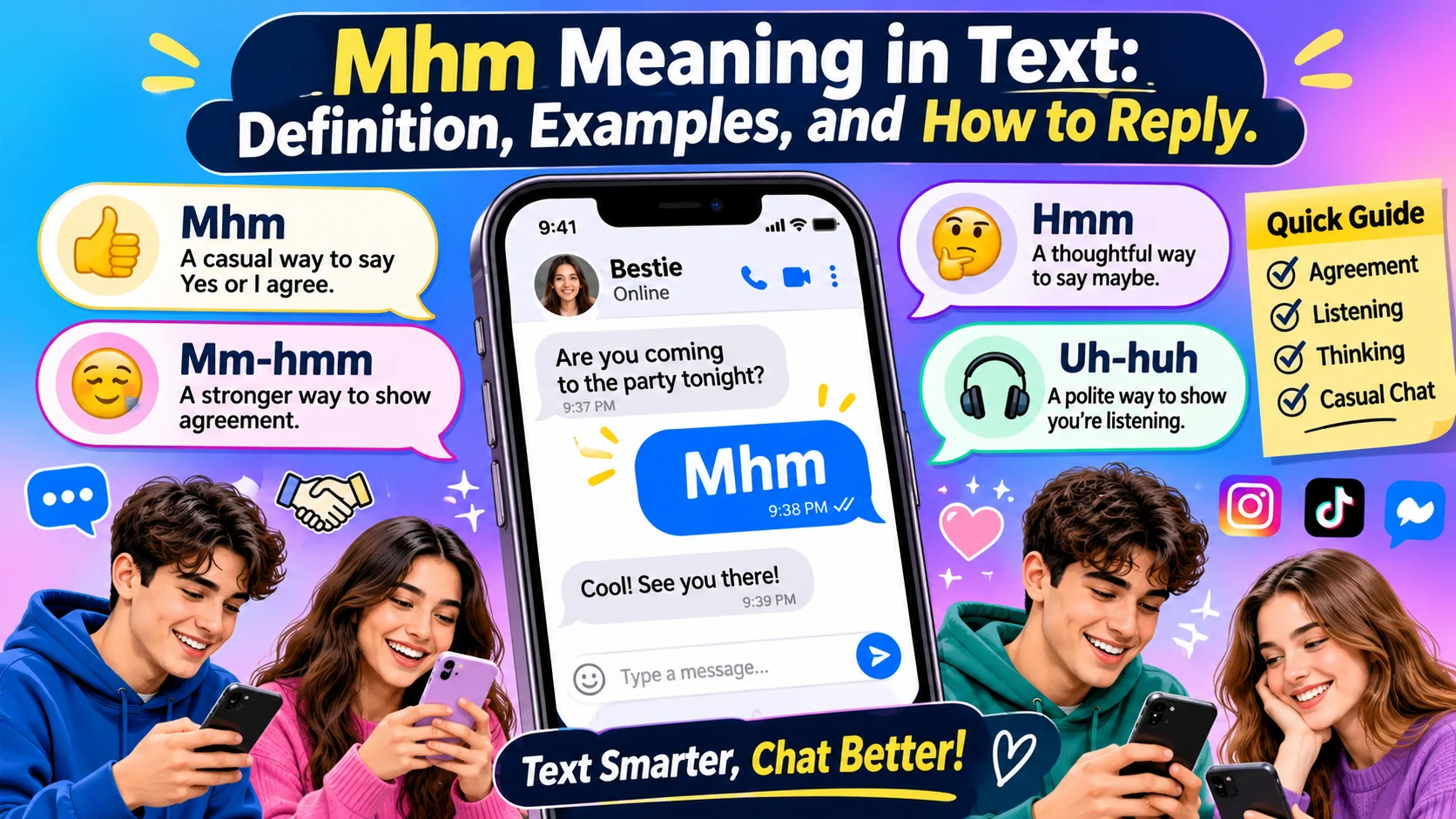
Mhm is a casual texting expression that usually means yes, agreement, acknowledgment, or that someone is listening. Its exact meaning depends on the conversation, punctuation, and tone. People commonly use it in texts, Snapchat, Instagram, and everyday online conversations.
Mhm meaning in text is usually connected to agreement, acknowledgment, or a simple way of saying yes without typing a complete response. You might see it in a message from a friend, a family member, or someone you chat with regularly.
However, this short expression can communicate more than one feeling. Sometimes it means someone agrees with you. Other times, it simply shows that they are following the conversation.
Furthermore, the way someone writes it can change its meaning. A quick mhm might sound friendly and natural, while a longer version such as mhmmm can suggest interest, thoughtfulness, or playful agreement.
Understanding this popular texting expression can help you avoid misunderstandings. It can also make your replies feel more natural across Snapchat, TikTok, Instagram, and regular text messages.
Quick Answer: Meaning at a Glance
| Category | Explanation |
|---|---|
| Meaning | Yes, okay, I agree, or I’m listening |
| Context | Casual conversations and everyday texting |
| Primary Platforms | Snapchat, TikTok, Instagram, WhatsApp, and SMS |
| Example | Are you coming today? Mhm! |
| Tone | Friendly, neutral, thoughtful, or occasionally dismissive |
What Does Mhm Meaning in Text Mean?
The expression mhm generally represents a spoken sound people make when they agree, acknowledge something, or show that they are listening.
It is a conversational alternative to words such as yes, okay, sure, and I understand.
For example:
Person A: Are you free this afternoon?
Person B: Mhm, what’s up?
Here, the response communicates agreement and shows that the person is available.
However, this expression does not always indicate a definite yes. Sometimes people use it simply to acknowledge information without adding anything else.
The Linguistic Origin of Mhm
Mhm comes from informal spoken communication. It represents a short vocal sound rather than a traditional dictionary word.
People have used similar sounds in everyday conversations for generations. They often make these sounds to show agreement without interrupting someone.
With the growth of texting and online messaging, people began writing these sounds as words.
Consequently, mhm became a convenient way to recreate a natural spoken response in digital conversations.
It belongs to a broader group of conversational expressions, including:
| Expression | Common Meaning |
|---|---|
| Mhm | Yes or I’m listening |
| Mm-hmm | Agreement or acknowledgment |
| Uh-huh | Yes or I understand |
| Hmm | Thinking or uncertainty |
| Yep | Yes |
| Yeah | Agreement or acknowledgment |
| Mm | Acknowledgment or thoughtfulness |
Although these expressions look similar, they do not always communicate the same feeling.
Is Mhm a Real Word?
Mhm is an informal interjection or conversational expression. It appears in everyday writing, dialogue, and digital communication.
It is not generally used in formal business writing or academic assignments.
Nevertheless, it has a recognizable purpose in everyday English.
Contextual Dynamics and Nuances of the Term
The meaning of a short texting expression often depends on the surrounding conversation.
Mhm is a good example because it can communicate several different reactions.
Understanding these differences helps you interpret messages more accurately.
1. Agreement and Confirmation
One of its most common uses is to communicate agreement.
For example:
Person A: Should we meet at 5?
Person B: Mhm!
The response means yes. It confirms the suggested plan.
2. Active Listening
People also use it to show that they are paying attention.
For example:
Person A: So, I went to the store yesterday and saw something interesting.
Person B: Mhm, go on.
Here, the response encourages the other person to continue.
3. Acknowledgment
Sometimes someone does not need to provide a detailed answer.
Instead, they use this expression to acknowledge information.
Person A: I’ll send you the pictures tonight.
Person B: Mhm, sounds good.
It communicates that the message has been received.
4. Uncertainty or Hesitation
Depending on the context, a short response can also sound uncertain.
For example:
Person A: Do you think this is a good idea?
Person B: Mhm…
The hesitation may suggest that the person is thinking before giving a definite answer.
However, you should not assume uncertainty from the expression alone.
5. Playful Agreement
Friends sometimes use longer versions to make conversations more expressive.
Person A: You know I’m always right!
Person B: Mhmmm, sure!
This response can sound playful or teasing.
The relationship and previous messages help determine the intended tone.
6. Short or Uninterested Replies
A very brief response can occasionally feel dismissive.
For example:
Person A: I wanted to tell you about my day.
Person B: Mhm.
If the person provides no further engagement, the response might feel distant.
However, a short message does not automatically mean someone is annoyed. They might simply be busy.
Real-Life Conversation Examples Using Mhm
The easiest way to understand conversational slang is to see how people actually use it.
Here are five realistic texting scenarios.
Example 1: Making Weekend Plans
Alex: Are we still going shopping on Saturday?
Jordan: Mhm, definitely!
Alex: Great! I’ll meet you there.
Meaning: The response confirms the plan and communicates agreement.
Example 2: Talking About School
Sam: I finally finished my assignment.
Taylor: Mhm, that’s great!
Sam: It took me all evening.
Meaning: The expression acknowledges the update and keeps the conversation moving.
Example 3: Sharing Exciting News
Emma: Guess what? I got selected for the school competition!
Olivia: Mhmmm! That’s amazing!
Emma: I’m so excited!
Meaning: The longer spelling creates a more expressive, enthusiastic response.
Example 4: Checking Availability
Chris: Can you help me with this project tomorrow?
Jamie: Mhm, what time?
Chris: Around 3 PM.
Meaning: The response indicates agreement while asking for additional information.
Example 5: Responding to a Long Story
Morgan: So, we arrived late, missed the first activity, and had to wait for everyone.
Riley: Mhm, what happened next?
Morgan: Then something unexpected happened!
Meaning: The expression shows active listening and encourages the speaker to continue.
Platform-Specific Breakdown
Different social media platforms encourage different communication styles.
However, the basic meaning usually stays consistent.
The main difference comes from the relationship between users, conversation style, and surrounding messages.
How Is Mhm Used on Snapchat?
Casual replies, quick reactions, and everyday conversations
Snapchat encourages quick and informal communication.
Users often send short messages rather than complete sentences. Therefore, this expression fits naturally into everyday Snapchat conversations.
Common examples include:
- Mhm, I’m coming.
- Mhm, that’s true.
- Mhmmm, I know!
- Mhm, tell me more.
- Mhm, exactly.
For example:
Friend 1: Are you watching the new episode?
Friend 2: Mhm!
Friend 1: Don’t spoil anything!
The reply simply confirms that the person is watching.
The Role of Mhm on TikTok
Comments, direct messages, and online reactions
TikTok has made informal internet expressions common across different age groups.
People encounter short reactions in comments, captions, and direct messages.
This expression can communicate:
- Agreement with someone’s opinion.
- Recognition of a relatable situation.
- Acknowledgment of a funny video.
- Interest in another person’s story.
- Playful reactions to comments.
For example:
User 1: This is exactly what happens every Monday.
User 2: Mhm, every single time!
The reply shows that the second person relates to the situation.
However, it does not have one special or official TikTok definition. Its meaning still depends on context.
Instagram and Texting Dynamics
DMs, story replies, and everyday messages
Instagram conversations often mix text, emojis, pictures, and reactions.
As a result, short expressions can communicate feelings without requiring lengthy explanations.
For example:
Person A: I finally visited that coffee shop!
Person B: Mhm, was it good?
The response acknowledges the message and invites more conversation.
People may also combine the expression with emojis:
| Message | Possible Tone |
|---|---|
| Mhm 😊 | Friendly agreement |
| Mhm 😂 | Playful acknowledgment |
| Mhm ❤️ | Warm acknowledgment |
| Mhm… | Hesitation or thoughtfulness |
| Mhmmm 👀 | Playful interest or curiosity |
| Mhm!! | Enthusiastic agreement |
These interpretations are possibilities, not fixed rules.
Alternative Meanings and NLP Variations of the Phrase
Not every similar-looking expression communicates the same idea.
Small spelling changes can affect how readers interpret a message.
Understanding these differences makes online communication easier.
Mhm vs. Mm-hmm
These expressions are closely related.
Both commonly communicate agreement or acknowledgment.
However, mm-hmm is a more conventional written representation of the spoken sound.
| Expression | Typical Interpretation |
|---|---|
| Mhm | Casual agreement |
| Mm-hmm | Spoken-style agreement |
| Mhm! | Positive acknowledgment |
| Mhm… | Potential hesitation |
Mhm vs. Hmm
This is an important distinction.
People sometimes confuse these expressions because they look similar.
However, their conversational functions differ.
Mhm usually communicates agreement or acknowledgment.
Hmm usually communicates thinking, uncertainty, or curiosity.
For example:
Question: Do you want pizza?
Answer: Mhm.
This generally means yes.
However:
Question: What should we eat tonight?
Answer: Hmm…
This suggests the person is considering the options.
Mhm vs. Uh-huh
Both expressions can communicate agreement.
However, uh-huh often sounds like a spoken acknowledgment during a conversation.
Mhm can feel slightly more relaxed in informal digital messages.
Mhm vs. Yeah
Yeah is a direct informal version of yes.
Mhm is often shorter and can sound more conversational.
For example:
Are you ready?
- Yeah! = Direct confirmation.
- Mhm! = Casual confirmation.
- Hmm = Thinking or uncertainty.
Common Spelling Variations
People use several spellings when recreating spoken sounds.
| Variation | Possible Meaning |
|---|---|
| Mhm | Yes or acknowledgment |
| Mm-hmm | Agreement |
| Mhmm | Friendly agreement |
| Mhmmm | Playful or expressive agreement |
| Mmm | Enjoyment or appreciation |
| Hmm | Thinking |
| Uh-huh | Yes or listening |
The intended meaning depends on the message surrounding the expression.
Is Mhm Positive or Negative?
It can be either, depending on the conversation.
A cheerful response with an exclamation mark may communicate enthusiasm.
A brief response during a serious conversation might sound neutral or distant.
Therefore, consider the complete interaction rather than judging one word.
Misinterpretations: When NOT to Use Mhm
Although this expression works well in casual conversations, it is not appropriate for every situation.
Knowing when to avoid it can help prevent communication problems.
1. Formal Business Emails
Avoid using casual conversational sounds in professional emails.
Instead, choose clearer alternatives.
| Informal Response | Professional Alternative |
|---|---|
| Mhm | Yes, I agree. |
| Mhm, okay | Understood. |
| Mhmm | That sounds good. |
| Mhm, sure | Certainly. |
For example:
Informal: Mhm, I’ll send the report.
Professional: Certainly, I’ll send the report today.
2. Serious Conversations
A short acknowledgment may sound dismissive when someone shares an important concern.
Instead, respond with a complete sentence.
For example:
Friend: I’ve been having a difficult week.
Less Helpful: Mhm.
More Supportive: I’m sorry to hear that. Do you want to talk about it?
The second response communicates greater attention.
3. When Someone Needs a Clear Answer
If someone asks an important question, a complete response can prevent confusion.
For example:
Question: Can you attend the meeting tomorrow?
Instead of replying only with mhm, write:
Yes, I’ll be there tomorrow.
This removes uncertainty.
4. Academic Writing
Avoid informal conversational expressions in essays, research papers, and formal assignments.
Use complete sentences and appropriate vocabulary.
5. When Your Tone Might Be Misunderstood
Text messages do not always communicate vocal tone accurately.
Consequently, a short expression may sound different from what you intended.
If you want to communicate enthusiasm, consider adding a few words.
For example:
- Mhm, absolutely!
- Yes, that sounds great.
- Definitely, I’m interested.
How to Respond in Chat Comfortably
Your response should match the other person’s message and the overall conversation.
You do not need to overthink every short reply.
Here are natural ways to continue the conversation.
1. When Someone Agrees With You
Try these responses:
- Exactly!
- Glad we’re on the same page.
- That’s what I thought.
- Right?
- Totally agree!
2. When Someone Shows They Are Listening
Keep the conversation moving with an open-ended question.
Examples:
- So, what happened next?
- Let me explain the rest.
- You get what I mean, right?
- There’s more to the story!
- Anyway, here’s the interesting part.
3. When Someone Gives a Short Reply
If you are unsure what they mean, ask naturally.
Examples:
- Are you agreeing?
- What do you think?
- Everything okay?
- Want to hear the rest?
- Should I explain more?
4. When Someone Uses a Playful Version
Match their friendly energy.
Examples:
- Haha, exactly!
- You know it!
- I knew you’d agree.
- That’s the spirit!
- Right on!
5. When You Want to Keep Things Friendly
Sometimes a simple response is enough.
Examples:
- Sounds good!
- Okay, perfect.
- Got it!
- Absolutely.
- Thanks for letting me know.
The most important thing is to respond naturally rather than forcing a particular texting style.
FAQs
1. What does mhm mean in text from a girl?
It usually means yes, agreement, or acknowledgment. However, the exact meaning depends on the conversation. It does not automatically indicate romantic interest or a particular emotion.
2. What does mhm mean in text from a guy?
A guy may use it to agree, acknowledge a message, or show that he is listening. It is generally a casual conversational response.
3. Does mhm mean yes or no?
It usually means yes or something similar to okay. However, context matters. Sometimes it simply acknowledges information without giving a definite answer.
4. Is mhm rude in texting?
Not necessarily. It is a normal informal expression. However, a very short response can sometimes sound uninterested, especially during an important conversation.
5. What does mhmmm mean in a message?
The longer spelling adds emphasis or expressiveness. It can suggest playful agreement, interest, or thoughtful acknowledgment. Its meaning depends on the surrounding conversation.
6. What is the difference between mhm and hmm?
Mhm usually communicates agreement or acknowledgment. Hmm generally communicates thinking, uncertainty, or curiosity. Their meanings can change with context.
7. Can mhm mean I am listening?
Yes. People often use it to show they are following a conversation. It can encourage someone to continue explaining their story.
8. What does mhm with an emoji mean?
An emoji adds emotional context. For example, a smiling emoji can make the response feel friendly, while a laughing emoji can make it playful. However, emoji meanings vary between users.
9. Should I reply when someone sends mhm?
You can reply if the conversation needs to continue. For example, ask a question, share another detail, or respond to the person’s agreement. If the conversation feels complete, no additional response is necessary.
10. Is mhm appropriate for professional communication?
It is generally better to avoid it in formal workplace messages. Use clear alternatives such as yes, understood, certainly, or I agree.
Conclusion
Understanding short internet expressions makes everyday digital communication easier.
Mhm is a simple example of how spoken language has become part of online conversations. It usually communicates yes, agreement, acknowledgment, or active listening.
However, its meaning can change with punctuation, spelling, emojis, and conversational context.
Whether you encounter it on Snapchat, TikTok, Instagram, or regular text messages, look at the complete conversation before deciding what someone means.
Most importantly, remember that short replies do not always reveal someone’s feelings. When something seems unclear, asking a friendly follow-up question is usually the best approach.