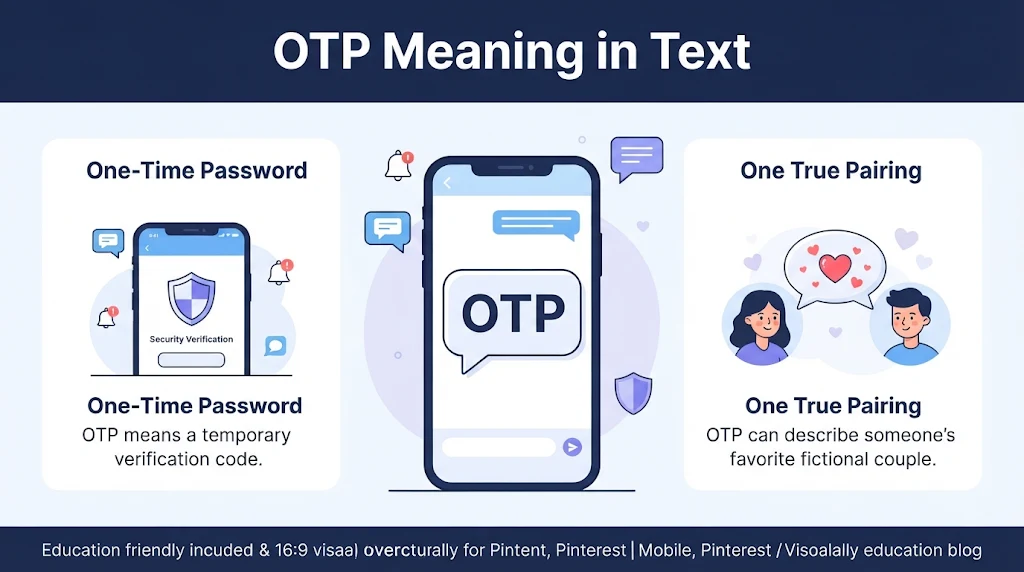
OTP most commonly means One-Time Password in texting and online security. However, in casual conversations and fandom communities, it can also mean One True Pairing, describing someone’s favorite romantic couple in a story, show, or fandom.
The phrase otp meaning in text can be confusing when you see it in a message, social media comment, or online conversation. One person might use OTP while discussing account security. Another might use the same abbreviation when talking about their favorite fictional couple. So, how do you know which meaning applies?
The answer depends on the conversation. In everyday digital communication, OTP commonly stands for One-Time Password. It refers to a temporary security code used to verify someone’s identity. However, entertainment fans also use OTP to mean One True Pairing. This meaning appears in discussions about movies, television shows, books, and fictional relationships.
Furthermore, understanding internet abbreviations helps you communicate more naturally. You can recognize the intended meaning without interrupting a conversation. Whether you discovered this abbreviation in a text message, Snapchat notification, Instagram comment, or TikTok discussion, this guide explains its different uses.
Throughout this article, you’ll discover common definitions, realistic conversations, platform-specific examples, alternative interpretations, and comfortable ways to respond.
Quick Answer
| Category | Explanation |
|---|---|
| Meaning | One-Time Password or One True Pairing |
| Context | Online security, texting, fandoms, and entertainment discussions |
| Primary Platforms | SMS, Snapchat, Instagram, TikTok, and messaging apps |
| Example | Send me the OTP so I can finish signing in. |
| Tone | Neutral in security conversations; enthusiastic in fandom discussions |
What Does OTP Meaning in Text Actually Refer To?
The abbreviation OTP has two widely recognized meanings. Understanding both helps you interpret messages correctly.
1. OTP Means One-Time Password
One-Time Password is a temporary verification code. Websites, apps, and online services use it to confirm that someone can access a particular phone number, email address, or authentication method.
For example, imagine you’re signing in to an online account. The service sends a temporary code to your registered device. You enter that code to complete the verification process.
Someone might text:
Please check your phone for the OTP.
Here, the sender is referring to a verification code.
Unlike a regular password, a one-time password usually works for a limited period or a particular authentication attempt. Its purpose is to add another layer of account protection.
Common situations include:
| Situation | What OTP Refers To |
|---|---|
| Online banking | A temporary verification code |
| Account login | A code confirming access |
| Password recovery | A temporary identity verification code |
| Online shopping | A transaction verification code |
| Account registration | A code confirming a contact method |
However, remember that legitimate verification codes are private. Never share them with someone who unexpectedly requests them. A person who receives your code may be able to access an account or approve an action.
2. OTP Means One True Pairing
In entertainment communities, OTP has a completely different meaning.
It stands for One True Pairing. Fans use this expression to describe their favorite romantic couple in a fictional story.
For example, someone who loves a particular couple from a television series might write:
They are my OTP!
This means the person considers that couple their favorite pairing.
The expression is especially common in fandom discussions. People use it when talking about fictional characters, romantic storylines, books, movies, and television shows.
Here are some examples:
| Message | Intended Meaning |
|---|---|
| They will always be my OTP. | That couple is my favorite. |
| This pairing is my OTP. | I strongly support this fictional couple. |
| I love their chemistry. Total OTP material! | Their relationship makes a favorite pairing. |
| What’s your OTP from this series? | Which fictional couple do you like most? |
Furthermore, fans sometimes use the term when discussing fictional relationships that they hope will become official within a story.
Why Does One Abbreviation Have Two Meanings?
Internet language develops across different communities. Consequently, the same abbreviation can acquire multiple meanings.
Technology users adopted OTP as shorthand for One-Time Password. Meanwhile, fandom communities popularized One True Pairing as an expression of their favorite fictional relationships.
Both meanings remain recognizable today.
The important difference is the subject of the conversation. A discussion about account access usually points toward a security code. A discussion about characters and relationships usually points toward a favorite pairing.
Contextual Dynamics and Nuances of the Term
Understanding an abbreviation involves more than memorizing its full form. You also need to recognize the situation, the sender’s intention, and the surrounding words.
The same three letters can communicate entirely different ideas.
OTP in Formal and Informal Communication
In formal digital communication, OTP usually refers to a One-Time Password.
For example:
Your OTP will expire shortly.
This message sounds like a standard security notification.
However, informal conversations can use the abbreviation differently.
They are literally my OTP!
This sounds like an enthusiastic fandom comment.
Therefore, the surrounding conversation matters more than capitalization or punctuation.
The Importance of Conversation Context
Consider these two messages:
Message A: Can you enter the OTP to complete the login?
Message B: Those two characters are my OTP.
Both contain the same abbreviation. However, their meanings are completely different.
Message A discusses account verification. Message B discusses a favorite fictional relationship.
Here are some additional contextual clues:
| Conversation Topic | Most Likely Meaning |
|---|---|
| Login and passwords | One-Time Password |
| Account verification | One-Time Password |
| Banking notifications | One-Time Password |
| Favorite characters | One True Pairing |
| Fictional relationships | One True Pairing |
| Fan edits and shipping | One True Pairing |
| Authentication messages | One-Time Password |
Does Capitalization Change the Meaning?
Usually, no.
People commonly write OTP in capital letters because it is an abbreviation. However, informal users might type otp in lowercase.
For example:
- Send me the OTP.
- What’s your favorite OTP?
- I just received my otp.
- They are my otp forever.
Capitalization alone does not identify the intended definition. Instead, examine the surrounding words.
Is OTP Slang or an Internet Abbreviation?
OTP is better described as an abbreviation with different meanings rather than a single slang expression.
One meaning belongs to technology and cybersecurity. The other belongs to internet fandom culture.
However, people sometimes include both meanings when explaining online communication. That’s why the abbreviation appears in texting dictionaries, technology guides, and entertainment discussions.
Real-Life Conversation Examples Using OTP
Real conversations make unfamiliar abbreviations easier to understand. The following examples demonstrate how people use the term in everyday digital communication.
Example 1: Receiving a Verification Code
Alex: I’m trying to sign in to my account.
Jordan: Did you receive the OTP?
Alex: Yes, the verification code just arrived.
Jordan: Great. Enter it on the official login page.
Meaning: Alex and Jordan are discussing a One-Time Password. The code helps verify the login attempt.
Example 2: Online Shopping Verification
Mia: My shopping app is asking me to verify something.
Emma: Does it say OTP?
Mia: Yes, it says a verification code was sent.
Emma: That sounds like an additional security check.
Meaning: The abbreviation refers to a temporary code used during an online transaction or verification process.
Example 3: Discussing a Favorite TV Couple
Lily: Have you watched the new episode?
Sophie: Yes! Those two characters are still my OTP.
Lily: Their storyline is so good.
Sophie: I hope they end up together!
Meaning: Sophie uses OTP to describe her favorite fictional couple.
Example 4: Talking About a Book Series
Noah: Which couple do you like most in the series?
Ethan: Definitely those two main characters.
Noah: Same! They’re my OTP.
Ethan: Their friendship makes the story even better.
Meaning: Both people are discussing their favorite fictional pairing.
Example 5: Asking About a Fandom Favorite
Ava: What’s your OTP from that show?
Grace: I really like the main characters together.
Ava: I can understand why. Their conversations are hilarious.
Grace: Exactly! They have great chemistry.
Meaning: Ava is asking Grace to name her favorite fictional couple.
These examples highlight an important point: the abbreviation does not have one universal interpretation. Its meaning changes according to the conversation.
Platform-Specific Breakdown
Different online platforms encourage different communication styles. Consequently, an abbreviation may appear in different contexts depending on where people use it.
Here is how the two common definitions appear across popular digital platforms.
How It Is Used on Snapchat
Snapchat encourages short conversations, quick replies, and temporary messages. Therefore, abbreviations are common in everyday chats.
Users might encounter OTP in two situations.
Security-related messages
Someone might receive a verification notification while signing in or recovering an account.
Example:
Friend: Did you get the OTP?
You: Yes, I received the verification code.
Fandom conversations
Snapchat users might also discuss television shows, fictional characters, and favorite couples.
Example:
Friend: Those two characters are my OTP.
You: Their storyline is actually so good!
The surrounding conversation helps identify the intended meaning.
However, never send a private verification code through Snapchat simply because someone asks for it. Protect your account information.
The Role of OTP on TikTok
TikTok has a strong entertainment and fandom culture. Users frequently discuss fictional characters, popular shows, and relationships.
Therefore, One True Pairing is especially relevant in fandom-related content.
For example, a creator might post a video featuring two fictional characters with the caption:
My OTP deserves a happy ending!
The creator is expressing support for that fictional couple.
Other common expressions include:
- This is my favorite OTP.
- Their chemistry is unmatched.
- My OTP finally got together.
- I will always support this pairing.
- They belong together in the story.
Furthermore, comment sections often contain conversations about different character pairings.
However, OTP can still refer to One-Time Password in account verification discussions. TikTok’s security-related notifications may also mention verification codes.
Instagram and Texting Dynamics
Instagram combines private messaging, public comments, fan pages, and entertainment content.
As a result, both definitions can appear naturally.
In direct messages
A friend might ask:
Did you receive the OTP?
The person is probably discussing a verification code.
In comments
Someone might comment:
These two are my OTP!
This indicates a favorite fictional pairing.
In fan accounts
Instagram fan pages frequently share edits, pictures, and discussions about fictional couples.
Therefore, the One True Pairing meaning fits naturally into these conversations.
In regular SMS messages
The abbreviation commonly appears in automated security notifications.
For example:
Your OTP is required to verify your account.
This message refers to a temporary authentication code.
Overall, Instagram and texting demonstrate why context is essential when interpreting short internet expressions.
Alternative Meanings and NLP Variations of the Phrase
Although One-Time Password and One True Pairing are the two major interpretations, OTP can appear in different forms across digital communication.
Understanding related vocabulary helps you recognize the intended message.
Common Expressions Related to One-Time Password
These terms frequently appear in technology and account verification conversations.
| Term | Meaning |
|---|---|
| Verification Code | A code used to confirm identity or access |
| Security Code | A code associated with account protection |
| Authentication Code | A code used during identity verification |
| Login Code | A temporary code used during sign-in |
| Two-Factor Authentication | An authentication method requiring an additional verification step |
| MFA | Multi-Factor Authentication |
| Passcode | A sequence of characters used for access |
These expressions are related, but they are not always interchangeable.
For example, an OTP is a type of temporary authentication code. Two-factor authentication is a broader security process that may use an OTP as one verification factor.
Common Expressions Related to One True Pairing
Fandom communities use several related expressions when discussing fictional relationships.
| Expression | Meaning |
|---|---|
| OTP | One True Pairing |
| Ship | To support a fictional relationship |
| Shipping | Supporting or discussing a pairing |
| Canon Couple | A relationship officially established in a story |
| Fan Favorite | A character or pairing popular among fans |
| Endgame | A couple expected or hoped to remain together |
| Chemistry | The connection between two characters |
| Pairing | Two characters considered as a potential couple |
For example, someone might write:
I ship them so much. They’re my OTP!
This means the person supports the fictional relationship.
Is OTP the Same as OOTD?
No. These abbreviations have different meanings.
OTP can mean One-Time Password or One True Pairing.
OOTD means Outfit of the Day. People commonly use it when sharing clothing, fashion ideas, or daily looks.
Although both abbreviations appear online, they serve completely different purposes.
Is OTP the Same as TTP?
No. These expressions are not interchangeable.
OTP has established meanings in authentication and fandom discussions. TTP is a separate abbreviation whose meaning depends on its particular context.
Therefore, avoid assuming that similar-looking abbreviations communicate the same idea.
Why Do Internet Abbreviations Have Multiple Definitions?
Online communities create language that suits their interests and communication habits.
Technology communities develop shortcuts for technical terms. Meanwhile, entertainment fans create expressions that help them discuss characters and storylines.
Over time, these expressions become familiar across different platforms.
Consequently, a single abbreviation may develop several recognized meanings without losing its original definition.
Misinterpretations: When NOT to Use OTP
Although the abbreviation is widely recognized, it does not fit every conversation.
Using it without considering the situation can create confusion.
1. Avoid Using It When a Clear Explanation Is Necessary
If you’re communicating with someone unfamiliar with internet abbreviations, write the complete phrase.
Instead of:
Send me the OTP.
You could write:
Please send the verification code from the official service.
This makes your request easier to understand.
2. Don’t Confuse a Security Code With a Fandom Expression
Imagine someone sends:
What’s your OTP?
Without context, the question could mean different things.
They might be asking about your favorite fictional couple. Alternatively, they could be referring to a verification code.
Rather than guessing, ask what they mean.
3. Never Share Private Verification Codes Casually
This is especially important when OTP refers to One-Time Password.
Verification codes can protect sensitive accounts. Sharing one with an unknown person can create security risks.
Remember these basic precautions:
- Never share unexpected verification codes.
- Avoid sending authentication codes to strangers.
- Check whether a login request came from you.
- Use official websites and applications.
- Enable additional account protection where available.
- Be cautious of messages creating unnecessary urgency.
A legitimate service should not require you to disclose a private authentication code to an unrelated person.
4. Avoid Using Fandom Terminology in Unrelated Professional Messages
One True Pairing is an informal expression.
It makes sense in conversations about entertainment, but it may confuse people in a professional setting.
For example, avoid using it in a formal business email unless the topic specifically involves fandom culture.
5. Don’t Assume Everyone Knows the Same Internet Slang
Different age groups, communities, and professional backgrounds use different expressions.
Some people understand OTP as a security term. Others recognize it through entertainment discussions.
Therefore, explaining the abbreviation can prevent unnecessary misunderstandings.
How to Respond in Chat Comfortably
Once you recognize the intended definition, responding becomes much easier.
The best response depends on whether the conversation concerns account security or a fictional relationship.
When Someone Asks for an OTP Verification Code
If someone mentions a verification code, first understand why they need it.
For a legitimate verification process that you initiated, follow the instructions provided by the official service.
However, do not send a private authentication code to another person.
You can use these responses:
| Situation | Comfortable Response |
|---|---|
| A friend asks whether a code arrived | Yes, I received the notification. |
| An app requests verification | I’m checking the official app now. |
| You receive an unexpected code | I didn’t request a verification code. |
| Someone asks you to share a private code | I don’t share authentication codes. |
| You don’t understand the message | Are you referring to a login verification code? |
These replies keep communication clear while protecting your information.
When Someone Talks About Their Favorite OTP
If the conversation involves fictional couples, you can respond casually.
Here are some natural replies:
Agreeing with their favorite pairing
- I completely agree!
- They’re such a great couple.
- Their chemistry is amazing.
- I love their storyline too.
- They’re definitely a fan favorite.
Sharing a different opinion
- I actually prefer the other pairing.
- I like them, but I have another favorite.
- Their friendship is my favorite part.
- I understand why people ship them.
Asking follow-up questions
- What made them your favorite?
- Which episode is your favorite?
- Have you watched the latest season?
- What’s your second favorite pairing?
These responses help keep the conversation interesting.
When You’re Unsure What Someone Means
Sometimes, the surrounding message does not provide enough information.
In that situation, asking a simple clarification is the easiest option.
Try these responses:
- What do you mean by OTP here?
- Are you talking about a verification code?
- Do you mean your favorite fictional couple?
- Can you explain what you mean?
- Which meaning are you referring to?
There is nothing wrong with asking for clarification. Clear communication is more useful than pretending to understand an unfamiliar expression.
FAQs
1. What Does OTP Mean in Text Messages?
OTP commonly means One-Time Password in text messages. It refers to a temporary verification code used during account authentication. However, in entertainment conversations, it can mean One True Pairing, someone’s favorite fictional couple.
2. Does OTP Mean One-Time Password?
Yes. One-Time Password is one of the most common definitions. It describes a temporary code used to verify identity or authorize an authentication attempt. The code typically has limited validity.
3. What Does OTP Mean on Snapchat?
On Snapchat, OTP can refer to a verification code or a favorite fictional couple. The meaning depends on the conversation. Messages about signing in suggest a security code, while discussions about characters suggest a fandom expression.
4. What Does OTP Mean on TikTok?
On TikTok, OTP often appears in fandom discussions. It stands for One True Pairing and describes a favorite fictional relationship. Users may include it in video captions, comments, and fan edits.
5. What Does OTP Mean in a Relationship?
In relationship discussions, OTP usually means One True Pairing. People use it to describe a couple they particularly like. It is especially common when discussing fictional characters and entertainment stories.
6. Is OTP a Romantic Expression?
It can be. When someone uses One True Pairing, they are expressing support for a romantic pairing. However, the same abbreviation also has a technical meaning unrelated to romance.
7. Can OTP Have More Than One Meaning?
Yes. The abbreviation has multiple interpretations. One-Time Password is common in technology, while One True Pairing appears in fandom communities. Other meanings may exist in specialized communities, so context remains important.
8. Is OTP Safe to Share With Someone?
No. You should treat a private verification code as confidential. Sharing it with another person could allow unauthorized access to an account or approval of an action. Only enter codes through the official service when you initiated the request.
9. What Is the Difference Between OTP and a Regular Password?
A regular password is generally chosen by an account holder and reused until changed. An OTP is a temporary code generated for a particular verification attempt or limited period. Both can help control account access, but they serve different roles.
10. How Can I Tell Which Meaning Someone Intends?
Look at the surrounding conversation. References to accounts, verification, and login usually indicate One-Time Password. Discussions about fictional characters, entertainment, and favorite couples usually indicate One True Pairing. If the meaning remains unclear, ask the sender.
Conclusion
Understanding otp meaning in text becomes simple once you recognize the conversation’s context. The abbreviation has two widely recognized definitions: One-Time Password and One True Pairing.
In technology and everyday messaging, it commonly describes a temporary verification code. However, in entertainment and fandom communities, it expresses support for someone’s favorite fictional couple.
Furthermore, platforms such as Snapchat, TikTok, and Instagram show how internet language changes across different communities. The same abbreviation can serve different purposes without confusing people who understand its context.
The most important lesson is to consider the surrounding message before interpreting unfamiliar shorthand. If someone mentions account access, think about verification. If they discuss fictional characters, consider the fandom meaning.
Once you understand these differences, you’ll find it easier to follow online conversations, recognize common abbreviations, and respond naturally.