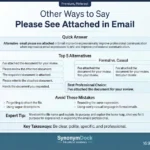
Other ways to say please be advised in an email include please note, kindly note, please be aware, for your information, and I would like to inform you. These alternatives make professional emails sound clearer, more natural, and polite.
The phrase please be advised is commonly used in professional emails to share important information, announce changes, or draw attention to something. Although grammatically correct, it can sometimes sound stiff, overly formal, or less conversational.
Choosing natural alternatives helps your emails feel more professional and easier to understand. Whether you’re writing to a colleague, contacting a client, communicating with a teacher, or sending an official announcement, the right expression makes your message more effective.
In this guide, you’ll discover 10 useful alternatives, their meanings, examples, appropriate situations, and differences in tone. You’ll also learn which expressions work best in business emails, academic writing, and everyday communication.
SERP Analysis Before Writing
The current search results show that readers mainly want practical email alternatives, explanations of tone, and examples they can use immediately.
Common topics covered by competing pages:
- Professional and polite synonyms.
- Formal alternatives for business emails.
- Meanings and example sentences.
- Comparisons between neutral and formal expressions.
- Advice about avoiding overly stiff language.
Content gaps and opportunities:
| Area | Opportunity for better content |
|---|---|
| Tone | Explain when a phrase sounds formal, neutral, or friendly |
| Context | Separate announcements, warnings, reminders, and updates |
| Grammar | Explain how to use each expression correctly |
| Email writing | Provide realistic workplace examples |
| Vocabulary | Include CEFR guidance and common collocations |
| Practice | Add scenarios and questions to test understanding |
Grammarly highlights how email expressions can sound redundant or unintentionally passive-aggressive. Other competing guides commonly list alternatives but provide limited guidance about choosing between them. Grammarly+3
Our editorial approach: Focus on meaning, context, natural English, and practical professional communication rather than simply replacing one phrase with another.
Quick Categories: Alternatives by Situation
1. Formal Alternatives
- We would like to inform you that
- This is to inform you that
- Please be aware that
- Kindly note that
Pro Tip: Use these expressions for official announcements, administrative notices, and formal correspondence.
2. Professional Alternatives
- Please note that
- I would like to highlight that
- I wanted to bring to your attention
- Please keep in mind that
Pro Tip: Choose direct expressions that communicate important information without making your email sound unnecessarily complicated.
3. Business Email Alternatives
- I am writing to let you know
- We would like to inform you
- Please note the following
- Just a quick update
Pro Tip: Match your expression to the purpose of the email. An update, warning, and reminder do not always need the same wording.
4. Academic Alternatives
- It is important to note that
- Please note that
- The following information should be considered
- I would like to emphasize that
Pro Tip: Academic writing usually benefits from precise, objective expressions instead of conversational phrases.
5. Casual Alternatives
- Just so you know
- Just a quick note
- Keep in mind that
- I wanted to let you know
Pro Tip: Use friendly expressions when communicating with classmates, familiar colleagues, or people you know well.
6. Informal Expressions
- Heads-up!
- FYI
- Just letting you know
- Thought you should know
Pro Tip: Informal expressions are useful in team chats and friendly messages, but may not suit official correspondence.
What Does “Other Ways to Say Please Be Advised in an Email” Mean?
The expression refers to alternative phrases that communicate important information politely and professionally in written correspondence.
Please be advised means that the recipient should know about something, pay attention to an update, or understand an important instruction.
For example:
- Original: Please be advised that the meeting has been postponed.
- Alternative: Please note that the meeting has been postponed.
Both sentences communicate the same basic information, but the second sounds simpler and more natural.
Grammar Explanation
The phrase contains three parts:
- Please: A polite word used to make a request.
- Be: A form of the verb to be.
- Advised: The past participle of advise, used in a passive construction.
It is commonly followed by that and a complete statement.
Example: Please be advised that applications close on Monday.
Remember the difference between advise and advice: advise is a verb, while advice is a noun.
When Should You Use These Alternatives?
Different situations call for different levels of formality.
| Situation | Recommended expression |
|---|---|
| Business communication | Please note that |
| Professional emails | I am writing to let you know |
| Meetings | Please keep in mind that |
| Presentations | I would like to highlight that |
| Academic writing | It is important to note that |
| Interviews | I would like to mention that |
| Daily conversations | Just so you know |
Business communication: Use clear expressions when announcing policy changes, sharing deadlines, or communicating workplace updates.
Emails: Choose phrases that introduce information without creating unnecessary formality.
Meetings: Use short expressions to draw attention to important details.
Presentations: Expressions such as “I would like to highlight” help introduce key points.
Academic writing: Objective expressions are preferable when explaining research, evidence, or important observations.
Interviews: Use natural phrases such as “I’d like to mention” when adding relevant information.
Daily conversations: Friendly expressions such as “Just so you know” work better than official-sounding notices.
Professional vs. Polite: What’s the Difference?
Professional and polite language often overlap, but they serve slightly different purposes.
| Style | Meaning | Example |
|---|---|---|
| Polite | Shows consideration | Kindly note that the schedule has changed. |
| Professional | Communicates clearly at work | Please note that the schedule has changed. |
| Formal | Follows official conventions | We would like to inform you that the schedule has changed. |
| Natural | Sounds conversational | I wanted to let you know that the schedule has changed. |
A phrase can be professional without sounding overly formal. In most everyday workplace emails, clear and respectful wording is the strongest choice.
Pros and Cons of Replacing “Please Be Advised”
Pros
- Better readability: Simpler expressions help readers understand information quickly.
- Natural communication: Friendly wording makes workplace conversations feel more approachable.
- Tone control: You can choose expressions that match your audience.
- Less repetition: Different phrases make repeated announcements easier to read.
- Clearer intentions: Specific wording helps readers understand whether something is an update, warning, or reminder.
Cons
- Wrong tone: Casual expressions may sound inappropriate in official notices.
- Unclear meaning: Some alternatives do not communicate urgency.
- Regional differences: Expressions such as “kindly note” may feel more natural in some varieties of English.
- Overuse: Repeating “please note” in every paragraph can become monotonous.
- Lost emphasis: A softer phrase may not communicate the seriousness of an important warning.
Other Ways to Say “Please Be Advised in an Email” (With Examples)
Here are 10 useful alternatives, arranged from versatile professional expressions to more casual options. Each phrase includes its meaning, tone, example, and recommended context.
1. Please Note That
Meaning: Draws attention to important information.
Explanation: This is one of the most natural and versatile alternatives. It works in professional emails without sounding unnecessarily formal.
- Formal: Yes
- Neutral: Yes
- Professional: Excellent
- Casual: Sometimes
- Example Sentence: Please note that the submission deadline has been extended until Friday.
- Best Use: Business updates
- Avoid Using In: Friendly greetings
- Tone: Clear and professional
- Formality Level: ⭐⭐⭐⭐
- Usage Frequency: Very Common
- CEFR Level: B1
- Common Collocations: Please note that, please note the date, please note the changes, please note the deadline.
Context Examples:
- Spoken English: Please note that we will start at nine.
- Professional English: Please note that the revised policy takes effect next month.
- Casual Conversation: Just note that the shop closes early today.
2. Kindly Note That
Meaning: Politely asks someone to pay attention to information.
Explanation: This expression is courteous and slightly more formal than “please note that.” It is particularly useful in formal correspondence and international business communication.
- Formal: Yes
- Neutral: Sometimes
- Professional: Excellent
- Casual: No
- Example Sentence: Kindly note that all documents must be submitted before the scheduled interview.
- Best Use: Formal correspondence
- Avoid Using In: Casual chats
- Tone: Courteous and respectful
- Formality Level: ⭐⭐⭐⭐⭐
- Usage Frequency: Common
- CEFR Level: B2
- Common Collocations: Kindly note the deadline, kindly note the changes, kindly note that, kindly note the requirements.
Context Examples:
- Spoken English: Kindly note that registration closes tomorrow.
- Professional English: Kindly note that your application is currently under review.
- Casual Conversation: Please remember that we are meeting tomorrow.
3. Please Be Aware That
Meaning: Makes someone aware of important information or a possible issue.
Explanation: Use this expression when communicating conditions, potential problems, or information that readers should understand before proceeding.
- Formal: Yes
- Neutral: Yes
- Professional: Excellent
- Casual: Sometimes
- Example Sentence: Please be aware that processing times may increase during public holidays.
- Best Use: Important warnings
- Avoid Using In: Simple greetings
- Tone: Direct and informative
- Formality Level: ⭐⭐⭐⭐
- Usage Frequency: Common
- CEFR Level: B2
- Common Collocations: Be aware of changes, be aware of risks, be aware that, fully aware of.
Context Examples:
- Spoken English: Please be aware that the road is closed.
- Professional English: Please be aware that additional documentation may be required.
- Casual Conversation: Just be aware that the weather might change.
4. I Am Writing to Let You Know
Meaning: Introduces information that the sender wants to share.
Explanation: This phrase sounds professional but approachable. It is especially useful when starting an email about an update, announcement, or change.
- Formal: Sometimes
- Neutral: Yes
- Professional: Excellent
- Casual: Sometimes
- Example Sentence: I am writing to let you know that your appointment has been rescheduled for Thursday.
- Best Use: Email announcements
- Avoid Using In: Very short replies
- Tone: Friendly and professional
- Formality Level: ⭐⭐⭐⭐
- Usage Frequency: Very Common
- CEFR Level: B1
- Common Collocations: Writing to let you know, writing to inform you, writing regarding, writing about an update.
Context Examples:
- Spoken English: I wanted to let you know about the change.
- Professional English: I am writing to let you know that your request has been approved.
- Casual Conversation: I just wanted to tell you something.
5. We Would Like to Inform You
Meaning: Formally communicates information to another person or group.
Explanation: This expression is suitable for customer service emails, company announcements, and administrative communication. It sounds official while remaining respectful.
- Formal: Yes
- Neutral: Sometimes
- Professional: Excellent
- Casual: No
- Example Sentence: We would like to inform you that our office will remain closed on Monday.
- Best Use: Official announcements
- Avoid Using In: Friendly chats
- Tone: Formal and respectful
- Formality Level: ⭐⭐⭐⭐⭐
- Usage Frequency: Common
- CEFR Level: B2
- Common Collocations: Inform you that, inform customers, inform the team, inform you about changes.
Context Examples:
- Spoken English: We would like to inform everyone about the new schedule.
- Professional English: We would like to inform you that your request has been processed.
- Casual Conversation: We wanted to tell you about the update.
Native Speaker Tip: Which First Five Sound Most Natural?
For everyday professional English, please note that is usually the safest choice. It is short, clear, and works across many workplace situations.
“We would like to inform you” is more appropriate for official announcements. “Kindly note that” is also useful, although it can sound more formal in some workplaces.
The key is to choose wording that fits the message rather than making every email sound official.
6. For Your Information
Meaning: Shares information that someone may find useful.
Explanation: This expression is often shortened to FYI in workplace communication. It is useful when sharing an update that does not necessarily require the recipient to take action.
- Formal: Sometimes
- Neutral: Yes
- Professional: Yes
- Casual: Yes
- Example Sentence: For your information, the revised schedule is available in the shared folder.
- Best Use: General updates
- Avoid Using In: Sensitive warnings
- Tone: Informative and neutral
- Formality Level: ⭐⭐⭐
- Usage Frequency: Very Common
- CEFR Level: B1
- Common Collocations: For your information, FYI only, information regarding, additional information.
Context Examples:
- Spoken English: For your information, the event starts at ten.
- Professional English: For your information, I have attached the updated report.
- Casual Conversation: FYI, the class has been moved online.
7. I Would Like to Highlight That
Meaning: Draws attention to a particularly important detail.
Explanation: This expression is useful when presenting key findings, explaining decisions, or emphasizing information that readers should not overlook.
- Formal: Yes
- Neutral: Yes
- Professional: Excellent
- Casual: No
- Example Sentence: I would like to highlight that the revised proposal includes all requested changes.
- Best Use: Important details
- Avoid Using In: Routine greetings
- Tone: Emphatic and professional
- Formality Level: ⭐⭐⭐⭐
- Usage Frequency: Common
- CEFR Level: C1
- Common Collocations: Highlight an issue, highlight key points, highlight the importance, highlight that.
Context Examples:
- Spoken English: I would like to highlight one important point.
- Professional English: I would like to highlight that the project remains on schedule.
- Casual Conversation: I just want to point out something important.
8. Please Keep in Mind That
Meaning: Reminds someone to consider particular information.
Explanation: This phrase is useful for explaining conditions, expectations, and important details. It sounds less official than “please be advised” while remaining respectful.
- Formal: Sometimes
- Neutral: Yes
- Professional: Yes
- Casual: Yes
- Example Sentence: Please keep in mind that all applications must include the required supporting documents.
- Best Use: Instructions and reminders
- Avoid Using In: Legal notifications
- Tone: Helpful and informative
- Formality Level: ⭐⭐⭐
- Usage Frequency: Common
- CEFR Level: B2
- Common Collocations: Keep in mind that, keep this in mind, important to remember, keep in mind the deadline.
Context Examples:
- Spoken English: Please keep in mind that the weather can change.
- Professional English: Please keep in mind that the revised schedule applies to everyone.
- Casual Conversation: Keep in mind that we need to leave early.
9. Just a Reminder
Meaning: Politely brings previously shared information back to someone’s attention.
Explanation: Use this expression when reminding someone about an existing deadline, appointment, meeting, or responsibility. It should not replace a first-time announcement.
- Formal: Sometimes
- Neutral: Yes
- Professional: Yes
- Casual: Yes
- Example Sentence: Just a reminder that the final report is due by Thursday afternoon.
- Best Use: Friendly reminders
- Avoid Using In: First announcements
- Tone: Friendly and helpful
- Formality Level: ⭐⭐⭐
- Usage Frequency: Very Common
- CEFR Level: B1
- Common Collocations: Friendly reminder, gentle reminder, reminder about the deadline, reminder that.
Context Examples:
- Spoken English: Just a reminder that our meeting starts soon.
- Professional English: Just a reminder that feedback is required by Friday.
- Casual Conversation: Just reminding you about tomorrow’s plans.
10. Just a Heads-Up
Meaning: Gives someone an informal warning or advance notice.
Explanation: This expression is common in friendly workplace communication and everyday conversations. It is less formal than most alternatives, so use it with an appropriate audience.
- Formal: No
- Neutral: Sometimes
- Professional: In informal workplaces
- Casual: Excellent
- Example Sentence: Just a heads-up that the office entrance will be temporarily unavailable tomorrow.
- Best Use: Informal updates
- Avoid Using In: Official letters
- Tone: Friendly and direct
- Formality Level: ⭐⭐
- Usage Frequency: Very Common
- CEFR Level: B2
- Common Collocations: Give a heads-up, quick heads-up, just a heads-up, advance heads-up.
Context Examples:
- Spoken English: Just a heads-up, the meeting room has changed.
- Professional English: Just a heads-up that the client call starts at 2 p.m.
- Casual Conversation: Heads-up, your favorite show is on tonight.
Native Speaker Tip: Choosing Alternatives 6–10
“For your information” works best when sharing something useful without requesting action. “Just a reminder” is better when the recipient already knows about an upcoming task.
“I would like to highlight that” sounds more suitable for presentations and reports. “Just a heads-up” is natural among familiar colleagues, but too casual for many official emails.
Expert Insight: How to Choose the Right Expression
Choosing an alternative is not simply about finding a similar phrase. It is about understanding what your reader needs to know.
Workplace communication: Use “please note that” for general updates and “please be aware that” for important conditions.
Email writing: “I am writing to let you know” creates a natural opening. However, avoid adding it when a shorter sentence communicates the message clearly.
Academic English: Choose “it is important to note that” when introducing relevant observations or evidence.
Professional tone: Avoid using formal expressions simply to sound more educated. Clear and respectful writing usually communicates confidence more effectively.
Quick Recap: Best Alternatives at a Glance
Best Professional Choice
Top pick
Please note that
Best Casual Choice
Just so you know
Best Formal Choice
We would like to inform you
Most Natural Choice
I am writing to let you know
Most Polite Choice
Kindly note that
Comparison Table: All 10 Alternatives
| Phrase | Tone | Formality | Best Use | Frequency |
|---|---|---|---|---|
| Please note that | Neutral | High | Business emails | Very Common |
| Kindly note that | Polite | Very High | Official updates | Common |
| Please be aware that | Direct | High | Warnings | Common |
| I am writing to let you know | Friendly | High | Email updates | Very Common |
| We would like to inform you | Formal | Very High | Announcements | Common |
| For your information | Neutral | Medium | Sharing updates | Very Common |
| I would like to highlight that | Emphatic | High | Reports | Common |
| Please keep in mind that | Helpful | Medium | Instructions | Common |
| Just a reminder | Friendly | Medium | Reminders | Very Common |
| Just a heads-up | Casual | Low | Informal updates | Very Common |
Formality and frequency are practical editorial estimates, not official linguistic measurements.
What Is the Best Alternative for Different Situations?
Not every expression works equally well in every email. Here are the best choices based on communication goals.
1. Best Overall: Please Note That
This expression works in almost every professional situation. It introduces important information without sounding too demanding or unnecessarily formal.
2. Best Professional: I Am Writing to Let You Know
Choose this phrase when communicating an update to colleagues, clients, or business partners. It sounds approachable while maintaining a professional tone.
3. Best Academic: It Is Important to Note That
This expression introduces relevant information in essays, research discussions, presentations, and academic reports.
4. Best Business Email: Kindly Note That
This is a useful option when addressing customers, managers, or professional contacts in formal correspondence.
5. Best Everyday Conversation: Just So You Know
This phrase sounds natural when sharing information with friends, classmates, or familiar colleagues.
6. Most Natural: Please Note That
It is short, easy to understand, and suitable for many workplace situations.
7. Most Polite: Kindly Note That
It communicates information respectfully, particularly in formal business correspondence.
Commonly Confused Phrases: Understand the Differences
Some expressions look similar but communicate slightly different intentions. Understanding these differences helps you avoid choosing the wrong phrase.
| Expression | Main Meaning | Difference |
|---|---|---|
| Please be advised | Officially communicate information | More formal and authoritative |
| Please advise | Ask someone for advice or information | Requests a response |
| Please note | Draw attention to information | Neutral and direct |
| Please be aware | Make someone conscious of something | Often emphasizes conditions |
| For your information | Share something useful | Does not necessarily request action |
| Please remember | Ask someone to retain information | Focuses on remembering |
| Just a reminder | Repeat previously shared information | Used for follow-ups |
Important grammar distinction:
- Please be advised that the meeting starts at 10 a.m. (You are informing someone.)
- Please advise whether the meeting can be rescheduled. (You are asking someone for an answer.)
These expressions are not interchangeable in every situation.
Another useful distinction is between “please note” and “please be aware.” The first highlights information, while the second often emphasizes a condition, risk, or possibility.
Common Mistakes to Avoid
Here are five mistakes English learners and professionals should watch for.
Mistake 1: Confusing Advise and Advice
- Wrong: Please advice that the deadline has changed.
- Why: Advice is a noun, not the verb needed here.
- Correct: Please note that the deadline has changed.
Mistake 2: Using Too Many Formal Expressions
- Wrong: Kindly please be advised that we would like to inform you.
- Why: Several polite expressions make the sentence unnecessarily complicated.
- Correct: Please note that the office will be closed tomorrow.
Mistake 3: Using Casual Language in Official Notices
- Wrong: Just a heads-up that your application was rejected.
- Why: This sounds too casual for sensitive administrative communication.
- Correct: We would like to inform you that your application was unsuccessful.
Mistake 4: Using FYI for Every Message
- Wrong: FYI, please complete this task immediately.
- Why: FYI usually introduces information rather than making a direct request.
- Correct: Please complete this task by the end of the day.
Mistake 5: Repeating the Same Phrase
- Wrong: Please note that the meeting has changed. Please note that the location is different. Please note that the time is updated.
- Why: Repetition makes the message less readable.
- Correct: The meeting time and location have both been updated. Please see the revised schedule.
Scenario Practice: Which Phrase Would You Choose?
Test your understanding with these five everyday communication situations.
Situation 1: Business Meeting
Your manager needs to announce that the weekly meeting has moved to Friday.
Which phrase would you choose?
Answer: Please note that the weekly meeting has been moved to Friday.
Explanation: This phrase is professional, direct, and appropriate for workplace announcements.
Situation 2: Interview
You want to share an additional detail about your professional experience with an interviewer.
Which phrase would you choose?
Answer: I would like to highlight that I have experience managing team projects.
Explanation: It emphasizes relevant information while maintaining a respectful professional tone.
Situation 3: Presentation
You are explaining an important finding during a classroom presentation.
Which phrase would you choose?
Answer: It is important to note that these results were collected over six months.
Explanation: This expression introduces an important observation in an objective way.
Situation 4: Classroom Discussion
You want to remind classmates that their assignments are due tomorrow.
Which phrase would you choose?
Answer: Just a reminder that our assignments are due tomorrow.
Explanation: It sounds friendly and communicates a previously shared deadline.
Situation 5: Email Reply
A colleague needs to know that you have attached the updated document.
Which phrase would you choose?
Answer: For your information, I have attached the updated document.
Explanation: It introduces useful information without sounding demanding. An even more natural option is simply, “I’ve attached the updated document.”
Mini Quiz: Test Your English Vocabulary
Choose the most appropriate expression for each situation.
Vocabulary challenge
0/5 answered
1. You are sending an official email announcing a company policy change. Which phrase fits best?Just a heads-upWe would like to inform youJust so you know
2. You want to draw attention to an important detail in a report.I would like to highlight thatJust a reminderFYI
3. A colleague already knows about a deadline, and you want to remind them.We wish to notify youJust a reminderPlease be informed
4. Which expression is more suitable for an informal workplace chat?This is to inform youWe would like to notify youJust a heads-up
5. You need to ask someone for advice. Which sentence is correct?Please advise on the next steps.Please advice on the next steps.Please note on the next steps.
Check Answers
FAQs
1. What is the most professional way to say please be advised in an email?
“Please note that” is one of the most professional alternatives. It communicates important information clearly without sounding overly formal. It works especially well for workplace announcements, schedule changes, instructions, and business correspondence.
2. Is please be advised considered rude?
No, “please be advised” is not grammatically rude or incorrect. However, it can sound stiff or authoritative depending on context. Using “please note” or “I wanted to let you know” can create a friendlier impression.
3. What is a polite alternative to please be advised?
“Kindly note that” is a polite alternative suitable for formal correspondence. “I am writing to let you know” is another respectful option when communicating updates to colleagues, clients, or professional contacts.
4. Can I use FYI instead of please be advised?
Yes, when you are simply sharing useful information. FYI means “for your information” and usually does not request action. Avoid using it when communicating formal warnings, sensitive decisions, or mandatory instructions.
5. How do I say please be advised in a friendly email?
Use conversational expressions such as “Just so you know,” “I wanted to let you know,” or “Just a quick note.” These alternatives sound approachable while keeping your message clear and respectful.
Infographic Prompt for SynonymDock
Pinterest-Style Educational Infographic
SEO Metadata
Meta Title (45–50 characters):
Other Ways to Say Please Be Advised in an Email
SEO Meta Description (140–150 characters):
SEO-Friendly URL:
/other-ways-to-say-please-be-advised-in-an-email/
Image Alt Text:
Other ways to say please be advised in an email, featuring 10 professional alternatives and formal email expressions.
Keyword Placement: The primary keyword appears in the title, introduction, featured snippet, headings, comparison content, FAQs, and conclusion.
Editorial note: The exact keyword is 47 characters long, so including both the complete keyword and “10 Examples” in a 40–50-character SEO title is not mathematically possible. The meta title above preserves the exact keyword and requested length.
Conclusion
Learning other ways to say please be advised in an email helps you communicate with greater clarity, confidence, and professionalism. Expressions such as please note that, kindly note that, and I am writing to let you know make your messages more natural while maintaining respect. Each alternative serves a different purpose, so consider your audience and communication goals before choosing one.
Practice these expressions in everyday emails, workplace conversations, and academic writing. As your vocabulary grows, expressing important information becomes easier. With SynonymDock, you can build stronger English communication skills one phrase at a time.