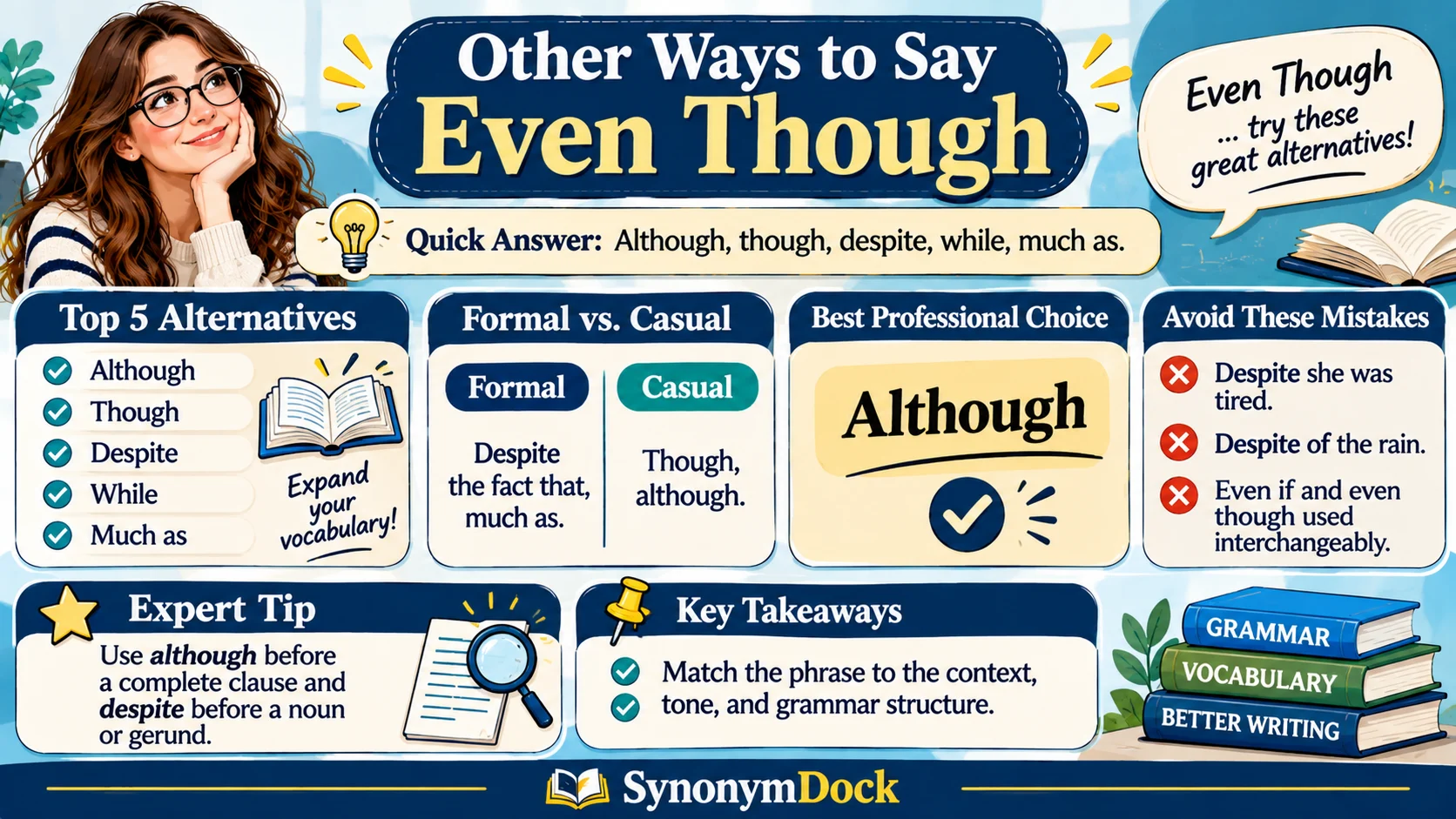
Other ways to say even though include although, though, despite the fact that, in spite of, and notwithstanding. These alternatives express contrast and help make everyday conversations, professional emails, and academic writing more natural.
The phrase even though helps connect two contrasting ideas. It shows that something happened or remains true despite an unexpected situation. For example, you might say, Even though it was raining, we enjoyed the picnic.
However, repeating the same expression can make your writing sound predictable. Learning other ways to say even though helps you communicate with greater variety, clarity, and confidence.
Whether you’re writing an academic essay, preparing a business email, participating in a meeting, or having a casual conversation, choosing the right alternative makes a difference. Some expressions sound professional, while others feel more natural in everyday English.
Quick Categories: 6 Types of Alternatives
Choosing an alternative becomes easier when you understand its tone and purpose.
1. Formal Alternatives
These expressions work well in academic assignments, reports, and official documents.
- Although
- Despite the fact that
- In spite of the fact that
- Much as
Pro Tip: Use although for clear, professional writing. Save much as for situations where you want to express a stronger contrast.
2. Professional Alternatives
These phrases help communicate contrasting information without sounding repetitive.
- Although
- Despite
- While
- Nevertheless
Pro Tip: Use although when introducing a limitation and despite when emphasizing that something succeeded despite an obstacle.
3. Business Email Alternatives
Use these expressions when discussing challenges, deadlines, results, or unexpected situations.
- Although the deadline was short
- Despite the circumstances
- In spite of the delay
- Nevertheless
Pro Tip: Keep business emails direct. Although and despite are usually more natural than lengthy expressions.
4. Academic Alternatives
These expressions help create variety in essays, research discussions, and analytical writing.
- Although
- Whereas
- While
- Much as
Pro Tip: Use whereas when comparing two different findings or viewpoints. Use although when acknowledging an opposing point.
5. Casual Alternatives
These options sound natural in everyday conversations.
- Though
- Although
- Even so
- But
Pro Tip: Though is particularly useful in spoken English. It can also appear at the end of a sentence.
6. Informal Expressions
Use these expressions with friends, classmates, and people you know well.
- Though
- But
- Still
- Even so
Pro Tip: Short expressions often make casual conversations sound smoother. However, check the sentence structure before replacing a conjunction.
What Does “Even Though” Mean?
Even though means despite the fact that something is true. It introduces a contrasting fact that makes the main statement unexpected or surprising.
It is a subordinating conjunction that connects a dependent clause with an independent clause.
Simple Explanation: You use even though when one situation does not prevent another situation from happening.
Example:
Even though Sarah was tired, she finished her homework.
In this sentence, Sarah’s tiredness contrasts with her decision to finish her work.
Grammar Structure
The standard structure is:
Even though + subject + verb + main clause
Examples:
- Even though it was cold, we went outside.
- She attended the meeting even though she was busy.
- Even though he practiced regularly, he struggled with the performance.
You can place the even though clause at the beginning or middle of a sentence. When it comes first, use a comma before the main clause.
When Should You Use Other Ways to Say Even Though?
Different situations require different levels of formality. Here is how to choose naturally.
Business Communication
Use although, despite, or nevertheless when explaining challenges and unexpected results.
Example: Although the initial proposal had limitations, the team approved the revised version.
Professional Emails
Use concise expressions that communicate a problem without making the message unnecessarily complicated.
Example: Despite the delay, we expect to complete the project this week.
Meetings
Use while or although to acknowledge another viewpoint before presenting your position.
Example: While I understand your concerns, I believe we should consider another option.
Presentations
Use although to introduce a limitation and explain a positive result.
Example: Although the first quarter was challenging, our overall performance improved.
Academic Writing
Use although, whereas, and much as to connect contrasting arguments and observations.
Example: Whereas the first study focused on children, the second examined adult learning patterns.
Interviews
Use although to acknowledge a challenge while demonstrating a positive outcome.
Example: Although I had limited experience initially, I developed strong communication skills through practice.
Daily Conversations
Use though, although, and but to express contrast naturally.
Example: I didn’t enjoy the weather. The trip was amazing, though.
Professional vs. Polite: Understanding the Difference
Professional and polite expressions are related, but they serve different communication purposes.
| Style | Meaning | Example |
|---|---|---|
| Polite | Respectful and considerate | Although I understand your concern, I have another suggestion. |
| Professional | Clear and workplace appropriate | Despite the delay, we completed the assignment. |
| Formal | Suitable for academic or official writing | In spite of the fact that the results were limited, the study continued. |
| Natural | Comfortable and conversational | It was difficult, though we managed. |
Expert Tip: Professional writing does not need complicated vocabulary. A simple, accurate expression often sounds more confident than an unnecessarily formal one.
Pros and Cons of Using Alternatives
Pros
- Improves vocabulary: You learn different ways to express contrasting ideas.
- Reduces repetition: Your writing becomes more varied and engaging.
- Improves tone: You can select expressions that suit professional or casual situations.
- Strengthens communication: Clear transitions help readers understand relationships between ideas.
- Supports academic writing: Appropriate alternatives make essays and explanations more flexible.
Cons
- Grammar differences: Some alternatives require different sentence structures.
- Meaning changes: Words such as even if do not mean exactly the same as even though.
- Overly formal language: Notwithstanding may sound unnatural in everyday conversations.
- Unnecessary complexity: Longer expressions can make simple sentences difficult to read.
- Context problems: While and whereas can suggest comparison rather than unexpected contrast.
Other Ways to Say “Even Though” (With Examples)
Here are 10 useful alternatives, arranged from widely applicable expressions to more specialized formal choices.
1. Although
Meaning: Despite the fact that something is true.
Explanation: Although is one of the closest alternatives to even though. It introduces a contrasting clause and works naturally in professional, academic, and everyday English.
- Formal: Yes
- Neutral: Yes
- Professional: Yes
- Casual: Yes
Example Sentence: Although the project was complicated, the team completed it successfully.
Best Use: Essays and reports
Avoid Using In: Noun-only phrases
Tone: Neutral, polished
Formality Level: ⭐⭐⭐⭐
Usage Frequency: Very Common
CEFR Level: B1
Common Collocations: Although it seems, although there is, although we know, although it remains.
Context Examples:
- Spoken English: Although I’m tired, I can still help.
- Professional English: Although the proposal needs revision, its overall direction is promising.
- Casual Conversation: Although it was late, we stayed longer.
2. Though
Meaning: Despite the fact that something happens or is true.
Explanation: Though is a shorter, conversational alternative to even though. It can introduce a clause or appear at the end of a contrasting statement.
- Formal: Sometimes
- Neutral: Yes
- Professional: Yes
- Casual: Yes
Example Sentence: The presentation was challenging. It was informative, though.
Best Use: Daily conversations
Avoid Using In: Highly formal reports
Tone: Friendly, natural
Formality Level: ⭐⭐⭐
Usage Frequency: Very Common
CEFR Level: B1
Common Collocations: Though I agree, though it seems, even though, though difficult.
Context Examples:
- Spoken English: Though I disagree, I understand your point.
- Professional English: The proposal has potential, though further research is necessary.
- Casual Conversation: I didn’t like the ending. The movie was good, though.
3. Despite the Fact That
Meaning: Even when a particular fact is true.
Explanation: This expression emphasizes a contrast and sounds more formal than although. It is useful when you want to highlight a specific circumstance in academic or professional writing.
- Formal: Yes
- Neutral: Sometimes
- Professional: Yes
- Casual: Less common
Example Sentence: Despite the fact that the budget was limited, the organization completed the project.
Best Use: Formal reports
Avoid Using In: Short casual messages
Tone: Formal, emphatic
Formality Level: ⭐⭐⭐⭐⭐
Usage Frequency: Common
CEFR Level: B2
Common Collocations: Despite the fact that it happened, despite the fact that we know, despite the fact that it remains, despite the fact that they agreed.
Context Examples:
- Spoken English: Despite the fact that it was raining, we went out.
- Professional English: Despite the fact that resources were limited, the department achieved its targets.
- Casual Conversation: Despite the fact that I was tired, I enjoyed the event.
4. In Spite of the Fact That
Meaning: Regardless of a particular situation or fact.
Explanation: This phrase communicates a strong contrast and is suitable for formal explanations. It introduces a complete clause through the words the fact that.
- Formal: Yes
- Neutral: Sometimes
- Professional: Yes
- Casual: Less common
Example Sentence: In spite of the fact that the schedule changed, everyone arrived on time.
Best Use: Formal explanations
Avoid Using In: Quick messages
Tone: Formal, explanatory
Formality Level: ⭐⭐⭐⭐⭐
Usage Frequency: Common
CEFR Level: B2
Common Collocations: In spite of the fact that it happened, in spite of the fact that we tried, in spite of the fact that they knew.
Context Examples:
- Spoken English: In spite of the fact that it was cold, we enjoyed ourselves.
- Professional English: In spite of the fact that the deadline changed, the team delivered the report.
- Casual Conversation: In spite of the fact that I was nervous, I enjoyed the experience.
5. Despite
Meaning: Without being prevented or affected by a particular circumstance.
Explanation: Despite is a concise alternative that works especially well in business writing and formal communication. It must be followed by a noun phrase, pronoun, or gerund rather than a regular subject-and-verb clause.
- Formal: Yes
- Neutral: Yes
- Professional: Yes
- Casual: Yes
Example Sentence: Despite the heavy workload, she completed every assignment.
Best Use: Business communication
Avoid Using In: Direct that-clauses
Tone: Clear, professional
Formality Level: ⭐⭐⭐⭐
Usage Frequency: Very Common
CEFR Level: B1–B2
Common Collocations: Despite challenges, despite expectations, despite difficulties, despite the delay.
Context Examples:
- Spoken English: Despite the traffic, we arrived early.
- Professional English: Despite limited resources, our department achieved its objectives.
- Casual Conversation: Despite being tired, I went shopping.
6. In Spite Of
Meaning: Without being stopped by something.
Explanation: In spite of has almost the same meaning as despite. It is slightly longer and introduces a noun, pronoun, or gerund. It is useful in both formal and everyday communication.
- Formal: Yes
- Neutral: Yes
- Professional: Yes
- Casual: Yes
Example Sentence: In spite of the difficulties, the students completed their assignment.
Best Use: Everyday writing
Avoid Using In: Direct that-clauses
Tone: Neutral, explanatory
Formality Level: ⭐⭐⭐⭐
Usage Frequency: Common
CEFR Level: B1–B2
Common Collocations: In spite of everything, in spite of difficulties, in spite of the weather, in spite of being busy.
Context Examples:
- Spoken English: In spite of the rain, we enjoyed the game.
- Professional English: In spite of the challenges, the organization maintained its progress.
- Casual Conversation: In spite of being busy, I called my friend.
Native Speaker Tip: Alternatives 1–6
Although is usually the safest replacement when you want the same basic meaning and sentence structure. Though sounds more conversational, while despite is especially useful for concise writing.
Native speakers choose based on sentence flow rather than formality alone. Avoid replacing every instance of even though with a longer expression.
7. While
Meaning: Although something is true, another situation also exists.
Explanation: While can introduce a contrasting idea and is common in professional and academic writing. However, it can also refer to time, so the surrounding sentence must make the intended meaning clear.
- Formal: Yes
- Neutral: Yes
- Professional: Yes
- Casual: Yes
Example Sentence: While the first approach was effective, the second produced better results.
Best Use: Balanced comparisons
Avoid Using In: Unclear time contexts
Tone: Balanced, thoughtful
Formality Level: ⭐⭐⭐⭐
Usage Frequency: Very Common
CEFR Level: B2
Common Collocations: While it is true, while some people, while the results, while we understand.
Context Examples:
- Spoken English: While I like the idea, I need more time.
- Professional English: While the proposal is promising, additional testing is required.
- Casual Conversation: While I enjoy reading, I don’t always have time.
8. Whereas
Meaning: In contrast to something else.
Explanation: Whereas is particularly useful when comparing two people, situations, findings, or opinions. It is more comparison-focused than even though and works well in academic and professional writing.
- Formal: Yes
- Neutral: Sometimes
- Professional: Yes
- Casual: Less common
Example Sentence: Whereas the first department preferred remote work, the second preferred office-based arrangements.
Best Use: Direct comparisons
Avoid Using In: Unexpected results
Tone: Analytical, formal
Formality Level: ⭐⭐⭐⭐
Usage Frequency: Common
CEFR Level: B2
Common Collocations: Whereas others prefer, whereas the first, whereas the second, whereas some believe.
Context Examples:
- Spoken English: Whereas I prefer tea, my brother enjoys coffee.
- Professional English: Whereas the previous strategy focused on growth, the new strategy prioritizes efficiency.
- Casual Conversation: Whereas I like summer, my sister prefers winter.
9. Much As
Meaning: Although something is true or strongly desired.
Explanation: Much as introduces a contrast, often involving feelings, preferences, or personal opinions. It has a more formal or literary tone and is especially effective when acknowledging something before explaining a limitation.
- Formal: Yes
- Neutral: Sometimes
- Professional: Yes
- Casual: Sometimes
Example Sentence: Much as I appreciate your suggestion, I believe another approach would work better.
Best Use: Polite disagreements
Avoid Using In: Simple factual statements
Tone: Refined, considerate
Formality Level: ⭐⭐⭐⭐⭐
Usage Frequency: Occasional
CEFR Level: C1
Common Collocations: Much as I appreciate, much as we would like, much as I admire, much as I enjoy.
Context Examples:
- Spoken English: Much as I love traveling, I enjoy staying home sometimes.
- Professional English: Much as we appreciate the opportunity, we cannot accept the revised terms.
- Casual Conversation: Much as I like the idea, I’m not sure it will work.
10. Notwithstanding the Fact That
Meaning: Despite the fact that a particular situation exists.
Explanation: This is a highly formal expression that emphasizes a contrast. It may appear in legal, administrative, or official writing, but it usually sounds unnecessarily complicated in everyday communication.
- Formal: Yes
- Neutral: Rarely
- Professional: In specialized contexts
- Casual: No
Example Sentence: Notwithstanding the fact that the original proposal faced criticism, the committee approved the revised plan.
Best Use: Official documents
Avoid Using In: Casual conversations
Tone: Legal, authoritative
Formality Level: ⭐⭐⭐⭐⭐
Usage Frequency: Rare
CEFR Level: C1–C2
Common Collocations: Notwithstanding the fact that it occurred, notwithstanding the fact that the policy changed, notwithstanding the fact that objections were raised.
Context Examples:
- Spoken English: Notwithstanding the fact that we were late, we attended the event.
- Professional English: Notwithstanding the fact that the original timeline changed, the project remained on schedule.
- Casual Conversation: Although it sounds unusual, you might encounter this expression in formal documents.
Native Speaker Tip: Alternatives 7–10
While is a flexible choice for professional discussions, whereas is better when directly comparing two things. Much as can make a disagreement sound considerate, while notwithstanding is generally reserved for highly formal contexts.
For most everyday situations, although, though, and despite are more natural choices.
Expert Insight: Choosing the Right Alternative
The best expression depends on the message you want to communicate.
Workplace Communication
Choose although when acknowledging a limitation before explaining a positive result. Use despite when a noun phrase or gerund follows the contrast.
Example: Despite the technical challenges, the team completed the assignment.
Email Writing
Professional emails benefit from clear and concise language. Although and despite usually communicate contrasting information without making sentences unnecessarily complicated.
Example: Although we received your feedback late, we have included your suggestions in the revised document.
Academic English
Academic writing requires accurate relationships between arguments. Use although to introduce a contrasting point, whereas to compare findings, and much as to acknowledge a limitation or preference.
Example: Although the research supports the theory, additional evidence is necessary.
Expert Recommendation: Prioritize grammatical accuracy over complicated vocabulary. A simple alternative used correctly is more effective than an advanced expression used incorrectly.
Quick Recap: Best Alternatives at a Glance
| Category | Best Choice |
|---|---|
| Best Professional Choice | Although |
| Best Casual Choice | Though |
| Best Formal Choice | Despite the fact that |
| Most Natural Choice | Although |
| Most Polite Choice | Much as |
Comparison Table: All 10 Alternatives
| Phrase | Tone | Formality | Best Use | Frequency |
|---|---|---|---|---|
| Although | Neutral | Medium | General writing | Very Common |
| Though | Friendly | Medium-low | Conversations | Very Common |
| Despite the fact that | Formal | High | Reports | Common |
| In spite of the fact that | Formal | High | Explanations | Common |
| Despite | Professional | Medium-high | Business writing | Very Common |
| In spite of | Neutral | Medium-high | General writing | Common |
| While | Balanced | Medium-high | Presentations | Very Common |
| Whereas | Analytical | High | Comparisons | Common |
| Much as | Refined | High | Polite disagreement | Occasional |
| Notwithstanding the fact that | Legal | Very High | Official documents | Rare |
Frequency and formality labels are practical editorial guidance, not measured corpus statistics. Usage can vary by context and region.
Best Choice: Which Alternative Should You Use?
There is no single perfect replacement for every sentence. These recommendations cover the most common communication situations.
Best Overall: Although
Although works in almost every situation and preserves the basic meaning of even though. It is an excellent choice for general writing and speaking.
Best Professional: Despite
Despite creates concise, polished sentences when followed by a noun phrase or gerund.
Best Academic: Whereas
Whereas is particularly useful when comparing different findings, arguments, or perspectives.
Best Business Email: Although
Although introduces a limitation while keeping the message clear and respectful.
Best Everyday Conversation: Though
Though sounds relaxed and natural, particularly when placed at the end of a sentence.
Most Natural: Although
Although is a reliable alternative when you want a straightforward contrast without changing the sentence structure.
Most Polite: Much As
Much as can soften a disagreement by acknowledging another person’s suggestion or feelings before explaining your position.
Commonly Confused Phrases
Some expressions look similar but communicate different relationships. Understanding these distinctions prevents confusing sentences.
Even Though vs. Even If
- Even though refers to a known or accepted fact.
- Even if refers to a possible or hypothetical condition.
Examples:
Even though it is raining, we are going outside.
Even if it rains, we will go outside.
The first sentence describes an existing situation. The second describes a possibility.
Even Though vs. Despite
- Even though introduces a complete clause.
- Despite introduces a noun phrase or gerund.
Correct: Even though she was tired, she continued studying.
Correct: Despite being tired, she continued studying.
Incorrect: Despite she was tired, she continued studying.
Although vs. However
- Although connects a dependent clause with a main clause.
- However is a linking adverb that connects contrasting statements.
Examples:
Although the task was difficult, we finished it.
The task was difficult. However, we finished it.
While vs. Whereas
- While can express contrast or time.
- Whereas primarily highlights a comparison or difference.
Example:
While I understand your concerns, I support the proposal.
Whereas I prefer working independently, my colleague enjoys teamwork.
Scenario Practice: Which Phrase Would You Choose?
Test your understanding with these five everyday and professional situations.
1. Business Meeting
Situation: Your team completed a project despite having limited resources.
Which phrase would you choose?
Answer: Despite
Example: Despite limited resources, our team completed the project successfully.
Explanation: Despite is concise and professional when followed by a noun phrase.
2. Job Interview
Situation: You want to explain that you achieved something despite having little experience.
Which phrase would you choose?
Answer: Although
Example: Although I had limited experience, I developed strong problem-solving skills.
Explanation: Although introduces a complete clause and helps present a challenge positively.
3. Presentation
Situation: You want to acknowledge that research has limitations before discussing its results.
Which phrase would you choose?
Answer: While
Example: While the research has some limitations, its findings offer useful insights.
Explanation: While introduces a balanced and professional contrast.
4. Classroom Discussion
Situation: You want to compare two students with different learning preferences.
Which phrase would you choose?
Answer: Whereas
Example: Whereas Ali prefers group activities, Sara enjoys independent learning.
Explanation: Whereas makes the difference between two situations clear.
5. Email Reply
Situation: You appreciate someone’s suggestion but cannot accept it.
Which phrase would you choose?
Answer: Much as
Example: Much as I appreciate your suggestion, I believe we should consider another option.
Explanation: Much as acknowledges the other person’s contribution while expressing disagreement politely.
Mini Quiz: Test Your Understanding
Choose the most appropriate answer for each question.
1. Which alternative is most suitable for introducing a complete clause in professional writing?
A. Despite
B. Although
C. In spite of
D. Notwithstanding
2. Which phrase is especially useful for comparing two different situations?
A. Whereas
B. Though
C. Despite
D. Much as
3. Complete the sentence: ______ the heavy rain, the event continued.
A. Although
B. Despite
C. Whereas
D. While
4. Which expression is more suitable for a casual conversation?
A. Notwithstanding the fact that
B. In spite of the fact that
C. Though
D. Much as
5. Which sentence is grammatically correct?
A. Despite she was tired, she worked.
B. Despite of being tired, she worked.
C. Despite being tired, she worked.
D. Despite she tired, she worked.
Answer Key
- B. Although – It introduces a complete subject-and-verb clause.
- A. Whereas – It highlights differences between two situations.
- B. Despite – It correctly introduces the noun phrase the heavy rain.
- C. Though – It sounds natural in everyday English.
- C. Despite being tired, she worked. – Despite is correctly followed by a gerund phrase.
Frequently Asked Questions
1. What is the most common alternative to even though?
Although is one of the most common alternatives to even though. It communicates the same basic contrast and works in professional emails, academic assignments, presentations, and everyday conversations.
2. What is a more professional way to say even though?
Although and despite are excellent professional alternatives. Use although before a complete clause and despite before a noun phrase or gerund to maintain grammatical accuracy.
3. Is despite the same as even though?
Despite has a similar meaning to even though, but their grammatical structures differ. Despite takes a noun, pronoun, or gerund, while even though introduces a complete clause.
4. Can I use though instead of even though?
Yes, though can replace even though in many sentences. It sounds more conversational and can appear at the beginning, middle, or end of a sentence, depending on the construction.
5. What is the difference between even though and even if?
Even though introduces an established or accepted fact, while even if introduces a possible condition. For example, even though it rains describes the rain as a fact, while even if it rains describes a possibility.
Conclusion
Learning other ways to say even though helps you express contrasting ideas with greater clarity and confidence. Although, though, despite, and while are useful alternatives for everyday communication, while whereas and much as offer more specialized options for academic and professional writing. The key is understanding their meanings, grammatical structures, and appropriate contexts rather than simply replacing one phrase with another.
Start by practicing three alternatives in your daily conversations and written messages. As your vocabulary grows, choosing natural expressions will become easier. Keep learning, keep writing, and let your English communication become more confident with every sentence.