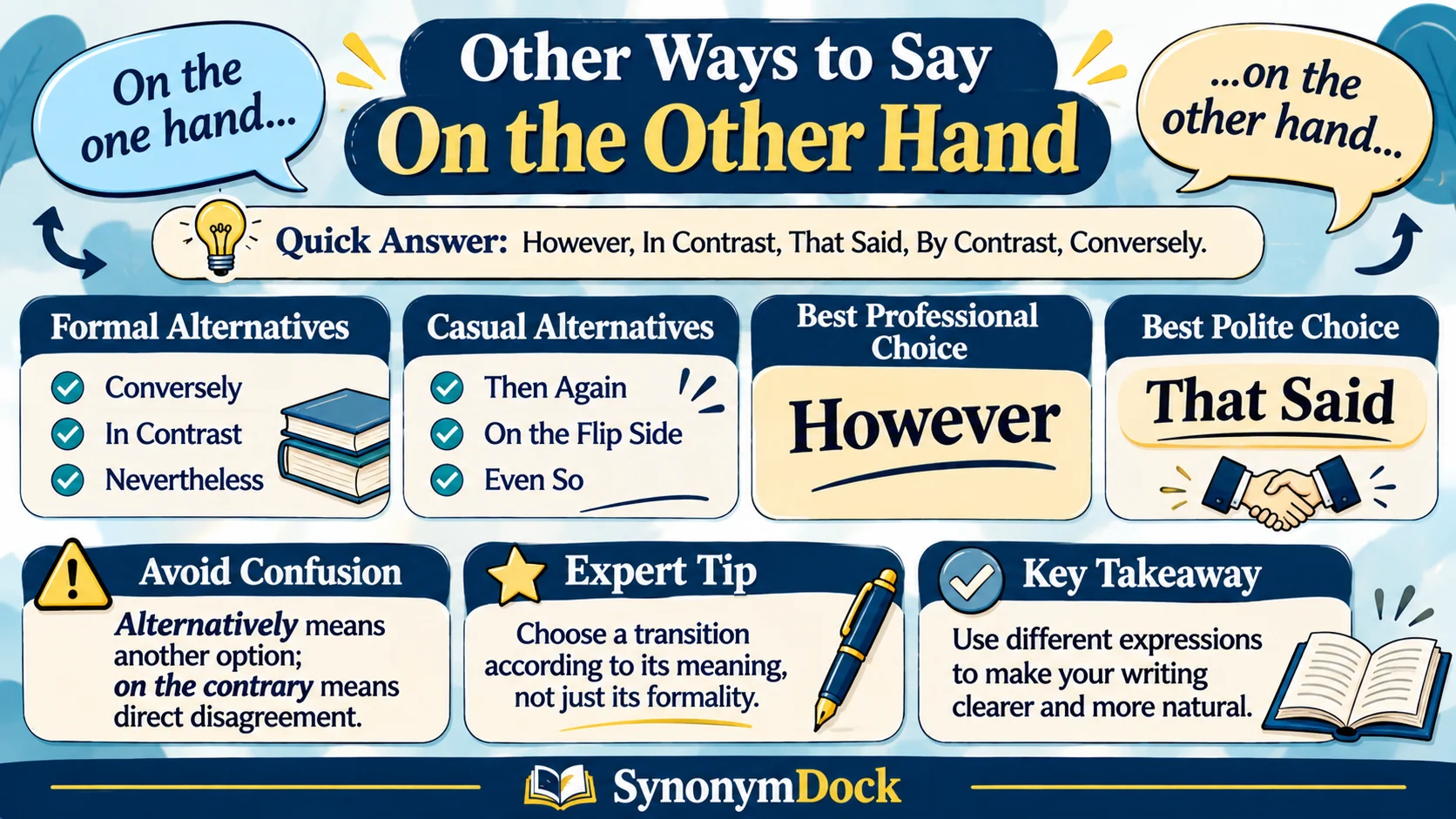
Other ways to say on the other hand include however, in contrast, conversely, that said, and by contrast. These expressions help introduce different viewpoints, compare ideas, and make professional or academic writing more natural.
Have you ever repeated on the other hand several times in an essay, email, or conversation? Although this expression is useful, relying on it too often can make your writing sound repetitive. Learning different ways to express contrast helps you communicate more clearly.
The phrase introduces another perspective, a contrasting fact, or an opposing consideration. However, not every alternative carries exactly the same meaning. Some expressions sound formal and academic, while others feel natural in everyday conversations.
In this guide, you’ll discover 10 useful alternatives, practical examples, professional recommendations, and common mistakes. Whether you’re an English learner, student, teacher, or professional, these expressions will help improve your vocabulary.
Quick Categories: Alternatives by Situation
Formal Alternatives
- Conversely
- In contrast
- By contrast
- Nevertheless
- Even so
Pro Tip: Choose these expressions for academic papers, research discussions, and formal reports. Make sure the relationship between your ideas is genuinely contrasting.
Professional Alternatives
- However
- That said
- At the same time
- By contrast
- Nevertheless
Pro Tip: Use however for straightforward workplace communication and that said when acknowledging another person’s point.
Business Email Alternatives
- However
- That said
- At the same time
- Nevertheless
- Even so
Pro Tip: Keep business emails direct. Choose a transition that connects your ideas instead of adding unnecessary formal language.
Academic Alternatives
- Conversely
- In contrast
- By contrast
- Nevertheless
- Whereas
Pro Tip: Use whereas when comparing two subjects within one sentence. Use conversely when showing an opposite relationship.
Casual Alternatives
- Then again
- That said
- Still
- At the same time
- Even so
Pro Tip: These expressions work well in friendly discussions and everyday conversations.
Informal Expressions
- On the flip side
- Then again
- But then again
- Still
- Mind you
Pro Tip: Save informal expressions for relaxed conversations, personal messages, and casual content.
What Does “On the Other Hand” Mean?
On the other hand is a transitional expression used to introduce a contrasting idea, opinion, fact, or perspective.
It helps readers understand that another side of a situation deserves consideration.
Simple explanation: When you say on the other hand, you’re asking someone to consider a different point of view.
Example:
The apartment is close to my workplace. On the other hand, the rent is quite expensive.
Here, the expression introduces a disadvantage that balances the earlier advantage.
Grammar explanation:
On the other hand functions as a transition phrase. It commonly appears at the beginning of a sentence and is followed by a comma.
Example: The course is affordable. On the other hand, it requires considerable study time.
The paired expression on the one hand … on the other hand is useful when presenting two sides of the same argument.
When Should You Use These Alternatives?
Business Communication: Use however or that said when discussing different opinions, project challenges, and business decisions.
Example: The proposal offers excellent value. However, we need to review the delivery schedule.
Emails: Use however for a clear contrast or that said for a more conversational and diplomatic transition.
Meetings: Use at the same time to acknowledge competing priorities without dismissing another person’s suggestion.
Presentations: Use in contrast or by contrast when comparing results, options, or performance.
Academic Writing: Use conversely when describing opposite relationships and in contrast when highlighting differences.
Interviews: Use that said to acknowledge a challenge before explaining another relevant strength or consideration.
Daily Conversations: Use then again, still, or on the flip side to introduce another thought naturally.
Professional vs. Polite vs. Formal vs. Natural
These expressions are related, but their tones are different.
- Polite: That said. It acknowledges an earlier point without sounding dismissive.
- Professional: However. It communicates a contrasting idea clearly.
- Formal: Conversely. It works well in analytical and academic contexts.
- Natural: Then again. It sounds relaxed in everyday conversations.
Example comparison:
Professional: The service is excellent. However, the waiting time is long.
Polite: I understand your suggestion. That said, we should consider another option.
Formal: The first method reduces costs. Conversely, the second method improves flexibility.
Natural: I like the idea. Then again, it might take too much time.
Pros and Cons of Using Alternatives
Pros
- Improved vocabulary: Learn different ways to express contrasting ideas.
- Better readability: Avoid repeating the same transition throughout an article.
- Clearer communication: Choose expressions that explain the relationship between ideas.
- Professional confidence: Adapt your language to emails, reports, and meetings.
- Natural conversations: Develop a wider range of everyday expressions.
Cons
- Meaning differences: Some alternatives do not express exactly the same relationship.
- Overly formal language: Words such as conversely may sound unnatural in casual conversations.
- Incorrect context: Using on the contrary instead of however can change your intended meaning.
- Repetition: Replacing one repeated phrase with another repeated phrase does not solve the problem.
- Grammar mistakes: Some expressions require different sentence structures.
Other Ways to Say “On the Other Hand” (With Examples)
Here are 10 useful alternatives, arranged from broadly useful expressions to more context-specific choices.
1. Phrase: However
Meaning: Introduces a contrasting statement or unexpected fact.
Explanation: However is one of the most versatile professional alternatives. It works in emails, essays, reports, presentations, and everyday communication.
- Formality: Neutral to formal
- Example Sentence: The new software saves time. However, employees need additional training.
- Best Use: Professional communication
- Avoid Using In: Unnecessary repetition
- Tone: Clear and neutral
- Formality Level: ⭐⭐⭐⭐
- Usage Frequency: Very Common
- CEFR Level: B1
- Common Collocations: However necessary, however difficult, however important, however small.
Context Examples:
- Spoken English: I like the idea. However, I’m not completely convinced.
- Professional English: The proposal is promising. However, additional approval is required.
- Casual Conversation: It looks expensive. However, the quality seems good.
2. Phrase: In Contrast
Meaning: Highlights a difference between two people, situations, or ideas.
Explanation: In contrast is particularly useful when comparing two subjects. It sounds organized and works well in academic and professional writing.
- Formality: Formal
- Example Sentence: The first department focuses on sales. In contrast, the second handles customer support.
- Best Use: Comparative writing
- Avoid Using In: Unrelated ideas
- Tone: Analytical and clear
- Formality Level: ⭐⭐⭐⭐
- Usage Frequency: Common
- CEFR Level: B2
- Common Collocations: In contrast to, in contrast with, sharp contrast, clear contrast.
Context Examples:
- Spoken English: My brother enjoys cities. In contrast, I prefer quiet places.
- Professional English: Our previous system was complicated. In contrast, the new platform is easier to navigate.
- Casual Conversation: This café is peaceful. In contrast, the one downtown is always busy.
3. Phrase: That Said
Meaning: Acknowledges an earlier point before introducing another consideration.
Explanation: That said creates a smooth transition without completely rejecting the previous statement. It is especially effective in friendly professional communication.
- Formality: Neutral
- Example Sentence: The schedule is demanding. That said, the experience will be valuable.
- Best Use: Diplomatic communication
- Avoid Using In: Highly formal legal writing
- Tone: Balanced and polite
- Formality Level: ⭐⭐⭐
- Usage Frequency: Very Common
- CEFR Level: B2
- Common Collocations: That said, I agree; that said, we should; that said, it remains; that said, there is.
Context Examples:
- Spoken English: It’s a long journey. That said, the destination is worth visiting.
- Professional English: The budget is limited. That said, we can explore other solutions.
- Casual Conversation: The movie was slow. That said, I enjoyed the ending.
4. Phrase: By Contrast
Meaning: Introduces a point that differs from another situation or example.
Explanation: By contrast is useful for structured comparisons. It is common in reports, presentations, and analytical writing.
- Formality: Formal
- Example Sentence: Urban areas have extensive transport networks. By contrast, rural communities may have limited services.
- Best Use: Formal comparisons
- Avoid Using In: Unrelated statements
- Tone: Objective and analytical
- Formality Level: ⭐⭐⭐⭐
- Usage Frequency: Common
- CEFR Level: B2
- Common Collocations: By contrast with, sharp contrast, clear contrast, striking contrast.
Context Examples:
- Spoken English: My old phone was slow. By contrast, this one works smoothly.
- Professional English: The first proposal requires more funding. By contrast, the second is relatively affordable.
- Casual Conversation: His room is colorful. By contrast, mine is quite simple.
5. Phrase: Conversely
Meaning: Introduces an opposite or reverse relationship.
Explanation: Conversely is more specific than however. Use it when the second statement presents an opposite relationship rather than just another consideration.
- Formality: Formal
- Example Sentence: When demand increases, prices may rise. Conversely, lower demand can reduce prices.
- Best Use: Analytical writing
- Avoid Using In: Simple unrelated comparisons
- Tone: Academic and precise
- Formality Level: ⭐⭐⭐⭐⭐
- Usage Frequency: Common
- CEFR Level: C1
- Common Collocations: Conversely true, conversely related, conversely proportional, conversely, the results show.
Context Examples:
- Spoken English: Some people prefer working early. Conversely, others are more productive at night.
- Professional English: Greater investment can increase capacity. Conversely, reduced investment may limit expansion.
- Casual Conversation: He enjoys cold weather. Conversely, I prefer warm days.
Native Speaker Tip After the First Five
For everyday and professional communication, however is usually the easiest choice. That said sounds more conversational and diplomatic. Conversely is less common in ordinary speech and is best reserved for clear opposite relationships.
6. Phrase: At the Same Time
Meaning: Introduces another consideration that exists alongside the first.
Explanation: This phrase is useful when two facts can both be true. It often creates a softer contrast than however.
- Formality: Neutral
- Example Sentence: We need to finish quickly. At the same time, accuracy must remain our priority.
- Best Use: Balanced arguments
- Avoid Using In: Direct oppositions
- Tone: Balanced and thoughtful
- Formality Level: ⭐⭐⭐
- Usage Frequency: Very Common
- CEFR Level: B1
- Common Collocations: At the same time, consider; at the same time, maintain; at the same time, ensure; at the same time, recognize.
Context Examples:
- Spoken English: I enjoy traveling. At the same time, I love staying home.
- Professional English: We should reduce costs. At the same time, product quality must remain consistent.
- Casual Conversation: I want to go out. At the same time, I’m feeling tired.
7. Phrase: Nevertheless
Meaning: Shows that something remains true despite an earlier difficulty or opposing fact.
Explanation: Nevertheless is a formal transition that emphasizes persistence despite a challenge. It is useful in academic essays and professional reports.
- Formality: Formal
- Example Sentence: The research faced several challenges. Nevertheless, the team completed the study.
- Best Use: Formal writing
- Avoid Using In: Relaxed everyday chats
- Tone: Confident and formal
- Formality Level: ⭐⭐⭐⭐⭐
- Usage Frequency: Common
- CEFR Level: C1
- Common Collocations: Nevertheless important, nevertheless successful, nevertheless remains, nevertheless continues.
Context Examples:
- Spoken English: It was difficult. Nevertheless, we finished the task.
- Professional English: The results were limited. Nevertheless, they provided valuable insights.
- Casual Conversation: It started raining. Nevertheless, we enjoyed our walk.
8. Phrase: Even So
Meaning: Introduces a statement that remains true despite the previous information.
Explanation: Even so is a flexible expression that shows a contrast while keeping the conversation natural. It is less formal than nevertheless.
- Formality: Neutral
- Example Sentence: The course is challenging. Even so, many students find it rewarding.
- Best Use: Everyday contrast
- Avoid Using In: Highly formal documents
- Tone: Natural and balanced
- Formality Level: ⭐⭐⭐
- Usage Frequency: Common
- CEFR Level: B2
- Common Collocations: Even so, it remains; even so, we can; even so, the result; even so, it matters.
Context Examples:
- Spoken English: The journey was tiring. Even so, I enjoyed it.
- Professional English: The deadline is tight. Even so, we expect to deliver the work.
- Casual Conversation: The restaurant was crowded. Even so, the food was excellent.
9. Phrase: Then Again
Meaning: Introduces another thought that makes someone reconsider an earlier opinion.
Explanation: Then again is a natural conversational alternative. It is useful when adding a second thought rather than presenting a strict opposite.
- Formality: Informal
- Example Sentence: I could buy the cheaper laptop. Then again, the more expensive model may last longer.
- Best Use: Casual conversations
- Avoid Using In: Academic papers
- Tone: Relaxed and reflective
- Formality Level: ⭐⭐
- Usage Frequency: Very Common
- CEFR Level: B2
- Common Collocations: But then again, maybe; then again, perhaps; then again, it might; then again, I think.
Context Examples:
- Spoken English: I might take the bus. Then again, walking could be easier.
- Professional English: We could postpone the meeting. Then again, the team may prefer to proceed today.
- Casual Conversation: I thought about ordering pizza. Then again, homemade food sounds better.
10. Phrase: On the Flip Side
Meaning: Introduces the opposite or less obvious side of a situation.
Explanation: On the flip side is a friendly, informal expression. It works well in blogs, casual discussions, and relaxed presentations.
- Formality: Informal
- Example Sentence: Working remotely saves commuting time. On the flip side, it can reduce face-to-face interaction.
- Best Use: Casual discussions
- Avoid Using In: Formal reports
- Tone: Friendly and conversational
- Formality Level: ⭐⭐
- Usage Frequency: Common
- CEFR Level: B2
- Common Collocations: On the flip side, there is; on the flip side, you get; on the flip side, it means; on the flip side of things.
Context Examples:
- Spoken English: Living downtown is convenient. On the flip side, it’s noisy.
- Professional English: Flexible working offers freedom. On the flip side, communication requires more planning.
- Casual Conversation: The holiday was expensive. On the flip side, we had an amazing time.
Native Speaker Tip After the Last Five
At the same time is useful when balancing two priorities. Nevertheless and even so emphasize persistence despite difficulties. Then again and on the flip side feel more conversational. Choose the phrase that matches your intended meaning rather than the one that simply sounds impressive.
Expert Insight: Choosing the Right Expression
Workplace Communication: However is a reliable choice for reports and meetings. Use that said when acknowledging someone’s opinion before explaining another consideration.
Email Writing: Keep transitions simple. However and that said usually sound more natural than unnecessarily complicated expressions.
Academic English: In contrast and by contrast help compare subjects. Conversely works when explaining opposite relationships, while nevertheless highlights something that remains true despite a challenge.
Professional Tone: Good communication depends on accuracy, not complicated vocabulary. A simple transition that fits your meaning is better than an impressive phrase used incorrectly.
Quick Recap: Best Alternatives
| Category | Best Choice |
|---|---|
| Best Professional Choice | However |
| Best Casual Choice | Then again |
| Best Formal Choice | Conversely |
| Most Natural Choice | However |
| Most Polite Choice | That said |
Comparison Table: 10 Alternatives
| Phrase | Tone | Formality | Best Use | Frequency |
|---|---|---|---|---|
| However | Neutral | High | Emails, reports | Very Common |
| In contrast | Analytical | High | Comparisons | Common |
| That said | Polite | Medium | Meetings, emails | Very Common |
| By contrast | Analytical | High | Academic writing | Common |
| Conversely | Academic | Very High | Opposite relationships | Common |
| At the same time | Balanced | Medium | Discussions | Very Common |
| Nevertheless | Formal | Very High | Reports, essays | Common |
| Even so | Natural | Medium | Everyday speech | Common |
| Then again | Casual | Low | Conversations | Very Common |
| On the flip side | Informal | Low | Casual discussions | Common |
Which Alternative Is the Best Choice?
Best Overall: However
It works across professional, academic, and everyday communication without sounding unnecessarily complicated.
Best Professional: However
It is clear, concise, and suitable for workplace discussions and business writing.
Best Academic: In Contrast
It helps readers identify differences between subjects, arguments, and research findings.
Best Business Email: That Said
It introduces another consideration while keeping the message friendly and respectful.
Best Everyday Conversation: Then Again
It sounds natural when reconsidering an opinion or introducing another thought.
Most Natural: However
It is a versatile expression that fits many everyday and professional situations.
Most Polite: That Said
It helps acknowledge an earlier point before presenting another perspective.
Commonly Confused Phrases
Not every expression that introduces a different idea means the same thing. Understanding these differences helps prevent confusing sentences.
1. However vs. On the Contrary
- However introduces a contrasting statement.
- On the contrary directly rejects or corrects an earlier statement.
Example: The service is not expensive. On the contrary, it is quite affordable.
2. Conversely vs. In Contrast
- Conversely shows an opposite or reverse relationship.
- In contrast highlights a difference between two subjects.
3. Alternatively vs. On the Other Hand
- Alternatively introduces another option or possibility.
- On the other hand presents a different perspective.
Example: We can meet on Monday. Alternatively, we can arrange a video call.
4. Nevertheless vs. However
- Nevertheless emphasizes that something remains true despite a difficulty.
- However simply introduces a contrasting point.
5. That Said vs. At the Same Time
- That said acknowledges an earlier statement before adding another consideration.
- At the same time emphasizes two considerations that coexist.
Scenario Practice: Which Phrase Would You Choose?
Test your understanding with these five realistic situations.
1. Business Meeting
Situation: Your team likes a proposal, but the budget needs additional review.
Which phrase would you choose?
Answer: However
Explanation: It introduces a clear concern without making the discussion sound unnecessarily complicated.
2. Interview
Situation: You acknowledge that a job requires experience, but you also want to highlight your willingness to learn.
Which phrase would you choose?
Answer: That said
Explanation: It helps acknowledge a challenge before presenting another positive consideration.
3. Presentation
Situation: You are comparing the performance of two departments.
Which phrase would you choose?
Answer: By contrast
Explanation: It clearly introduces a comparison between two different subjects.
4. Classroom Discussion
Situation: You explain that online learning offers flexibility, but classroom learning provides direct interaction.
Which phrase would you choose?
Answer: In contrast
Explanation: It highlights the difference between two learning methods.
5. Email Reply
Situation: You agree with a colleague’s suggestion but want to mention a possible scheduling problem.
Which phrase would you choose?
Answer: That said
Explanation: It maintains a respectful tone while introducing another consideration.
Mini Quiz: Test Your Knowledge
Choose the most suitable expression for each sentence.
1. Which expression is best for formal analytical writing when showing an opposite relationship?
A. Then again
B. Conversely
C. On the flip side
D. But then again
2. Which phrase is most suitable for a friendly professional email?
A. That said
B. On the contrary
C. On the flip side
D. Mind you
3. Complete the sentence: The journey was difficult. ______, we enjoyed the experience.
A. Alternatively
B. Nevertheless
C. On the contrary
D. Whereas
4. Which expression introduces another available option?
A. However
B. Nevertheless
C. Alternatively
D. Even so
5. Which phrase sounds most natural in a casual conversation when reconsidering an opinion?
A. Conversely
B. Then again
C. By contrast
D. Notwithstanding
Answer Key
- B. Conversely – Shows an opposite relationship.
- A. That said – Creates a polite, conversational transition.
- B. Nevertheless – Shows that the positive outcome remained true despite difficulty.
- C. Alternatively – Introduces another option.
- B. Then again – Naturally introduces a second thought.
FAQs
1. What is another way to say on the other hand?
You can say however, in contrast, by contrast, conversely, or that said. Each expression introduces a different perspective, but the best choice depends on whether you’re writing formally or speaking casually.
2. What is a professional way to say on the other hand?
However is one of the best professional alternatives. It sounds clear and appropriate in business emails, reports, meetings, and presentations. That said is another useful option for a more conversational workplace tone.
3. What is a formal alternative to on the other hand?
Conversely, in contrast, by contrast, and nevertheless are useful formal alternatives. Choose conversely for opposite relationships and in contrast when comparing different subjects in academic or professional writing.
4. Can I use however instead of on the other hand?
Yes. However can introduce a contrasting statement in most situations. However, it does not always emphasize two balanced perspectives in exactly the same way, so consider your intended meaning.
5. What is a casual way to say on the other hand?
Then again and on the flip side are useful casual expressions. Then again introduces another thought, while on the flip side highlights another aspect of a situation.
Conclusion
Learning other ways to say on the other hand can make your English more flexible, natural, and professional. Expressions such as however, that said, conversely, and in contrast help you communicate different perspectives without repeating the same transition. The important thing is understanding their meanings, tones, and appropriate situations.
Start by practicing one or two alternatives in your emails, essays, and everyday conversations. Pay attention to how each phrase connects your ideas. With regular practice, you’ll develop stronger vocabulary, write more confidently, and express contrasting opinions with greater clarity.