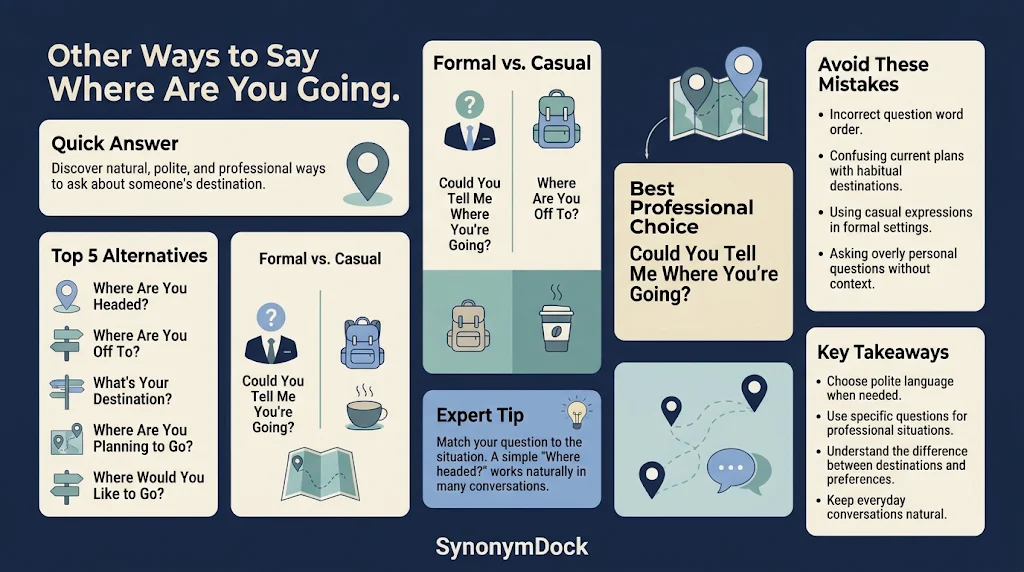
Other ways to say Where Are You Going include Where are you headed?, Where are you off to?, What’s your destination?, Do you have somewhere in mind?, and Where are you planning to go? Choose based on tone and context.
Asking Where Are You Going? is a simple way to learn about someone’s destination or plans. However, repeating the same question can make conversations feel predictable or sometimes too direct.
Learning different expressions helps you sound more natural, polite, and confident in English. Some alternatives are perfect for friends, while others work better in professional conversations and business communication.
In this guide, you’ll discover ten practical alternatives, their meanings, examples, and the situations where each expression works best.
Quick Categories: Alternatives by Situation
1. Formal Alternatives
Use these expressions when speaking with unfamiliar people, professional contacts, or individuals you want to address respectfully.
- May I ask where you’re headed?
- What is your intended destination?
- Could you tell me where you’re going?
- Where will you be traveling?
Pro Tip: Use indirect questions when speaking with someone you do not know well.
2. Professional Alternatives
These expressions work well in workplace conversations and professional discussions.
- Where are you heading next?
- Are you traveling to another location?
- What is your next destination?
- Where will you be going afterward?
Pro Tip: Ask only for information relevant to the conversation or work activity.
3. Business Email Alternatives
- Could you share your planned destination?
- May I confirm your next location?
- Where will you be traveling for the meeting?
- Could you let me know your intended travel destination?
Pro Tip: Explain why you need the information instead of asking an unexplained personal question.
4. Academic Alternatives
Use these expressions in classroom discussions, language exercises, and educational conversations.
- Where are you planning to go?
- What destination have you chosen?
- Where would you like to travel?
- Which place are you considering visiting?
Pro Tip: Use planning and preference questions when discussing travel assignments or future activities.
5. Casual Alternatives
These phrases sound relaxed and friendly.
- Where are you headed?
- Where are you off to?
- What’s the plan?
- Going somewhere interesting?
Pro Tip: These expressions work naturally with friends and familiar colleagues.
6. Informal Expressions
Use these short expressions in relaxed conversations and messages.
- Where to next?
- Heading out somewhere?
- Off somewhere?
- What’s your next stop?
Pro Tip: Informal questions work best when you already have a comfortable relationship with the person.
What Does “Other Ways to Say Where Are You Going” Mean?
Other ways to say Where Are You Going refers to alternative questions used to ask about someone’s destination, direction, or future travel plans.
The original expression is a direct question that usually asks where someone is traveling now or intends to travel soon.
Simple explanation: You want to know which place someone is going to visit, travel toward, or reach next.
Example:
- Original: “Where are you going after work?”
- Alternative: “Where are you headed after work?”
Both questions ask about someone’s destination, although the second sounds slightly more conversational.
Grammar Explanation
The original question uses the present continuous tense.
Structure:
Where + are + subject + going?
Example: Where are you going?
The present continuous can describe an action happening now or an arranged future plan.
Compare these questions:
- Where do you go? Asks about regular or habitual destinations.
- Where are you going? Asks about a current journey or future plan.
- Where will you go? Asks about a future destination.
- Where would you like to go? Asks about someone’s preference.
Understanding these differences helps English learners ask more accurate questions.
When Should You Use Alternatives to Where Are You Going?
The right expression depends on your relationship with the person and the reason for asking.
Business Communication
In workplace conversations, questions about destinations should have a clear purpose.
Example: “Where are you heading for your next client meeting?”
This sounds more focused than asking about someone’s personal movements without context.
Emails
When coordinating travel or appointments, use polite and specific expressions.
Example: “Could you let me know which office you’ll be visiting tomorrow?”
This explains the information you need.
Meetings
If a colleague is leaving for another appointment, you can ask about their next work destination.
Example: “Are you heading to another meeting after this?”
Presentations
During presentations about travel, logistics, or future plans, use clear questions.
Example: “Where are we planning to go for the next stage of the project?”
Academic Writing
The direct expression is usually more suitable for dialogue exercises than formal academic essays.
For research or reports, use more precise descriptions such as:
- Which destination did the participants select?
- Where did the travelers plan to visit?
- What location was chosen for the study?
Interviews
If an interview involves travel, career goals, or relocation, ask a specific question.
Example: “Where would you ideally like to work in the future?”
This sounds more relevant than a general question about someone’s immediate destination.
Daily Conversations
For friends and family, short and relaxed expressions are usually best.
Example: “Where are you off to this evening?”
It sounds friendly and natural.
Professional vs. Polite: What’s the Difference?
Although professional and polite expressions often overlap, they serve slightly different purposes.
| Style | Purpose | Example |
|---|---|---|
| Polite | Shows consideration | May I ask where you’re headed? |
| Professional | Focuses on relevant information | Where are you traveling for the meeting? |
| Formal | Uses respectful language | Could you tell me your intended destination? |
| Natural | Sounds conversational | Where are you off to? |
Expert recommendation: A polite question is not necessarily a long question. Sometimes adding a simple Could you tell me or May I ask makes your communication more considerate.
Pros and Cons of Using Different Expressions
Pros
- Better vocabulary: You learn more ways to ask questions naturally.
- Improved communication: You can adjust your language to different audiences.
- Professional confidence: You gain useful phrases for workplace discussions.
- Polite conversations: Indirect questions help soften requests for personal information.
- Greater accuracy: Different expressions help distinguish destinations from future plans.
Cons
- Unclear meaning: Some alternatives ask about plans rather than actual destinations.
- Wrong tone: Informal expressions may seem unsuitable in professional situations.
- Unnecessary complexity: Long questions can make simple conversations awkward.
- Privacy concerns: Asking about someone’s destination may feel intrusive without context.
- Grammar mistakes: Indirect questions require different word order.
Other Ways to Say “Where Are You Going” (With Examples)
Here are ten useful alternatives, arranged from versatile everyday questions to more specialized expressions.
1. Where Are You Headed?
Meaning: Asks someone about the place they are traveling toward.
Explanation: This is one of the most natural alternatives in everyday spoken English. It works with friends, colleagues, and familiar people without sounding overly formal.
It is suitable for neutral, casual, and some professional situations.
Example Sentence: “You’re leaving already? Where are you headed?”
Best Use: Everyday conversations.
Avoid Using In: Formal reports.
Tone: Friendly and natural.
Formality Level: ⭐⭐⭐
Usage Frequency: Very Common.
CEFR Level: B1 (approximate).
Common Collocations:
- Headed home
- Headed downtown
- Headed to work
- Headed in that direction
Context Examples:
- Spoken English: “Where are you headed after lunch?”
- Professional English: “Where are you headed for your next appointment?”
- Casual Conversation: “Hey, where are you headed?”
2. Where Are You Off To?
Meaning: Asks someone about their destination in a friendly way.
Explanation: This expression sounds relaxed and conversational. It is especially useful when someone is getting ready to leave or appears to be going somewhere.
It is more common in casual conversation than formal writing.
Example Sentence: “You’ve got your backpack ready. Where are you off to?”
Best Use: Friendly conversations.
Avoid Using In: Formal emails.
Tone: Casual and warm.
Formality Level: ⭐⭐
Usage Frequency: Common.
CEFR Level: B2 (approximate).
Common Collocations:
- Off to work
- Off to school
- Off to town
- Off to somewhere
Context Examples:
- Spoken English: “Where are you off to this morning?”
- Professional English: “Are you off to the client meeting?”
- Casual Conversation: “Where are you off to today?”
3. What’s Your Destination?
Meaning: Asks someone to identify the place they intend to reach.
Explanation: This expression is more formal and direct than everyday alternatives. It is particularly useful in travel, transportation, booking, and logistical situations.
It may sound too official when speaking casually with friends.
Example Sentence: “Could you confirm your destination before we arrange transportation?”
Best Use: Travel arrangements.
Avoid Using In: Friendly chats.
Tone: Direct and formal.
Formality Level: ⭐⭐⭐⭐⭐
Usage Frequency: Common.
CEFR Level: B1 (approximate).
Common Collocations:
- Final destination
- Travel destination
- Intended destination
- Destination address
Context Examples:
- Spoken English: “What’s your destination?”
- Professional English: “Please confirm your destination for the scheduled transfer.”
- Casual Conversation: “So, what’s your destination today?”
4. Where Are You Planning to Go?
Meaning: Asks about someone’s intended destination or future travel plans.
Explanation: This phrase focuses on planning rather than immediate movement. It is useful when discussing holidays, trips, weekends, and future activities.
It sounds neutral and works in both professional and personal conversations.
Example Sentence: “Where are you planning to go during the summer holidays?”
Best Use: Future travel plans.
Avoid Using In: Immediate departures.
Tone: Neutral and curious.
Formality Level: ⭐⭐⭐⭐
Usage Frequency: Very Common.
CEFR Level: B1 (approximate).
Common Collocations:
- Planning to travel
- Planning to visit
- Planning to go abroad
- Planning a trip
Context Examples:
- Spoken English: “Where are you planning to go this weekend?”
- Professional English: “Where are you planning to travel for the conference?”
- Casual Conversation: “Where are you planning to go on vacation?”
5. Where Would You Like to Go?
Meaning: Asks someone about their preferred destination.
Explanation: This expression is polite and considerate because it focuses on the other person’s preference. It is particularly useful when planning activities together.
It is also suitable for customer service and travel-related conversations.
Example Sentence: “We’re choosing a place for our weekend trip. Where would you like to go?”
Best Use: Asking preferences.
Avoid Using In: Urgent directions.
Tone: Polite and friendly.
Formality Level: ⭐⭐⭐⭐
Usage Frequency: Very Common.
CEFR Level: B1 (approximate).
Common Collocations:
- Like to visit
- Like to travel
- Like to explore
- Like to go next
Context Examples:
- Spoken English: “Where would you like to go for dinner?”
- Professional English: “Where would you like to travel for the business event?”
- Casual Conversation: “Where would you like to go this weekend?”
Native Speaker Tip: Choosing the First Five
“Where are you headed?” is one of the most flexible alternatives for everyday conversations. “Where are you off to?” sounds more relaxed, while “What’s your destination?” is better suited to travel arrangements.
“Where are you planning to go?” asks about future intentions. “Where would you like to go?” focuses on preferences rather than confirmed plans.
A useful distinction: asking where someone is headed is not the same as asking where they want to go.
6. Where Will You Be Going?
Meaning: Asks about someone’s expected future destination.
Explanation: This expression is slightly more formal than Where are you going? It works well when discussing scheduled travel, appointments, and future arrangements.
Example Sentence: “Where will you be going after the training session?”
Best Use: Future arrangements.
Avoid Using In: Quick casual chats.
Tone: Neutral and formal.
Formality Level: ⭐⭐⭐⭐
Usage Frequency: Common.
CEFR Level: B1 (approximate).
Common Collocations:
- Will be traveling
- Will be visiting
- Will be going next
- Future destination
Context Examples:
- Spoken English: “Where will you be going tomorrow?”
- Professional English: “Where will you be going after the client presentation?”
- Casual Conversation: “Where will you be going for your holidays?”
7. Could You Tell Me Where You’re Going?
Meaning: Politely asks someone to share their destination.
Explanation: This is an indirect question. The introductory words Could you tell me make the request softer and more considerate.
It is appropriate for professional conversations and situations involving unfamiliar people.
Example Sentence: “Could you tell me where you’re going so I can arrange the transportation?”
Best Use: Polite inquiries.
Avoid Using In: Very relaxed chats.
Tone: Respectful and considerate.
Formality Level: ⭐⭐⭐⭐⭐
Usage Frequency: Common.
CEFR Level: B1 (approximate).
Common Collocations:
- Tell me where
- Share your destination
- Explain your plans
- Provide travel details
Context Examples:
- Spoken English: “Could you tell me where you’re going?”
- Professional English: “Could you tell me where you’re traveling for the scheduled meeting?”
- Casual Conversation: “Can you tell me where you’re headed?”
8. What’s Your Next Stop?
Meaning: Asks about the next place someone plans to visit or reach.
Explanation: This phrase is especially useful when someone is traveling between several places. It also works in conversations about schedules, tours, and daily plans.
Example Sentence: “You’ve already visited the museum. What’s your next stop?”
Best Use: Multiple destinations.
Avoid Using In: One-location discussions.
Tone: Friendly and curious.
Formality Level: ⭐⭐⭐
Usage Frequency: Common.
CEFR Level: B1 (approximate).
Common Collocations:
- Next stop
- Final stop
- First stop
- Travel itinerary
Context Examples:
- Spoken English: “What’s your next stop?”
- Professional English: “What’s your next stop on the business itinerary?”
- Casual Conversation: “So, what’s your next stop today?”
9. Are You Heading Somewhere?
Meaning: Asks whether someone is going to another place.
Explanation: This expression is slightly less direct because it asks whether the person is going somewhere rather than requesting an exact destination.
It works naturally when someone appears ready to leave.
Example Sentence: “You seem to be in a hurry. Are you heading somewhere?”
Best Use: Casual inquiries.
Avoid Using In: Formal interviews.
Tone: Relaxed and curious.
Formality Level: ⭐⭐⭐
Usage Frequency: Common.
CEFR Level: B1 (approximate).
Common Collocations:
- Heading somewhere
- Heading out
- Heading home
- Heading downtown
Context Examples:
- Spoken English: “Are you heading somewhere after class?”
- Professional English: “Are you heading to another office location?”
- Casual Conversation: “Are you heading somewhere fun?”
10. Where Are You Bound?
Meaning: Asks about someone’s intended destination or direction of travel.
Explanation: This is a more specialized expression that appears in travel-related and somewhat literary language. It is less common in ordinary everyday conversation.
A more complete version is “Where are you bound for?”
Example Sentence: “The traveler checked the train schedule and asked, ‘Where are you bound for?'”
Best Use: Travel conversations.
Avoid Using In: Everyday emails.
Tone: Formal and literary.
Formality Level: ⭐⭐⭐⭐
Usage Frequency: Occasional.
CEFR Level: C1 (approximate).
Common Collocations:
- Bound for London
- Bound for home
- Northbound journey
- Destination ahead
Context Examples:
- Spoken English: “Where are you bound for?”
- Professional English: “Which destination is the scheduled vehicle bound for?”
- Casual Conversation: “Where are you heading?”
Native Speaker Tip: Choosing the Last Five
“Where will you be going?” works when discussing future arrangements. “Could you tell me where you’re going?” is a polite alternative when you need to ask someone directly.
“What’s your next stop?” is useful for journeys with multiple destinations. “Are you heading somewhere?” is more general, while “Where are you bound?” is less common in everyday speech.
For most ordinary conversations, native English speakers generally prefer simple expressions such as “Where are you headed?” or “Where are you off to?”
Expert Insight: Choosing the Right Question
Workplace Communication
Professional questions should focus on relevant information rather than someone’s private movements.
Recommended:
- Where are you heading for the next meeting?
- Are you visiting another office today?
- What is your next business destination?
Email Writing
Use indirect questions when requesting travel information.
Example:
“Could you let me know which office you’ll be visiting tomorrow? This will help us coordinate the meeting schedule.”
This explains the purpose and makes the request more considerate.
Academic English
When discussing travel plans, destinations, or preferences, use clear and specific expressions.
Recommended:
- Where are you planning to go?
- Which destination have you selected?
- Where would you like to travel?
Professional Tone
Avoid using overly personal questions without a clear reason. A respectful question gives people room to share only the information they feel comfortable providing.
Quick Recap: Best Alternatives
| Category | Best Choice |
|---|---|
| Best Professional Choice | Could You Tell Me Where You’re Going? |
| Best Casual Choice | Where Are You Off To? |
| Best Formal Choice | What’s Your Destination? |
| Most Natural Choice | Where Are You Headed? |
| Most Polite Choice | Where Would You Like to Go? |
Comparison Table: All 10 Alternatives
| Phrase | Tone | Formality | Best Use | Frequency |
|---|---|---|---|---|
| Where Are You Headed? | Friendly | Medium | Daily conversations | Very Common |
| Where Are You Off To? | Casual | Low | Friendly chats | Common |
| What’s Your Destination? | Direct | High | Travel arrangements | Common |
| Where Are You Planning to Go? | Neutral | Medium | Future plans | Very Common |
| Where Would You Like to Go? | Polite | Medium-high | Preferences | Very Common |
| Where Will You Be Going? | Neutral | Medium-high | Future arrangements | Common |
| Could You Tell Me Where You’re Going? | Respectful | High | Professional inquiries | Common |
| What’s Your Next Stop? | Curious | Medium | Travel itineraries | Common |
| Are You Heading Somewhere? | Relaxed | Medium-low | Casual inquiries | Common |
| Where Are You Bound? | Literary | High | Travel discussions | Occasional |
Frequency labels are practical editorial estimates, not measured language-corpus statistics.
Which Alternative Is the Best Choice?
Best Overall: Where Are You Headed?
This expression works in many everyday situations. It sounds natural, friendly, and clear without being overly formal.
Best Professional: Could You Tell Me Where You’re Going?
It makes a direct question more considerate and is useful when requesting relevant information from colleagues.
Best Academic: Where Are You Planning to Go?
It works well for classroom discussions, travel assignments, and conversations about future plans.
Best Business Email: Could You Share Your Planned Destination?
This alternative is specific and professional. It is particularly useful when coordinating travel arrangements.
Best Everyday Conversation: Where Are You Off To?
It sounds relaxed and friendly when speaking with people you already know.
Most Natural: Where Are You Headed?
It is short, conversational, and widely understood across different English-speaking audiences.
Most Polite: Where Would You Like to Go?
It focuses on someone’s preferences rather than demanding information about their movements.
Commonly Confused Phrases: What’s the Difference?
1. Where Are You Going vs. Where Do You Go?
- Where are you going? Asks about a current or planned destination.
- Where do you go? Asks about a regular or habitual destination.
Examples:
- “Where are you going after school?”
- “Where do you go for lunch every day?”
2. Where Are You Going vs. Where Are You Headed?
- Where are you going? Is a general question about someone’s destination.
- Where are you headed? Is a conversational alternative that emphasizes direction.
Both are natural in everyday English.
3. Where Are You Going vs. Where Would You Like to Go?
- Where are you going? Asks about an actual or planned destination.
- Where would you like to go? Asks about someone’s preference.
Example:
“Where would you like to go for our next holiday?”
4. Where Are You Going vs. Where Are You Off To?
- Where are you going? Is neutral and widely suitable.
- Where are you off to? Sounds more relaxed and conversational.
The second expression is particularly common when someone is preparing to leave.
5. Where Are You Going vs. Where Will You Be Going?
- Where are you going? Often refers to current or planned movement.
- Where will you be going? Focuses on an expected future destination.
The choice depends on the time and situation being discussed.
Common Mistakes When Asking Where Are You Going
Mistake 1: Using Incorrect Word Order
Wrong usage: Where you are going?
Why incorrect: Direct questions require the auxiliary verb before the subject.
Correct phrase: Where are you going?
Example: “Where are you going after work?”
Mistake 2: Confusing Habitual and Current Actions
Wrong usage: Where do you going?
Why incorrect: Do cannot be followed directly by going in this question structure.
Correct phrase: Where are you going?
Example: “Where are you going this afternoon?”
Mistake 3: Using Informal Language in Formal Situations
Wrong usage: Where you off to, sir?
Why incorrect: This shortened construction may sound too casual in formal communication.
Correct phrase: May I ask where you’re headed?
Example: “May I ask where you’re headed after the appointment?”
Mistake 4: Incorrect Indirect Question Structure
Wrong usage: Could you tell me where are you going?
Why incorrect: Indirect questions use statement word order inside the embedded question.
Correct phrase: Could you tell me where you are going?
Example: “Could you tell me where you are going after the meeting?”
Mistake 5: Asking Without Considering Privacy
Wrong usage: Demanding someone’s exact destination without a clear reason.
Why incorrect: Even grammatically correct questions can sound intrusive.
Correct phrase: “Are you heading somewhere, or would you prefer to keep your plans private?”
Example: Use a friendly tone and respect the other person’s choice not to answer.
Scenario Practice: Which Phrase Would You Choose?
Test your understanding with these five situations.
Situation 1: Business Meeting
Your colleague is leaving for another office after a meeting.
Which phrase would you choose?
Answer: “Where are you heading for your next meeting?”
Why: It is specific, professional, and connected to the work situation.
Situation 2: Interview
You are discussing a candidate’s future career preferences.
Which phrase would you choose?
Answer: “Where would you like to work in the future?”
Why: It asks about professional preferences rather than immediate travel plans.
Situation 3: Presentation
You are introducing the next destination on a travel itinerary.
Which phrase would you choose?
Answer: “What’s our next stop?”
Why: It is concise and appropriate when discussing multiple destinations.
Situation 4: Classroom Discussion
Your teacher asks students about their holiday plans.
Which phrase would you choose?
Answer: “Where are you planning to go during the holidays?”
Why: It naturally asks about future intentions.
Situation 5: Email Reply
You need to confirm a colleague’s destination for a scheduled business trip.
Which phrase would you choose?
Answer: “Could you confirm your planned destination?”
Why: It is clear, polite, and appropriate for professional correspondence.
Mini Quiz: Test Your English Vocabulary
Question 1: Which phrase sounds most natural in a casual conversation?
A. Where are you bound?
B. Where are you headed?
C. What is your intended destination?
D. Kindly disclose your destination.
Question 2: Which expression is most suitable for asking about someone’s preference?
A. Where are you going?
B. Where are you off to?
C. Where would you like to go?
D. Where are you bound?
Question 3: Which expression is best for a professional inquiry?
A. Where you off to?
B. Could you tell me where you’re going?
C. Where to next?
D. Going somewhere fun?
Question 4: Which question asks about a habitual destination?
A. Where are you going?
B. Where will you go?
C. Where do you go?
D. Where are you headed?
Question 5: Which phrase is most useful when discussing several travel destinations?
A. What’s your next stop?
B. Where would you like to go?
C. Are you heading somewhere?
D. Where are you off to?
Answer Key
- B: It is natural and conversational.
- C: It asks about someone’s preference.
- B: It is polite and professional.
- C: It asks about a regular or habitual destination.
- A: It identifies the next location on a journey.
FAQs
1. What are the best other ways to say Where Are You Going?
Some natural alternatives include Where Are You Headed?, Where Are You Off To?, What’s Your Destination?, Where Are You Planning to Go?, and What’s Your Next Stop? Choose according to your relationship and situation.
2. How do you ask Where Are You Going politely?
You can say, “May I ask where you’re headed?” or “Could you tell me where you’re going?” These indirect questions sound considerate and work well with unfamiliar people and professional contacts.
3. What is a casual way to ask someone where they are going?
Try expressions such as “Where are you off to?”, “Where are you headed?”, or “What’s your next stop?” These alternatives sound friendly and natural when speaking with friends, classmates, or familiar colleagues.
4. What is a professional way to ask Where Are You Going?
Use specific questions such as “Where are you traveling for the meeting?” or “Could you confirm your next destination?” These expressions are appropriate when coordinating business appointments or workplace travel.
5. Is Where Are You Going grammatically correct?
Yes. Where Are You Going? is a grammatically correct present continuous question. It can refer to someone’s current movement or an arranged future plan. Use Where Do You Go? for habitual destinations instead.
Conclusion
Learning other ways to say Where Are You Going helps you communicate more naturally and confidently. Expressions such as Where Are You Headed?, Where Are You Off To?, and Where Would You Like to Go? make conversations more varied and appropriate for different situations. Understanding their meanings also helps you choose between casual, polite, and professional English.
Practice these alternatives in everyday conversations, classroom activities, and workplace discussions. Pay attention to your audience and the purpose of your question. With regular practice, you’ll develop stronger vocabulary and express yourself more comfortably.