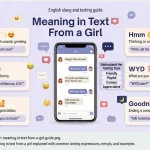
The meaning in text from a girl depends on the words, conversation, and situation. Her message might express friendliness, excitement, curiosity, humor, or interest. However, context matters more than individual words. Always consider the conversation before interpreting her intentions.
The meaning in text from a girl can sometimes feel confusing, especially when she uses short replies, emojis, abbreviations, or unfamiliar internet slang. A simple message might have several interpretations. Therefore, understanding the surrounding conversation helps you avoid unnecessary confusion.
Texting has changed how people communicate. Platforms like Snapchat, TikTok, Instagram, and iMessage encourage shorter messages and creative expressions. Furthermore, people often communicate emotions through emojis, punctuation, and texting habits. However, not every message carries a hidden meaning. Sometimes, a short reply is simply a quick response.
This guide explains how to interpret messages naturally. You will discover common texting situations, platform differences, realistic conversation examples, and alternative interpretations. Additionally, you will learn how to respond without overthinking every word. Whether you are reading a friendly message or trying to understand an unfamiliar expression, this guide will help you communicate more clearly.
Quick Answer: Understanding Her Text Messages
| Category | Explanation |
|---|---|
| Meaning | Understanding what a girl’s message communicates in a conversation |
| Context | Friendship, everyday communication, humor, curiosity, or possible interest |
| Primary Platforms | Snapchat, TikTok, Instagram, iMessage, and WhatsApp |
| Example | Girl: Heyyy! How was your day? |
| Tone | Friendly, casual, playful, curious, or sometimes affectionate |
What Does Meaning in Text From a Girl Mean?
The phrase meaning in text from a girl refers to understanding the message, expression, or intention behind something a girl sends through texting. It involves interpreting her words, abbreviations, emojis, punctuation, and conversational tone.
However, there is no universal dictionary that explains every message. The same expression can communicate different things depending on the situation.
For example, consider the word “okay.”
Someone might use it to acknowledge information. Another person might use it to agree with a suggestion. Furthermore, it can sometimes sound dismissive when the conversation feels tense.
Therefore, the surrounding conversation matters.
Understanding the Difference Between Words and Intentions
Words communicate the direct message. Intentions describe what someone wants to express through that message.
These two things do not always match perfectly.
Consider these examples:
| Text Message | Possible Interpretation |
|---|---|
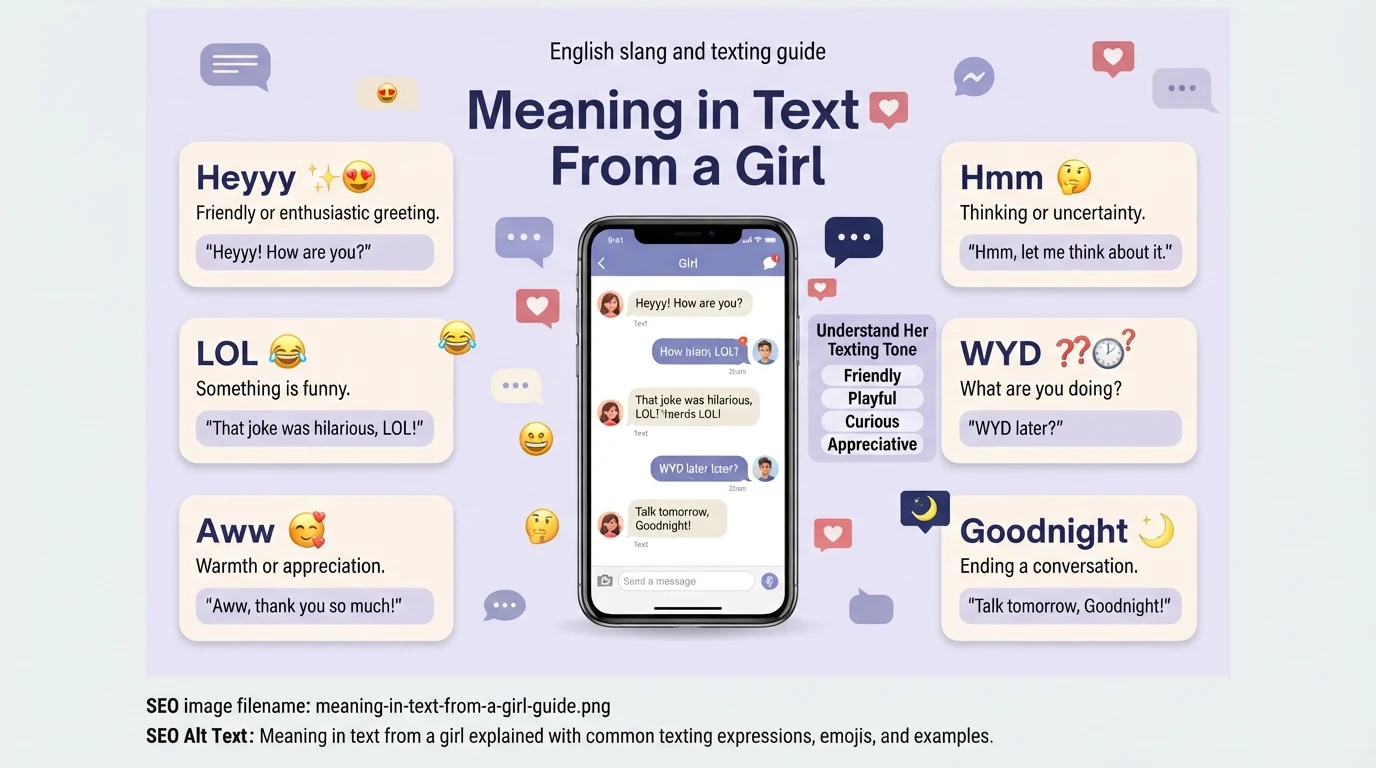
| Hey! | A casual greeting |
| Heyyy! | An enthusiastic or playful greeting |
| LOL | Amusement or a casual reaction |
| Hmm | Thinking or uncertainty |
| Okay! | Agreement or acknowledgment |
| Aww | Appreciation or a warm reaction |
| Really? | Surprise or curiosity |
| Sure | Agreement, depending on context |
| Goodnight | A friendly way to end a conversation |
| Take care | A thoughtful or polite goodbye |
These interpretations are possibilities, not fixed rules.
Does a Girl’s Text Always Have a Hidden Meaning?
No. Most messages communicate exactly what they say.
For example, if someone texts “I’m busy right now,” she might genuinely have something to do. It does not automatically suggest annoyance or avoidance.
Similarly, a friendly emoji does not necessarily indicate romantic interest.
Furthermore, people have different communication styles. Some write long messages, while others prefer short replies. Therefore, avoid making assumptions based on one message.
Why Context Matters in Texting
Context provides information that individual words cannot explain.
Consider the message “That’s nice.”
Its meaning can change depending on the conversation.
| Situation | Possible Meaning |
|---|---|
| You share good news | Genuine appreciation |
| You show a new project | Positive feedback |
| You suggest an activity | Agreement or acknowledgment |
| You discuss a disagreement | A potentially neutral or distant response |
The best approach is to consider what happened before the message.
Contextual Dynamics and Nuances of the Term
Text messages contain more than words. People use punctuation, emojis, abbreviations, and response patterns to express themselves.
Consequently, understanding these details can make everyday conversations easier.
1. The Importance of Message Length
Message length can influence how a conversation feels. However, it does not provide definite information about someone’s emotions.
For example:
| Message | Possible Tone |
|---|---|
| Yes | Direct |
| Yesss! | Excited |
| Okay | Neutral |
| Okayyy | Playful or expressive |
| No problem | Reassuring |
| Absolutely! | Enthusiastic |
Some people naturally send short messages. Others enjoy detailed conversations.
Therefore, compare a message with the person’s usual communication style rather than judging it independently.
2. Understanding Repeated Letters
Repeated letters often add emphasis or emotion.
For example:
Heyyy: An expressive greeting.
Yesss: An enthusiastic agreement.
Noooo: A dramatic or playful reaction.
Thank youuu: An affectionate or expressive way to show appreciation.
However, repeated letters do not have one official meaning. Their interpretation depends on the conversation.
3. The Role of Punctuation
Punctuation can change how a message sounds.
Compare these examples:
| Message | How It May Sound |
|---|---|
| Really? | Curious or surprised |
| Really!! | Very surprised |
| Really… | Hesitant or uncertain |
| Really. | Direct or serious |
| That’s great! | Enthusiastic |
| That’s great. | Neutral acknowledgment |
These differences are especially noticeable in casual texting.
Nevertheless, punctuation habits vary between individuals. Someone who frequently uses periods might not intend to sound serious.
4. Understanding Emojis and Their Emotional Tone
Emojis provide visual context. They can make messages feel more expressive and personal.
Here are some common examples:
| Emoji | Common Interpretation |
|---|---|
| 😂 | Something is funny |
| ❤️ | Love, affection, or appreciation |
| 😊 | Happiness or friendliness |
| 😭 | Strong emotion, laughter, or exaggeration |
| 🙄 | Annoyance or playful sarcasm |
| 🥰 | Warmth or affection |
| 👀 | Curiosity or attention |
| 💀 | Something is extremely funny or surprising |
| ✨ | Excitement or emphasis |
| 🤔 | Thinking or questioning |
For example:
Girl: That video was hilarious 😂
This message communicates amusement. The laughing emoji reinforces her reaction.
However, an emoji alone cannot establish someone’s intentions.
5. Timing and Conversation Patterns
Response timing sometimes affects how a conversation feels. However, people have different schedules and responsibilities.
For example, someone might respond immediately during free time but take longer while studying, working, or spending time with family.
Consider these situations:
| Texting Pattern | Possible Explanation |
|---|---|
| Immediate response | Available to chat |
| Delayed response | Busy or unavailable |
| Long messages | Enjoys detailed communication |
| Short messages | Prefers concise communication |
| Frequent questions | Interested in the discussion |
| Changing topics | Exploring different subjects |
Consequently, avoid treating response speed as a reliable measure of someone’s feelings.
Real-Life Conversation Examples Using Meaning in Text From a Girl
Realistic conversations make texting expressions easier to understand. Below are five examples covering different everyday situations.
Example 1: When She Sends “Heyyy”
Conversation:
Girl: Heyyy!
You: Hey! What’s up?
Girl: Nothing much. How’s your day going?
What Does It Mean?
The extended greeting sounds friendly and expressive. She might simply enjoy communicating in a casual way.
Furthermore, her follow-up question helps continue the conversation.
A Natural Response:
Hey! My day has been pretty good. How about yours?
Example 2: When She Replies “LOL”
Conversation:
You: I accidentally joined the wrong online meeting today.
Girl: LOL 😂 How did that happen?
You: I clicked the wrong invitation.
What Does It Mean?
LOL generally means “laughing out loud.” People also use it to acknowledge something funny or make a message feel less serious.
Here, she finds the situation amusing and asks a follow-up question.
A Natural Response:
I still don’t know how I managed that!
Example 3: When She Texts “Aww”
Conversation:
You: I helped my younger brother with his homework today.
Girl: Aww, that’s sweet!
You: He actually understood everything this time.
What Does It Mean?
Aww usually expresses warmth, appreciation, or an affectionate reaction.
In this example, she appreciates something thoughtful.
A Natural Response:
Thanks! He was really happy about it.
Example 4: When She Says “Hmm”
Conversation:
You: Do you think we should try that new restaurant?
Girl: Hmm, I’m not sure.
You: No worries. We can decide later.
What Does It Mean?
Hmm often indicates thinking, hesitation, or uncertainty.
However, it does not automatically mean disagreement. She might simply need more information.
A Natural Response:
That’s fine. We can look at a few other places.
Example 5: When She Sends “Goodnight”
Conversation:
Girl: I’m getting sleepy. Goodnight!
You: Goodnight! Sleep well.
Girl: Thank you 😊
What Does It Mean?
Goodnight usually signals that someone wants to end the conversation before sleeping.
The additional emoji makes the message feel friendly.
However, it does not automatically communicate romantic feelings.
A Natural Response:
You’re welcome! Have a peaceful night.
Platform-Specific Breakdown
Different social media platforms encourage different communication styles. Some focus on disappearing messages, while others encourage comments, reactions, and short conversations.
Therefore, understanding the platform can provide useful context.
How It Is Used on Snapchat
Snapchat encourages casual, quick communication. Users frequently exchange snaps, short messages, emojis, and reactions.
A message can also relate to something happening in the sender’s daily life.
Here are some common Snapchat expressions:
| Expression | Common Meaning |
|---|---|
| SFS | Shoutout for shoutout |
| SB | Snap back |
| Streaks | Consecutive daily snap exchanges |
| WYD | What are you doing? |
| WYA | Where are you? |
| HMU | Hit me up |
| LMAO | Laughing my ass off |
| NGL | Not gonna lie |
| TBT | Throwback Thursday |
| FR | For real |
Example Snapchat Conversation:
Girl: WYD?
You: Just watching a movie. What about you?
Girl: Nothing much, just relaxing.
In this situation, WYD is a casual way to ask what someone is doing.
What Makes Snapchat Different?
Snapchat often combines visual communication with texting.
For example, a picture might provide context that a written message cannot. Furthermore, reactions and streaks can make conversations feel more interactive.
However, maintaining a streak does not necessarily indicate a close friendship or romantic interest.
The Role of Meaning in Text From a Girl on TikTok
TikTok communication often involves trending expressions, viral jokes, memes, and short comments.
People also borrow slang from videos and popular online discussions.
For example, someone might send:
Girl: That’s so real 😭
This expression usually communicates strong agreement or recognition. The crying emoji can add humor or exaggeration.
Other common TikTok expressions include:
| Slang | Meaning |
|---|---|
| FR | For real |
| NGL | Not gonna lie |
| POV | Point of view |
| IYKYK | If you know, you know |
| TBH | To be honest |
| IMO | In my opinion |
| ATP | At this point |
| Rizz | Charisma or flirting ability |
| Main character energy | Acting confidently or feeling central to a situation |
| It’s giving | Describing a particular impression or vibe |
Example TikTok Conversation:
Girl: This video is literally me 😭
You: The accuracy is unbelievable!
Girl: Right? 😂
The conversation uses humor and shared experiences.
Why TikTok Slang Changes Quickly
TikTok trends can introduce new expressions within days. Consequently, a phrase that feels popular today might become less common later.
Furthermore, some expressions have different meanings in different communities.
Always consider the video, comment, and surrounding discussion.
Instagram and Texting Dynamics
Instagram combines direct messages, story replies, comments, and reactions.
Therefore, the same expression can serve different purposes depending on where someone sends it.
Instagram Story Reply
Girl: Where is this place? 😍
You: It’s a restaurant downtown.
Here, she is showing curiosity about the location.
Instagram Direct Message
Girl: Hahaha, that’s actually funny.
You: I knew you’d find it funny!
This exchange communicates amusement and friendly interaction.
Common Instagram Texting Expressions
| Expression | Meaning |
|---|---|
| DM | Direct message |
| TBH | To be honest |
| IKR | I know, right? |
| OOTD | Outfit of the day |
| FOMO | Fear of missing out |
| GRWM | Get ready with me |
| BFF | Best friends forever |
| TMI | Too much information |
| BRB | Be right back |
| IDK | I don’t know |
Instagram users also communicate through story likes, reactions, and shared posts.
However, liking a story or sending an emoji does not automatically reveal someone’s feelings.
How Texting Works on iMessage and WhatsApp
Both platforms include features such as emojis, voice messages, stickers, and message reactions.
Common expressions include:
| Expression | Meaning |
|---|---|
| GM | Good morning |
| GN | Goodnight |
| TTYL | Talk to you later |
| BRB | Be right back |
| BTW | By the way |
| IDK | I don’t know |
| IMO | In my opinion |
| NP | No problem |
| TY | Thank you |
| WBU | What about you? |
Example WhatsApp Conversation:
Girl: GM! Did you finish the assignment?
You: Good morning! Yes, I finished it yesterday.
Girl: Great, thanks for letting me know.
This is a straightforward conversation about schoolwork.
The message does not require a deeper interpretation.
Alternative Meanings and NLP Variations of the Phrase
Natural language processing, commonly called NLP, studies how computers understand human language.
One important concept in NLP is contextual meaning. A word or expression can communicate different things depending on the surrounding text.
The same principle applies to everyday messaging.
Common Ways to Describe a Girl’s Texting Style
People use several related phrases when discussing messages and online communication.
| Related Phrase | Meaning |
|---|---|
| Texting tone | The emotional sound of a written message |
| Hidden meaning | An interpretation beyond the literal words |
| Chat slang | Informal expressions used in conversations |
| Digital communication | Sharing information through online platforms |
| Text message interpretation | Understanding a written message |
| Conversational context | Information surrounding a conversation |
| Emoji meaning | The message or emotion represented by an emoji |
| Online expressions | Words and phrases used on the internet |
| Casual texting | Informal everyday messaging |
| Message intent | What someone wants to communicate |
Literal Meaning vs. Implied Meaning
Literal meaning describes what the words directly communicate.
Implied meaning refers to an interpretation suggested by the context.
Consider this example:
Message: “You’re so funny.”
The literal meaning is that someone finds your humor amusing.
The implied meaning might be appreciation, friendliness, or playful conversation.
However, the implied meaning is not always romantic.
Friendly, Playful, and Affectionate Messages
Understanding different conversational tones helps prevent misunderstandings.
| Tone | Example | Possible Interpretation |
|---|---|---|
| Friendly | Hey, how are you? | Casual interest in your day |
| Playful | Stop being so funny 😂 | Enjoying the humor |
| Supportive | You’ve got this! | Encouragement |
| Appreciative | Thank you so much! | Gratitude |
| Curious | What happened next? | Interest in the story |
| Affectionate | Aww, that’s adorable | Warm appreciation |
These categories overlap. For example, a playful message can also be friendly.
Common Texting Abbreviations You Should Know
Understanding abbreviations makes online communication easier.
| Abbreviation | Full Form |
|---|---|
| LOL | Laughing out loud |
| LMAO | Laughing my ass off |
| LMK | Let me know |
| IDK | I don’t know |
| IDC | I don’t care |
| IMO | In my opinion |
| IMHO | In my humble opinion |
| TBH | To be honest |
| NVM | Never mind |
| TTYL | Talk to you later |
| RN | Right now |
| WYD | What are you doing? |
| WYA | Where are you? |
| OMW | On my way |
| SMH | Shaking my head |
| ILY | I love you |
| ILYSM | I love you so much |
| OFC | Of course |
| NGL | Not gonna lie |
| FR | For real |
Some abbreviations can have different interpretations in specific communities. Therefore, check the context before assuming their meaning.
Misinterpretations: When NOT to Use Meaning in Text From a Girl
Texting misunderstandings happen when someone assumes more than the message actually communicates.
A short reply, emoji, or delayed response does not provide enough information to understand another person’s complete intentions.
Here are common mistakes to avoid.
1. Assuming Every Emoji Has a Romantic Meaning
An emoji can communicate many emotions.
For example, a heart might express appreciation, friendship, support, or affection.
Likewise, a smiling face might simply make a message feel warmer.
Therefore, do not automatically interpret emojis as romantic signals.
2. Treating Short Replies as Negative Responses
A message such as “Okay” might seem distant.
However, some people naturally communicate with short sentences.
They might also be busy, distracted, or responding quickly.
Consider the overall conversation before deciding what the message means.
3. Assuming Delayed Replies Show Disinterest
People have different schedules.
Someone might take several hours to respond because of school, family responsibilities, work, or personal activities.
Furthermore, not everyone checks notifications regularly.
Response timing alone cannot establish someone’s level of interest.
4. Confusing Friendliness With Romantic Interest
Friendly communication does not necessarily indicate romantic attraction.
For example:
Girl: You’re really helpful. Thank you!
This message communicates appreciation.
It should not automatically be interpreted as a romantic expression.
Respectful communication starts with understanding what someone actually says.
5. Ignoring the Conversation Before the Message
A single expression can change meaning depending on what happened earlier.
For example, “Whatever” might communicate frustration during an argument. However, it might sound playful during a casual discussion.
Consequently, previous messages provide important information.
6. Taking Sarcasm Literally
People sometimes use sarcasm to make conversations humorous.
For example:
Girl: Wow, you’re such a genius 😂
Depending on the situation, this might be playful teasing rather than a serious compliment.
Look at the surrounding conversation before interpreting sarcasm.
7. Assuming Online Activity Means Someone Is Available
Seeing someone active online does not mean they are ready to chat.
They might be watching videos, checking notifications, or browsing social media.
Everyone has a right to manage their time and conversations.
How to Respond in Chat Comfortably
A good response does not need complicated wording.
The best approach is to understand the message and reply naturally.
Furthermore, keeping your response respectful makes communication easier.
1. Match the Conversation’s Tone
If someone sends a cheerful message, a friendly response usually works well.
Example:
Girl: Heyyy! How are you?
You: Hey! I’m doing great. How about you?
However, avoid forcing a texting style that does not feel natural.
2. Ask Questions When Something Is Unclear
Sometimes, the easiest solution is to ask for clarification.
Example:
Girl: Hmm, maybe.
You: No problem. Do you want to decide later?
This response keeps the conversation comfortable without making assumptions.
3. Keep Your Replies Simple
You do not need to write a long paragraph for every message.
Consider these examples:
| Her Message | A Natural Response |
|---|---|
| Hey! | Hey! How’s it going? |
| LOL 😂 | Glad you found it funny! |
| Thank you! | You’re welcome! |
| Goodnight! | Goodnight! Sleep well. |
| That’s interesting. | Right? I thought so too. |
| I’m busy. | No worries. Talk later! |
| Really? | Yes! It’s true. |
| Aww! | Thank you! That’s kind of you. |
Simple replies often create better conversations.
4. Respect Her Communication Preferences
Not everyone enjoys texting constantly.
Some people prefer occasional conversations, while others like exchanging messages throughout the day.
Therefore, respect her preferred communication style.
Avoid repeatedly sending messages when someone has not responded.
5. Avoid Overthinking Every Word
Constantly analyzing every emoji, punctuation mark, or abbreviation can make normal conversations unnecessarily stressful.
Instead, focus on the complete discussion.
If something genuinely confuses you, ask politely.
For example:
You: I’m not sure I understood that. What did you mean?
This approach encourages clear communication.
6. Use Humor Naturally
Humor can make conversations enjoyable when both people appreciate it.
For example:
Girl: I need coffee before doing anything today.
You: Sounds like coffee is running the schedule!
This response is lighthearted without forcing the conversation.
7. Understand When to End a Conversation
Not every conversation needs to continue indefinitely.
If someone says they are tired or busy, acknowledge their message.
Example:
Girl: I have to go now. Talk later!
You: Sure! Have a great day.
Respecting boundaries is an important part of healthy communication.
FAQs
1. What Is the Meaning in Text From a Girl?
It refers to understanding the message, tone, and possible intention behind something a girl sends. The interpretation depends on her wording, emojis, conversation history, and communication style.
2. Does “Heyyy” Mean a Girl Likes You?
Not necessarily. Heyyy is usually an expressive greeting. It can sound friendly, enthusiastic, or playful. However, the greeting alone cannot establish romantic interest.
3. What Does It Mean When a Girl Texts “Hmm”?
Hmm usually communicates thinking, hesitation, curiosity, or uncertainty. However, the exact interpretation depends on the discussion. Sometimes, it is simply a natural conversational response.
4. Why Does a Girl Send “LOL” Instead of Laughing?
LOL stands for laughing out loud. People frequently use it to acknowledge something funny, communicate amusement, or keep conversations casual. It does not always indicate actual laughter.
5. What Does “Aww” Mean in a Text Message?
Aww commonly expresses warmth, appreciation, sympathy, or affection. Someone might use it after receiving a thoughtful message or hearing a cute story. Its exact tone depends on the situation.
6. What Does It Mean When a Girl Replies Late?
A delayed response can have several explanations. She might be busy, studying, working, or away from her phone. Response timing alone does not reliably communicate someone’s feelings.
7. Does a Girl Using Heart Emojis Mean She Likes You?
Not always. Heart emojis can represent friendship, appreciation, affection, or support. Consider the surrounding conversation rather than interpreting one emoji as definite evidence of romantic interest.
8. What Does WYD Mean When a Girl Sends It?
WYD stands for “What are you doing?” It is a common texting abbreviation used to ask what someone is currently doing. It usually starts or continues a casual conversation.
9. How Should You Reply When a Girl Sends “Goodnight”?
A simple, friendly response works well. You can say, “Goodnight! Sleep well,” or “Have a peaceful night.” Match her tone and keep the conversation respectful.
10. How Can You Understand a Girl’s Text Without Overthinking?
Focus on the complete conversation, wording, and context. Avoid assuming hidden intentions from individual emojis or short replies. If something remains unclear, ask a polite question instead of guessing.
Conclusion
Understanding the meaning in text from a girl becomes easier when you focus on context, communication style, and the actual words she uses. Expressions like Heyyy, LOL, Aww, and Hmm can communicate different emotions depending on the conversation. Furthermore, emojis, abbreviations, and platform-specific slang add personality to everyday messages.
However, not every short reply or emoji contains a hidden message. Avoid making assumptions based on response times or individual expressions. Instead, communicate naturally, ask questions when something is unclear, and respect personal boundaries. Whether you are chatting on Snapchat, TikTok, Instagram, or WhatsApp, clear communication matters more than decoding every single word.