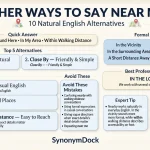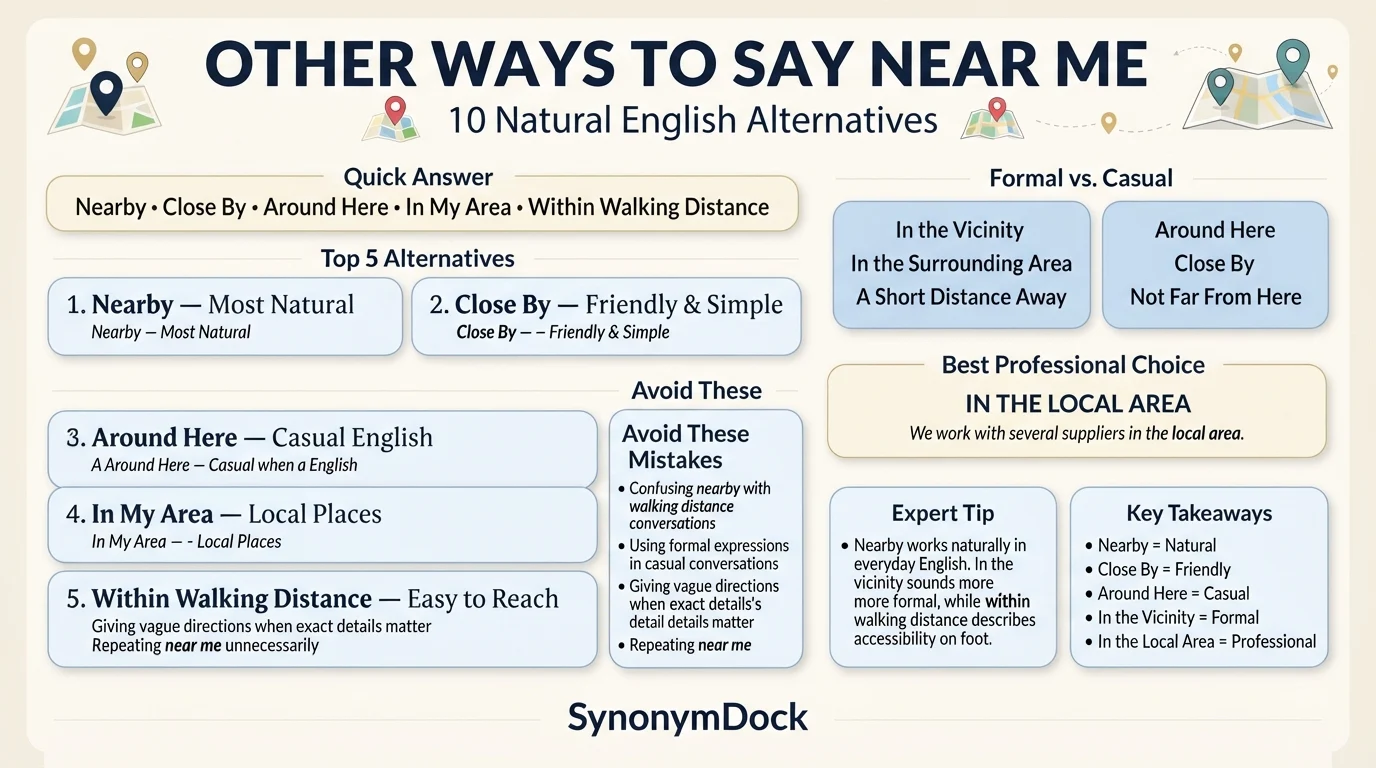
Other ways to say near me include nearby, close by, around here, in my area, in the neighborhood, within walking distance, near my location, not far from here, in the vicinity, and a short distance away.
The phrase near me is commonly used when looking for nearby restaurants, shops, services, attractions, and other places. It helps people find locations close to their current position without needing to mention a specific address. Although this expression is useful, repeating it in conversations or writing can sometimes sound monotonous.
Learning other ways to say near me can make your English more natural, flexible, and descriptive. Expressions such as nearby, close by, around here, and in my area work in different situations. Some are ideal for everyday conversations, while others fit professional communication, directions, travel descriptions, and formal writing.
In this guide, you’ll discover 10 useful alternatives, their meanings, examples, differences, and best uses. Whether you’re an English learner, student, writer, blogger, or professional, these expressions will help you describe locations more confidently.
Quick List: 10 Alternatives to Near Me
- Nearby
- Close by
- Around here
- In my area
- In the neighborhood
- Within walking distance
- Near my location
- Not far from here
- In the vicinity
- A short distance away
Formal, Professional, Casual, and Natural Alternatives
Formal Alternatives
- In the vicinity
- In the surrounding area
- Within the immediate area
- A short distance away
Pro Tip: Use formal expressions when writing reports, directions, announcements, or location descriptions. Avoid making simple sentences unnecessarily complicated.
Professional Alternatives
- Nearby
- In the local area
- In the surrounding area
- Close to our office
Pro Tip: Professional communication should be clear and specific. Mention the location or landmark whenever it helps the reader.
Business Email Alternatives
- Located nearby
- Within the local area
- Close to the office
- A short distance from our location
Pro Tip: When arranging meetings, mention the actual place instead of relying on vague location expressions.
Academic Alternatives
- In the surrounding area
- Within the local region
- In close proximity
- In the immediate geographical area
Pro Tip: Use geographical terms only when they add precision to your writing. Simpler alternatives are often easier to understand.
Casual Alternatives
- Around here
- Close by
- Not far from here
- In the neighborhood
Pro Tip: These phrases are great for conversations with friends, asking for recommendations, and describing familiar places.
Informal Expressions
- Just around the corner
- Down the street
- A few minutes away
- Right nearby
Pro Tip: Informal expressions sound natural in spoken English, but make sure the distance you describe is accurate.
What Does “Near Me” Mean?
Near me means close to the place where the speaker is currently located. It is used when describing or searching for places within a convenient distance, such as shops, restaurants, schools, parks, or services.
Grammatically, near functions as a preposition, while me is its object pronoun. The expression is often used in questions, statements, and online searches.
Examples:
- Is there a pharmacy near me?
- I need to find a grocery store near me.
- Are there any good restaurants near me?
In online searches, near me usually signals that the person wants location-relevant results. In everyday English, however, speakers often use nearby, close by, or around here instead.
When to Use Alternatives to Near Me
Choosing the right expression depends on your audience, situation, and the amount of detail you want to communicate.
| Situation | Best Expression | Example |
|---|---|---|
| Business communication | In the local area | We have several suppliers in the local area. |
| Emails | Located nearby | The meeting venue is located nearby. |
| Meetings | Close by | The conference room is close by. |
| Presentations | In the surrounding area | Several facilities are available in the surrounding area. |
| Academic writing | In the vicinity | The study examined businesses in the vicinity. |
| Interviews | In my area | Several companies operate in my area. |
| Daily conversations | Around here | Is there a café around here? |
| Giving directions | Down the street | The bakery is down the street. |
Professional vs. Polite: Which Expression Sounds Better?
A professional expression is not necessarily more formal or difficult. The best wording communicates your message clearly while respecting the situation.
| Style | Expression | Example |
|---|---|---|
| Polite | Nearby | Is there a restaurant nearby? |
| Professional | In the local area | We serve customers in the local area. |
| Formal | In the vicinity | Parking is available in the vicinity. |
| Natural | Close by | There’s a supermarket close by. |
| Casual | Around here | What’s good to eat around here? |
Expert Tip: Use nearby or close by when you want simple, natural English. Save in the vicinity for more formal situations where it sounds appropriate.
Pros and Cons of Using Alternatives
Pros
- Prevents repetitive wording in articles and conversations.
- Helps you sound more natural in spoken English.
- Makes professional location descriptions more flexible.
- Improves vocabulary and understanding of geographical expressions.
- Helps communicate the distance or accessibility of places more clearly.
Cons
- Some expressions may suggest a different distance.
- Formal phrases can sound stiff in casual conversations.
- Informal expressions may not suit academic or business writing.
- Certain phrases require a clear reference point to make sense.
Other Ways to Say “Near Me” (With Examples)
Below are the 10 best alternatives, arranged from the most natural and useful expressions to more specific choices.
1. Nearby
Meaning: Close to your current location or another place.
Explanation: Nearby is one of the easiest and most natural alternatives to near me. It works in everyday speech, messages, directions, and professional writing. You can use it without specifying an exact distance.
- Tone: Neutral and natural
- Formality Level: ⭐⭐⭐⭐
- Usage Frequency: Very Common
- CEFR Level: B1
- Common Collocations: nearby shops, nearby restaurants, nearby facilities, nearby attractions
Example Sentence: Is there a good coffee shop nearby?
Best Use: Everyday English
Avoid Using In: Exact directions
Context Examples:
- Spoken English: Are there any supermarkets nearby?
- Professional English: Several service providers are located nearby.
- Casual Conversation: Let’s find somewhere nearby to eat.
2. Close By
Meaning: Located a short distance away.
Explanation: Close by sounds friendly and conversational. It is useful when talking about places that are easy to reach. It works naturally in questions, suggestions, and simple descriptions.
- Tone: Friendly and relaxed
- Formality Level: ⭐⭐⭐
- Usage Frequency: Very Common
- CEFR Level: B1
- Common Collocations: shops close by, parking close by, offices close by, restaurants close by
Example Sentence: Is there a bookstore close by?
Best Use: Casual Conversation
Avoid Using In: Technical descriptions
Context Examples:
- Spoken English: Is the bus stop close by?
- Professional English: Parking is available close by.
- Casual Conversation: There’s a pizza place close by.
3. Around Here
Meaning: Somewhere in the area surrounding your present location.
Explanation: Around here is a natural spoken expression. People use it when asking for recommendations, looking for facilities, or talking about places they can visit locally.
- Tone: Casual and conversational
- Formality Level: ⭐⭐
- Usage Frequency: Very Common
- CEFR Level: B1
- Common Collocations: restaurants around here, shops around here, places around here, anything around here
Example Sentence: Do you know any good restaurants around here?
Best Use: Spoken English
Avoid Using In: Formal Reports
Context Examples:
- Spoken English: Is there an ATM around here?
- Professional English: Are there any meeting facilities around here?
- Casual Conversation: What’s fun to do around here?
4. In My Area
Meaning: Within the neighborhood, district, or region where someone lives or stays.
Explanation: In my area is useful when talking about local services, businesses, facilities, or places. It can refer to a wider geographical area than nearby.
- Tone: Neutral and informative
- Formality Level: ⭐⭐⭐
- Usage Frequency: Very Common
- CEFR Level: B1
- Common Collocations: shops in my area, restaurants in my area, schools in my area, services in my area
Example Sentence: Are there any affordable gyms in my area?
Best Use: Local Recommendations
Avoid Using In: Exact Directions
Context Examples:
- Spoken English: What are the best restaurants in my area?
- Professional English: We offer delivery services in my area.
- Casual Conversation: I need a good barber in my area.
5. In the Neighborhood
Meaning: Within the nearby residential or local community.
Explanation: In the neighborhood is often used for places around homes, streets, and local communities. It is useful when talking about shops, restaurants, parks, or familiar places.
- Tone: Friendly and neutral
- Formality Level: ⭐⭐⭐
- Usage Frequency: Common
- CEFR Level: B1
- Common Collocations: shops in the neighborhood, restaurants in the neighborhood, parks in the neighborhood, neighborhood businesses
Example Sentence: Is there a bakery in the neighborhood?
Best Use: Local Places
Avoid Using In: Precise Distance
Context Examples:
- Spoken English: Do you know any doctors in the neighborhood?
- Professional English: We support businesses in the neighborhood.
- Casual Conversation: There’s a new café in the neighborhood.
Native Speaker Tip (Alternatives 1–5)
- Most natural: Nearby and close by are simple choices for everyday situations.
- Most professional: Nearby is flexible enough for many workplace conversations.
- More conversational: Around here is especially natural when asking people for recommendations.
- Important distinction: In my area can describe a wider region than nearby.
6. Within Walking Distance
Meaning: Close enough to reach by walking.
Explanation: This expression focuses on accessibility rather than simply geographical closeness. It is particularly useful when discussing hotels, public transport, tourist attractions, restaurants, or meeting venues.
- Tone: Practical and descriptive
- Formality Level: ⭐⭐⭐⭐
- Usage Frequency: Common
- CEFR Level: B2
- Common Collocations: within walking distance of the hotel, shops within walking distance, walking distance from the station, within walking distance of restaurants
Example Sentence: Is there a supermarket within walking distance of the hotel?
Best Use: Travel Planning
Avoid Using In: Vehicle-Only Locations
Context Examples:
- Spoken English: Is the beach within walking distance?
- Professional English: The venue is within walking distance of the hotel.
- Casual Conversation: There are a few cafés within walking distance.
7. Near My Location
Meaning: Close to a specific position or current place.
Explanation: Near my location sounds practical and direct. It is often used in navigation, technology, location-based services, and situations where someone wants to identify places around a particular position.
- Tone: Direct and practical
- Formality Level: ⭐⭐⭐
- Usage Frequency: Common
- CEFR Level: B1–B2
- Common Collocations: restaurants near my location, stores near my location, services near my location, hotels near my location
Example Sentence: Can you find a grocery store near my location?
Best Use: Location Searches
Avoid Using In: Friendly Small Talk
Context Examples:
- Spoken English: Is there a petrol station near my location?
- Professional English: Please identify available facilities near my location.
- Casual Conversation: Can you find something to eat near my location?
8. Not Far From Here
Meaning: At a location that is reasonably close to the speaker.
Explanation: Not far from here is a natural expression for describing a place without giving an exact distance. It is useful in conversations, directions, and friendly recommendations.
- Tone: Relaxed and conversational
- Formality Level: ⭐⭐⭐
- Usage Frequency: Common
- CEFR Level: B1
- Common Collocations: not far from here, shops not far from here, restaurants not far from here, a station not far from here
Example Sentence: There’s a good restaurant not far from here.
Best Use: Giving Directions
Avoid Using In: Exact Distance
Context Examples:
- Spoken English: Is there a bus station not far from here?
- Professional English: The client’s office is not far from here.
- Casual Conversation: There’s a nice park not far from here.
9. In the Vicinity
Meaning: In the surrounding area of a particular place.
Explanation: In the vicinity is a formal expression often used in official notices, business descriptions, instructions, and reports. It usually needs a reference point to make the location clear.
- Tone: Formal and informative
- Formality Level: ⭐⭐⭐⭐⭐
- Usage Frequency: Occasional
- CEFR Level: C1
- Common Collocations: in the vicinity of the office, in the vicinity of the airport, businesses in the vicinity, parking in the vicinity
Example Sentence: Several restaurants are located in the vicinity of the conference center.
Best Use: Formal Writing
Avoid Using In: Casual Chats
Context Examples:
- Spoken English: Are there any hotels in the vicinity?
- Professional English: Additional parking is available in the vicinity.
- Casual Conversation: There are a few shops in the vicinity.
10. A Short Distance Away
Meaning: Separated from a place by a relatively small distance.
Explanation: A short distance away is useful when describing the position of something in relation to another place. It sounds descriptive and slightly more polished than casual expressions.
- Tone: Descriptive and neutral
- Formality Level: ⭐⭐⭐⭐
- Usage Frequency: Common
- CEFR Level: B2
- Common Collocations: a short distance away from the office, located a short distance away, a short distance away from the station, a short distance away from the hotel
Example Sentence: The nearest shopping center is a short distance away.
Best Use: Location Descriptions
Avoid Using In: Exact Measurements
Context Examples:
- Spoken English: There’s a park a short distance away.
- Professional English: Our branch is located a short distance away.
- Casual Conversation: The café is just a short distance away.
Native Speaker Tip (Alternatives 6–10)
- Most descriptive: Within walking distance tells readers they can reach a place on foot.
- Most practical: Near my location is useful when searching or discussing location-based results.
- Most formal: In the vicinity fits official and professional contexts.
- Natural preference: A short distance away works well when describing the distance between two places.
Expert Insight: How to Choose the Right Expression
Workplace Communication
In professional communication, choose expressions that explain a location without making your sentence unnecessarily complicated. Nearby, in the local area, and a short distance away are useful for discussing offices, suppliers, meeting venues, and services.
Instead of:
There are some offices near me.
Write:
Several offices are located nearby.
The second sentence sounds clearer because it focuses on the location rather than the speaker.
Email Writing
When writing business emails, avoid vague location descriptions if the reader needs to find a specific place.
Less helpful: The restaurant is near me.
Better: The restaurant is located near our office.
More informative: The restaurant is a five-minute walk from our office.
Providing a landmark, street name, or actual distance can be more useful than simply replacing near me with another expression.
Academic English
Academic writing requires precise and meaningful descriptions. In the vicinity, in the surrounding area, and within the local region may work when describing geographical locations.
However, do not use formal phrases just to make your writing sound advanced. The best academic vocabulary is accurate, relevant, and easy to understand.
Quick Recap: Best Alternatives to Near Me
Best Professional Choice
In the local area
Best Casual Choice
Around here
Best Formal Choice
In the vicinity
Most Natural Choice
Nearby
Most Polite Choice
Close by
Comparison Table: 10 Alternatives to Near Me
| Phrase | Tone | Formality | Best Use | Frequency |
|---|---|---|---|---|
| Nearby | Neutral | Medium | Everyday situations | Very Common |
| Close by | Friendly | Medium | Conversation | Very Common |
| Around here | Casual | Low | Spoken English | Very Common |
| In my area | Neutral | Medium | Local services | Very Common |
| In the neighborhood | Friendly | Medium | Local places | Common |
| Within walking distance | Practical | Medium-High | Travel, directions | Common |
| Near my location | Direct | Medium | Location searches | Common |
| Not far from here | Conversational | Medium | Directions | Common |
| In the vicinity | Formal | High | Official writing | Occasional |
| A short distance away | Descriptive | Medium-High | Location descriptions | Common |
Best Choice: Which Alternative Should You Use?
Best Overall: Nearby
Nearby is the most versatile alternative. It works in conversations, directions, emails, and simple descriptions without sounding overly formal.
Best Professional: In the Local Area
Use this when discussing local businesses, services, suppliers, facilities, or offices. It sounds informative and suitable for professional communication.
Best Academic: In the Surrounding Area
This phrase works well in reports, research, and geographical descriptions when discussing places around a specific location.
Best Business Email: Located Nearby
This expression is clear and professional when describing a meeting venue, office, restaurant, or service location.
Best Everyday Conversation: Around Here
Use it when asking people for local recommendations or discussing familiar surroundings.
Most Natural: Close By
Close by is friendly and easy to use. It fits everyday conversations and informal messages.
Most Polite: Nearby
Nearby is neutral and respectful. It works comfortably in most conversations without sounding too casual or formal.
Commonly Confused Expressions
Nearby vs. Within Walking Distance
Nearby describes a place that is close. Within walking distance suggests that the place can reasonably be reached on foot.
- Nearby: There’s a restaurant nearby.
- Within walking distance: There’s a restaurant within walking distance of the hotel.
A nearby place may still require transportation, depending on the area.
Around Here vs. In My Area
Around here usually refers to the immediate surroundings and sounds conversational. In my area can refer to a broader neighborhood, district, or local region.
- Around here: Is there a bank around here?
- In my area: There are several banks in my area.
Close By vs. In the Vicinity
Close by sounds natural in daily speech. In the vicinity sounds more formal and is often used in official information.
- Close by: The pharmacy is close by.
- In the vicinity: Several pharmacies are located in the vicinity.
Near Me vs. Near My Location
Near me is common in everyday speech and online searches. Near my location sounds more technical and is useful in navigation or location-based applications.
- Near me: Are there any restaurants near me?
- Near my location: Find available parking near my location.
Scenario Practice: Choose the Best Phrase
Read each situation and decide which expression sounds most natural.
1. Business Meeting
You want to tell a colleague that a meeting room is close to your office.
Which phrase would you choose?
Answer: Nearby
Example: The meeting room is located nearby.
Why: Nearby sounds natural and professional without adding unnecessary detail.
2. Job Interview
An interviewer asks whether you know businesses operating in your region.
Which phrase would you choose?
Answer: In my area
Example: Several well-known companies operate in my area.
Why: This phrase works naturally when discussing local businesses or your familiarity with a region.
3. Presentation
You are describing facilities located around a conference center.
Which phrase would you choose?
Answer: In the vicinity
Example: Several useful facilities are available in the vicinity of the conference center.
Why: It suits informative presentations and formal descriptions.
4. Classroom Discussion
Your teacher asks whether there are interesting places students can visit locally.
Which phrase would you choose?
Answer: Around here
Example: There are several interesting places to visit around here.
Why: It is natural for everyday spoken English and informal discussions.
5. Business Email
You are informing a visitor that the hotel is close enough to walk to the event venue.
Which phrase would you choose?
Answer: Within walking distance
Example: The hotel is within walking distance of the event venue.
Why: This phrase explains accessibility and helps the visitor understand the convenience of the location.
Mini Quiz: Test Your English Vocabulary
Choose the best answer for each question.
1. Which phrase sounds most natural when asking a friend about local restaurants?
A. In the vicinity
B. Around here
C. In the geographical area
D. Near my position
2. Which expression specifically suggests that you can reach a place on foot?
A. Nearby
B. In my area
C. Within walking distance
D. In the vicinity
3. Which phrase is most suitable for a formal location announcement?
A. Around here
B. Just around the corner
C. In the vicinity
D. Close by
4. Which expression works well when discussing local suppliers professionally?
A. In the local area
B. Around here
C. Just around the corner
D. Close by
5. Which sentence is grammatically correct and natural?
A. Is there bakery near me?
B. Is there a bakery nearby?
C. Is there nearby a bakery me?
D. Is bakery close by me located?
Answer Key
- B — Around here
- C — Within walking distance
- C — In the vicinity
- A — In the local area
- B — Is there a bakery nearby?
FAQs
1. What is another word for near me?
Nearby, close by, and around here are natural alternatives to near me. These expressions describe places close to your current surroundings and are useful when asking for recommendations, giving directions, or talking about local facilities.
2. What is a professional way to say near me?
In the local area, located nearby, and in the surrounding area are professional alternatives. They work well in business emails, presentations, workplace discussions, and descriptions of local offices, facilities, or services.
3. What is a formal way to say near me?
In the vicinity is a formal alternative to near me. It is suitable for official announcements, reports, directions, and informational writing when describing places surrounding a particular location.
4. How do you say near me in casual English?
Around here, close by, and not far from here are natural casual expressions. They are useful when talking with friends, asking for recommendations, or discussing shops, restaurants, and places in your surroundings.
5. Is nearby the same as near me?
Nearby and near me have similar meanings, but their grammar differs. Nearby can stand alone in sentences such as “There’s a shop nearby,” while near me specifically identifies the speaker’s location.
Conclusion
Learning other ways to say near me helps you express location more naturally in everyday conversations, professional emails, and written descriptions. Expressions such as nearby, close by, around here, and in my area offer simple ways to improve vocabulary without making sentences complicated. Each phrase has its own tone and purpose, so choosing the right one makes communication clearer and more effective.
Practice these alternatives by using them when asking for directions, describing places, or writing messages. Focus on understanding their meanings rather than memorizing them. With regular practice, you’ll develop stronger vocabulary, better communication skills, and greater confidence in English.