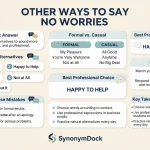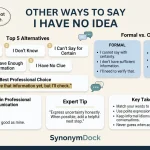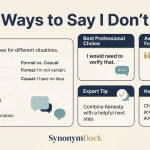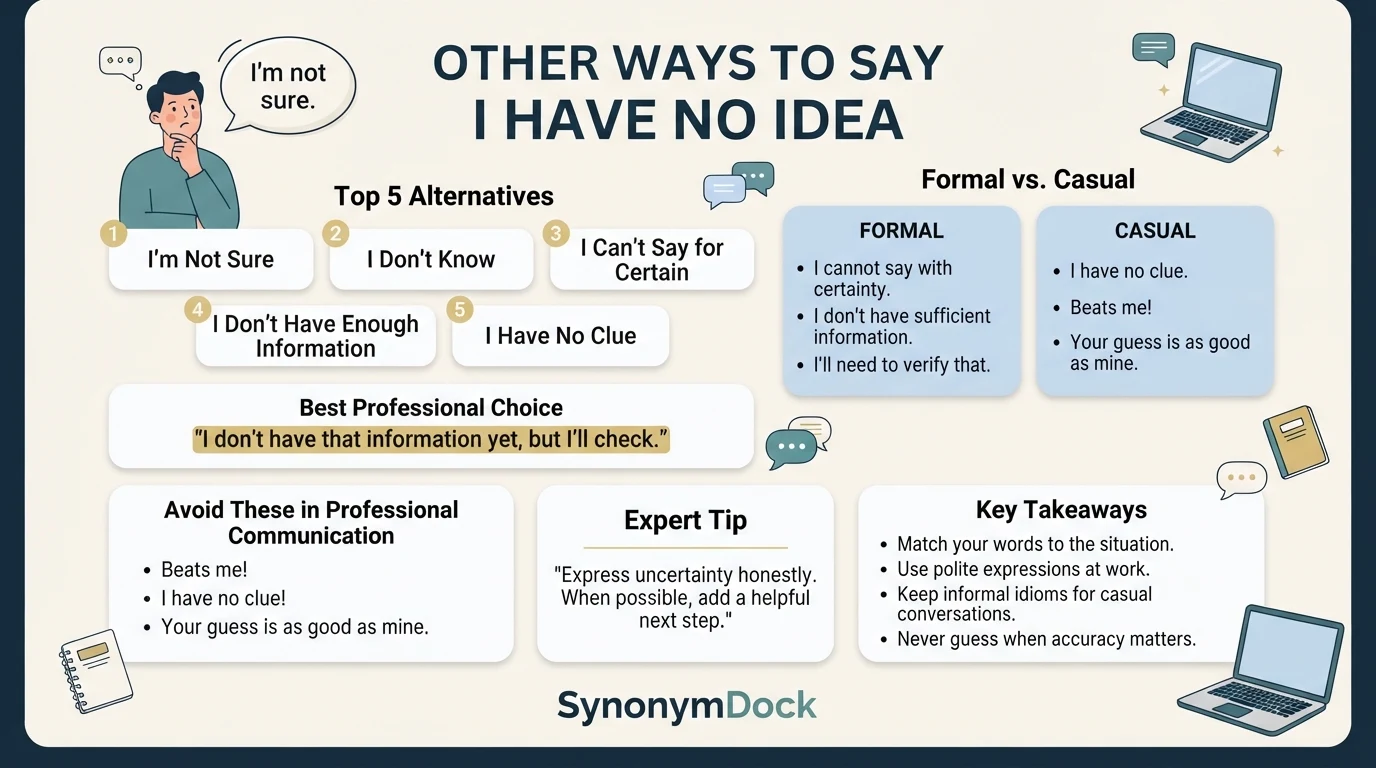
Other ways to say I have no idea include I’m not sure, I don’t know, I can’t say for certain, I have no clue, and I don’t have enough information. These alternatives help express uncertainty naturally in professional and casual conversations.
Saying I have no idea is a natural way to admit that you don’t know something. However, repeating this expression in every conversation can make your English sound less varied. Choosing the right alternative helps you communicate uncertainty without sounding rude, confused, or unprofessional.
Different situations require different expressions. You might need a polite response during a business meeting, a formal phrase in academic writing, or a relaxed expression when talking with friends. Understanding these differences helps you choose words that match your audience and purpose.
This guide explores 10 other ways to say I have no idea, with clear meanings, practical examples, common collocations, and formality levels. You’ll also learn how to use these expressions in emails, presentations, interviews, classrooms, and everyday conversations.
Quick Categories: Other Ways to Say I Have No Idea
Formal Alternatives
- I cannot say with certainty.
- I’m not certain about that.
- I don’t have sufficient information.
- I would need to investigate further.
Pro Tip: Use these expressions when accuracy matters, especially in academic discussions, formal meetings, and professional communication.
Professional Alternatives
- I don’t have that information yet.
- I’ll need to verify that.
- I haven’t confirmed that.
- I would need to check the details.
Pro Tip: Acknowledge what you don’t know and explain what you can do next. This makes your response more constructive.
Business Email Alternatives
- I don’t have confirmation at the moment.
- Let me check and get back to you.
- I’ll need to review the information.
- I cannot confirm that just yet.
Pro Tip: Don’t promise a follow-up unless you can provide one. Be clear about what you can verify.
Academic Alternatives
- I’m not certain about that conclusion.
- I haven’t researched that subject in detail.
- I don’t have enough evidence to support that.
- I would need to review the relevant material.
Pro Tip: Academic communication requires accuracy. Distinguish between lacking knowledge and lacking sufficient evidence.
Casual Alternatives
- I’m not sure.
- I don’t know.
- I have no clue.
- I couldn’t tell you.
Pro Tip: These expressions sound natural in everyday conversations. Your tone and relationship with the listener still matter.
Informal Expressions
- Beats me!
- Your guess is as good as mine.
- I haven’t got a clue.
- No idea!
Pro Tip: Save these expressions for relaxed conversations with friends and familiar people. They may sound dismissive in serious situations.
What Does “I Have No Idea” Mean?
The expression I have no idea means that you don’t know something or have no useful information to answer a particular question. It communicates a lack of knowledge, understanding, or certainty.
The phrase contains the verb have and the noun idea. Here, idea refers to knowledge or understanding rather than a suggestion or creative thought.
Simple example:
“Do you know why the meeting was canceled?”
“I have no idea. Nobody informed me.”
The expression can communicate different feelings depending on context. It may sound neutral when answering a simple question or express surprise when someone shares unexpected information.
Grammar note: Use have no idea followed by a question word when explaining what you don’t know.
- I have no idea where they went.
- I have no idea why she left.
- I have no idea what happened.
- I have no idea when the results will arrive.
You can also use have no idea about before a noun phrase.
Example: I have no idea about the new company policy.
When Should You Use Alternatives to “I Have No Idea”?
The best expression depends on your audience, purpose, and level of knowledge.
1. Business Communication
In the workplace, a short answer such as “I have no idea” may sound unhelpful when someone expects assistance.
Better: “I don’t have that information yet, but I’ll check with the relevant team.”
This communicates honesty while showing responsibility.
2. Professional Emails
Business emails benefit from clear and respectful language. Avoid casual expressions when responding to customers, managers, or business partners.
Example: “I haven’t received confirmation of the delivery date yet. I’ll review the latest information.”
3. Meetings
Unexpected questions can arise during meetings. You don’t need to guess when you lack reliable information.
Example: “I’m not certain about the updated figures, so I’ll verify them before confirming.”
4. Presentations
When someone asks a question outside your preparation, acknowledge the limitation without inventing an answer.
Example: “I can’t say with certainty, but I’ll review that information after the presentation.”
5. Academic Writing
Academic discussions require careful explanations and supported conclusions.
Example: “I don’t have enough evidence to support that interpretation.”
6. Job Interviews
If an interviewer asks about an unfamiliar subject, be honest about your experience.
Example: “I’m not familiar with that particular system, but I understand the basic principles behind similar tools.”
7. Daily Conversations
With friends and family, simple expressions are usually more natural.
Example: “Beats me! I haven’t heard anything about their plans.”
Other Ways to Say “I Have No Idea” (With Examples)
Here are 10 alternatives arranged by usefulness, naturalness, and conversational application.
1. I’m Not Sure
Meaning: You don’t know something with complete confidence.
Explanation: This is one of the most versatile alternatives. It sounds softer than “I have no idea” and works in casual conversations and many professional situations.
Usage styles:
- Formal: I’m not entirely certain about that.
- Neutral: I’m not sure.
- Professional: I’m not sure about the figures yet.
- Casual: Hmm, I’m not sure.
Example Sentence: I’m not sure which version of the document is correct.
Best Use: Everyday conversations
Avoid Using In: Verified factual statements
Tone: Polite, neutral
Formality Level: ⭐⭐⭐
Usage Frequency: Very Common
CEFR Level: B1
Common Collocations:
- Not sure about
- Not sure whether
- Not entirely sure
- Not quite sure
Context Examples:
- Spoken English: I’m not sure when the guests will arrive.
- Professional English: I’m not sure whether the revised figures are accurate.
- Casual Conversation: I’m not sure what movie to watch.
2. I Don’t Know
Meaning: You don’t have the answer or information.
Explanation: This is a direct, simple, and widely understood expression. It works in most situations, although your tone can make it sound either neutral or dismissive.
Usage styles:
- Formal: I don’t know the answer to that question.
- Neutral: I don’t know.
- Professional: I don’t know yet, but I’ll check.
- Casual: Honestly, I don’t know.
Example Sentence: I don’t know who scheduled the meeting, but I can ask the organizer.
Best Use: General conversations
Avoid Using In: Situations requiring detailed explanations
Tone: Direct, neutral
Formality Level: ⭐⭐⭐
Usage Frequency: Very Common
CEFR Level: A2
Common Collocations:
- Don’t know why
- Don’t know whether
- Don’t know much about
- Don’t know anything about
Context Examples:
- Spoken English: I don’t know where she went.
- Professional English: I don’t know the final deadline yet.
- Casual Conversation: I don’t know what to order.
3. I Can’t Say for Certain
Meaning: You cannot give a definite or confirmed answer.
Explanation: This expression is useful when you have some information but cannot guarantee that your answer is correct. It sounds measured and more formal than “I’m not sure.”
Usage styles:
- Formal: I cannot say with certainty.
- Neutral: I can’t say for certain.
- Professional: I can’t say for certain until the figures are verified.
- Casual: I couldn’t say for sure.
Example Sentence: I can’t say for certain whether the event will take place next Friday.
Best Use: Formal discussions
Avoid Using In: Simple casual questions
Tone: Careful, measured
Formality Level: ⭐⭐⭐⭐
Usage Frequency: Common
CEFR Level: B2
Common Collocations:
- Say for certain
- Can’t confirm
- Cannot determine
- Give a definite answer
Context Examples:
- Spoken English: I can’t say for certain when he’ll arrive.
- Professional English: I can’t say for certain until the review is complete.
- Casual Conversation: I couldn’t say for sure!
4. I Don’t Have Enough Information
Meaning: You lack the details needed to answer accurately.
Explanation: This phrase is particularly useful when you know something about a subject but need additional facts before reaching a conclusion.
Usage styles:
- Formal: I don’t have sufficient information.
- Neutral: I don’t have enough information.
- Professional: I don’t have enough information to confirm the request.
- Casual: I need a little more information.
Example Sentence: I don’t have enough information to explain why the project was delayed.
Best Use: Evidence-based discussions
Avoid Using In: Questions you can answer immediately
Tone: Objective, professional
Formality Level: ⭐⭐⭐⭐
Usage Frequency: Common
CEFR Level: B2
Common Collocations:
- Enough information
- Sufficient information
- Additional information
- Relevant details
Context Examples:
- Spoken English: I don’t have enough information to answer.
- Professional English: We don’t have enough information to approve the request.
- Casual Conversation: I need more details before I can decide.
5. I Haven’t Looked Into That Yet
Meaning: You haven’t investigated or researched something.
Explanation: Use this expression when you haven’t checked a particular subject. It is more precise than saying you have no idea because it explains why you cannot answer.
Usage styles:
- Formal: I haven’t investigated that matter yet.
- Neutral: I haven’t looked into that yet.
- Professional: I haven’t reviewed those details yet.
- Casual: I haven’t checked that out yet.
Example Sentence: I haven’t looked into the new schedule yet, so I can’t confirm the changes.
Best Use: Workplace discussions
Avoid Using In: Matters already investigated
Tone: Honest, responsible
Formality Level: ⭐⭐⭐⭐
Usage Frequency: Common
CEFR Level: B2
Common Collocations:
- Look into a matter
- Look into an issue
- Investigate further
- Review the details
Context Examples:
- Spoken English: I haven’t looked into that yet.
- Professional English: I haven’t looked into the proposed changes, but I’ll review them.
- Casual Conversation: I haven’t checked that out yet.
Native Speaker Insight: Alternatives 1–5
“I’m not sure” is often the most natural choice when you want to sound relaxed and polite. “I don’t know” is equally natural when you have no answer.
For professional communication, “I don’t have enough information” and “I haven’t looked into that yet” explain the reason behind your uncertainty. “I can’t say for certain” is useful when accuracy matters.
6. I’m Not Familiar With That
Meaning: You don’t have knowledge or experience with a particular subject.
Explanation: Use this phrase when something is unfamiliar rather than when you simply don’t know a specific answer. It is especially useful when discussing software, processes, subjects, or unfamiliar concepts.
Usage styles:
- Formal: I’m not familiar with that subject.
- Neutral: I’m not familiar with it.
- Professional: I’m not familiar with that system yet.
- Casual: I don’t know much about it.
Example Sentence: I’m not familiar with that accounting software, but I can review its basic functions.
Best Use: Unfamiliar subjects
Avoid Using In: Known information
Tone: Polite, neutral
Formality Level: ⭐⭐⭐⭐
Usage Frequency: Common
CEFR Level: B2
Common Collocations:
- Familiar with a subject
- Familiar with a system
- Not familiar with
- Become familiar with
Context Examples:
- Spoken English: I’m not familiar with that restaurant.
- Professional English: I’m not familiar with this reporting system.
- Casual Conversation: I’m not familiar with that game.
7. I Don’t Have That Information
Meaning: You don’t currently possess the details needed to answer.
Explanation: This is a clear and professional alternative. It is particularly useful when answering questions about schedules, reports, customer requests, or workplace decisions.
Usage styles:
- Formal: I don’t have the necessary information.
- Neutral: I don’t have that information.
- Professional: I don’t have those details available at the moment.
- Casual: I don’t know those details.
Example Sentence: I don’t have the updated schedule at the moment, so I can’t confirm the meeting time.
Best Use: Business communication
Avoid Using In: Lighthearted conversations
Tone: Factual, professional
Formality Level: ⭐⭐⭐⭐
Usage Frequency: Common
CEFR Level: B2
Common Collocations:
- Information available
- Updated information
- Relevant information
- Necessary information
Context Examples:
- Spoken English: I don’t have that information right now.
- Professional English: I don’t have the revised figures available.
- Casual Conversation: I don’t know those details.
8. I Couldn’t Tell You
Meaning: You cannot provide an answer to a particular question.
Explanation: This is a conversational expression that can sound neutral or slightly dismissive. Adding a reason or offering to check makes it more helpful.
Usage styles:
- Formal: I wouldn’t be able to provide a definite answer.
- Neutral: I couldn’t tell you.
- Professional: I couldn’t tell you without reviewing the records.
- Casual: Honestly, I couldn’t tell you.
Example Sentence: I couldn’t tell you when the new schedule will be released.
Best Use: Spoken conversations
Avoid Using In: Formal written reports
Tone: Conversational, neutral
Formality Level: ⭐⭐⭐
Usage Frequency: Common
CEFR Level: B2
Common Collocations:
- Couldn’t tell you why
- Couldn’t tell you when
- Couldn’t tell you exactly
- Honestly couldn’t tell you
Context Examples:
- Spoken English: I couldn’t tell you where they went.
- Professional English: I couldn’t tell you without checking the records.
- Casual Conversation: I couldn’t tell you what happened.
9. I Have No Clue
Meaning: You have no knowledge or useful information about something.
Explanation: This expression is more emphatic and informal than “I’m not sure.” It works naturally with friends and family but may sound too relaxed in formal situations.
Usage styles:
- Formal: I have no information regarding that matter.
- Neutral: I have no clue about that.
- Professional: I don’t have any information on that yet.
- Casual: I have absolutely no clue!
Example Sentence: I have no clue where everyone went after the event.
Best Use: Casual conversations
Avoid Using In: Formal business emails
Tone: Informal, expressive
Formality Level: ⭐⭐
Usage Frequency: Very Common
CEFR Level: B1
Common Collocations:
- Have no clue
- Absolutely no clue
- No clue whatsoever
- Clueless about something
Context Examples:
- Spoken English: I have no clue who called me.
- Professional English: I don’t have the details about that issue yet.
- Casual Conversation: I have no clue what to watch tonight.
10. Your Guess Is as Good as Mine
Meaning: You don’t know the answer, and the other person probably doesn’t know either.
Explanation: This is a common idiom used when two people have equally little information. It often sounds humorous or friendly, especially when discussing uncertain situations.
Usage styles:
- Formal: I cannot determine that either.
- Neutral: I’m just as unsure as you are.
- Professional: I don’t have any more information than you do.
- Casual: Your guess is as good as mine!
Example Sentence: Your guess is as good as mine when it comes to predicting the final results.
Best Use: Friendly discussions
Avoid Using In: Serious client meetings
Tone: Humorous, informal
Formality Level: ⭐⭐
Usage Frequency: Common
CEFR Level: B2
Common Collocations:
- Your guess is as good as mine
- Anyone’s guess
- Hard to predict
- No way to know
Context Examples:
- Spoken English: Your guess is as good as mine.
- Professional English: I don’t have any more information than you do.
- Casual Conversation: Your guess is as good as mine about who will win.
Native Speaker Insight: Alternatives 6–10
“I’m not familiar with that” is more precise when you lack experience with a subject. “I don’t have that information” works better when you simply lack particular details.
“I couldn’t tell you” is conversational, while “I have no clue” is more emphatic. “Your guess is as good as mine” is best when both people share the same uncertainty.
Expert Insight: How to Express Uncertainty Professionally
A strong response does more than admit that you don’t know something. It explains what is missing and, when possible, identifies the next step.
Workplace Communication
Instead of saying, “I have no idea what happened to the report,” try:
“I haven’t identified the issue yet, but I’ll review the latest updates.”
This sounds responsible without pretending to know the cause.
Business Email Writing
Choose clear expressions that communicate what you can and cannot confirm.
- I haven’t received confirmation yet.
- I’ll need to verify those details.
- I don’t have the updated information available.
Academic English
Use careful language when discussing research or unfamiliar subjects.
- I haven’t examined that argument in detail.
- I don’t have enough evidence to support that conclusion.
- I would need to review the original research.
Expert Tip: Never confuse confidence with pretending to know everything. Honest uncertainty builds clearer communication than an unsupported answer.
Quick Recap: Best Alternatives at a Glance
| Category | Best Phrase |
|---|---|
| Best Professional Choice | I don’t have that information yet. |
| Best Casual Choice | I have no clue. |
| Best Formal Choice | I can’t say for certain. |
| Most Natural Choice | I’m not sure. |
| Most Polite Choice | I’m not quite sure about that. |
Comparison Table: 10 Alternatives to I Have No Idea
| Phrase | Tone | Formality | Best Use | Frequency |
|---|---|---|---|---|
| I’m not sure | Polite, neutral | Medium | Everyday speech | Very Common |
| I don’t know | Direct, neutral | Medium | General situations | Very Common |
| I can’t say for certain | Careful | High | Formal discussions | Common |
| I don’t have enough information | Objective | High | Research and work | Common |
| I haven’t looked into that yet | Responsible | High | Workplace discussions | Common |
| I’m not familiar with that | Polite | High | Unfamiliar subjects | Common |
| I don’t have that information | Professional | High | Business communication | Common |
| I couldn’t tell you | Conversational | Medium | Spoken English | Common |
| I have no clue | Informal | Low | Casual conversations | Very Common |
| Your guess is as good as mine | Humorous | Low | Friendly discussions | Common |
Best Choice: Which Expression Should You Use?
Best Overall: I’m Not Sure
This expression is versatile, natural, and easy to understand. It works in everyday conversations and many professional situations.
Best Professional: I Don’t Have That Information Yet
Choose this phrase when answering workplace questions. It communicates your current limitation without sounding careless.
Best Academic: I Don’t Have Enough Evidence to Support That
Use this when discussing research, arguments, interpretations, or conclusions. It avoids presenting unsupported information as fact.
Best Business Email: I’ll Need to Verify That
This is a clear and helpful way to explain that you need confirmation before providing an answer.
Best Everyday Conversation: I Don’t Know
Its simplicity makes it suitable for ordinary questions. You don’t need complicated vocabulary to sound natural.
Most Natural: I’m Not Sure
It is a comfortable way to express uncertainty without making a conversation awkward.
Most Polite: I’m Not Quite Sure About That
This softer expression works when responding to someone respectfully, particularly when you want to avoid sounding overly direct.
Professional vs. Polite vs. Formal vs. Natural
These communication styles overlap, but they are not identical.
| Style | Recommended Expression | Why It Works |
|---|---|---|
| Professional | I don’t have that information yet. | Clear and responsible |
| Polite | I’m not quite sure about that. | Softens the response |
| Formal | I cannot say with certainty. | Measured and respectful |
| Natural | I’m not sure. | Common conversational English |
| Academic | I don’t have enough evidence to support that. | Emphasizes accuracy |
| Casual | I have no clue. | Relaxed and expressive |
Important distinction: A phrase does not become professional simply because it contains formal vocabulary. Professional communication also requires accuracy, appropriate tone, and a helpful response.
Pros and Cons of Using Alternatives
Pros
- Greater vocabulary variety: You can express uncertainty without repeating the same words.
- Better tone control: You can adjust your language for friends, teachers, colleagues, and customers.
- Clearer communication: Specific phrases explain whether you lack knowledge, evidence, or confirmation.
- Professional confidence: Appropriate wording helps you respond honestly during important discussions.
- Improved fluency: Practicing expressions in context makes everyday English conversations easier.
Cons
- Wrong context: Informal idioms may sound inappropriate in professional communication.
- Unnatural wording: Using complicated expressions in simple conversations can sound stiff.
- Meaning differences: Not every alternative communicates exactly the same type of uncertainty.
- Misleading promises: Saying you’ll investigate creates an expectation that you will follow up.
- Overuse: Repeating the same alternative can make your language sound less varied.
Commonly Confused Expressions
I Don’t Know vs. I’m Not Sure
“I don’t know” communicates a lack of an answer. “I’m not sure” suggests that you may have an idea but cannot confirm it confidently.
- I don’t know where the office is.
- I’m not sure whether the office is open.
I Have No Clue vs. I’m Not Familiar With That
“I have no clue” expresses a lack of knowledge about something. “I’m not familiar with that” specifically communicates a lack of experience or knowledge about a subject.
- I have no clue who sent the message.
- I’m not familiar with that software.
I’m Uncertain vs. I Can’t Say for Certain
“I’m uncertain” describes your state of doubt. “I can’t say for certain” emphasizes that you cannot provide a definite answer.
- I’m uncertain about the outcome.
- I can’t say for certain when the outcome will be announced.
I Don’t Have That Information vs. I Haven’t Looked Into That Yet
The first expression means you don’t currently possess the necessary details. The second explains that you haven’t investigated the matter.
- I don’t have the updated schedule.
- I haven’t looked into the schedule changes yet.
Understanding these differences helps you choose accurate alternatives rather than replacing one expression with another without considering its meaning.
Scenario Practice: Which Phrase Would You Choose?
Test your understanding with these five everyday and professional situations.
1. Business Meeting
Your manager asks whether the latest report includes updated figures, but you haven’t reviewed it.
Which phrase would you choose?
Suggested Answer: “I haven’t checked that yet, but I’ll review the report.”
Why: It honestly explains your current position and offers a useful next step.
2. Job Interview
An interviewer asks whether you’ve worked with a particular software program, but you haven’t used it.
Which phrase would you choose?
Suggested Answer: “I’m not familiar with that particular program, but I’m willing to learn.”
Why: It communicates honesty while showing a positive attitude toward learning.
3. Presentation
An audience member asks about a statistic that isn’t included in your presentation.
Which phrase would you choose?
Suggested Answer: “I can’t say for certain, but I can verify that information.”
Why: You avoid guessing and show that accuracy matters.
4. Classroom Discussion
Your teacher asks a question about a chapter you haven’t studied carefully.
Which phrase would you choose?
Suggested Answer: “I’m not sure about that answer. I would need to review the chapter.”
Why: It expresses uncertainty while showing willingness to understand the subject.
5. Business Email
A colleague asks you to confirm a deadline, but you haven’t received the updated schedule.
Which phrase would you choose?
Suggested Answer: “I don’t have confirmation of the deadline yet. I’ll check the updated schedule.”
Why: It is clear, professional, and avoids giving an unverified answer.
Mini Quiz: Test Your Understanding
Choose the best answer for each question.
1. Which expression is most suitable for a formal discussion?
A. Beats me!
B. I can’t say for certain.
C. I have no clue.
D. Your guess is as good as mine.
2. Which phrase sounds most natural in everyday English?
A. I cannot determine that.
B. I remain uncertain.
C. I’m not sure.
D. I lack sufficient information.
3. Your colleague asks for information you haven’t checked. What should you say?
A. Beats me. Ask someone else.
B. I don’t have that information yet, but I’ll check.
C. Your guess is as good as mine.
D. I have no clue.
4. What does “I’m not familiar with that” communicate?
A. I strongly disagree.
B. I have already confirmed it.
C. The subject is unfamiliar to me.
D. I don’t want to discuss it.
5. Which expression can sound dismissive in a serious conversation?
A. I couldn’t tell you without checking.
B. I’m not certain about that.
C. I’ll need to verify that.
D. Beats me!
Answer Key
| Question | Correct Answer | Explanation |
|---|---|---|
| 1 | B | It communicates uncertainty formally. |
| 2 | C | It is natural and widely used. |
| 3 | B | It combines honesty with action. |
| 4 | C | It describes unfamiliarity. |
| 5 | D | It can sound too casual or careless. |
FAQs
1. What is a professional way to say I have no idea?
A professional alternative is “I don’t have that information at the moment.” You can also say “I’ll need to verify that” when accuracy matters. These expressions communicate uncertainty without sounding careless.
2. What is the most natural alternative to I have no idea?
“I’m not sure” is one of the most natural alternatives in everyday English. It sounds softer than “I have no idea” and works in conversations with friends, colleagues, classmates, and acquaintances.
3. How do you say I have no idea politely?
You can say “I’m not quite sure about that” or “I can’t say for certain.” Both expressions communicate uncertainty respectfully. Adding “Let me check” makes your response more helpful.
4. Is I have no clue formal or informal?
“I have no clue” is generally informal and conversational. It works well with friends and family, but professional emails, customer discussions, and formal meetings usually benefit from more neutral expressions.
5. How can I avoid saying I don’t know in business emails?
Use expressions such as “I’ll need to verify that,” “I don’t have confirmation yet,” or “Let me check the details.” These phrases keep your email clear, respectful, and professional.
Conclusion
Learning other ways to say I have no idea helps you express uncertainty naturally in conversations, classrooms, meetings, and professional emails. Expressions such as “I’m not sure,” “I can’t say for certain,” and “I don’t have that information yet” offer different levels of formality and clarity. Choosing the right phrase helps you communicate honestly while respecting your audience.
Practice these alternatives in everyday conversations and writing exercises. Pay attention to their meanings, tones, and appropriate situations instead of memorizing them individually. You don’t need complicated vocabulary to communicate confidently. You need accurate words, natural expressions, and the confidence to use them correctly.