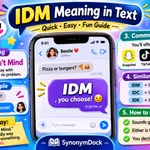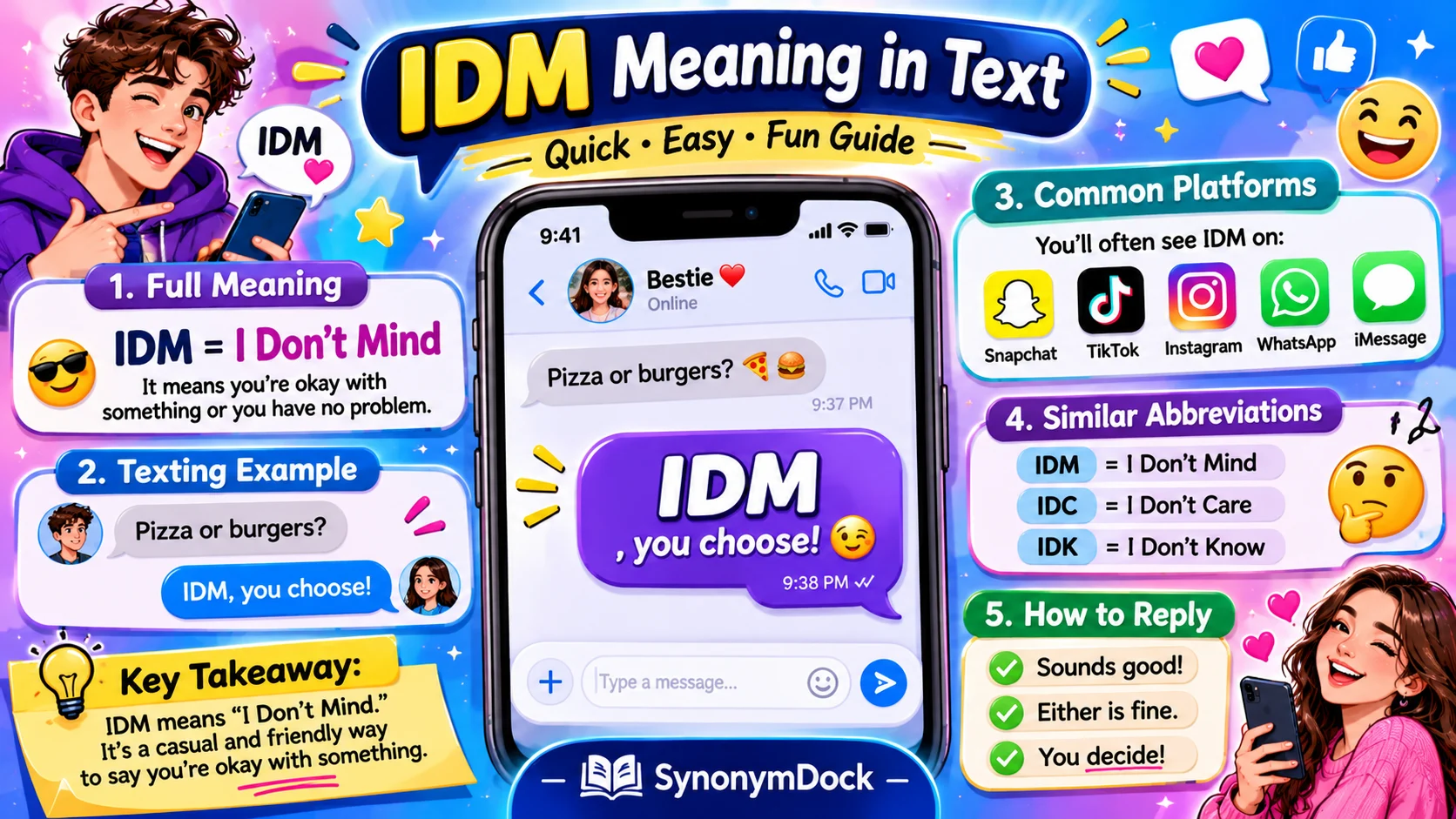
IDM usually means I Don’t Mind in texting and online conversations. People use it to show they are comfortable with a suggestion, choice, or situation. It expresses flexibility, agreement, or a relaxed attitude toward something.
Introduction
The idm meaning in text is usually “I Don’t Mind,” a casual expression people use when they feel comfortable with a suggestion or decision. Instead of typing a complete sentence, they use three simple letters to communicate that they are flexible. For example, someone might reply with “IDM” when a friend asks where they want to eat.
However, understanding this abbreviation requires more than knowing its full form. Its meaning can change slightly depending on the conversation, relationship, and tone. Furthermore, people use it differently across Snapchat, TikTok, Instagram, and everyday text messages.
In this guide, you’ll discover how IDM works in modern American texting. You’ll also learn its alternative interpretations, common mistakes, realistic conversation examples, and natural replies. Whether you received it from a friend or noticed it in a social media comment, you’ll understand how to interpret it confidently.
Quick Answer: IDM Meaning in Text
| Category | Explanation |
|---|---|
| Meaning | I Don’t Mind |
| Context | Casual conversations, suggestions, and decisions |
| Primary Platforms | Snapchat, TikTok, Instagram, WhatsApp, iMessage |
| Example | “Where should we meet?” “IDM, you choose.” |
| Tone | Relaxed, flexible, agreeable, and informal |
What Does IDM Mean in Text? Full Definition and Origin
In everyday digital communication, IDM commonly stands for I Don’t Mind. It communicates that someone has no strong preference about a particular choice or situation.
For instance, imagine your friend asks whether you prefer pizza or burgers. You could simply respond with “IDM.” This tells your friend that either option works for you.
Unlike abbreviations that express excitement or strong agreement, this expression communicates flexibility. Consequently, it often appears in conversations involving plans, preferences, and everyday decisions.
Understanding the Three Letters
Each letter represents a word in the original expression.
| Letter | Word | Meaning |
|---|---|---|
| I | I | The person speaking |
| D | Don’t | A negative contraction |
| M | Mind | To object to or care about something |
Together, these letters create a short expression that saves typing time.
What Does I Don’t Mind Actually Communicate?
The phrase can communicate several related ideas.
1. I’m Comfortable With Either Choice
Someone may use it when two or more options seem equally acceptable.
Example:
Friend: “Should we watch a comedy or an action movie?”
You: “IDM. Both sound good.”
2. You Can Decide
Sometimes, the sender wants another person to make the final decision.
Example:
Friend: “Do you want to meet at the mall or the café?”
You: “IDM, you pick.”
3. I Have No Strong Preference
It can also show that the person does not feel strongly about a particular subject.
Example:
Friend: “Do you prefer texting or calling?”
You: “IDM, either works.”
4. I’m Not Opposed to Your Suggestion
Additionally, it can indicate that someone accepts an idea without expressing strong enthusiasm.
Example:
Friend: “Would you like to study together tomorrow?”
You: “IDM, sounds fine.”
Is IDM an Old or New Internet Abbreviation?
IDM belongs to the broader tradition of internet shorthand. People have used abbreviations in online chats, instant messaging, and text messages to communicate faster.
However, it does not have one universally documented creation date or inventor. Its popularity reflects a wider digital communication habit: shortening familiar expressions into easy-to-type letters.
Today, it fits naturally into casual conversations on social platforms and messaging applications.
Contextual Dynamics and Nuances of the Term
Although the basic definition stays the same, the expression can communicate slightly different attitudes. Therefore, the surrounding conversation matters.
Understanding these differences helps you avoid confusing flexibility with enthusiasm or indifference.
IDM as Agreement
Sometimes, people use it to accept a suggestion.
Example:
Person A: “Let’s meet after school.”
Person B: “IDM.”
Here, the response suggests that the proposed plan is acceptable.
However, it does not necessarily mean the person is especially excited.
IDM as Flexibility
This is one of its most common uses.
For example:
Person A: “Would you rather go shopping on Saturday or Sunday?”
Person B: “IDM. Whatever works for you.”
The sender communicates that both choices are fine.
IDM as Indifference
Depending on the conversation, the expression may sound slightly indifferent.
Consider this exchange:
Person A: “Do you want to join us for lunch?”
Person B: “IDM.”
The reply could mean that the person is comfortable joining. However, it does not provide much enthusiasm.
Consequently, readers must consider the previous messages before deciding what the sender intended.
IDM and Politeness
The abbreviation is generally casual rather than formal.
For example, responding with “IDM” to a close friend sounds natural. However, using it in a professional email might seem too informal.
A more polished alternative would be:
“I don’t have a preference. Please choose whichever option works best.”
How Punctuation Changes the Tone
Punctuation and additional words can influence how a message sounds.
| Message | Possible Interpretation |
|---|---|
| IDM | No strong preference |
| IDM! | Relaxed or enthusiastic acceptance |
| IDM 🙂 | Friendly and agreeable |
| IDM, you choose | Flexible and helpful |
| IDM, whatever | Potentially indifferent or dismissive |
| I don’t mind at all | Clear and reassuring |
Remember that these interpretations are not fixed rules. The relationship between the people also affects the message.
Real-Life Conversation Examples Using IDM
The easiest way to understand internet slang is through realistic conversations. The following examples show how people might use the abbreviation in everyday situations.
Example 1: Choosing a Restaurant
Conversation:
Alex: Where should we go for dinner tonight?
Sam: IDM. You can choose.
Alex: How about the Italian restaurant?
Sam: Sounds good!
Meaning: Sam does not have a particular restaurant preference. The abbreviation makes the response quick and relaxed.
Example 2: Making Weekend Plans
Conversation:
Mia: Are you free on Saturday or Sunday?
Jordan: IDM. Both days work for me.
Mia: Great! Let’s meet on Saturday.
Jordan: Perfect!
Meaning: Jordan is flexible about the meeting date. Therefore, Mia can select whichever day is more convenient.
Example 3: Discussing Music Preferences
Conversation:
Chris: Do you want to listen to pop or hip-hop?
Taylor: IDM. I like both.
Chris: Let’s play some pop songs first.
Taylor: Sure!
Meaning: Taylor does not have a strong preference between the two music genres.
Example 4: Planning a Movie Night
Conversation:
Emma: Should we watch a comedy or a mystery movie?
Noah: IDM, whichever you prefer.
Emma: Let’s watch a mystery!
Noah: Sounds interesting.
Meaning: Noah is comfortable with either movie choice. His response allows Emma to make the decision.
Example 5: Discussing a Study Schedule
Conversation:
Liam: Do you want to study in the morning or afternoon?
Olivia: IDM. Just let me know the time.
Liam: Let’s start at 2 PM.
Olivia: That works!
Meaning: Olivia is flexible about the schedule. She simply wants to know the final arrangement.
Additional Everyday Situations
The abbreviation also appears naturally in several other situations.
| Situation | Question | Possible Response |
|---|---|---|
| Food | “Tea or coffee?” | “IDM, either is fine.” |
| Travel | “Window or aisle seat?” | “IDM.” |
| Shopping | “Which store should we visit?” | “IDM, you choose.” |
| Entertainment | “Music or a podcast?” | “IDM, both are okay.” |
| Scheduling | “Morning or evening?” | “IDM, whatever works.” |
| Group plans | “Should we meet here?” | “IDM, that’s fine.” |
These examples demonstrate why short abbreviations remain popular. They make ordinary conversations quicker without requiring lengthy explanations.
Platform-Specific Breakdown
Different social platforms encourage different communication styles. However, the general interpretation usually remains consistent across messaging applications.
How It Is Used on Snapchat
<figure> </figure>
Snapchat encourages quick conversations through direct messages, snaps, and disappearing messages. Therefore, short expressions fit naturally into its communication style.
Someone might use IDM when discussing weekend plans, choosing a location, or responding to a friend’s suggestion.
Snapchat conversation examples:
Friend: “Wanna hang out later?”
You: “IDM!”
Friend: “Let’s go to the mall.”
You: “Sounds good.”
Another example:
Friend: “Should I send you the blue or black picture?”
You: “IDM, both look good.”
In these situations, the abbreviation communicates flexibility rather than a specific emotional reaction.
The Role of IDM Meaning in Text on TikTok
TikTok conversations often include short comments, replies, captions, and direct messages. Users regularly rely on internet abbreviations to keep interactions quick.
For example, someone might comment:
“Which song should I use for my next video?”
Another user could respond:
“IDM, both tracks are good.”
However, context is particularly important in comment sections. A short response may not provide enough information to determine whether someone genuinely agrees or simply has no preference.
Here are some common situations:
| TikTok Situation | Example |
|---|---|
| Video recommendations | “IDM, recommend anything.” |
| Music discussions | “IDM, both songs are great.” |
| Content choices | “IDM, choose your favorite.” |
| Group conversations | “IDM, I’m flexible.” |
Although the platform has its own trends, the abbreviation does not automatically have a different meaning on TikTok.
Instagram and Texting Dynamics
Instagram users communicate through direct messages, story replies, comments, and group chats. IDM can appear in all these settings.
For example:
Instagram DM:
Friend: “Want to grab coffee tomorrow?”
You: “IDM, sounds good.”
Story reply:
Friend: “Which outfit should I wear?”
You: “IDM, both options work!”
Regular texting:
Friend: “Should I call you later?”
You: “IDM, whenever you’re free.”
The expression works because it is short and understandable. Nevertheless, adding a few extra words can make your intention clearer.
WhatsApp and iMessage Conversations
WhatsApp and Apple’s iMessage support informal conversations between friends, relatives, classmates, and colleagues.
In these messaging environments, the abbreviation may appear when people coordinate plans or discuss everyday preferences.
For example:
Person A: “Do you want to order food?”
Person B: “IDM, what are you thinking?”
Person A: “Maybe burgers?”
Person B: “Sure!”
However, consider your audience. A complete sentence may be more appropriate when messaging someone who does not regularly use internet slang.
Alternative Meanings and NLP Variations of the Phrase
Although I Don’t Mind is the common conversational interpretation, abbreviations can have multiple meanings across different communities.
Therefore, it is important not to assume that every occurrence represents the same phrase.
Other Possible Interpretations of IDM
IDM can also appear as an acronym in technical, professional, and specialized contexts.
| Alternative Meaning | Context | Explanation |
|---|---|---|
| Intelligent Dance Music | Music | An electronic music genre and label |
| Identity Management | Technology | Managing digital identities and access |
| Integrated Device Manufacturer | Technology | A company that designs and manufactures its own semiconductor products |
| Internet Download Manager | Software | A download management application |
| IDM as a company abbreviation | Business | May represent an organization or product name |
These meanings are different from everyday texting slang.
For example, someone discussing electronic music might use IDM to refer to Intelligent Dance Music. Similarly, a technology professional might use it when discussing identity management.
How to Identify the Correct Meaning
Use these clues to understand the intended interpretation.
1. Check the Previous Message
The message before the abbreviation usually provides the strongest clue.
If someone asks, “Pizza or pasta?” then I Don’t Mind is a reasonable interpretation.
2. Consider the Platform
A casual direct message is more likely to use everyday texting shorthand. Meanwhile, a technical article may use an industry-specific definition.
3. Look at the Conversation Topic
If the discussion involves music genres, software, or cybersecurity, consider the relevant technical meaning.
4. Read the Complete Sentence
The surrounding words can clarify whether the sender is expressing a preference or discussing a specialized subject.
Similar Expressions and Semantic Variations
Several other abbreviations and phrases communicate similar ideas.
| Expression | Full Form or Meaning | Difference |
|---|---|---|
| IDC | I Don’t Care | Can sound more indifferent |
| IDK | I Don’t Know | Expresses uncertainty |
| IDGAF | I Don’t Give a… | Stronger and potentially offensive |
| Whatever | Any option is acceptable | Depends heavily on tone |
| Either is fine | Both options are acceptable | Clearer and more complete |
| Up to you | You can decide | Gives another person control |
| I’m good with either | No strong preference | Friendly and conversational |
| No preference | Neither option is favored | Neutral and direct |
IDM vs. IDC: What’s the Difference?
These abbreviations may look similar, but their meanings differ.
IDM usually communicates that someone is comfortable with an option.
IDC usually communicates that someone does not care about something.
For example:
Friend: “Should we watch a comedy?”
Response A: “IDM.”
This suggests that watching a comedy is acceptable.
Response B: “IDC.”
This may suggest that the person has little interest in the choice.
However, tone and context can influence both expressions.
IDM vs. IDK: What’s the Difference?
IDM and IDK serve different conversational purposes.
IDM means I Don’t Mind, while IDK means I Don’t Know.
Consider these examples:
Friend: “Do you want pizza or tacos?”
You: “IDM.”
This means either choice works.
Friend: “What time does the restaurant close?”
You: “IDK.”
This means you do not know the answer.
Confusing these abbreviations can change the entire meaning of a conversation.
Misinterpretations: When NOT to Use IDM
Although this abbreviation works well in casual messaging, it is not appropriate for every situation.
Understanding its limitations helps you communicate clearly and avoid awkward interactions.
1. Avoid It in Formal Emails
Professional communication usually requires complete sentences.
Instead of writing:
“IDM which meeting time you choose.”
Write:
“I don’t have a preference regarding the meeting time. Please select whichever option works best.”
This version sounds more professional and communicates the same idea.
2. Avoid It When You Have a Strong Preference
The expression suggests flexibility or a lack of strong preference.
Therefore, do not use it when you genuinely prefer one option over another.
For example:
Friend: “Should we order pizza or sushi?”
If you strongly prefer pizza, say:
“I’d prefer pizza, please.”
This provides a clearer answer.
3. Avoid It When Someone Needs a Direct Answer
Sometimes, people need specific information rather than a flexible response.
For example:
Friend: “Are you coming to the event?”
Responding with “IDM” does not clearly answer the question.
Instead, say:
“Yes, I’ll be there.”
Or:
“Sorry, I can’t make it.”
4. Avoid It When It Could Sound Dismissive
A one-word response may seem uninterested in certain conversations.
For example:
Friend: “I’ve been planning this special dinner for weeks. Do you like the idea?”
Responding only with “IDM” might sound less enthusiastic than intended.
A warmer response would be:
“That sounds lovely! I’m happy with whatever you choose.”
5. Avoid It When the Meaning Is Unclear
If someone asks about something important, use a complete sentence.
For instance:
Person A: “Are you comfortable with this arrangement?”
Person B: “I don’t mind, but I’d like to understand the details first.”
This communicates flexibility while leaving room for clarification.
Common Mistakes to Remember
| Mistake | Better Approach |
|---|---|
| Treating IDM and IDC as identical | Understand their different meanings |
| Using it in formal documents | Write the complete expression |
| Assuming it always shows excitement | Check the surrounding conversation |
| Using it to answer factual questions | Give a direct answer |
| Assuming every acronym means I Don’t Mind | Consider the topic and context |
How to Respond in Chat Comfortably
If someone sends you this abbreviation, you do not need to overthink your reply.
Your response should depend on what you were discussing and whether you need a specific decision.
1. Friendly and Casual Replies
Use these responses when chatting with friends.
- Okay, sounds good!
- Sure, that’s fine.
- Great, let’s do it.
- Works for me!
- No problem.
- Perfect!
- Either option is good.
- That’s totally fine.
Example:
Friend: “We can meet at 4 or 5. IDM.”
You: “Let’s go with 5!”
2. Funny and Playful Replies
If the conversation is relaxed, a little humor can make your response more entertaining.
- Easygoing as always!
- You’re making my job easier.
- Perfect, I’ll choose then.
- That’s one less decision to make!
- Excellent, decision-making is mine today.
- I’ll take that as a yes!
Example:
Friend: “IDM, you choose the movie.”
You: “Hope you’re ready for my questionable movie taste!”
3. Polite and Respectful Replies
Sometimes, you want to acknowledge the other person’s flexibility.
Try these:
- Thanks for being flexible.
- I appreciate it!
- Great, I’ll let you know.
- That’s helpful, thank you.
- Thanks for letting me decide.
- I appreciate your understanding.
Example:
Friend: “IDM, whatever time works for you.”
You: “Thanks for being flexible. Let’s meet at 3.”
4. Responses When You Need Clarification
If the message seems unclear, asking a simple question is better than guessing.
- Do you mean either option is fine?
- Are you okay with both choices?
- Do you have a preference?
- Would you rather I decide?
- Just checking, are you comfortable with that?
Example:
Friend: “IDM.”
You: “So, either restaurant works for you?”
Friend: “Yes, absolutely!”
5. Professional Alternatives
When communicating with colleagues, clients, or managers, use complete expressions.
| Casual Expression | Professional Alternative |
|---|---|
| IDM | I don’t have a preference. |
| You choose | Please select whichever option works best. |
| Either is fine | Both options are suitable. |
| Whatever works | I’m flexible with the schedule. |
| That’s fine | That arrangement works for me. |
These alternatives preserve the original meaning while making your communication more polished.
FAQs
1. What Does IDM Mean in Text Messages?
IDM usually means I Don’t Mind. People use it in text messages when they have no strong preference about a suggestion, decision, or arrangement. It communicates flexibility and makes casual conversations quicker.
2. What Does IDM Mean on Snapchat?
On Snapchat, IDM generally means I Don’t Mind. Friends may use it when discussing plans, choosing activities, or responding to suggestions. Its meaning usually stays consistent with everyday texting.
3. Is IDM a Positive or Negative Expression?
IDM is generally neutral or positive. It communicates that someone is comfortable with an option. However, a short response without additional context may occasionally sound uninterested or indifferent.
4. Does IDM Mean I Don’t Care?
Not exactly. I Don’t Mind suggests that someone is comfortable with a situation, while I Don’t Care can communicate indifference. Although they sometimes overlap, their conversational tones are different.
5. What Does IDM Mean From a Girl or Boy?
The abbreviation has the same basic meaning regardless of who sends it. It usually communicates flexibility or a lack of preference. It does not automatically indicate romantic interest, attraction, or a particular emotion.
6. How Should I Reply When Someone Says IDM?
You can respond naturally with phrases like “Sounds good,” “Okay, you choose,” or “Perfect!” If you need to make a decision, simply suggest the option that works best for you.
7. Is IDM the Same as IDK?
No. IDM means I Don’t Mind, while IDK means I Don’t Know. The first communicates flexibility, whereas the second expresses uncertainty or a lack of information.
8. Can I Use IDM in Professional Conversations?
You can use the complete expression in professional communication, but the abbreviation is generally too casual for formal emails and business documents. Instead, write “I don’t have a preference” or “Either option works for me.”
9. What Does IDM Mean in TikTok Comments?
In TikTok comments, the abbreviation usually communicates that someone does not mind a particular choice. For example, a user might respond with IDM when asked which song or video idea they prefer.
10. What Are Some Alternatives to IDM?
Popular alternatives include “Either is fine,” “I’m flexible,” “You decide,” “No preference,” and “Whatever works for me.” These expressions communicate similar ideas while offering different levels of formality.
Conclusion
Understanding the idm meaning in text makes everyday digital conversations easier. The abbreviation generally stands for I Don’t Mind. People use it to express flexibility, accept suggestions, and communicate that they have no strong preference. It is especially common in casual messages, social media conversations, and group chats.
However, context always matters. IDM is not identical to IDC or IDK, and it does not automatically communicate excitement or romantic interest. Furthermore, the abbreviation may have different meanings in technical or professional discussions. When communicating formally, use complete expressions such as “I don’t have a preference” or “Either option works for me.” Once you understand these differences, you can recognize the abbreviation and respond naturally in almost any everyday conversation.