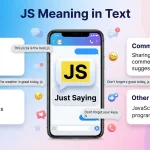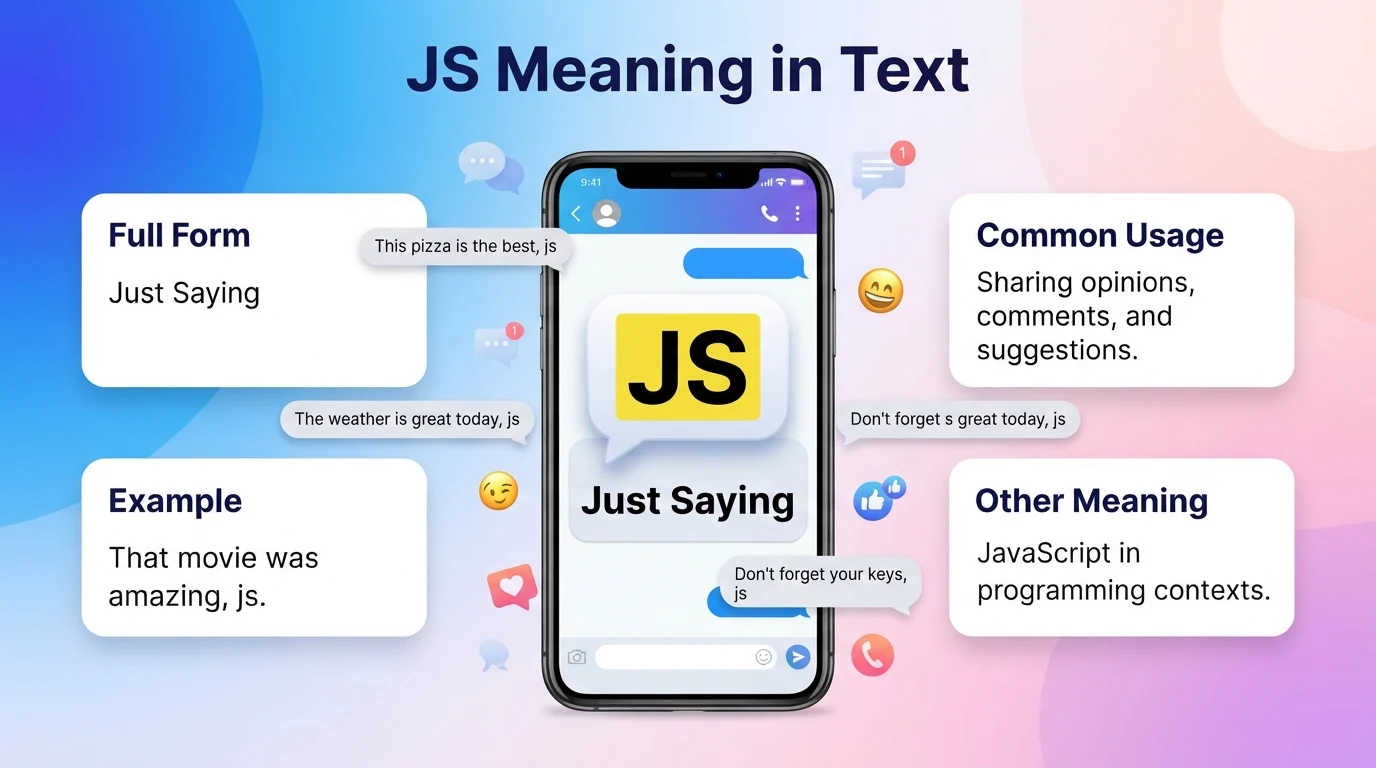
JS usually means Just Saying in text messages and online conversations. People use it to express opinions, share suggestions, or emphasize personal thoughts. However, in technology discussions, JS commonly refers to JavaScript.
The js meaning in text is usually Just Saying, a casual expression people use when sharing opinions, making observations, or adding personal comments to conversations. Instead of typing the complete phrase, they use two simple letters to communicate quickly.
You may encounter this abbreviation in text messages, Snapchat conversations, TikTok comments, Instagram posts, and online discussions. For example, someone might write, “That restaurant has amazing food, js.” Here, the sender simply shares a personal opinion. However, the meaning is not always the same. In programming conversations, JS commonly stands for JavaScript, a popular programming language used to build interactive websites and applications.
Understanding the surrounding conversation helps you identify the intended meaning. Furthermore, knowing how to use this expression can make your digital communication more natural. This guide explores its definitions, different interpretations, texting examples, social media usage, and appropriate responses.
Quick Answer: JS Meaning at a Glance
| Category | Explanation |
|---|---|
| Full Form | Just Saying |
| Main Meaning | Expressing an opinion or personal thought |
| Common Context | Text messages and informal conversations |
| Social Media | Snapchat, TikTok, Instagram, and other platforms |
| Example | That movie was really good, js. |
| Tone | Casual, conversational, sometimes sarcastic |
| Other Meaning | JavaScript in programming |
What Does JS Mean in Text?
The most common meaning of JS in casual texting is Just Saying. People use this abbreviation when they want to express an opinion, make a suggestion, or emphasize something they have mentioned.
It often appears at the end of a sentence. However, people may also use the complete phrase when they want to make their meaning clearer.
For example:
- That new song is actually amazing, js.
- You should try that restaurant sometime, js.
- Everyone deserves a little appreciation, js.
- I think we need another vacation, js.
- Your presentation was really impressive, js.
In these examples, the sender expresses a personal thought without expecting everyone to agree.
What Is the Full Form of JS?
The full form is Just Saying.
It is an informal expression that allows someone to share an observation or opinion. Depending on the conversation, it can sound friendly, humorous, direct, or slightly sarcastic.
Consider these examples:
| Text Message | Intended Meaning |
|---|---|
| You should get some rest, js. | A friendly suggestion |
| That outfit looks great, js. | A casual compliment |
| We need better planning, js. | A personal observation |
| That movie was overrated, js. | An honest opinion |
| You have a good point, js. | Agreement or emphasis |
The abbreviation does not automatically make a statement polite or friendly. Its tone depends on the actual words and the relationship between the people communicating.
Why Do People Use This Abbreviation?
People prefer short expressions because digital conversations often move quickly. JS provides a convenient way to share thoughts without typing additional words.
Here are five common reasons people use it.
1. To Express Personal Opinions
Someone might add the abbreviation after sharing an opinion.
Example: “Chocolate ice cream is the best, js.”
2. To Give Friendly Suggestions
It can introduce casual advice without making the message sound like an instruction.
Example: “You should watch that series, js.”
3. To Emphasize a Point
People sometimes use it to highlight an observation.
Example: “Everyone needs a little encouragement, js.”
4. To Keep Conversations Casual
Short abbreviations fit naturally into informal messages between friends.
Example: “We should plan another trip, js.”
5. To Add Humor or Sarcasm
The expression can also accompany playful comments.
Example: “Maybe reading the instructions would help, js.”
However, readers should consider the surrounding conversation before deciding whether the sender is joking or being serious.
Where Did JS Come From?
JS belongs to the broader culture of internet abbreviations and shortened expressions.
As texting and instant messaging became popular, people began using shorter forms of everyday phrases. Expressions such as LOL, BRB, TBH, and IDK became familiar examples of this communication style.
Just Saying fits the same pattern. It offers a shorter alternative to a phrase people already use in everyday conversations.
There is no reliably established single inventor or exact creation date for this abbreviation. Therefore, it is more accurate to understand it as part of the gradual development of digital communication.
Contextual Dynamics and Different Uses
The intended meaning can change according to the conversation. Therefore, recognizing the tone is just as important as understanding the abbreviation itself.
1. Sharing an Honest Opinion
One common use is expressing a personal viewpoint.
Example:
“That restaurant has the best desserts, js.”
The sender shares a preference. They are not necessarily criticizing other restaurants or expecting everyone to agree.
2. Making a Friendly Suggestion
People sometimes use it when recommending something.
Example:
“You should join the photography club, js.”
Here, the sender encourages someone to try a new activity. The message sounds informal rather than demanding.
3. Adding Emphasis
The abbreviation can reinforce an important observation.
Example:
“Good communication makes every friendship stronger, js.”
The sender wants to highlight a personal belief.
4. Making a Sarcastic Remark
Sometimes, the expression appears after a playful or sarcastic statement.
Example:
“Maybe arriving on time would be helpful, js.”
Depending on the relationship, this could be friendly teasing or criticism.
5. Giving Constructive Feedback
People may use it when suggesting improvements.
Example:
“Your introduction could be a little shorter, js.”
The sender might intend to help. However, the statement can still sound blunt without additional explanation.
How Context Changes the Tone
| Situation | Example | Possible Tone |
|---|---|---|
| Friendly conversation | You should try that cafe, js. | Helpful |
| Compliment | Your artwork looks amazing, js. | Positive |
| Personal opinion | Summer is the best season, js. | Casual |
| Disagreement | That plan needs more work, js. | Direct |
| Playful teasing | You’re always late, js. | Humorous |
| Criticism | You should listen more, js. | Potentially negative |
Important: The abbreviation does not have a fixed emotional meaning. Always consider the complete message before interpreting someone’s intention.
Real-Life Conversation Examples Using JS
The easiest way to understand internet slang is through realistic conversations. These five examples demonstrate how people might use the expression in different everyday situations.
Example 1: Talking About Food
Alex: Have you tried the new pizza place?
Sam: Yes! Their cheese pizza is amazing.
Alex: You should definitely go again, js.
Sam: Absolutely. I already want another slice.
Meaning: Alex shares a friendly recommendation. The abbreviation keeps the conversation relaxed and informal.
Example 2: Discussing School
Emma: I think our science presentation needs more pictures.
Noah: We could add a few diagrams too.
Emma: That would make everything easier to understand, js.
Noah: Good idea. Let’s update the slides.
Meaning: Emma shares an observation about improving their school project. She uses the expression to emphasize her opinion.
Example 3: Giving Friendly Advice
Ryan: I’m not sure whether I should join the photography club.
Mia: You really enjoy taking pictures.
Ryan: That’s true, but I’m a little nervous.
Mia: You should give it a try, js.
Ryan: Maybe you’re right!
Meaning: Mia encourages Ryan to explore an activity he enjoys. Her suggestion feels supportive rather than demanding.
Example 4: Making a Playful Comment
Lily: I finished my homework early today.
Chris: That’s impressive!
Lily: I’m officially the most organized person ever, js.
Chris: Haha, let’s see if that lasts until tomorrow!
Meaning: Lily makes a humorous comment about herself. The surrounding conversation makes her playful intention clear.
Example 5: Sharing an Honest Opinion
Daniel: What did you think about the movie?
Sophie: The acting was great, but the ending felt rushed.
Daniel: I actually agree.
Sophie: A little more time for the ending would have made it better, js.
Daniel: Exactly! It needed another ten minutes.
Meaning: Sophie expresses her opinion about the movie. The abbreviation reinforces her personal observation.
What Can We Learn From These Examples?
These conversations demonstrate three important points:
- The abbreviation usually expresses a personal thought or opinion.
- Its tone changes depending on the subject and relationship.
- It works naturally in informal conversations but is less suitable for formal writing.
Furthermore, the complete sentence usually provides more information than the abbreviation itself.
Platform-Specific Breakdown
Different social platforms encourage different communication styles. Nevertheless, the general interpretation of JS often remains similar in informal conversations.
How It Is Used on Snapchat
Snapchat focuses on quick communication through snaps, stories, direct messages, and group conversations.
People may use JS when reacting to pictures, sharing opinions, or giving friends casual suggestions.
Common Snapchat examples:
- That filter looks great on you, js.
- We should hang out this weekend, js.
- Your new profile picture looks amazing, js.
- That story was hilarious, js.
- You should post more pictures, js.
Example conversation:
Friend: Do you like my new profile picture?
You: It looks really good, js!
Friend: Thank you!
Here, the sender uses the abbreviation to add emphasis to a friendly compliment.
However, short messages can sometimes create misunderstandings. Therefore, consider the sender’s usual communication style before assuming a particular tone.
The Role of JS on TikTok
TikTok encourages quick interactions through video comments, captions, reactions, and discussions.
People may use JS when expressing opinions about videos, trends, entertainment, or everyday topics.
Common TikTok examples:
- This trend is actually fun, js.
- The original version was better, js.
- That explanation makes so much sense, js.
- Everyone should watch this series, js.
- This song deserves more attention, js.
Example:
Someone uploads a video about their favorite pizza toppings.
A viewer comments:
“Adding extra cheese makes everything better, js.”
The commenter expresses a personal food preference. They are not necessarily criticizing the creator.
Furthermore, the meaning can change when the conversation involves programming or technology. In those discussions, JS may refer to JavaScript.
Instagram and Texting Dynamics
Instagram combines photographs, reels, stories, comments, and direct messages. Consequently, people often use informal abbreviations when reacting to content.
Instagram examples:
- Your travel pictures look amazing, js.
- That cafe deserves more attention, js.
- You should share more artwork, js.
- This song is seriously underrated, js.
- Your latest post looks fantastic, js.
Example conversation:
Friend: I’m thinking about changing my study routine.
You: Taking regular breaks could help, js.
Friend: That’s actually a good idea.
Here, the sender offers a simple suggestion.
The same expression can also appear in ordinary SMS messages, WhatsApp conversations, and other messaging applications.
Does It Mean the Same Thing on Every Platform?
Not necessarily. The interpretation depends on the subject and community.
| Platform | Possible Usage | Example |
|---|---|---|
| Snapchat | Friendly opinions | That picture looks great, js. |
| TikTok | Comments and reactions | This video is hilarious, js. |
| Opinions about posts | Love this design, js. | |
| Personal conversations | We should meet soon, js. | |
| SMS | Everyday messages | That sounds interesting, js. |
| Discord | Informal discussions | This idea could work, js. |
These are illustrative examples, not platform-specific rules. Users do not necessarily use the abbreviation in every conversation.
Alternative Meanings and Related Abbreviations
Although Just Saying is a common interpretation in casual messaging, the same letters can represent other expressions.
The subject of the conversation usually provides the strongest clue.
1. JavaScript
JavaScript is a programming language used to create interactive websites and applications.
Developers commonly shorten its name to JS.
Examples:
- I’m learning JS for web development.
- This website uses JS for interactive features.
- Can you help me understand this JS code?
- Our project requires basic JS knowledge.
In these examples, the abbreviation refers to programming rather than an informal expression.
2. Job Search
In some personal notes or career-related discussions, people may use JS as shorthand for job search.
However, this is not a universally established texting meaning.
Example:
“My JS is taking longer than expected.”
The surrounding conversation would need to establish that the sender means job search.
3. Personal Initials
JS can also represent someone’s initials.
Example:
“JS will join our meeting tomorrow.”
Here, the letters might refer to a person’s name rather than an abbreviation.
Comparison of Different Interpretations
| Meaning | Context | Example |
|---|---|---|
| Just Saying | Casual conversations | That sounds great, js. |
| JavaScript | Programming | I am learning JS. |
| Job Search | Career discussions | My JS continues this week. |
| Personal Initials | Names and references | JS sent the message. |
Related Texting Abbreviations
Learning related expressions can make digital conversations easier to understand.
| Abbreviation | Full Form | Purpose |
|---|---|---|
| TBH | To Be Honest | Introducing an honest opinion |
| IMO | In My Opinion | Sharing a viewpoint |
| IMHO | In My Humble Opinion | Expressing a personal thought |
| NGL | Not Gonna Lie | Introducing a candid statement |
| IDK | I Don’t Know | Expressing uncertainty |
| FYI | For Your Information | Sharing useful information |
| BTW | By The Way | Introducing another point |
| LOL | Laughing Out Loud | Expressing amusement |
| FR | For Real | Showing agreement or emphasis |
| IKR | I Know, Right? | Expressing agreement |
JS vs. TBH: What Is the Difference?
These two expressions may appear in similar conversations, but they serve different purposes.
JS (Just Saying): Adds emphasis to a comment, observation, or opinion.
Example: “You should take a break, js.”
TBH (To Be Honest): Introduces an honest or candid statement.
Example: “TBH, I prefer the original version.”
The distinction is useful because both abbreviations can appear when people share personal thoughts.
Misinterpretations: When NOT to Use JS
Understanding an abbreviation is only part of communicating effectively. You should also recognize situations where informal expressions might create confusion.
1. Avoid It in Formal Emails
Professional emails usually require complete sentences and clear wording.
Informal:
“The meeting needs more time, js.”
Professional:
“I believe the meeting would benefit from additional time.”
The second version communicates the suggestion more professionally.
2. Avoid It in Academic Writing
School assignments, research papers, reports, and presentations generally require standard English.
For example, avoid adding informal abbreviations to an academic explanation.
Instead, express your ideas through complete sentences and appropriate vocabulary.
3. Avoid It During Serious Conversations
Serious discussions require thoughtful communication.
Imagine someone shares an important concern. Responding with a short comment followed by JS might sound dismissive.
Instead, acknowledge their feelings and explain your thoughts carefully.
4. Avoid It When the Meaning Is Unclear
Not everyone recognizes internet abbreviations.
For example:
“That could work, js.”
Someone unfamiliar with the expression might not understand the intended meaning.
Writing the complete phrase can prevent unnecessary confusion.
5. Avoid Using It to Hide Harsh Criticism
Adding Just Saying does not automatically make negative comments acceptable.
Potentially rude:
“You never listen to anyone, js.”
More considerate:
“I sometimes feel that my suggestions aren’t receiving enough attention. Could we discuss them?”
The second version communicates the concern more constructively.
Common Mistakes to Avoid
| Mistake | Why It Is a Problem | Better Approach |
|---|---|---|
| Using it in business emails | Sounds overly informal | Write complete sentences |
| Adding it to serious criticism | Can sound dismissive | Explain your concern |
| Assuming everyone understands it | Creates confusion | Use the complete phrase |
| Using it in academic work | Reduces formality | Follow standard English |
| Treating it as automatically polite | Tone depends on wording | Choose considerate language |
The best approach is to match your communication style to your audience. Casual expressions work well among friends, while clear language is more appropriate in professional and academic settings.
How to Respond in Chat Comfortably
When someone sends this abbreviation, you do not need a special reply. Simply respond to the actual opinion or statement.
However, your response should match the tone of the conversation.
1. When You Agree
If you share the same opinion, respond naturally.
Possible replies:
- Exactly!
- I completely agree.
- That’s a good point.
- Honestly, I feel the same way.
- Couldn’t agree more!
- You’re absolutely right.
Example:
Friend: That restaurant has the best desserts, js.
You: Absolutely! Their chocolate cake is amazing.
2. When You Disagree Politely
You can share a different opinion without making the conversation uncomfortable.
Possible replies:
- I see your point, but I think differently.
- That’s interesting. I have another perspective.
- Maybe, but there is another side to consider.
- I understand what you mean.
- Fair enough, although I slightly disagree.
Example:
Friend: Summer is definitely the best season, js.
You: I understand, but I prefer spring.
3. When Someone Gives You Advice
Acknowledge the suggestion, especially when someone is trying to help.
Possible replies:
- Thanks for the suggestion!
- I’ll definitely consider that.
- That’s actually helpful.
- Good point. I’ll think about it.
- I appreciate your advice.
Example:
Friend: You should start practicing every day, js.
You: You’re right. I’ll try to make it a habit.
4. When Someone Makes a Joke
If the conversation is playful, respond with a little humor.
Possible replies:
- Haha, you might be right!
- That’s one way to look at it.
- Fair point!
- Okay, I can’t argue with that.
- You’re making a convincing argument.
5. When You Don’t Understand the Message
There is nothing wrong with asking for clarification.
Possible replies:
- What do you mean by that?
- Can you explain what you mean?
- Are you saying Just Saying?
- Do you mean that seriously?
- I’m not sure I understand.
Quick Response Guide
| Situation | Natural Response |
|---|---|
| Agreement | Exactly! |
| Disagreement | I see it differently. |
| Friendly advice | Thanks, I’ll consider that. |
| Humor | Haha, fair enough! |
| Compliment | That’s really kind of you. |
| Confusion | What do you mean? |
| Strong opinion | Interesting point! |
Remember, you do not need to copy someone else’s abbreviations. A natural response is more important than using trendy expressions.
FAQs
1. What does JS mean in text messages?
JS usually means Just Saying in casual text messages. People use it to share opinions, observations, and suggestions. It can also emphasize a statement without making the conversation sound overly formal.
2. What does JS mean on Snapchat?
On Snapchat, JS generally means Just Saying when friends exchange informal messages. Someone might use it after a compliment, suggestion, or personal opinion. However, the surrounding conversation determines the intended meaning.
3. Is JS slang or an abbreviation?
JS is an abbreviation commonly used as internet slang. It represents Just Saying in casual communication. People use it to shorten messages and express thoughts quickly across different digital platforms.
4. Does JS mean Just Saying?
Yes. Just Saying is a common interpretation in everyday texting. Someone might add it after sharing an opinion or suggestion. However, technical conversations may use the same letters differently.
5. What does JS mean on TikTok?
TikTok users may use JS in comments, captions, and discussions to express personal opinions. It generally means Just Saying. For example, someone might comment, “This song deserves more attention, js.”
6. Is JS rude or disrespectful?
Not necessarily. The abbreviation is generally neutral, but the surrounding statement can sound rude, sarcastic, or critical. Consider the sender’s wording, relationship, and previous messages before interpreting its tone.
7. What is the difference between JS and TBH?
JS means Just Saying, while TBH means To Be Honest. JS usually emphasizes an opinion or comment. TBH introduces a candid thought or honest observation.
8. How should I reply when someone uses JS?
Respond to the actual statement rather than focusing on the abbreviation. You can agree, disagree politely, ask a question, or make a friendly comment. For example, “That’s a good point!” works naturally.
9. Can I use JS in professional communication?
It is better to avoid it in formal emails, business reports, and workplace documents. Use complete sentences to communicate your ideas clearly. Professional writing benefits from appropriate language and a respectful tone.
10. Does JS always mean Just Saying?
No. Its interpretation depends on context. In everyday messaging, it commonly means Just Saying. In software development, it usually refers to JavaScript. Other communities may use it for different expressions or initials.
Conclusion
Understanding js meaning in text makes everyday digital conversations easier to follow. The abbreviation commonly stands for Just Saying. People use it to express opinions, share suggestions, and emphasize personal observations in informal messages.
However, context is essential. The same letters can represent JavaScript in programming discussions or other terms in specific communities. Therefore, always consider the surrounding words before deciding what someone means.
Internet slang continues to evolve as people communicate through Snapchat, TikTok, Instagram, and messaging applications. Learning common abbreviations helps you understand these conversations more confidently. Most importantly, choose expressions that suit your audience and situation. Casual abbreviations are useful among friends, while complete sentences remain the better choice for professional and academic communication.