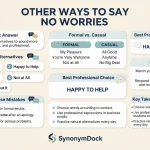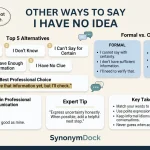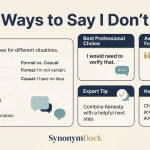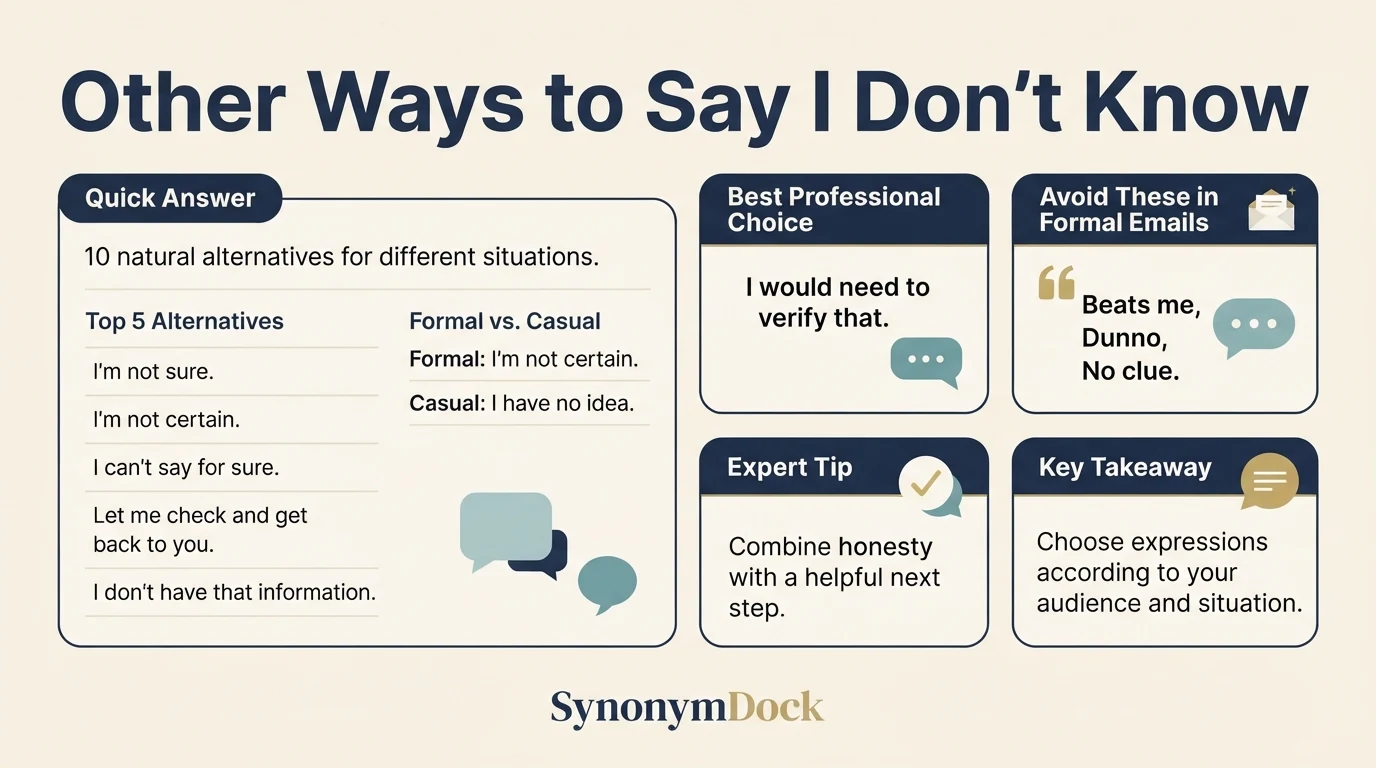
Other ways to say I don’t know include I’m not sure, I’m not certain, I can’t say for sure, let me check, and I don’t have that information. These alternatives help you communicate uncertainty politely and naturally.
Saying “I don’t know” is perfectly acceptable English, but repeating it can make conversations sound less engaging. Choosing different expressions helps you communicate uncertainty without sounding dismissive or unprepared. The best alternative depends on your audience, situation, and intended tone.
Whether you’re answering a workplace question, writing a business email, participating in class, or chatting with friends, having different expressions makes communication easier. These alternatives also help English learners develop stronger vocabulary and sound more confident.
In this guide, you’ll discover 10 practical alternatives, their meanings, natural examples, and differences in formality. You’ll also learn which expressions work best in professional conversations and everyday English.
Quick Categories: Different Ways to Say I Don’t Know
1. Formal Alternatives
- I am not certain.
- I cannot say for certain.
- I am unable to confirm that.
- I do not have sufficient information.
Pro Tip: Use complete sentences and respectful wording in formal discussions, reports, and professional correspondence.
2. Professional Alternatives
- I would need to verify that.
- Let me look into it.
- I will confirm that shortly.
- I don’t have that information yet.
Pro Tip: Whenever possible, explain how you plan to find the answer.
3. Business Email Alternatives
- I’ll check and get back to you.
- I will verify the details.
- Let me confirm that for you.
- I need to review the information first.
Pro Tip: Give a realistic follow-up time when promising to provide an answer.
4. Academic Alternatives
- I am unsure about that.
- I cannot determine the answer yet.
- I need to review the evidence.
- I am not familiar with this concept.
Pro Tip: Academic communication should distinguish between missing knowledge and conclusions that require further research.
5. Casual Alternatives
- I’m not sure.
- I have no idea.
- I couldn’t say.
- Beats me.
Pro Tip: These expressions work naturally with friends, classmates, and familiar colleagues.
6. Informal Expressions
- No clue!
- Dunno!
- Who knows?
- Your guess is as good as mine.
Pro Tip: Save slang and humorous expressions for relaxed conversations.
What Does “I Don’t Know” Mean?
“I don’t know” is an English expression used when someone lacks information, cannot answer a question, or feels uncertain about something.
Grammar explanation: The phrase follows a simple subject + auxiliary verb + main verb structure.
- I = Subject
- Do = Auxiliary verb
- Know = Main verb
Example: I don’t know when the next meeting will begin.
In simple words, you’re telling someone that you don’t currently have the answer.
When Should You Use Alternatives to I Don’t Know?
Different situations require different communication styles.
- Business communication: Say “I would need to verify that” when discussing important information.
- Emails: Use “I’ll check and get back to you” when you need time to confirm details.
- Meetings: Say “I’m not certain about that” when answering unexpected questions.
- Presentations: Use “I can’t say for sure” when information needs further confirmation.
- Academic writing: Say “The available evidence is insufficient” when research doesn’t support a definite conclusion.
- Interviews: Use “I haven’t worked with that particular topic, but I’m willing to learn” when discussing unfamiliar subjects.
- Daily conversations: Choose “I’m not sure” or “I have no idea” for relaxed discussions.
Other Ways to Say I Don’t Know (With Examples)
Here are 10 useful alternatives, arranged from versatile professional expressions to informal everyday phrases.
1. I’m Not Sure
Meaning: You don’t have a definite answer or feel uncertain about something.
Explanation: This is one of the most natural alternatives. It sounds softer than a direct “I don’t know” and works in many situations.
- Formal: Acceptable
- Neutral: Excellent
- Professional: Suitable
- Casual: Excellent
Example Sentence: I’m not sure whether the new schedule has been approved.
Best Use: Everyday communication
Avoid Using In: None generally
Tone: Polite and neutral
Formality Level: ⭐⭐⭐⭐
Usage Frequency: Very Common
CEFR Level: B1
Common Collocations: Not sure about, not sure whether, not entirely sure, really not sure.
Context Examples:
- Spoken English: I’m not sure what time they’re arriving.
- Professional English: I’m not sure whether the report is ready.
- Casual Conversation: I’m not sure what to watch tonight.
2. I’m Not Certain
Meaning: You don’t have enough confidence to confirm something.
Explanation: This expression sounds slightly more formal than “I’m not sure.” It’s useful when discussing facts, decisions, and professional matters.
- Formal: Excellent
- Neutral: Suitable
- Professional: Excellent
- Casual: Acceptable
Example Sentence: I’m not certain whether the figures include last month’s expenses.
Best Use: Formal discussions
Avoid Using In: Relaxed texting
Tone: Respectful and measured
Formality Level: ⭐⭐⭐⭐⭐
Usage Frequency: Common
CEFR Level: B2
Common Collocations: Not certain about, not certain whether, absolutely certain, reasonably certain.
Context Examples:
- Spoken English: I’m not certain about the answer.
- Professional English: I’m not certain that the proposal meets our requirements.
- Casual Conversation: I’m not certain what happened yesterday.
3. I Can’t Say for Sure
Meaning: You cannot confidently confirm something.
Explanation: Use this phrase when you have limited information or cannot make a reliable prediction. It communicates uncertainty without sounding dismissive.
- Formal: Suitable
- Neutral: Excellent
- Professional: Suitable
- Casual: Excellent
Example Sentence: I can’t say for sure when the package will arrive.
Best Use: Uncertain answers
Avoid Using In: Verified facts
Tone: Cautious and polite
Formality Level: ⭐⭐⭐⭐
Usage Frequency: Common
CEFR Level: B2
Common Collocations: Can’t say for sure, can’t confirm, can’t predict, can’t guarantee.
Context Examples:
- Spoken English: I can’t say for sure what time she’ll arrive.
- Professional English: I can’t say for sure until the figures are reviewed.
- Casual Conversation: I can’t say for sure, but maybe tomorrow.
4. I Don’t Have That Information
Meaning: You currently lack the specific details someone is requesting.
Explanation: This is a clear, professional expression. It works particularly well when answering customer questions or discussing workplace responsibilities.
- Formal: Excellent
- Neutral: Suitable
- Professional: Excellent
- Casual: Less common
Example Sentence: I don’t have that information right now, but I’ll check with the relevant department.
Best Use: Business communication
Avoid Using In: Friendly small talk
Tone: Direct and professional
Formality Level: ⭐⭐⭐⭐⭐
Usage Frequency: Common
CEFR Level: B2
Common Collocations: Information available, information required, information provided, additional information.
Context Examples:
- Spoken English: I don’t have that information right now.
- Professional English: I don’t have that information available at present.
- Casual Conversation: I don’t have those details.
5. Let Me Check and Get Back to You
Meaning: You need time to find an accurate answer and respond later.
Explanation: This phrase combines honesty with a helpful next step. It’s especially useful in meetings, workplace conversations, and business emails.
- Formal: Suitable
- Neutral: Excellent
- Professional: Excellent
- Casual: Suitable
Example Sentence: Let me check the latest figures and get back to you this afternoon.
Best Use: Workplace follow-ups
Avoid Using In: Instant answers
Tone: Helpful and responsible
Formality Level: ⭐⭐⭐⭐⭐
Usage Frequency: Very Common
CEFR Level: B2
Common Collocations: Check the details, check the figures, get back to you, confirm the information.
Context Examples:
- Spoken English: Let me check and get back to you.
- Professional English: I’ll review the information and get back to you by Friday.
- Casual Conversation: Let me check my messages first.
Native Speaker Tip: Choosing the First Five
“I’m not sure” is the most flexible everyday choice, while “I don’t have that information” suits professional situations.
“Let me check and get back to you” sounds helpful because it offers a clear next step. Native English speakers generally choose simple wording rather than unnecessarily complicated expressions.
6. I Would Need to Verify That
Meaning: You need to check whether something is accurate before confirming it.
Explanation: This expression is particularly useful when accuracy matters. It communicates responsibility and avoids presenting assumptions as facts.
- Formal: Excellent
- Neutral: Suitable
- Professional: Excellent
- Casual: Unusual
Example Sentence: I would need to verify that information before giving you a final answer.
Best Use: Fact checking
Avoid Using In: Friendly chats
Tone: Careful and professional
Formality Level: ⭐⭐⭐⭐⭐
Usage Frequency: Common
CEFR Level: C1
Common Collocations: Verify the details, verify the information, verify the figures, verify the accuracy.
Context Examples:
- Spoken English: I’d need to verify that first.
- Professional English: I would need to verify the figures before approving the report.
- Casual Conversation: I’d have to check that.
7. I’m Not Familiar With That
Meaning: You don’t have much knowledge or experience about a particular subject.
Explanation: Use this expression when discussing unfamiliar topics, systems, or processes. It doesn’t necessarily mean you cannot learn about them.
- Formal: Suitable
- Neutral: Excellent
- Professional: Excellent
- Casual: Suitable
Example Sentence: I’m not familiar with that software, but I can review its features.
Best Use: Unfamiliar topics
Avoid Using In: Known subjects
Tone: Honest and respectful
Formality Level: ⭐⭐⭐⭐
Usage Frequency: Common
CEFR Level: B2
Common Collocations: Familiar with the process, familiar with the topic, familiar with the system, familiar with the subject.
Context Examples:
- Spoken English: I’m not familiar with that place.
- Professional English: I’m not familiar with this reporting system.
- Casual Conversation: I’m not familiar with that game.
8. I Couldn’t Say
Meaning: You cannot provide a reliable answer or prediction.
Explanation: This expression is polite and slightly reserved. It’s useful when someone asks about an uncertain situation or requests an opinion you cannot confidently give.
- Formal: Suitable
- Neutral: Excellent
- Professional: Suitable
- Casual: Excellent
Example Sentence: I couldn’t say whether the event will be postponed.
Best Use: Uncertain predictions
Avoid Using In: Confirmed details
Tone: Reserved and polite
Formality Level: ⭐⭐⭐⭐
Usage Frequency: Common
CEFR Level: B2
Common Collocations: Couldn’t say for certain, couldn’t say exactly, couldn’t say whether, really couldn’t say.
Context Examples:
- Spoken English: I couldn’t say when they’ll arrive.
- Professional English: I couldn’t say without reviewing the proposal.
- Casual Conversation: I couldn’t say. Maybe next week.
9. I Have No Idea
Meaning: You have absolutely no information or knowledge about something.
Explanation: This is a common informal expression. It sounds natural among friends but can seem blunt when someone expects a professional response.
- Formal: Not recommended
- Neutral: Sometimes
- Professional: Limited
- Casual: Excellent
Example Sentence: I have no idea where I left my notebook.
Best Use: Friendly conversations
Avoid Using In: Formal meetings
Tone: Casual and direct
Formality Level: ⭐⭐
Usage Frequency: Very Common
CEFR Level: B1
Common Collocations: Have no idea why, have no idea where, have no idea how, have no idea what.
Context Examples:
- Spoken English: I have no idea what happened.
- Professional English: I have no idea is better replaced with “I haven’t confirmed that yet.”
- Casual Conversation: I have no idea where my keys are.
10. Beats Me
Meaning: You don’t know the answer to something.
Explanation: This informal idiom expresses complete uncertainty, often with a humorous or relaxed feeling. Use it with friends rather than in formal communication.
- Formal: Not recommended
- Neutral: Unusual
- Professional: Avoid
- Casual: Excellent
Example Sentence: Why is the internet so slow today? Beats me!
Best Use: Friendly conversations
Avoid Using In: Business emails
Tone: Humorous and casual
Formality Level: ⭐
Usage Frequency: Common
CEFR Level: B2
Common Collocations: Beats me why, beats me how, honestly beats me, that beats me.
Context Examples:
- Spoken English: Why did they cancel? Beats me.
- Professional English: Replace this with “I’m not sure what caused the issue.”
- Casual Conversation: Who ate the last cookie? Beats me!
Native Speaker Tip: Choosing the Last Five
“I would need to verify that” is a strong choice when accuracy matters. “I’m not familiar with that” is useful when discussing unfamiliar subjects.
“I have no idea” and “Beats me” are natural in relaxed conversations. However, they can sound too casual when answering clients or managers.
Expert Insight: How to Sound More Professional
The strongest communication strategy is to combine honesty with a helpful response.
Workplace communication: Instead of stopping at “I’m not sure,” explain what you’ll check. This shows responsibility without pretending to know everything.
Email writing: “I’ll verify the details and get back to you” sounds more constructive than simply saying you don’t know.
Academic English: Distinguish between missing information and uncertainty about evidence. Expressions such as “I cannot determine this from the available evidence” are more precise.
Professional tone: Never invent an answer to appear knowledgeable. Clear communication builds more trust than unsupported confidence.
Quick Recap: Best Alternatives
| Category | Best Phrase |
|---|---|
| Best Professional Choice | I would need to verify that. |
| Best Casual Choice | I have no idea. |
| Best Formal Choice | I’m not certain. |
| Most Natural Choice | I’m not sure. |
| Most Polite Choice | Let me check and get back to you. |
Comparison Table: All 10 Alternatives
| Phrase | Tone | Formality | Best Use | Frequency |
|---|---|---|---|---|
| I’m not sure | Neutral | Medium | Everyday English | Very Common |
| I’m not certain | Respectful | High | Formal discussions | Common |
| I can’t say for sure | Cautious | Medium | Predictions | Common |
| I don’t have that information | Direct | High | Workplace | Common |
| Let me check and get back to you | Helpful | High | Business emails | Very Common |
| I would need to verify that | Professional | High | Fact checking | Common |
| I’m not familiar with that | Respectful | Medium | Unfamiliar topics | Common |
| I couldn’t say | Reserved | Medium | Opinions | Common |
| I have no idea | Casual | Low | Friendly chats | Very Common |
| Beats me | Humorous | Very Low | Informal speech | Common |
Professional vs. Polite vs. Formal vs. Natural
These terms describe different qualities of communication. A phrase can be professional and polite without sounding overly formal.
Polite: Uses considerate wording to respect the other person.
Example: “I’m sorry, but I’m not entirely sure.”
Professional: Communicates honestly while showing responsibility.
Example: “I’ll verify the information and follow up.”
Formal: Uses complete, carefully structured language.
Example: “I am unable to confirm that at present.”
Natural: Sounds comfortable and appropriate in everyday English.
Example: “I’m not sure about that.”
The best expression balances the situation, relationship, and purpose.
Pros and Cons of Using Alternatives
Pros
- Better vocabulary: You learn different ways to express uncertainty.
- Clearer communication: You can explain exactly what you don’t know.
- Professional confidence: Helpful expressions make workplace conversations more constructive.
- Natural English: Different phrases help prevent repetitive communication.
- Greater flexibility: You can adjust your tone for different audiences.
Cons
- Wrong context: Informal expressions can sound inappropriate in professional situations.
- Unclear meaning: Some phrases express uncertainty rather than complete lack of knowledge.
- Unnecessary complexity: Long expressions can make simple answers sound unnatural.
- False promises: Saying you’ll check creates an expectation that you will follow up.
- Misleading confidence: Saying you’re uncertain when you actually lack information can confuse listeners.
Best Choice: Which Alternative Should You Use?
- Best Overall: “I’m not sure.” It’s simple, natural, and suitable for many situations.
- Best Professional: “I would need to verify that.” It emphasizes accuracy and responsibility.
- Best Academic: “I cannot determine that from the available evidence.” It communicates research limitations clearly.
- Best Business Email: “Let me check and get back to you.” It offers a practical next step.
- Best Everyday Conversation: “I have no idea.” It sounds relaxed among friends.
- Most Natural: “I’m not sure.” It fits everyday spoken English.
- Most Polite: “Let me check and get back to you.” It communicates willingness to help.
Commonly Confused Phrases
Understanding these differences helps you select the right expression.
1. I’m Not Sure vs. I Have No Idea
“I’m not sure” suggests uncertainty, while “I have no idea” suggests almost complete lack of knowledge.
2. I’m Not Certain vs. I Can’t Say for Sure
“I’m not certain” describes your confidence level. “I can’t say for sure” emphasizes that you cannot confirm something.
3. I’m Not Familiar With That vs. I Don’t Know
“I’m not familiar with that” suggests limited experience with a subject. “I don’t know” simply states that you lack an answer.
4. Let Me Check vs. I’ll Get Back to You
“Let me check” describes an immediate action. “I’ll get back to you” promises a future response.
5. Beats Me vs. I Couldn’t Say
“Beats me” is informal and sometimes humorous. “I couldn’t say” is more reserved and polite.
Scenario Practice: Which Phrase Would You Choose?
Test your understanding with these five practical situations.
1. Business Meeting
Your manager asks whether the latest figures are correct, but you haven’t reviewed them.
Best Answer: “I would need to verify that before confirming.”
Why: It communicates responsibility and avoids providing inaccurate information.
2. Job Interview
The interviewer asks about software you’ve never used.
Best Answer: “I’m not familiar with that software, but I’m willing to learn.”
Why: It honestly acknowledges your experience while showing a positive attitude.
3. Presentation
Someone asks about a result that hasn’t been confirmed.
Best Answer: “I can’t say for sure until the results are finalized.”
Why: It communicates uncertainty without making unsupported claims.
4. Classroom Discussion
Your teacher asks a question, and you’re unsure of the answer.
Best Answer: “I’m not entirely sure, but I’d like to understand it better.”
Why: It shows honesty and willingness to learn.
5. Email Reply
A colleague requests information that you need to check.
Best Answer: “Let me check the details and get back to you.”
Why: It sounds professional and establishes a clear next step.
Mini Quiz: Test Your Understanding
1. Which phrase is most suitable for a professional meeting?
A. Beats me.
B. I would need to verify that.
C. Dunno.
2. Which expression sounds most natural with friends?
A. I have no idea.
B. I am unable to confirm that.
C. I would need to investigate.
3. What does “I’m not familiar with that” communicate?
A. You completely disagree.
B. You have limited knowledge or experience.
C. You already know the answer.
4. Which phrase offers a helpful next step?
A. Beats me.
B. Who knows?
C. Let me check and get back to you.
5. Which expression is best for uncertain predictions?
A. I can’t say for sure.
B. No clue.
C. Dunno.
Answer Key:
- B
- A
- B
- C
- A
FAQs
1. What is the most polite way to say I don’t know?
“I’m not entirely sure, but I’ll check for you” is a polite alternative. It acknowledges uncertainty while showing willingness to help. This expression works particularly well in professional conversations and customer communication.
2. What is a professional way to say I don’t know in an email?
You can write, “I don’t have that information available at the moment, but I’ll verify the details.” This sounds professional, communicates honesty, and offers a practical next step.
3. What are some casual alternatives to I don’t know?
Common casual expressions include “I’m not sure,” “I have no idea,” “No clue,” and “Beats me.” These phrases work naturally with friends and family, although some sound too informal for workplace communication.
4. Is I’m not sure better than I don’t know?
“I’m not sure” usually sounds softer because it expresses uncertainty rather than complete lack of knowledge. Both expressions are correct, but your choice should depend on the information you have and the situation.
5. How can I avoid saying I don’t know repeatedly?
Build a vocabulary of expressions for different situations. Practise alternatives such as “I’m not certain,” “Let me check,” and “I couldn’t say.” Choose each phrase according to your intended meaning and audience.
Conclusion
Learning other ways to say I don’t know helps you communicate with greater clarity, confidence, and flexibility. Whether you’re speaking with colleagues, answering questions in class, writing emails, or chatting with friends, the right expression makes your message more appropriate. You don’t need complicated vocabulary to sound professional. Simple, well-chosen phrases often communicate your meaning more effectively.
Start by practising two or three alternatives each day. Use “I’m not sure” in everyday conversations and “Let me check and get back to you” in professional situations. With regular practice, you’ll develop more natural English and express uncertainty without hesitation.