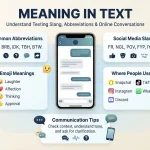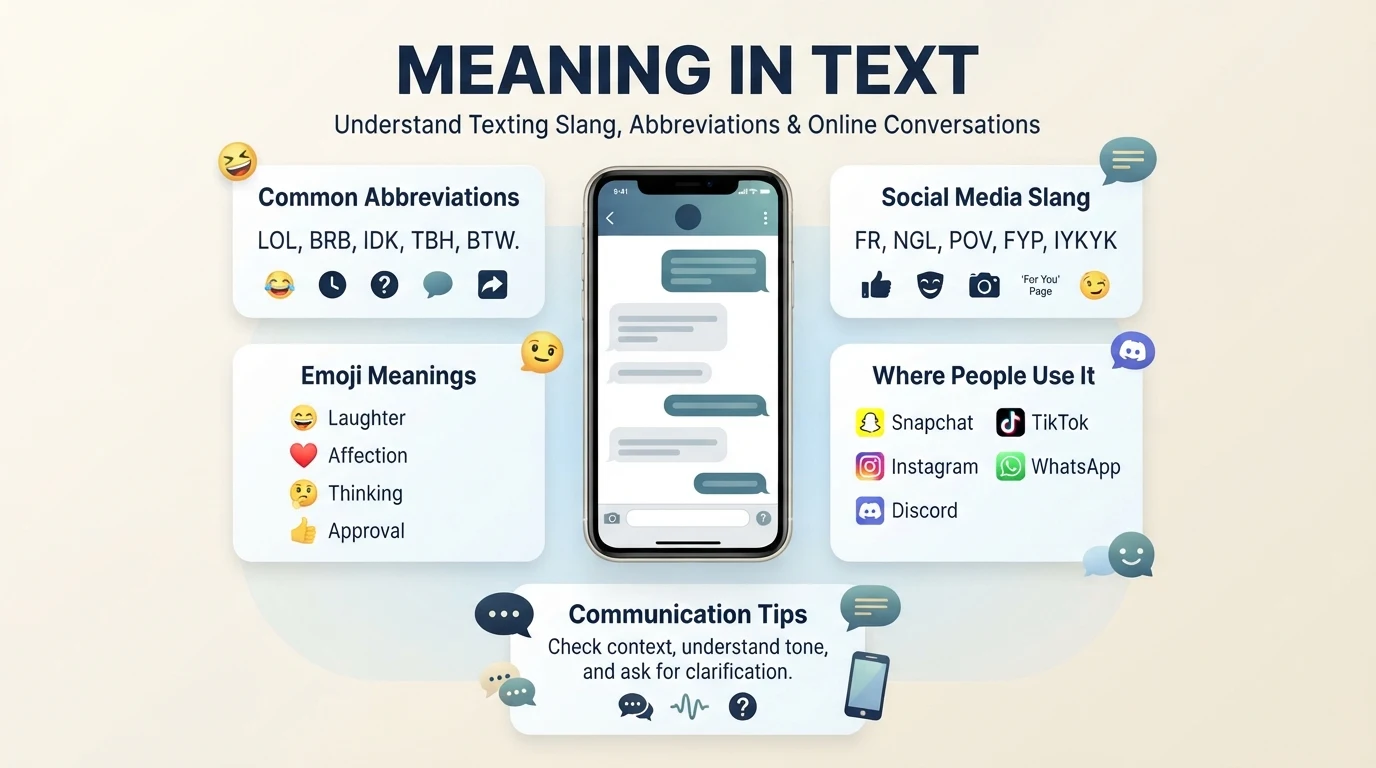
Meaning in text refers to the definition or intended message behind a word, abbreviation, emoji, or phrase in a digital conversation. It helps readers understand slang, tone, context, and online communication across texting and social media platforms.
Meaning in text helps people understand unfamiliar words, abbreviations, and expressions in everyday digital conversations. Modern texting moves quickly. Therefore, people often shorten messages, use slang, and add emojis to communicate their thoughts. These habits can make conversations faster, but they can also create confusion.
For example, someone might send an abbreviation that you have never seen before. You may understand the individual letters but still miss the intended message. Similarly, a familiar word can carry a different meaning in a casual conversation. Context, punctuation, and the relationship between speakers all matter.
Today, people communicate through SMS, Snapchat, TikTok, Instagram, WhatsApp, Discord, and other platforms. Each space has its own communication habits. However, the basic goal remains the same: understand what another person wants to say.
This guide explains common texting interpretations, conversational examples, platform differences, alternative expressions, and practical responses. Furthermore, it explores how to recognize slang without making assumptions about someone’s intentions.
Quick Answer Box
| Category | Explanation |
|---|---|
| Meaning | The definition or intended message behind a word, phrase, abbreviation, or emoji |
| Context | Text messages, online conversations, comments, captions, and direct messages |
| Primary Platforms | Snapchat, TikTok, Instagram, WhatsApp, Discord, and SMS |
| Example | What does this abbreviation mean in text? |
| Tone | Informational, casual, conversational, and context-dependent |
What Does Meaning in Text Mean?
The phrase describes what a particular word, expression, symbol, or message communicates in a written digital conversation.
In everyday communication, people often ask what something means because they encounter unfamiliar language. They might see a short abbreviation in a friend’s message or notice an unfamiliar expression in a social media comment.
For example:
Person A: She replied with “FR.”
Person B: It means “for real.”
Here, the abbreviation communicates agreement, sincerity, or emphasis. However, its precise meaning depends on the surrounding conversation.
Understanding the Basic Definition
Digital communication includes several types of language:
- Abbreviations: Shortened forms such as LOL, BRB, and IDK.
- Acronyms: Expressions formed from initial letters, such as TBH and IMO.
- Internet slang: Informal expressions popular in online communities.
- Emojis: Small symbols that communicate emotions, reactions, or ideas.
- Texting expressions: Casual phrases that people use in everyday messages.
- Contextual language: Ordinary words that carry special meanings in particular conversations.
These categories often overlap. For instance, an abbreviation can also become popular internet slang.
Why People Search for Digital Definitions
People frequently encounter unfamiliar expressions while chatting. Therefore, they look up definitions to avoid misunderstanding a message.
Common reasons include:
- Understanding a friend’s unfamiliar abbreviation.
- Interpreting a social media comment.
- Learning current internet slang.
- Understanding an emoji or reaction.
- Responding naturally to a casual message.
- Recognizing whether an expression sounds friendly, sarcastic, or serious.
- Improving everyday digital communication.
Furthermore, younger audiences often encounter new expressions through online communities. However, not every trending phrase has one universally accepted definition.
How Digital Slang Developed
Text messaging encouraged shorter communication because early mobile phones had limited keyboards and message constraints. Consequently, people developed abbreviations to save time and typing effort.
Later, instant messaging and social networks expanded these habits. Platforms introduced new formats, including comments, captions, short videos, reactions, and disappearing messages.
Today, digital language changes through community participation. A phrase can become popular in one online group while remaining unfamiliar elsewhere.
Importantly, slang does not always originate on a particular platform. It can spread through music, entertainment, gaming, school communities, and everyday conversations.
Contextual Dynamics and Nuances of the Term
Understanding a digital message requires more than looking up individual words. The sender’s intention, the conversation, and the platform can all influence interpretation.
For example, the word “bet” can communicate agreement, confidence, or acceptance. Similarly, “sure” might sound enthusiastic or neutral. In some situations, it may even sound reluctant.
1. The Importance of Conversation Context
Always read the complete message before deciding what an unfamiliar expression means.
Consider these examples:
| Message | Possible Interpretation |
|---|---|
| Bet, see you there! | Agreement |
| That’s wild! | Surprise or excitement |
| IDK, maybe tomorrow | Uncertainty |
| FR, I agree | Strong agreement |
| Okay, got it | Understanding or acknowledgment |
The surrounding words provide useful clues. However, the same expression can communicate different feelings in another conversation.
2. Tone and Emotional Meaning
Written conversations lack many features of face-to-face communication. You cannot always hear someone’s voice or observe their facial expressions.
Therefore, people use punctuation, emojis, capitalization, and repeated letters to add emotional information.
| Texting Style | Possible Tone |
|---|---|
| Okay. | Neutral or firm |
| Okayyy! | Playful or enthusiastic |
| OKAY! | Excited or emphatic |
| Haha | Amused or friendly |
| Hmm… | Thoughtful or uncertain |
| Sure! | Positive or agreeable |
| Sure. | Neutral or potentially reluctant |
These interpretations are not universal rules. A person’s usual writing style matters more than one punctuation mark.
3. Relationship Between the Sender and Receiver
The relationship between two people also influences interpretation.
A close friend might use informal expressions without explaining them. However, a teacher, employer, or unfamiliar person might choose clearer language.
For example:
Between friends: “BRB, grabbing food.”
In a professional conversation: “I’ll be away briefly and will return shortly.”
Both messages communicate a similar idea. Nevertheless, their levels of formality differ.
4. Cultural and Generational Differences
Internet language changes across communities and generations. A phrase that feels familiar to one group might confuse another.
Furthermore, regional expressions can carry meanings that do not translate directly into American English.
Consider these factors:
- Age and communication habits.
- Regional language differences.
- Online communities and shared interests.
- Gaming and entertainment culture.
- Personal preferences.
- Workplace communication standards.
Consequently, avoid assuming that everyone understands the same abbreviations.
5. Literal Meaning Versus Intended Meaning
Sometimes, the literal definition does not explain the complete message.
For example:
Message: “I’m dead 😂”
The sender usually does not mean this literally. Instead, the expression often communicates that something is extremely funny.
Similarly, “I’m crying” can express amusement or strong emotion in an informal conversation.
The surrounding context helps readers distinguish figurative language from literal statements.
Real-Life Conversation Examples Using Meaning in Text
The following conversations demonstrate how people interpret common abbreviations and informal expressions. Each example includes a short explanation to make the communication easier to understand.
Example 1: Understanding LOL
Alex: Did you see that funny video?
Jordan: Yes, LOL. That was hilarious!
Alex: I watched it three times.
Jordan: Same here!
Explanation: LOL stands for “laughing out loud.” People commonly use it to communicate amusement. However, it can also soften a message or make a conversation feel more relaxed.
Example 2: Understanding IDK
Mia: Are we meeting after school?
Emma: IDK yet. I need to check my schedule.
Mia: No problem. Just let me know.
Emma: Sure, I’ll message you later.
Explanation: IDK means “I don’t know.” It communicates uncertainty or a lack of information. Furthermore, the sender can use it naturally when they have not made a decision.
Example 3: Understanding TBH
Ryan: Did you enjoy the movie?
Chris: TBH, I thought the ending was confusing.
Ryan: Really? I liked it.
Chris: The beginning was great, though.
Explanation: TBH stands for “to be honest.” People use it before sharing an opinion or personal observation. It can introduce a positive, negative, or neutral statement.
Example 4: Understanding BRB
Sophie: Are you still working on the assignment?
Olivia: Yes, but BRB. I need to get my notebook.
Sophie: Okay, take your time.
Olivia: I’m back!
Explanation: BRB means “be right back.” It tells another person that the sender will temporarily leave the conversation and return shortly.
Example 5: Understanding FR
Daniel: That presentation was really impressive.
Ethan: FR! The speaker explained everything clearly.
Daniel: I learned a lot from it.
Ethan: Same!
Explanation: FR means “for real.” It emphasizes agreement or sincerity. People often use it in casual messages when they strongly agree with something.
What These Examples Teach Us
These conversations demonstrate three important principles:
- Abbreviations make casual conversations quicker.
- The surrounding sentence helps clarify the intended message.
- Tone and relationships influence how people interpret short replies.
Furthermore, readers should avoid assuming that every abbreviation has only one possible definition.
Platform-Specific Breakdown
Different social media platforms encourage different communication styles. Although many expressions appear across multiple services, their usage can change depending on the content and audience.
How It Is Used on Snapchat
Quick messages, reactions, and informal conversations
Snapchat encourages quick communication through direct messages, Snaps, Stories, and reactions.
Friends often use abbreviations because they want to communicate quickly. They may also combine short phrases with emojis and pictures.
Common examples include:
| Expression | Meaning | Example |
|---|---|---|
| WYD | What are you doing? | WYD tonight? |
| WYA | Where are you? | WYA right now? |
| HMU | Hit me up | HMU when you’re free. |
| NGL | Not gonna lie | NGL, that was funny. |
| FR | For real | FR, I agree. |
| IDK | I don’t know | IDK what happened. |
Example Snapchat Conversation
Person A: WYD?
Person B: Just watching a movie.
Person A: NGL, that sounds relaxing.
Person B: FR!
Snapchat also has platform-specific features that should not be confused with ordinary slang.
For example, a Snapstreak refers to an ongoing exchange of Snaps between friends on consecutive days. A Story is content shared for other people to view.
These terms describe platform features rather than general texting abbreviations.
The Role of Meaning in Text on TikTok
Viral expressions, comments, trends, and community language
TikTok has become an influential space for discovering and sharing internet expressions. Users encounter unfamiliar language through video captions, comments, hashtags, and creator discussions.
Furthermore, viral trends can introduce expressions to audiences who rarely use them elsewhere.
Here are some examples:
| Expression | Common Meaning | Example |
|---|---|---|
| POV | Point of view | POV: You forgot your homework. |
| FYP | For You Page | This video appeared on my FYP. |
| GRWM | Get ready with me | GRWM for a school event. |
| IYKYK | If you know, you know | That moment was unforgettable. |
| NGL | Not gonna lie | NGL, this song is great. |
| FR | For real | FR, this is relatable. |
Example TikTok Comment Conversation
User A: This video describes my entire week.
User B: FR, especially the ending!
User C: IYKYK 😂
Explanation: FR emphasizes agreement. Meanwhile, IYKYK suggests that people familiar with a particular situation will understand the reference.
TikTok trends also demonstrate how language evolves. A phrase might become popular through one creator’s video and spread into comments across other platforms.
However, popularity does not guarantee that every viewer understands the same interpretation.
Instagram and Texting Dynamics
Direct messages, captions, comments, and reactions
Instagram combines visual content with written communication. People use comments, direct messages, Stories, and captions to interact with friends and communities.
As a result, abbreviations often appear alongside images, videos, and emoji reactions.
Common expressions include:
| Expression | Meaning | Example |
|---|---|---|
| DM | Direct message | Send me a DM. |
| OOTD | Outfit of the day | Here’s my OOTD. |
| TBH | To be honest | TBH, I enjoyed it. |
| IMO | In my opinion | IMO, this is better. |
| ICYMI | In case you missed it | ICYMI, here’s the update. |
| LMK | Let me know | LMK what you think. |
Example Instagram Conversation
Person A: Did you see my latest post?
Person B: Yes! Your photos look great.
Person A: Thanks! TBH, I spent a lot of time editing them.
Person B: It definitely shows!
Instagram users also communicate through reactions. A heart, thumbs-up, or laughing emoji can sometimes replace a complete sentence.
Nevertheless, reactions do not always communicate the same thing. Consider the relationship and conversation before interpreting them.
WhatsApp and Everyday Messaging
WhatsApp supports private conversations, group chats, voice messages, and community discussions.
People often combine regular English with abbreviations.
Examples include:
- OMW: On my way.
- TTYL: Talk to you later.
- BTW: By the way.
- NP: No problem.
- ASAP: As soon as possible.
- LMK: Let me know.
For example:
Friend A: Are you coming to the event?
Friend B: OMW!
Friend A: Great. See you soon.
The abbreviation communicates that the sender is traveling toward the meeting location.
Discord and Online Communities
Discord supports group conversations, community servers, voice channels, and gaming discussions.
Its users often communicate through short messages because conversations can move quickly.
| Expression | Meaning | Common Context |
|---|---|---|
| AFK | Away from keyboard | Gaming and chat |
| GG | Good game | Games and friendly competition |
| BRB | Be right back | Group conversations |
| IMO | In my opinion | Discussions |
| IRL | In real life | Online conversations |
| DM | Direct message | Private communication |
For example:
Player A: Are you joining the next round?
Player B: BRB, getting something to drink.
Player A: Okay, we’ll wait.
The main lesson is simple: platform culture can influence language, but the surrounding conversation remains essential.
Alternative Meanings and NLP Variations of the Phrase
Digital communication includes several overlapping language categories. Understanding their differences makes unfamiliar expressions easier to interpret.
1. Texting Slang
Texting slang consists of informal expressions that people use in digital conversations.
Examples include:
- Bet: Agreement or acceptance.
- No cap: Honestly or without exaggeration.
- Mid: Average or unimpressive.
- Rizz: Charm or charisma.
- Low-key: Slightly, secretly, or moderately, depending on context.
These expressions do not necessarily shorten longer phrases. Instead, they add informal vocabulary to everyday communication.
2. Texting Abbreviations
Abbreviations shorten common expressions. They can save time and make casual messages easier to type.
| Abbreviation | Full Form |
|---|---|
| LOL | Laughing out loud |
| BRB | Be right back |
| IDK | I don’t know |
| TBH | To be honest |
| BTW | By the way |
| TTYL | Talk to you later |
| LMK | Let me know |
| IMO | In my opinion |
| NVM | Never mind |
| OMW | On my way |
These expressions are generally suitable for informal conversations. However, full sentences usually work better in formal writing.
3. Internet Acronyms and Initialisms
People often use the words acronym and abbreviation interchangeably. However, they have slightly different linguistic meanings.
An acronym forms a word from initial letters and is usually pronounced as a word. An initialism uses individual letters pronounced separately.
For example:
- NASA is an acronym.
- LOL is commonly pronounced letter by letter.
- BRB is an initialism.
- ASAP can be pronounced as a word or as individual letters.
In everyday online conversations, both categories frequently fall under the broader label of internet abbreviations.
4. Emoji Interpretations
Emojis add emotional and visual information to written messages.
| Emoji | Common Interpretation |
|---|---|
| 😂 | Laughter or amusement |
| ❤️ | Love, affection, or appreciation |
| 😊 | Happiness or friendliness |
| 🙌 | Celebration or support |
| 🤔 | Thinking or questioning |
| 👍 | Approval or acknowledgment |
| 🎉 | Celebration |
| 😭 | Sadness or exaggerated laughter, depending on context |
An emoji’s interpretation can change across communities and situations. Therefore, avoid treating one symbol as proof of someone’s exact feelings.
5. Semantic and Linguistic Variations
Search engines recognize related expressions that share similar meanings and search intent.
For this topic, useful semantic variations include:
- Text message definitions.
- What does a text abbreviation mean?
- Internet slang explanations.
- Texting acronyms and meanings.
- Social media expressions.
- Online communication language.
- Digital messaging vocabulary.
- Chat abbreviations.
- Modern texting terminology.
- Common internet expressions.
These phrases help explain the subject naturally without repeating one exact search phrase in every paragraph.
6. Meaning Versus Context Versus Tone
These three concepts work together, but they describe different parts of communication.
| Concept | Definition | Example |
|---|---|---|
| Meaning | What the expression communicates | IDK means I don’t know. |
| Context | The situation surrounding the message | A friend asks about weekend plans. |
| Tone | The emotional quality of the message | Friendly, uncertain, or serious |
Understanding all three provides a more complete interpretation than looking up a definition alone.
Misinterpretations: When NOT to Use Meaning in Text
Not every unfamiliar expression has a fixed definition. Some abbreviations have several interpretations, while others only make sense within particular communities.
Therefore, readers should avoid making quick assumptions.
1. When an Abbreviation Has Multiple Meanings
Some abbreviations represent different phrases depending on the conversation.
For example:
| Abbreviation | Possible Meanings |
|---|---|
| ATM | At the moment; automated teller machine |
| PM | Private message; afternoon time designation |
| RN | Right now; registered nurse |
| GG | Good game; other specialized meanings |
| NFS | Not for sale; context-specific meanings |
| IRL | In real life |
The surrounding sentence usually identifies the intended interpretation.
For example, “I’ll message you ATM” probably refers to “at the moment” in casual messaging. However, “I stopped at the ATM” refers to a banking machine.
2. When the Expression Is a Private Joke
Friends sometimes create their own abbreviations, nicknames, and expressions.
These phrases may not appear in standard slang dictionaries.
For example:
Person A: Remember our usual Friday plan?
Person B: Of course! Same tradition.
The phrase “Friday plan” might have a special meaning between these friends. An outside reader cannot automatically know that meaning.
3. When a Message Sounds Sarcastic
Sarcasm can make ordinary expressions difficult to interpret.
Consider:
Person A: I forgot my notebook again.
Person B: Great job!
The second person might be joking rather than offering genuine praise.
However, sarcasm depends on the relationship, previous conversation, and writing style. Avoid assuming someone is being rude without stronger evidence.
4. When Slang Is Inappropriate for Professional Communication
Informal abbreviations can make business messages sound overly casual.
Compare these examples:
| Informal Message | Professional Alternative |
|---|---|
| IDK the answer. | I don’t know the answer yet. |
| BTW, here’s the update. | Additionally, here’s the update. |
| BRB. | I’ll return shortly. |
| LMK your thoughts. | Please share your thoughts. |
| Thx for your help. | Thank you for your assistance. |
Professional communication benefits from clarity and complete sentences.
5. When You Are Unsure About Someone’s Intention
Never treat one short message as definitive proof of someone’s feelings.
For example, a person replying “Okay” might simply be busy. They might prefer shorter messages or have nothing else to add.
Instead of guessing, consider asking:
- Did you mean that positively?
- Could you explain what you meant?
- Just checking that I understood correctly.
- Are you agreeing with the suggestion?
A respectful question can prevent unnecessary confusion.
6. When an Expression Is Outdated
Internet slang changes frequently. Some expressions remain popular for years, while others become less common.
Consequently, an old abbreviation might sound unfamiliar to someone who mainly follows newer online trends.
Similarly, a phrase that becomes popular on one platform might never become widely used elsewhere.
The best approach is to check the expression’s current usage and consider the community where it appeared.
How to Respond in Chat Comfortably
Understanding an unfamiliar message is only half the challenge. Choosing a natural response also matters.
You do not need to use every trending expression. A simple, clear reply often works better than forcing unfamiliar slang into a conversation.
1. Ask for Clarification
If you do not recognize an abbreviation, ask politely.
Examples:
- What does that abbreviation mean?
- Could you explain that phrase?
- I’m not familiar with that expression.
- What do you mean by that?
- Can you clarify your message?
These responses show curiosity without making the conversation awkward.
2. Respond According to the Conversation
Your reply should match the subject and tone.
| Situation | Natural Response |
|---|---|
| Someone says LOL | That’s hilarious! |
| Someone says IDK | No worries. |
| Someone says BRB | Sure, take your time. |
| Someone says FR | Absolutely! |
| Someone says TBH | I appreciate your honesty. |
| Someone says LMK | Sure, I’ll let you know. |
| Someone says OMW | See you soon! |
3. Avoid Forcing Internet Slang
Using unfamiliar expressions incorrectly can create confusion.
For example, inserting several abbreviations into one sentence may make your message difficult to understand.
Instead, choose expressions that you understand and that fit your relationship with the receiver.
4. Match Formality to the Audience
A casual reply works well with friends. However, teachers, colleagues, and unfamiliar contacts may prefer complete sentences.
Consider these examples:
Casual: “NP, happy to help!”
Polite: “No problem. I’m happy to help.”
Professional: “You’re welcome. I’m glad I could assist.”
All three communicate a similar message, but their levels of formality differ.
5. Use Emojis Carefully
Emojis can make a short response feel warmer. Nevertheless, they do not always suit every conversation.
For example:
Friendly: “Thanks for helping me! 😊”
Professional: “Thank you for your assistance.”
A professional message usually benefits from clear wording rather than unnecessary decoration.
6. Check Before Assuming
If an unfamiliar abbreviation appears in an important conversation, check a reliable dictionary or ask the sender.
A search result can provide a possible definition. However, the sender’s intended meaning may depend on personal or community-specific usage.
FAQs
1. What does meaning in text refer to?
It refers to the definition or intended message behind a word, abbreviation, emoji, or phrase in digital communication. People use it to understand unfamiliar expressions in text messages, social media comments, and online conversations.
2. Why do people use abbreviations when texting?
People use abbreviations to communicate quickly and conveniently. Short expressions also create an informal tone. Furthermore, familiar abbreviations help friends exchange information without typing complete sentences every time.
3. Does texting slang have the same meaning everywhere?
No. Some expressions have widely recognized definitions, while others change across regions, platforms, and communities. Therefore, readers should consider the surrounding conversation before choosing an interpretation.
4. What is the difference between slang and abbreviations?
Slang includes informal words and expressions used within particular communities. Abbreviations shorten longer words or phrases. For example, “mid” is slang, while “IDK” shortens “I don’t know.”
5. How can I understand unfamiliar text abbreviations?
Start by reading the complete conversation. Then consider the sender, subject, and platform. If the expression remains unclear, check a reliable reference or ask the sender for clarification.
6. Are texting abbreviations appropriate in professional messages?
Some common abbreviations, such as ASAP, are widely understood in professional settings. However, expressions such as LOL and BRB generally suit casual communication better. Complete sentences provide greater clarity in formal situations.
7. What does LOL mean in a text message?
LOL stands for “laughing out loud.” People use it to show amusement, react to something funny, or make a message feel more casual. Sometimes, it also softens a statement without indicating actual laughter.
8. Why do Snapchat and TikTok users use different expressions?
Each platform has its own communication habits and community culture. Snapchat emphasizes quick interactions, while TikTok encourages video comments and trend-based expressions. However, many popular abbreviations appear across both platforms.
9. Can one abbreviation have two different definitions?
Yes. Some abbreviations have multiple meanings. For example, ATM can refer to “at the moment” in texting or an automated teller machine in banking. The sentence usually provides the necessary context.
10. How does internet slang change over time?
Internet slang changes through online communities, entertainment, social media trends, and everyday conversations. Some expressions become widely recognized, while others lose popularity. New meanings can also develop as people use familiar phrases in different situations.
Conclusion
Digital communication continues to change how people write, share information, and express emotions. From traditional text abbreviations to modern social media expressions, online language has become an important part of everyday conversations.
Understanding the meaning in text requires more than memorizing definitions. Readers should consider context, tone, relationships, and platform culture. Furthermore, familiar expressions such as LOL, BRB, IDK, TBH, and FR demonstrate how short messages can communicate complete ideas.
Whether you use Snapchat, TikTok, Instagram, WhatsApp, or Discord, learning common expressions can make digital conversations easier to follow. However, clear communication should always remain the priority. When an expression seems confusing, ask for clarification instead of making assumptions.
Ultimately, understanding internet slang helps you communicate confidently, recognize changing language trends, and avoid unnecessary misunderstandings in modern online conversations.