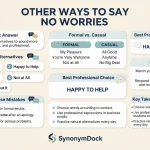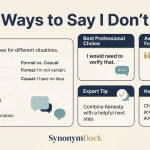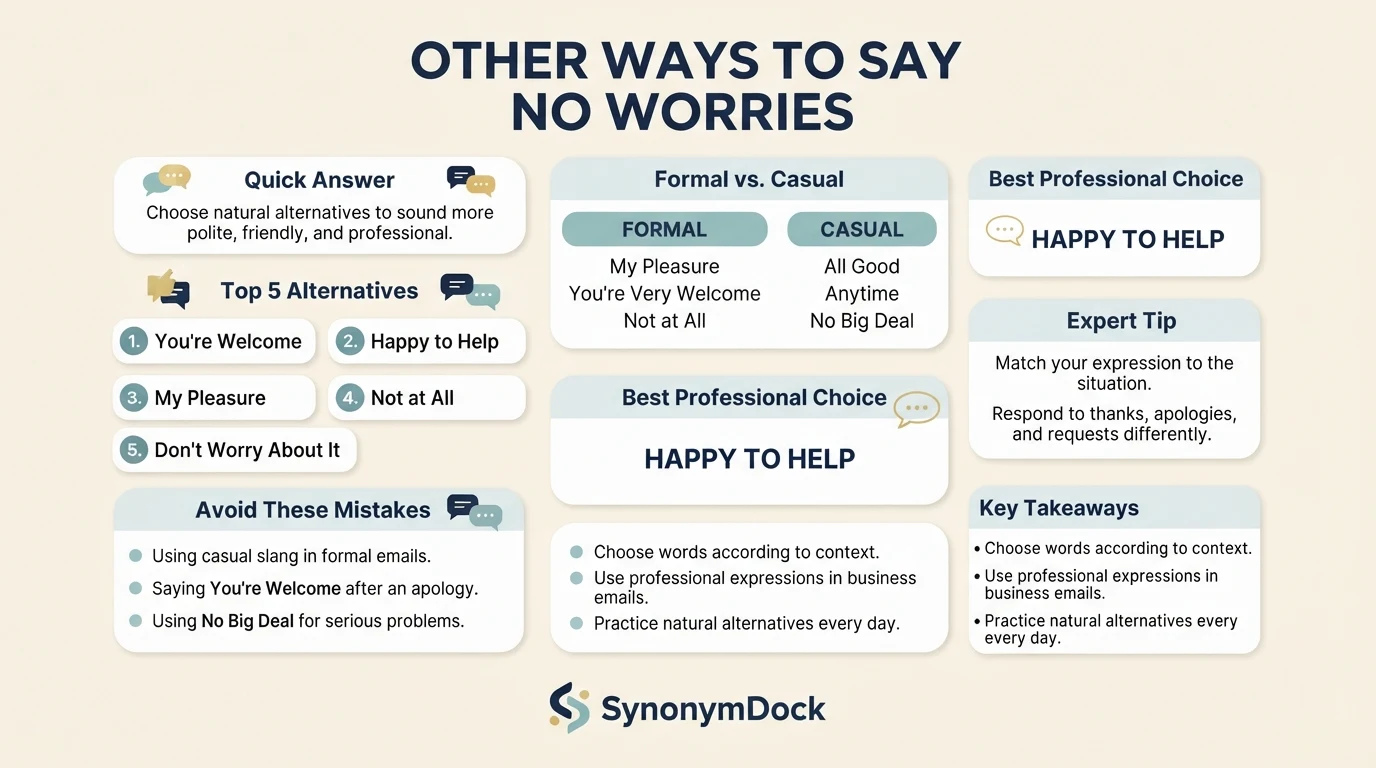
Other ways to say no worries include you’re welcome, happy to help, my pleasure, not at all, and don’t worry about it. These alternatives help you sound more natural, polite, friendly, and professional.
“No worries” is a friendly English expression used to reassure someone, accept an apology, or respond to a thank-you. It communicates that something is not a problem and that the other person does not need to feel concerned.
However, using the same expression repeatedly can make your communication sound less varied. Learning other ways to say no worries helps you choose words that match different situations, relationships, and levels of formality.
Whether you’re writing a business email, speaking with a teacher, responding to a colleague, or chatting with friends, the right alternative makes your message clearer. This guide explains 10 useful expressions with meanings, examples, professional applications, and practical usage tips.
SERP Analysis: What Readers Need to Know
Current search results show that readers primarily want three things: natural alternatives, professional expressions, and examples showing when each phrase works.
Many competing articles group expressions by formality but don’t clearly explain the difference between responding to gratitude, accepting an apology, and agreeing to a request. These situations require slightly different language. definegrammar.com+3
Our content approach: This guide separates those communication situations, compares all 10 alternatives, explains common mistakes, and provides practical examples for workplace, academic, and everyday English.
Quick Categories: Alternatives to No Worries
Different situations require different expressions. Here are useful alternatives organized by communication style.
1. Formal Alternatives
Use these expressions when communicating respectfully with clients, teachers, senior colleagues, or unfamiliar people.
- My pleasure.
- Not at all.
- Certainly.
- You’re very welcome.
Pro Tip: Choose “My pleasure” when responding to gratitude. Use “Certainly” when agreeing to a request.
2. Professional Alternatives
These expressions sound respectful without making workplace conversations unnecessarily formal.
- Happy to help.
- Of course.
- It’s no trouble at all.
- I’d be glad to help.
Pro Tip: “Happy to help” is a particularly useful choice after completing a colleague’s request.
3. Business Email Alternatives
Use these expressions when replying to professional messages.
- You’re very welcome.
- I’m glad I could assist.
- Certainly, I’ll take care of that.
- It was my pleasure.
Pro Tip: Pair your response with a clear update about the completed task whenever possible.
4. Academic Alternatives
These expressions work well when communicating with teachers, classmates, professors, and academic colleagues.
- You’re welcome.
- Not at all.
- Happy to help.
- Of course.
Pro Tip: Choose complete, respectful expressions in academic emails rather than texting abbreviations.
5. Casual Alternatives
Use these phrases with friends, classmates, and familiar colleagues.
- All good.
- Don’t worry about it.
- No problem at all.
- Anytime.
Pro Tip: “All good” works especially well when reassuring someone about a small mistake.
6. Informal Expressions
These expressions are relaxed and conversational.
- No big deal.
- No sweat.
- It’s all good.
- Don’t mention it.
Pro Tip: Keep playful expressions for relaxed conversations. They may sound too casual in formal correspondence.
What Does “No Worries” Mean?
“No worries” means that something is okay, acceptable, or not worth worrying about. It is commonly used to reassure someone after an apology or acknowledge their thanks.
Simple explanation: When someone says “No worries,” they mean that everything is fine and there is no reason to feel uncomfortable.
Examples:
- Thanks for helping me today! No worries.
- Sorry I’m late. No worries, take your time.
- Thanks for waiting. No worries at all.
Grammar Explanation
“No worries” is an informal conversational expression. It is grammatically a noun phrase rather than a complete sentence, but it works naturally as a standalone response.
It can also appear in longer sentences:
- No worries, I’ll send the document tomorrow.
- There are no worries about the meeting.
Important distinction: “No worries” can respond to thanks, apologies, or minor concerns. However, it does not automatically replace expressions used to accept a request.
When Should You Use Alternatives to No Worries?
Choosing the right expression depends on the situation and your relationship with the listener.
| Situation | Recommended Expression | Example |
|---|---|---|
| Business communication | Happy to help | Happy to help with the report. |
| Professional emails | My pleasure | My pleasure. Thank you for your message. |
| Meetings | Certainly | Certainly, I’ll handle that. |
| Presentations | Of course | Of course, I’d be happy to explain. |
| Academic writing | You’re welcome | You’re welcome. |
| Interviews | I’d be glad to help | I’d be glad to discuss that. |
| Daily conversations | All good | All good, don’t worry. |
Remember: Formality is not the only consideration. Always consider whether you’re responding to gratitude, an apology, or a request.
Professional vs. Polite: What’s the Difference?
Although professional and polite expressions often overlap, they communicate slightly different things.
- Polite: Shows kindness and respect. Example: “You’re very welcome.”
- Professional: Communicates willingness and reliability. Example: “Happy to help.”
- Formal: Uses more traditional, respectful language. Example: “It was my pleasure.”
- Natural: Sounds comfortable in everyday conversation. Example: “All good.”
For workplace communication, “Happy to help” is usually a useful choice. For a formal thank-you, “My pleasure” sounds gracious.
Pros and Cons of Using Different Expressions
Pros
- Improves vocabulary variety and communication skills.
- Helps you adjust your language to different audiences.
- Makes professional emails sound more thoughtful.
- Builds confidence in spoken and written English.
- Helps prevent repetitive communication.
Cons
- Some expressions may sound too formal among friends.
- Informal phrases can seem unprofessional in official emails.
- Certain alternatives only work after specific conversational statements.
- Unfamiliar expressions may sound unnatural when used incorrectly.
- Some phrases can unintentionally minimize a serious inconvenience.
The solution is simple: learn the meaning and context before replacing one expression with another.
Other Ways to Say “No Worries” (With Examples)
Here are 10 useful alternatives, arranged from versatile professional expressions to relaxed everyday phrases.
1. Phrase: You’re Welcome
Meaning: A polite response that acknowledges someone’s gratitude.
Explanation: This is one of the safest alternatives to “no worries.” It works in professional, academic, and everyday communication.
- Formal: Yes, appropriate.
- Neutral: Yes.
- Professional: Yes.
- Casual: Yes.
Example Sentence: You’re welcome! I’m glad I could help you complete the assignment.
- Best Use: Responding to thanks.
- Avoid Using In: Accepting requests.
- Tone: Polite and friendly.
- Formality Level: ⭐⭐⭐⭐
- Usage Frequency: Very Common
- CEFR Level: A2 (approximate)
- Common Collocations: You’re very welcome, you’re most welcome, you’re always welcome.
Context Examples:
- Spoken English: “Thanks for your help.” “You’re welcome!”
- Professional English: “You’re welcome. Please let me know if you need anything else.”
- Casual Conversation: “Thanks for sharing your notes!” “You’re welcome!”
2. Phrase: Happy to Help
Meaning: You are pleased to assist someone.
Explanation: This expression communicates willingness and friendliness. It is especially useful in workplaces, customer communication, and professional emails.
- Formal: Suitable.
- Neutral: Yes.
- Professional: Excellent.
- Casual: Yes.
Example Sentence: Happy to help with the presentation whenever you need assistance.
- Best Use: Workplace communication.
- Avoid Using In: Unrelated apologies.
- Tone: Warm and professional.
- Formality Level: ⭐⭐⭐⭐
- Usage Frequency: Very Common
- CEFR Level: B1 (approximate)
- Common Collocations: Happy to help you, happy to assist, always happy to help, happy to support.
Context Examples:
- Spoken English: “Could you explain this section?” “Happy to help.”
- Professional English: “Happy to help with the project.”
- Casual Conversation: “Thanks for checking my work!” “Happy to help!”
3. Phrase: My Pleasure
Meaning: Helping someone was enjoyable or satisfying.
Explanation: “My pleasure” is a gracious response to gratitude. It sounds more polished than casual expressions and works particularly well in customer service.
- Formal: Yes.
- Neutral: Yes.
- Professional: Excellent.
- Casual: Yes, depending on context.
Example Sentence: My pleasure. I’m glad the information was useful.
- Best Use: Formal thank-you replies.
- Avoid Using In: Agreeing to difficult requests.
- Tone: Gracious and respectful.
- Formality Level: ⭐⭐⭐⭐⭐
- Usage Frequency: Very Common
- CEFR Level: B1 (approximate)
- Common Collocations: My absolute pleasure, it was my pleasure, always a pleasure, with pleasure.
Context Examples:
- Spoken English: “Thank you for your guidance.” “My pleasure.”
- Professional English: “It was my pleasure to assist you with the project.”
- Casual Conversation: “Thanks for helping me!” “My pleasure!”
4. Phrase: Not at All
Meaning: Indicates that something caused no inconvenience or difficulty.
Explanation: This expression is polite and slightly formal. It can respond to gratitude or an apology, depending on the conversation.
- Formal: Yes.
- Neutral: Yes.
- Professional: Yes.
- Casual: Sometimes.
Example Sentence: Not at all. I’m happy to answer your questions.
- Best Use: Polite reassurance.
- Avoid Using In: Very casual texting.
- Tone: Courteous and calm.
- Formality Level: ⭐⭐⭐⭐
- Usage Frequency: Common
- CEFR Level: B1 (approximate)
- Common Collocations: Not at all, not at all necessary, not at all difficult, not at all inconvenient.
Context Examples:
- Spoken English: “Sorry to bother you.” “Not at all.”
- Professional English: “Thank you for your time.” “Not at all.”
- Casual Conversation: “Sorry for asking again.” “Not at all!”
5. Phrase: Don’t Worry About It
Meaning: Reassures someone that a mistake or inconvenience is acceptable.
Explanation: This expression is particularly natural when someone apologizes or feels uncomfortable about a small mistake. It is friendly but less formal.
- Formal: Sometimes.
- Neutral: Yes.
- Professional: Suitable in friendly workplaces.
- Casual: Excellent.
Example Sentence: Don’t worry about it; we can reschedule the meeting for tomorrow.
- Best Use: Accepting apologies.
- Avoid Using In: Serious complaints.
- Tone: Reassuring and friendly.
- Formality Level: ⭐⭐⭐
- Usage Frequency: Very Common
- CEFR Level: A2 (approximate)
- Common Collocations: Don’t worry about it, really don’t worry, don’t worry too much, please don’t worry.
Context Examples:
- Spoken English: “Sorry I forgot your notebook.” “Don’t worry about it.”
- Professional English: “Don’t worry about the delay; we can adjust the schedule.”
- Casual Conversation: “Sorry I interrupted you.” “Don’t worry about it!”
NATIVE SPEAKER TIP · AFTER THE FIRST FIVE
The most natural everyday expressions are “You’re welcome” and “Don’t worry about it.” For professional communication, “Happy to help” is a strong choice. “Not at all” is slightly more traditional and sounds especially natural in polite British English.
6. Phrase: Of Course
Meaning: Shows that you are willing to help or agree to something.
Explanation: “Of course” is versatile and natural. It works particularly well when someone asks for assistance or permission.
- Formal: Suitable.
- Neutral: Excellent.
- Professional: Yes.
- Casual: Yes.
Example Sentence: Of course, I’ll review your document before the meeting.
- Best Use: Accepting requests.
- Avoid Using In: Serious complaints.
- Tone: Confident and friendly.
- Formality Level: ⭐⭐⭐⭐
- Usage Frequency: Very Common
- CEFR Level: A2 (approximate)
- Common Collocations: Of course I can, of course not, of course you can, of course I’d be happy to.
Context Examples:
- Spoken English: “Can you explain this?” “Of course!”
- Professional English: “Of course, I’ll arrange the meeting.”
- Casual Conversation: “Can I borrow your book?” “Of course!”
7. Phrase: It’s No Trouble at All
Meaning: Communicates that helping someone did not cause inconvenience.
Explanation: This phrase is more polished than “no worries.” It is useful when reassuring someone after they request assistance or apologize.
- Formal: Yes.
- Neutral: Yes.
- Professional: Excellent.
- Casual: Yes.
Example Sentence: It’s no trouble at all to send you the updated presentation.
- Best Use: Professional reassurance.
- Avoid Using In: Serious inconvenience.
- Tone: Courteous and reassuring.
- Formality Level: ⭐⭐⭐⭐
- Usage Frequency: Common
- CEFR Level: B2 (approximate)
- Common Collocations: No trouble at all, absolutely no trouble, cause any trouble, be no trouble.
Context Examples:
- Spoken English: “Sorry for taking your time.” “It’s no trouble at all.”
- Professional English: “It’s no trouble at all to arrange another appointment.”
- Casual Conversation: “Thanks for picking this up!” “It’s no trouble at all.”
8. Phrase: Anytime
Meaning: Shows that you are willing to help someone again.
Explanation: “Anytime” is a friendly response to gratitude. It suggests that the person can ask for your help again in the future.
- Formal: Limited.
- Neutral: Yes.
- Professional: Suitable in friendly workplaces.
- Casual: Excellent.
Example Sentence: Anytime! Let me know if you need help with another assignment.
- Best Use: Friendly thank-you replies.
- Avoid Using In: Formal correspondence.
- Tone: Warm and relaxed.
- Formality Level: ⭐⭐⭐
- Usage Frequency: Very Common
- CEFR Level: A2 (approximate)
- Common Collocations: Anytime you need help, anytime you like, available anytime, call me anytime.
Context Examples:
- Spoken English: “Thanks for explaining everything.” “Anytime!”
- Professional English: “Anytime. Please reach out if you need further assistance.”
- Casual Conversation: “Thanks for lending me your notes.” “Anytime!”
9. Phrase: All Good
Meaning: Indicates that everything is fine and there is no problem.
Explanation: This expression is relaxed and conversational. It works especially well when someone apologizes for a small mistake or inconvenience.
- Formal: No.
- Neutral: Yes, informally.
- Professional: Limited.
- Casual: Excellent.
Example Sentence: All good! We still have plenty of time to finish the project.
- Best Use: Casual reassurance.
- Avoid Using In: Formal emails.
- Tone: Relaxed and friendly.
- Formality Level: ⭐⭐
- Usage Frequency: Very Common
- CEFR Level: B1 (approximate)
- Common Collocations: All good here, we’re all good, everything is all good, it’s all good.
Context Examples:
- Spoken English: “Sorry for being late.” “All good!”
- Professional English: “All good, we can move the meeting.”
- Casual Conversation: “Sorry I forgot to call.” “It’s all good.”
10. Phrase: No Big Deal
Meaning: Indicates that something is minor or not particularly important.
Explanation: This is a casual expression that minimizes the importance of a small inconvenience. It works best with friends, classmates, and familiar colleagues.
- Formal: No.
- Neutral: Informally.
- Professional: Limited.
- Casual: Excellent.
Example Sentence: No big deal! I can share my notes with you tomorrow.
- Best Use: Small favors.
- Avoid Using In: Serious situations.
- Tone: Relaxed and informal.
- Formality Level: ⭐⭐
- Usage Frequency: Common
- CEFR Level: B1 (approximate)
- Common Collocations: No big deal, it’s no big deal, make a big deal, not a big deal.
Context Examples:
- Spoken English: “Sorry I made a small mistake.” “No big deal.”
- Professional English: “It’s no big deal; we can correct the formatting.”
- Casual Conversation: “Thanks for sharing your snacks!” “No big deal!”
NATIVE SPEAKER TIP · AFTER THE LAST FIVE
“Of course” is a natural choice when accepting requests. “It’s no trouble at all” sounds more polished in professional situations. “All good” and “No big deal” are relaxed expressions, best reserved for informal conversations.
Expert Insight: Choosing the Right Expression
The biggest difference between natural and awkward communication is understanding what the other person actually means.
Workplace communication: Choose “Happy to help” when acknowledging assistance or “Certainly” when accepting a task. Adding a clear commitment makes your response more useful.
Email writing: Use “My pleasure” after receiving thanks. For a request, write “Of course, I’ll send the updated document shortly.”
Academic English: “You’re welcome” and “I’d be happy to help” are suitable for communicating with teachers and classmates.
Professional tone: Avoid making every response sound overly casual. Match your vocabulary to the audience, situation, and seriousness of the conversation.
Quick Recap: Best Alternatives to No Worries
Best Professional Choice
Happy to help
Best Casual Choice
All good
Best Formal Choice
My pleasure
Most Natural Choice
You’re welcome
Most Polite Choice
Not at all
Comparison Table: 10 Alternatives to No Worries
| Phrase | Tone | Formality | Best Use | Frequency |
|---|---|---|---|---|
| You’re welcome | Polite | High | Gratitude | Very Common |
| Happy to help | Warm | High | Workplace | Very Common |
| My pleasure | Gracious | Very High | Formal thanks | Very Common |
| Not at all | Courteous | High | Apologies | Common |
| Don’t worry about it | Reassuring | Medium | Apologies | Very Common |
| Of course | Friendly | High | Requests | Very Common |
| It’s no trouble at all | Respectful | High | Professional help | Common |
| Anytime | Friendly | Medium | Gratitude | Very Common |
| All good | Relaxed | Low | Casual reassurance | Very Common |
| No big deal | Informal | Low | Small favors | Common |
Formality and frequency labels are practical usage guidance, not measured statistical rankings.
Best Alternatives: Which Expression Should You Choose?
Not every alternative works equally well. Here are the best choices according to your communication needs.
1. Best Overall: You’re Welcome
This is a versatile expression that works in everyday conversations, professional communication, and academic settings. It is particularly appropriate when someone thanks you.
2. Best Professional: Happy to Help
This phrase communicates willingness and a positive attitude. Use it when responding to colleagues, customers, or professional contacts.
3. Best Academic: Not at All
This expression sounds courteous when responding to someone who apologizes or thanks you. It is useful in respectful academic conversations.
4. Best Business Email: My Pleasure
“My pleasure” creates a warm, polished impression. It works especially well when responding to a client’s appreciation or acknowledging a professional thank-you.
5. Best Everyday Conversation: All Good
This expression is short, relaxed, and natural. Use it when a friend apologizes for something minor.
6. Most Natural: Of Course
“Of course” sounds effortless in everyday English. It is particularly useful when agreeing to help or accepting a request.
7. Most Polite: You’re Very Welcome
This expression adds warmth and courtesy to a response. It is appropriate when you want to acknowledge someone’s gratitude respectfully.
Commonly Confused Phrases: No Worries vs. Similar Expressions
Some English expressions have similar meanings but communicate different intentions. Understanding these differences helps you avoid awkward responses.
| Expression | Meaning | Main Difference |
|---|---|---|
| No worries | Nothing to worry about | Relaxed reassurance |
| No problem | It wasn’t an issue | General reassurance |
| You’re welcome | Acknowledges thanks | Responds to gratitude |
| No big deal | Something is minor | Minimizes importance |
| Don’t mention it | No need to thank me | Dismisses the need for thanks |
| It’s okay | Everything is acceptable | Accepts a situation |
| My pleasure | I was happy to help | Shows graciousness |
No Worries vs. No Problem
Both expressions communicate that something is acceptable. However, “no worries” sounds more relaxed, while “no problem” focuses on the absence of difficulty.
No Worries vs. You’re Welcome
“No worries” can respond to thanks or apologies. “You’re welcome” specifically acknowledges gratitude.
No Worries vs. My Pleasure
“My pleasure” sounds more gracious and professional. “No worries” is generally more casual and conversational.
No Worries vs. Don’t Worry About It
Both reassure someone, but “don’t worry about it” directly addresses another person’s concern. “No worries” is shorter and more conversational.
Common Mistakes When Using Alternatives to No Worries
Learning alternative expressions is helpful, but using them in the wrong context can create confusion.
Mistake 1: Using Casual Expressions in Formal Emails
Wrong: No big deal, I’ll send the report.
Why Incorrect: “No big deal” sounds too relaxed for many official business messages.
Correct: Certainly, I’ll send the report.
Example: Certainly, I’ll send the revised report before the deadline.
Mistake 2: Using You’re Welcome After an Apology
Wrong:
Person A: Sorry I’m late.
Person B: You’re welcome!
Why Incorrect: “You’re welcome” responds to gratitude, not an apology.
Correct: Don’t worry about it.
Example: Don’t worry about it. We haven’t started yet.
Mistake 3: Using My Pleasure for Every Request
Wrong: My pleasure, I’ll complete this difficult task immediately.
Why Incorrect: “My pleasure” usually responds to gratitude or expresses gracious willingness. It does not replace a clear commitment.
Correct: Certainly, I’ll take care of it.
Example: Certainly, I’ll complete the task by Thursday.
Mistake 4: Treating All Good as a Formal Expression
Wrong: Dear Professor, all good regarding your instructions.
Why Incorrect: “All good” is conversational and may sound too informal in academic correspondence.
Correct: Thank you for the clarification.
Example: Thank you for the clarification. Everything is clear now.
Mistake 5: Using Don’t Worry About It for Serious Problems
Wrong: Don’t worry about it after someone reports a significant problem.
Why Incorrect: It may sound dismissive when the other person needs acknowledgment or a practical solution.
Correct: Thank you for bringing this to my attention. I’ll look into it.
Example: Thank you for bringing this issue to my attention. I’ll investigate it and provide an update.
Scenario Practice: Choose the Right Expression
Test your understanding with these five realistic communication situations.
Situation 1: Business Meeting
Your colleague thanks you for preparing the meeting documents.
Question: Which phrase would you choose?
Answer: Happy to help.
Explanation: This expression sounds positive and professional. It acknowledges appreciation without sounding overly formal.
Situation 2: Job Interview
An interviewer thanks you for explaining your previous experience.
Question: Which phrase would you choose?
Answer: You’re very welcome.
Explanation: This response is respectful and natural. It acknowledges the interviewer’s gratitude without sounding too casual.
Situation 3: Presentation
A classmate asks whether you can explain a presentation slide again.
Question: Which phrase would you choose?
Answer: Of course.
Explanation: It communicates willingness to explain something again and keeps the conversation friendly.
Situation 4: Classroom Discussion
A student apologizes for asking several questions.
Question: Which phrase would you choose?
Answer: Not at all.
Explanation: This expression reassures the student that their questions are welcome and that they have not caused inconvenience.
Situation 5: Email Reply
A client thanks you for arranging an appointment.
Question: Which phrase would you choose?
Answer: My pleasure.
Explanation: It sounds gracious and professional. It is especially suitable when responding to appreciation in business correspondence.
Mini Quiz: Test Your English Vocabulary
Choose the most appropriate answer for each situation.
English Vocabulary Quiz
0/5 answered
1. Your colleague thanks you for helping with a report. What sounds professional?No big dealHappy to helpAll good
2. Someone apologizes for arriving late. Which response is natural?You’re welcomeMy pleasureDon’t worry about it
3. A client thanks you for your assistance. Which expression sounds gracious?My pleasureNo big dealAll good
4. A friend thanks you for sharing your notes. What is a relaxed response?CertainlyAnytimeIt is my pleasure to assist
5. Someone asks whether you can explain something again. What should you say?Of courseYou’re welcomeNo big deal
Check My Answers
FAQs
1. What is another way to say no worries?
Other ways to say no worries include you’re welcome, happy to help, my pleasure, not at all, and don’t worry about it. Choose an expression based on whether you’re responding to gratitude, an apology, or a request.
2. How do you say no worries professionally?
You can say happy to help, certainly, my pleasure, or it’s no trouble at all. These expressions sound courteous and professional when communicating with clients, colleagues, managers, and customers.
3. Is no worries formal or informal?
“No worries” is generally informal and conversational. It is widely understood in everyday English and can work in friendly workplace conversations, but more polished expressions may suit official correspondence.
4. What is the most polite way to say no worries?
“You’re very welcome” and “My pleasure” are polite alternatives when responding to gratitude. If someone apologizes, “Not at all” or “Please don’t worry about it” may sound more appropriate.
5. Can I use no worries in a business email?
Yes, you can use “no worries” in friendly workplace emails when communicating with familiar colleagues. For clients or formal correspondence, “Happy to help” or “My pleasure” may sound more professional.
Conclusion
Learning other ways to say no worries helps you communicate with greater confidence and vocabulary variety. Expressions such as “Happy to help,” “My pleasure,” and “You’re welcome” make professional conversations more polished, while “All good” and “No big deal” work naturally in casual situations. The important thing is understanding the meaning, tone, and context behind each expression.
Practice using these alternatives in emails, classroom discussions, meetings, and everyday conversations. Start with two or three expressions and gradually introduce others. With regular practice, you’ll develop more natural English communication skills and express yourself confidently in different situations.