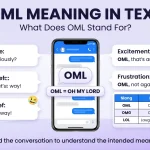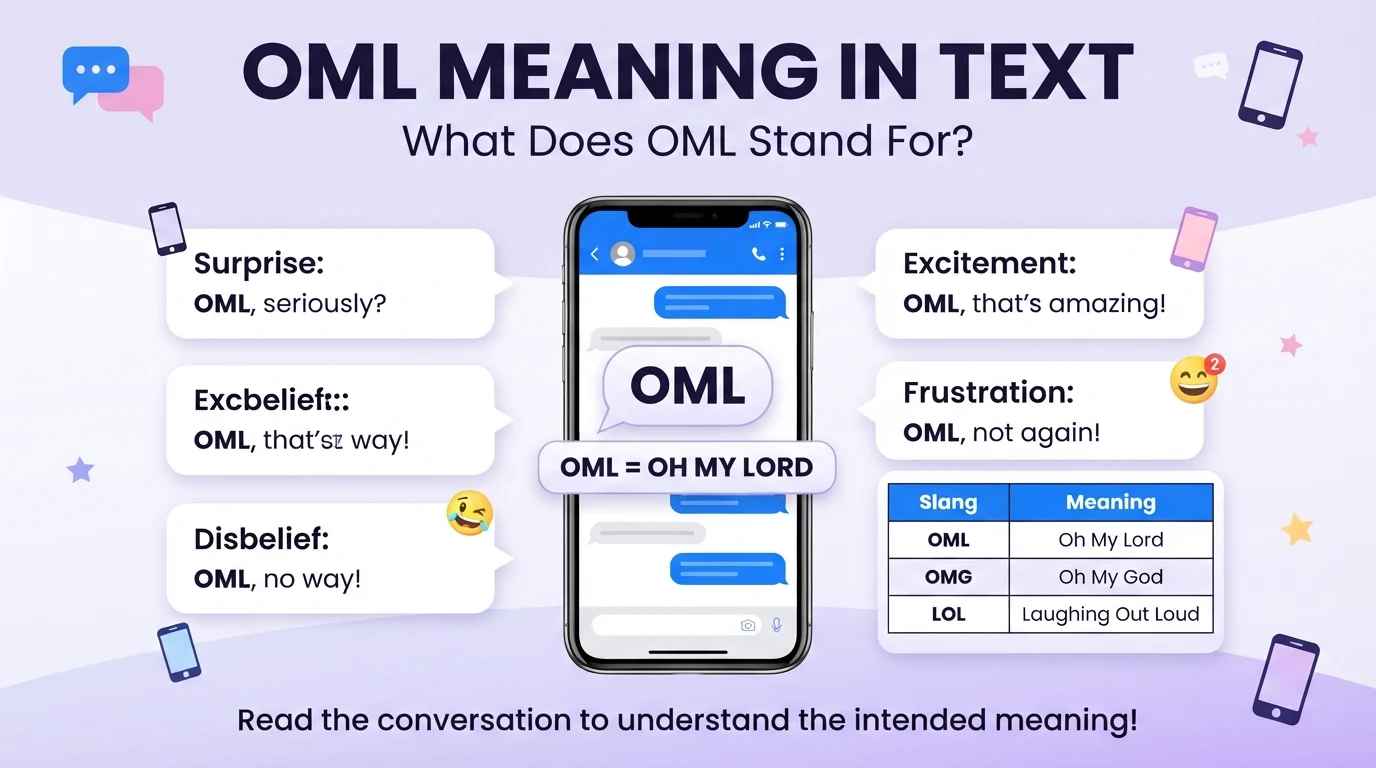
OML means “Oh My Lord” in texting and online conversations. People use it to express surprise, excitement, disbelief, frustration, or amusement. It appears in text messages, Snapchat, TikTok, Instagram comments, and casual conversations with friends.
The oml meaning in text is something many people encounter while chatting with friends or browsing social media. OML usually stands for “Oh My Lord.” People use this abbreviation to express strong emotions without typing a complete sentence. For example, someone might write “OML, that was amazing!” after watching an exciting video. Similarly, a friend might send “OML, I forgot!” after remembering something important.
However, this abbreviation can communicate several different feelings. Its meaning often depends on the conversation, punctuation, and relationship between the people chatting. Furthermore, you might see it in Snapchat messages, TikTok comments, Instagram captions, and everyday text conversations. Understanding the context helps you interpret the message correctly. This guide explains its definition, common uses, platform differences, realistic examples, alternative meanings, and natural responses.
Quick Answer: Meaning, Context, and Usage
| Category | Explanation |
|---|---|
| Meaning | Oh My Lord |
| Context | Surprise, excitement, disbelief, frustration, or amusement |
| Primary Platforms | Snapchat, TikTok, Instagram, iMessage, and WhatsApp |
| Example | OML, that movie was incredible! |
| Tone | Informal, emotional, friendly, and conversational |
What Does OML Mean in Text? Definition and Origin
The most common oml meaning in text is “Oh My Lord.” It is an initialism, which means people use the first letters of a phrase to create a shorter expression.
For example, consider this message:
“OML, I can’t believe we won!”
The sender expresses excitement and disbelief. They do not need to write the complete phrase. The three letters communicate the reaction quickly.
Understanding the Three Letters
Each letter represents one word.
| Letter | Word | Explanation |
|---|---|---|
| O | Oh | Introduces an emotional reaction |
| M | My | Connects the expression |
| L | Lord | Completes the exclamation |
Together, these letters create a familiar expression. People often use it like OMG, which stands for “Oh My God.”
However, the two abbreviations use different wording. Some people prefer OML because they feel more comfortable using “Lord” instead of “God.”
Where Did OML Come From?
The expression did not begin with social media. People used “Oh My Lord” in spoken English long before smartphones existed.
According to Dictionary.com, the word “Lord” appeared as an interjection in written English centuries ago. The expression later became a familiar way to communicate surprise or frustration. dictionary.com
Furthermore, internet users gradually shortened familiar expressions into initialisms. This made emotional reactions easier to type during fast conversations.
There is no universally confirmed date or individual credited with creating the abbreviation. However, its structure follows the same pattern as other popular texting expressions.
Today, people use it in private messages, online discussions, comments, and casual digital conversations.
Is OML an Acronym or an Initialism?
Technically, OML is an initialism.
An initialism uses the first letters of several words. People pronounce each letter separately rather than saying it as one word.
For example:
| Term | Full Form | Type |
|---|---|---|
| OML | Oh My Lord | Initialism |
| OMG | Oh My God | Initialism |
| LOL | Laughing Out Loud | Initialism |
| BRB | Be Right Back | Initialism |
| IDK | I Don’t Know | Initialism |
In everyday conversations, people often call these expressions acronyms. However, initialism is the more precise linguistic term.
Contextual Dynamics and Nuances of the Term
The letters themselves provide only part of the message. The surrounding conversation reveals the sender’s actual emotion.
For instance, someone might write OML after receiving exciting news. Another person might use the same expression after making a silly mistake.
Consequently, you should consider the situation before interpreting the message.
1. Expressing Surprise
People commonly use the abbreviation when something unexpected happens.
It communicates an immediate reaction without requiring a detailed explanation.
Example:
Friend: I just found out our favorite singer is coming to town!
You: OML, seriously?
Here, the sender expresses surprise and wants to know whether the information is true.
2. Showing Excitement
It can also communicate happiness about positive news.
For example, imagine your friend finally gets tickets to a concert.
Example:
Friend: I got the tickets!
You: OML, that’s amazing!
The expression makes the reply feel enthusiastic and natural.
3. Expressing Disbelief
Sometimes, people use it when something seems difficult to believe.
For example:
Friend: He finished the entire project in one afternoon.
You: OML, how did he do that?
In this situation, the sender communicates disbelief rather than frustration.
4. Reacting to Something Funny
Friends frequently use emotional abbreviations when sharing jokes, memes, and entertaining videos.
For example:
Friend: Remember when we walked into the wrong classroom?
You: OML 😂 I still remember that!
The laughing emoji reinforces the humorous meaning.
5. Showing Frustration
The same expression can communicate annoyance when something goes wrong.
For example:
Friend: I forgot my notebook again.
You: OML, that’s the second time this week!
Here, the sender sounds surprised and slightly frustrated.
6. Reacting to Embarrassing Moments
People also use it when something awkward happens.
For example:
Friend: I accidentally waved at someone who wasn’t waving at me.
You: OML, that must have been awkward!
The abbreviation adds humor to an embarrassing situation.
7. Expressing Admiration
A person might use it when seeing something impressive.
For example:
Friend: Look at this beautiful painting!
You: OML, that’s incredible!
The expression communicates genuine appreciation.
8. Adding Dramatic Emphasis
Some people use it even when discussing ordinary situations.
For example:
“OML, I have so much homework tonight.”
The sender might not feel genuinely shocked. Instead, they use the abbreviation to make a small complaint sound more dramatic.
What Does OML Say About the Sender’s Tone?
The following table explains how context changes the emotional meaning.
| Situation | Intended Emotion | Example |
|---|---|---|
| Unexpected news | Surprise | OML, really? |
| Good news | Excitement | OML, congratulations! |
| Unbelievable story | Disbelief | OML, no way! |
| Funny conversation | Amusement | OML, that’s hilarious! |
| Repeated mistake | Frustration | OML, not again! |
| Impressive achievement | Admiration | OML, amazing work! |
| Awkward experience | Embarrassment | OML, that’s so awkward! |
The important point is simple: the abbreviation does not have one fixed emotional tone. The situation determines its meaning.
Real Life Conversation Examples Using OML
Learning slang becomes easier when you see it inside natural conversations. The following examples demonstrate how friends might use the abbreviation in everyday situations.
These are illustrative chat scenarios, not quotations from actual conversations.
Example 1: Reacting to Exciting News
Conversation:
Alex: Guess what? I made the school team!
Jordan: OML, that’s awesome! Congratulations!
Alex: Thank you! I really wanted this.
Meaning: Jordan uses the expression to show excitement and happiness. The abbreviation makes the reaction feel enthusiastic.
Example 2: Responding to a Funny Story
Conversation:
Mia: I accidentally called my teacher Mom today.
Sophie: OML 😂 I would never recover from that.
Mia: Everyone started laughing!
Meaning: Sophie uses it to express amusement. The laughing emoji makes the playful tone clear.
Example 3: Showing Disbelief
Conversation:
Ryan: My brother finished that entire book in one day.
Chris: OML, how is that even possible?
Ryan: He literally didn’t put it down.
Meaning: Chris finds the situation surprising. The abbreviation emphasizes disbelief.
Example 4: Expressing Frustration
Conversation:
Emma: I forgot to bring my lunch again.
Olivia: OML, you need to check your bag before leaving!
Emma: I know. I keep forgetting.
Meaning: Olivia expresses mild frustration. However, her response still sounds friendly.
Example 5: Reacting to an Unexpected Surprise
Conversation:
Noah: Your friends planned a surprise party for you.
Liam: OML, are you serious?
Noah: Yes! They have been planning it all week.
Meaning: Liam uses the expression to show surprise and excitement.
What These Examples Teach You
These conversations demonstrate several important points:
- OML usually introduces an emotional reaction.
- The words following it help explain the intended feeling.
- Emojis can make the tone easier to understand.
- Capitalization does not usually change the basic meaning.
- A short expression can communicate excitement, disbelief, or frustration.
Furthermore, you do not need to use it in every conversation. A natural reaction is more important than using popular slang.
Platform Specific Breakdown
Different social media platforms encourage different communication styles. However, the abbreviation generally keeps its familiar meaning across them.
People might use it in direct messages, public comments, group conversations, or replies to entertaining content.
How It Is Used on Snapchat
Snapchat encourages quick, informal conversations. Friends often exchange short messages, pictures, videos, and reactions.
In this environment, OML works as a fast response to something surprising or funny.
Common Snapchat examples:
| Snapchat Message | Intended Meaning |
|---|---|
| OML, look at this! | Excitement |
| OML 😂 | Amusement |
| OML, no way! | Disbelief |
| OML, I’m so tired | Frustration |
| OML, that’s beautiful | Admiration |
For example, a friend might send a funny picture followed by “OML.” The recipient can understand the reaction from the image and previous messages.
However, you should not assume that every message expresses the same emotion.
A short reply might indicate excitement, annoyance, or simple amusement. Reading the previous messages helps you understand the intended tone.
The Role of OML on TikTok
TikTok has a comment culture built around short reactions, humor, trends, and shared experiences.
People use OML when responding to surprising videos, funny moments, impressive performances, and relatable situations.
For example:
Video: A person shares an unexpectedly funny classroom moment.
Comment: OML, I would have laughed so hard!
The commenter expresses amusement and connects with the video’s situation.
Other possible examples include:
| TikTok Comment | Emotional Purpose |
|---|---|
| OML, this is hilarious | Amusement |
| OML, that was unexpected | Surprise |
| OML, I love this | Excitement |
| OML, the ending! | Disbelief |
| OML, so relatable | Recognition |
Furthermore, users sometimes repeat letters to make their reactions more expressive.
For example, “OMLLL” can communicate a stronger reaction than a simple “OML.”
However, extra letters do not create a completely different definition. They mainly change the visual emphasis.
Instagram and Texting Dynamics
Instagram users often communicate through direct messages, story replies, comments, and group chats.
The abbreviation fits these conversations because it is short and easy to understand.
For example, someone might reply to a friend’s vacation picture:
“OML, this place looks amazing!”
Here, the message expresses admiration and excitement.
Similarly, someone might respond to a funny Instagram Reel:
“OML 😂 why is this so accurate?”
The expression adds an emotional reaction without requiring a long comment.
In ordinary texting, people use the same abbreviation in iMessage, WhatsApp, and other messaging services.
Examples from everyday texting:
- OML, I forgot to tell you something.
- OML, that was such a good movie.
- OML, you made my day.
- OML, I can’t believe it’s already Friday.
- OML, this conversation is hilarious.
The platform does not determine the definition. The surrounding message provides the important clues.
Alternative Meanings and NLP Variations of the Phrase
Although “Oh My Lord” is the primary interpretation, OML can have other meanings in particular conversations.
This is where context becomes especially important. The same three letters can represent different phrases depending on the speaker’s habits and the subject.
1. Oh My Lord
This is the most widely recognized texting interpretation.
People use it to express:
- Surprise about unexpected news.
- Excitement about something positive.
- Disbelief about an unusual situation.
- Frustration with a repeated problem.
- Amusement about a funny experience.
Example: OML, that was the best performance ever!
2. Oh My Life
Some internet users interpret OML as “Oh My Life.”
This alternative works as an emotional exclamation. People might use it when discussing stressful, surprising, or overwhelming situations.
Example: OML, what a long day!
However, this interpretation is less universally recognized than “Oh My Lord.” You should consider the surrounding sentence before choosing it.
3. On My Life
Another possible interpretation is “On My Life.”
Unlike an emotional exclamation, this phrase emphasizes honesty or makes a strong personal assurance.
Example:
Friend: Did you really finish the assignment?
You: OML, I finished it yesterday!
Here, the sender emphasizes that the statement is true.
However, this meaning depends heavily on the conversation. It is not the default interpretation in ordinary texting.
4. One More Light
OML can also refer to “One More Light,” the title of an album and song by Linkin Park.
This interpretation is relevant in music discussions, fan communities, and conversations about the band’s music.
For example:
Friend: I have been listening to One More Light today.
You: OML is such a meaningful album.
Here, the conversation clearly concerns music rather than a reaction. Lilach Bullock+1
Comparison of Different Interpretations
| Possible Meaning | Typical Context | Intended Message |
|---|---|---|
| Oh My Lord | Everyday texting | Surprise or excitement |
| Oh My Life | Emotional reactions | Frustration or disbelief |
| On My Life | Promises or denials | Emphasizing honesty |
| One More Light | Music discussions | Album or song reference |
Important Linguistic Variations
People do not always write the abbreviation in exactly the same way.
Here are some common variations:
| Variation | Explanation |
|---|---|
| OML | Standard uppercase form |
| oml | Casual lowercase form |
| Oml | Mixed capitalization |
| omlll | Extended emotional reaction |
| oml!!! | Strong emphasis |
| oml 😂 | Amused reaction |
| OML 😭 | Dramatic or emotional reaction |
These variations generally preserve the same basic expression. However, punctuation and emojis can change how strongly the sender communicates a feeling.
OML vs. OMG: What Is the Difference?
OML and OMG are closely related expressions. Both communicate surprise, excitement, disbelief, and other strong emotions.
The main difference is their wording.
| Feature | OML | OMG |
|---|---|---|
| Full Form | Oh My Lord | Oh My God |
| Main Purpose | Expressing reactions | Expressing reactions |
| Tone | Casual and emotional | Casual and emotional |
| Common Use | Texting and social media | Texting and social media |
| Religious Wording | Uses Lord | Uses God |
For example:
- OML, that’s incredible!
- OMG, that’s incredible!
Both messages communicate excitement. The sender simply chooses a different expression.
Some people prefer one form because of personal or religious preferences. Others choose whichever feels more natural.
OML vs. Other Popular Texting Abbreviations
Understanding related expressions can help you interpret digital conversations more accurately.
| Slang | Full Meaning | Main Purpose |
|---|---|---|
| OML | Oh My Lord | Surprise or excitement |
| OMG | Oh My God | Strong reaction |
| LOL | Laughing Out Loud | Amusement |
| SMH | Shaking My Head | Disappointment or disbelief |
| FR | For Real | Agreement or emphasis |
| NGL | Not Gonna Lie | Honest opinion |
| IDK | I Don’t Know | Uncertainty |
| TBH | To Be Honest | Personal opinion |
| IMO | In My Opinion | Sharing a viewpoint |
| BTW | By The Way | Introducing extra information |
These expressions serve different conversational purposes. Therefore, replacing one with another can change the meaning of a message.
Misinterpretations: When NOT to Use OML
Internet slang makes conversations quicker. However, not every abbreviation works in every situation.
Understanding when to avoid an expression is just as important as learning its definition.
1. Avoid It in Formal Emails
Professional emails usually require clear and respectful language.
For example, this message sounds too casual:
“OML, I completely forgot about the meeting.”
A more appropriate version would be:
“I apologize for overlooking the meeting reminder.”
The second sentence communicates the same general concern. However, it sounds more professional.
2. Avoid It in Academic Writing
School assignments, research papers, and formal reports require standard English.
For example:
Informal: OML, this experiment was difficult.
Academic: This experiment presented several challenges.
The second version communicates the idea more clearly in an academic setting.
3. Avoid It During Serious Conversations
Sometimes, a person shares difficult or important news.
Responding with a casual abbreviation might make your reaction seem insensitive.
For example:
Friend: I’m really worried about my exam results.
Less suitable: OML, that’s wild!
Better: I understand. I hope everything works out well.
The better response acknowledges the person’s feelings.
4. Avoid Assuming It Always Means Excitement
Not every emotional reaction is positive.
For example:
“OML, I lost my notes again.”
This message communicates frustration rather than happiness.
Consequently, interpreting every use as excitement can lead to misunderstandings.
5. Avoid Using It With People Who Do Not Understand Slang
Some people are unfamiliar with internet abbreviations.
If your recipient does not recognize the expression, write the complete phrase instead.
Clear communication matters more than using fashionable language.
Common Mistakes to Avoid
| Mistake | Why It Causes Confusion | Better Approach |
|---|---|---|
| Assuming it always means excitement | It can express frustration | Read the context |
| Treating it as formal English | It is casual slang | Use standard wording |
| Confusing it with OMG | The wording differs | Learn both definitions |
| Assuming it is flirtatious | The abbreviation is not inherently romantic | Consider the full conversation |
| Ignoring emojis | Emojis can clarify tone | Read the entire message |
| Assuming every alternative is equally common | Some meanings are context specific | Start with the primary meaning |
The best approach is to match your language to the situation. Use casual abbreviations with people who understand them. Choose complete sentences when clarity and professionalism matter.
How to Respond in Chat Comfortably
When someone sends OML, you do not need a complicated reply. Your response should match the situation and the sender’s emotion.
First, identify whether the person sounds excited, surprised, amused, or frustrated. Then choose a natural response.
1. When Someone Expresses Excitement
If a friend shares exciting news, respond with enthusiasm.
Message: OML, I finally got the tickets!
Possible replies:
- That’s amazing!
- No way! Congratulations!
- I’m so happy for you!
- That’s such great news!
- You’re going to have so much fun!
2. When Someone Sounds Surprised
Sometimes, the sender wants to share something unexpected.
Message: OML, guess what happened today!
Possible replies:
- What happened?
- Tell me everything!
- Seriously? What is it?
- Now I’m curious!
- I wasn’t expecting that!
3. When Someone Shares Something Funny
If the conversation is playful, respond naturally.
Message: OML 😂 that video is hilarious.
Possible replies:
- I know, right?
- I couldn’t stop laughing!
- That was too funny.
- I need to watch it again.
- Send me another one!
4. When Someone Expresses Frustration
Acknowledge the situation instead of making the conversation more difficult.
Message: OML, I forgot my homework again.
Possible replies:
- Hopefully, you can sort it out.
- That sounds frustrating.
- Don’t worry. It happens.
- Maybe you can finish it later.
- I hope tomorrow goes better.
5. When You Do Not Understand the Meaning
If the context is unclear, asking for clarification is perfectly reasonable.
You can respond with:
- What do you mean?
- Wait, what happened?
- Are you surprised or annoyed?
- Can you explain?
- What happened before that?
There is no need to pretend you understand an unfamiliar expression.
Response Guide at a Glance
| Situation | Natural Response |
|---|---|
| Excitement | That’s amazing! |
| Surprise | No way! |
| Disbelief | Seriously? |
| Amusement | That’s hilarious! |
| Frustration | That sounds frustrating. |
| Confusion | What do you mean? |
| Admiration | That’s incredible! |
Remember, a good response depends on the conversation. You do not have to copy someone else’s slang to communicate naturally.
FAQs
1. What Is the OML Meaning in Text?
The oml meaning in text is usually “Oh My Lord.” People use this abbreviation to express surprise, excitement, disbelief, frustration, or amusement. It is common in casual text messages, social media comments, and conversations with friends.
2. What Does OML Mean From a Girl?
When a girl sends OML, she usually means “Oh My Lord.” She might be reacting to something funny, surprising, exciting, or unexpected. However, the abbreviation does not automatically indicate romantic interest. The surrounding conversation provides better clues about her intention.
3. What Does OML Mean From a Guy?
When a guy uses OML, it generally has the same meaning. He might express surprise, excitement, disbelief, or frustration. For example, “OML, that game was incredible!” communicates enthusiasm rather than a special meaning connected to the sender’s gender.
4. Does OML Mean Oh My Lord or Oh My Life?
Both interpretations appear in informal online communication. However, “Oh My Lord” is the primary meaning in ordinary texting. Some people use “Oh My Life” as an alternative emotional expression. The surrounding sentence usually helps identify the intended expansion.
5. Is OML the Same as OMG?
OML and OMG serve similar purposes in digital communication. OML stands for “Oh My Lord,” while OMG means “Oh My God.” Both expressions communicate surprise, excitement, and disbelief. People may choose between them according to personal preference.
6. What Does OML Mean on Snapchat?
On Snapchat, OML generally means “Oh My Lord.” Friends use it in chats and reactions to communicate surprise, amusement, excitement, or frustration. For example, “OML, look at this picture!” expresses an immediate reaction to something interesting.
7. What Does OML Mean on TikTok?
On TikTok, users commonly use OML in comments and conversations. It usually expresses a strong reaction to a video, joke, performance, or unexpected moment. For example, “OML, this is so funny” communicates amusement.
8. Is OML a Rude or Offensive Word?
OML is generally a casual expression rather than an insult or offensive word. However, some people may have religious preferences about expressions involving the word “Lord.” Consider your audience and choose wording that feels respectful.
9. How Should I Reply When Someone Texts OML?
Your reply should match the conversation. If someone expresses excitement, say “That’s amazing!” If they sound surprised, try “Seriously?” For a funny situation, respond with “That’s hilarious!” You can also ask for clarification when the meaning is unclear.
10. Can I Use OML in Professional Messages?
OML is best suited to informal conversations. It usually does not belong in professional emails, academic assignments, or formal reports. Instead, use expressions such as “That’s surprising,” “I understand,” or “Thank you for sharing that information.”
Conclusion
Understanding the oml meaning in text makes everyday digital conversations easier to follow. The abbreviation most commonly stands for “Oh My Lord.” People use it to communicate surprise, excitement, disbelief, amusement, and frustration. Furthermore, it appears across messaging apps and social media platforms, including Snapchat, TikTok, and Instagram.
However, context always matters. Some people use OML to mean “Oh My Life” or “On My Life.” Therefore, reading the surrounding message helps you understand the intended meaning. Remember that internet slang works best in relaxed conversations. Choose clear, complete expressions when communicating professionally or discussing serious topics. Learning these small language differences can make your online communication more natural, confident, and effective.