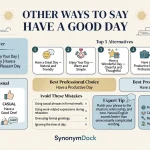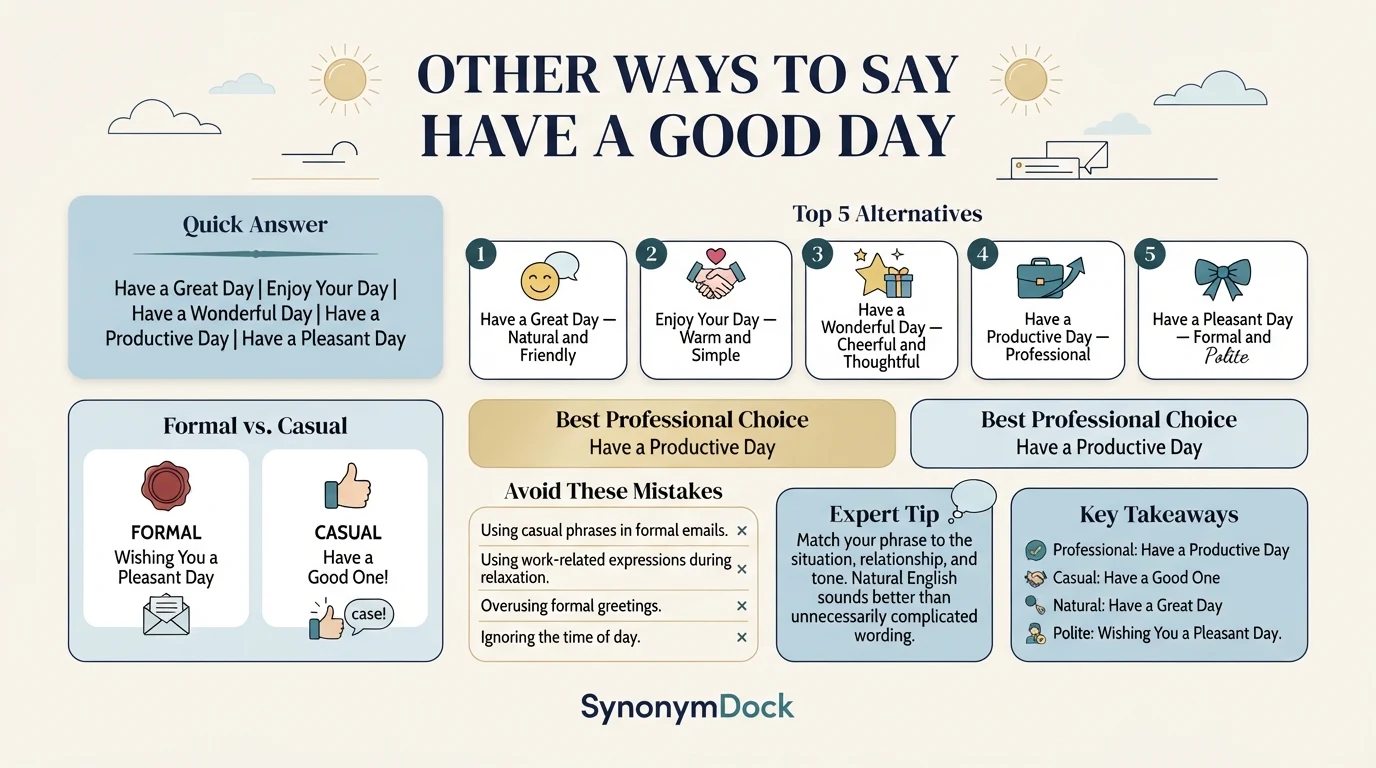
Other ways to say have a good day include Have a Great Day, Enjoy Your Day, Have a Wonderful Day, Have a Productive Day, and Wishing You a Pleasant Day. These expressions suit professional emails, friendly conversations, and everyday goodbyes.
Have a good day is one of the most familiar expressions in everyday English. People use it when leaving work, ending a phone call, finishing a meeting, or saying goodbye to friends. Although it is always a useful phrase, repeating the same words can sometimes make conversations feel predictable.
Learning other ways to say have a good day helps you communicate with more variety and confidence. Some alternatives sound professional and polite, while others feel cheerful, relaxed, or thoughtful. Understanding these differences helps you choose expressions that match your audience and situation.
Whether you are writing a business email, speaking with a customer, talking to classmates, or messaging a friend, the right expression can make your communication sound more natural.
Quick Categories: Different Ways to Say Have a Good Day
Formal Alternatives
- Wishing you a pleasant day.
- I hope you have a wonderful day.
- Have a pleasant day ahead.
- Wishing you a successful day.
Pro Tip: Use these expressions when communicating with clients, unfamiliar people, or professional contacts. They sound courteous without being unnecessarily complicated.
Professional Alternatives
- Have a productive day.
- Enjoy the rest of your day.
- Hope your day goes smoothly.
- Have a great day ahead.
Pro Tip: Choose professional expressions that match the conversation. Productivity works well for colleagues, while a great day suits almost any workplace interaction.
Business Email Alternatives
- Wishing you a pleasant day.
- Have a productive day ahead.
- I hope the rest of your day goes well.
- Enjoy the remainder of your day.
Pro Tip: Place your day-wish after your main message and before your email signature when it feels appropriate. Avoid adding another closing phrase if the message already has a natural sign-off.
Academic Alternatives
- Have a successful day of learning.
- Enjoy your classes today.
- Wishing you a productive study session.
- Hope your presentation goes well.
Pro Tip: Make your expression relevant to the student’s activities. A specific encouragement often sounds more thoughtful than a general goodbye.
Casual Alternatives
- Have a great one!
- Enjoy your day!
- Have an awesome day!
- Hope today goes well!
Pro Tip: These phrases work naturally with friends, classmates, and familiar coworkers. Keep your wording simple and friendly.
Informal Expressions
- Take it easy!
- Have a good one!
- Catch you later!
- Have fun today!
Pro Tip: Some informal expressions are farewells rather than exact alternatives to a day-wish. Use them when the situation and relationship make a relaxed goodbye appropriate.
What Does “Have a Good Day” Mean?
Have a good day is a polite expression that communicates a positive wish for someone’s day. It shows that you hope the other person experiences enjoyable moments, successful activities, or a pleasant day overall.
People commonly use this phrase when ending conversations, leaving workplaces, completing customer interactions, or saying goodbye.
Grammar Explanation
The phrase uses the imperative form of the verb have. However, it functions as a friendly wish rather than a command.
Examples:
- Have a good day.
- Have a wonderful afternoon.
- Have a productive day.
The adjective describes the type of day you are wishing for. You can replace good with words such as great, pleasant, wonderful, or productive to change the tone.
When Should You Use Other Ways to Say Have a Good Day?
The best alternative depends on your relationship with the listener, the communication setting, and the time of day.
Business Communication
Professional expressions help you end workplace conversations positively. Have a productive day is useful when colleagues have important tasks, meetings, or deadlines.
Example: Thank you for your input during today’s discussion. Have a productive day!
Professional Emails
A courteous closing can make your message feel complete without adding unnecessary sentences.
Example: Thank you for your assistance with this request. Wishing you a pleasant day.
Meetings
Choose a short expression when ending a meeting or thanking participants.
Example: Thank you, everyone, for sharing your ideas. Enjoy the rest of your day.
Presentations
A friendly closing helps you finish confidently and leave a positive impression.
Example: Thank you for listening to my presentation. Have a wonderful day!
Academic Communication
Students and teachers can use encouraging expressions before classes, examinations, or classroom activities.
Example: Good luck with your assignments. Have a successful day of learning!
Interviews
After an interview, a polite expression shows appreciation and professionalism.
Example: Thank you for taking the time to meet with me. I hope you have a wonderful day.
Daily Conversations
Short expressions are usually best when talking with friends, family, or familiar people.
Example: See you tomorrow. Have a great one!
Other Ways to Say “Have a Good Day” (With Examples)
Here are 10 useful alternatives, arranged according to their everyday usefulness and communication contexts.
1. Have a Great Day
Meaning: A cheerful wish that someone enjoys a positive and enjoyable day.
Explanation: This is one of the closest and most natural alternatives to have a good day. The word great adds enthusiasm while keeping the expression simple. It works in professional and personal conversations.
Example Sentence: Thanks for stopping by. Have a great day!
Best Use: Everyday communication
Avoid Using In: Serious discussions
Tone: Friendly, cheerful
Formality Level: ⭐⭐⭐☆☆
Usage Frequency: Very Common
CEFR Level: B1 (approximate)
Common Collocations: Great day ahead, great day at work, great rest of your day, great day today.
Context Examples:
- Spoken English: Have a great day, everyone!
- Professional English: Thank you for your time. Have a great day.
- Casual Conversation: See you tomorrow. Have a great day!
2. Enjoy Your Day
Meaning: Encourages someone to make the most of their day.
Explanation: This expression focuses on enjoyment rather than general well-being. It sounds natural when someone has plans, activities, free time, or something enjoyable ahead.
Example Sentence: I hope everything goes smoothly. Enjoy your day!
Best Use: Friendly conversations
Avoid Using In: Formal reports
Tone: Warm, relaxed
Formality Level: ⭐⭐⭐☆☆
Usage Frequency: Very Common
CEFR Level: B1 (approximate)
Common Collocations: Enjoy your day off, enjoy your afternoon, enjoy your weekend, enjoy your time.
Context Examples:
- Spoken English: Enjoy your day!
- Professional English: Thank you for your cooperation. Enjoy your day.
- Casual Conversation: Enjoy your day at the beach!
3. Have a Wonderful Day
Meaning: Expresses a warm wish for an especially enjoyable day.
Explanation: Wonderful sounds more enthusiastic than good. It is useful when you want to sound particularly positive and considerate. It also works well in customer service and friendly professional communication.
Example Sentence: It was lovely speaking with you. Have a wonderful day!
Best Use: Warm greetings
Avoid Using In: Serious announcements
Tone: Warm, enthusiastic
Formality Level: ⭐⭐⭐⭐☆
Usage Frequency: Very Common
CEFR Level: B1 (approximate)
Common Collocations: Wonderful day ahead, wonderful afternoon, wonderful experience, wonderful weekend.
Context Examples:
- Spoken English: Have a wonderful day!
- Professional English: Thank you for meeting with me. Have a wonderful day.
- Casual Conversation: Hope you have a wonderful day out!
4. Have a Productive Day
Meaning: Wishes someone a successful and useful day.
Explanation: This expression focuses on completing tasks, making progress, and achieving goals. It is particularly suitable for workplace conversations and messages to colleagues who have busy schedules.
Example Sentence: Good luck with your projects today. Have a productive day!
Best Use: Workplace communication
Avoid Using In: Relaxation occasions
Tone: Professional, encouraging
Formality Level: ⭐⭐⭐⭐☆
Usage Frequency: Common
CEFR Level: B2 (approximate)
Common Collocations: Productive morning, productive workday, productive meeting, productive week.
Context Examples:
- Spoken English: Have a productive day!
- Professional English: I hope your tasks go smoothly. Have a productive day.
- Casual Conversation: Hope you get everything done today!
5. Have a Pleasant Day
Meaning: Wishes someone a comfortable, enjoyable, or peaceful day.
Explanation: Pleasant is more reserved than great or wonderful. This expression is appropriate for customer service, formal conversations, and professional communication where a courteous tone matters.
Example Sentence: Thank you for contacting our office. Have a pleasant day.
Best Use: Customer service
Avoid Using In: Excited celebrations
Tone: Polite, reserved
Formality Level: ⭐⭐⭐⭐⭐
Usage Frequency: Common
CEFR Level: B2 (approximate)
Common Collocations: Pleasant afternoon, pleasant experience, pleasant stay, pleasant weather.
Context Examples:
- Spoken English: Have a pleasant day.
- Professional English: Thank you for your time. Have a pleasant day.
- Casual Conversation: Hope you have a pleasant afternoon!
Native Speaker Tip: Alternatives 1–5
Have a great day is the most versatile choice for everyday communication. Have a productive day is more appropriate for work-related situations, while have a pleasant day sounds more reserved.
Native English speakers do not always search for a more sophisticated alternative. They usually choose the shortest expression that fits the conversation naturally.
6. Enjoy the Rest of Your Day
Meaning: Wishes someone well during the remaining hours of their day.
Explanation: This expression is especially useful when the day is already underway. It sounds natural after meetings, phone calls, appointments, or afternoon conversations.
Example Sentence: Thanks for the quick update. Enjoy the rest of your day!
Best Use: Afternoon goodbyes
Avoid Using In: Early morning greetings
Tone: Friendly, considerate
Formality Level: ⭐⭐⭐⭐☆
Usage Frequency: Very Common
CEFR Level: B1–B2 (approximate)
Common Collocations: Rest of your afternoon, rest of your evening, rest of the day, enjoy the weekend.
Context Examples:
- Spoken English: Enjoy the rest of your day!
- Professional English: Thank you for your assistance. Enjoy the rest of your day.
- Casual Conversation: Enjoy the rest of today!
7. Have a Good One
Meaning: A short, informal way to wish someone well.
Explanation: The word one refers to the day, although the phrase does not mention it directly. It is especially common in relaxed spoken English and quick everyday interactions.
Example Sentence: Thanks for your help today. Have a good one!
Best Use: Casual goodbyes
Avoid Using In: Formal letters
Tone: Relaxed, friendly
Formality Level: ⭐⭐☆☆☆
Usage Frequency: Very Common
CEFR Level: B1 (approximate)
Common Collocations: Have a good one today, have a good one at work, have a good one tonight.
Context Examples:
- Spoken English: Have a good one!
- Professional English: Thanks for your help. Have a good one!
- Casual Conversation: See you later. Have a good one!
8. Hope Your Day Goes Well
Meaning: Expresses hope that someone experiences a smooth and positive day.
Explanation: This phrase sounds considerate and sincere. It is useful when someone has an appointment, presentation, important task, or busy schedule.
Example Sentence: Good luck with your appointment. Hope your day goes well!
Best Use: Personal encouragement
Avoid Using In: Formal academic essays
Tone: Supportive, thoughtful
Formality Level: ⭐⭐⭐⭐☆
Usage Frequency: Common
CEFR Level: B1–B2 (approximate)
Common Collocations: Hope things go well, hope work goes well, hope everything goes smoothly, hope today goes well.
Context Examples:
- Spoken English: Hope your day goes well!
- Professional English: I hope your day goes well and your meetings are successful.
- Casual Conversation: Hope everything goes well today!
9. Wishing You a Lovely Day
Meaning: Sends someone a kind wish for an enjoyable day.
Explanation: Lovely adds a gentle and cheerful feeling. It works well in friendly messages, personal conversations, and warm professional communication. It is particularly natural in British English, although it is understood elsewhere.
Example Sentence: Thank you for your thoughtful message. Wishing you a lovely day!
Best Use: Friendly messages
Avoid Using In: Strict business notices
Tone: Gentle, cheerful
Formality Level: ⭐⭐⭐⭐☆
Usage Frequency: Common
CEFR Level: B2 (approximate)
Common Collocations: Lovely afternoon, lovely morning, lovely weekend, lovely time.
Context Examples:
- Spoken English: Wishing you a lovely day!
- Professional English: Thank you for your response. Wishing you a lovely day.
- Casual Conversation: Hope you’re having a lovely day!
10. Take Care
Meaning: Expresses concern for someone’s well-being.
Explanation: Take care is a farewell expression rather than an exact synonym for have a good day. It focuses on the person’s well-being instead of wishing them a particular kind of day. It is especially useful with friends, familiar colleagues, and acquaintances.
Example Sentence: It was nice catching up with you. Take care!
Best Use: Friendly farewells
Avoid Using In: Routine formal notices
Tone: Caring, relaxed
Formality Level: ⭐⭐⭐☆☆
Usage Frequency: Very Common
CEFR Level: B1 (approximate)
Common Collocations: Take care of yourself, take care out there, take good care, take care until next time.
Context Examples:
- Spoken English: Take care!
- Professional English: Thank you for your time. Take care.
- Casual Conversation: See you soon. Take care!
Native Speaker Tip: Alternatives 6–10
Enjoy the rest of your day is especially natural when someone is already halfway through their day. Have a good one is a relaxed everyday expression, while take care focuses more on personal well-being.
The important difference is meaning. A farewell does not always communicate the same wish as a direct day-wish. Choose the expression that matches what you actually want to say.
Expert Insight: Choosing the Right Expression
Professional communication does not always require formal vocabulary. In fact, simple expressions often sound more natural than complicated alternatives.
For workplace conversations, have a productive day works well when discussing tasks, deadlines, or projects. For client emails, wishing you a pleasant day offers a courteous and respectful closing.
In academic English, expressions such as have a successful day or enjoy your classes today are useful when encouraging students. In everyday conversations, have a great day and enjoy your day are flexible choices.
One useful writing principle is to avoid adding a day-wish to every message. In a long email conversation, repeating the same closing sentence can feel unnecessary. Save it for the point where the conversation naturally ends.
Quick Recap: Best Alternatives
| Category | Best Phrase |
|---|---|
| Best Professional Choice | Have a productive day. |
| Best Casual Choice | Have a good one! |
| Best Formal Choice | Have a pleasant day. |
| Most Natural Choice | Have a great day. |
| Most Polite Choice | I hope you have a wonderful day. |
Professional vs. Polite vs. Formal vs. Natural
These expressions may look similar, but their communication styles differ.
| Style | Example | Main Purpose |
|---|---|---|
| Professional | Have a productive day. | Workplace encouragement |
| Polite | I hope you have a wonderful day. | Consideration |
| Formal | Wishing you a pleasant day. | Respect and courtesy |
| Natural | Have a great day! | Everyday friendliness |
| Casual | Have a good one! | Relaxed goodbye |
Professional: Use workplace-friendly expressions with colleagues, clients, and managers.
Polite: Choose warm expressions when you want to show consideration.
Formal: Use reserved wording when communicating with unfamiliar people or external contacts.
Natural: Keep your wording simple and conversational.
Casual: Use relaxed expressions with people you know well.
Remember that polite and formal do not mean the same thing. A simple expression can be perfectly polite without sounding formal.
Pros and Cons of Using Different Expressions
Pros
- Improves vocabulary: You learn more ways to express everyday thoughts.
- Reduces repetition: Different expressions help your conversations feel less predictable.
- Builds confidence: You become more comfortable communicating in different situations.
- Improves professional communication: You learn to match your wording to clients, colleagues, and customers.
- Adds warmth: Thoughtful expressions can make everyday interactions more pleasant.
Cons
- Tone mismatch: An informal expression may not suit a formal business relationship.
- Unnatural wording: Unusual alternatives can sound awkward when used without context.
- Overuse: Too many variations can make simple communication unnecessarily complicated.
- Meaning differences: Some expressions focus on enjoyment, while others focus on work or personal well-being.
- Timing issues: Enjoy the rest of your day is less suitable as an early-morning greeting.
The solution is to choose phrases based on meaning and context rather than replacing every familiar expression.
Comparison Table: 10 Alternatives
| Phrase | Tone | Formality | Best Use | Frequency |
|---|---|---|---|---|
| Have a great day | Cheerful | Neutral | Everyday communication | Very Common |
| Enjoy your day | Friendly | Neutral | General conversations | Very Common |
| Have a wonderful day | Warm | Medium | Friendly messages | Very Common |
| Have a productive day | Professional | Medium-high | Workplace | Common |
| Have a pleasant day | Courteous | High | Customer service | Common |
| Enjoy the rest of your day | Friendly | Medium | Afternoon goodbyes | Very Common |
| Have a good one | Casual | Low | Spoken goodbyes | Very Common |
| Hope your day goes well | Thoughtful | Medium | Encouragement | Common |
| Wishing you a lovely day | Gentle | Medium | Friendly messages | Common |
| Take care | Caring | Medium | Farewells | Very Common |
Best Choice: Which Alternative Should You Use?
Best Overall: Have a Great Day
This expression is flexible, friendly, and suitable for most everyday situations. It works with colleagues, customers, classmates, friends, and acquaintances.
Best Professional: Have a Productive Day
Choose this phrase when someone has important tasks, meetings, or deadlines. It sounds encouraging and appropriate for workplace communication.
Best Academic: Have a Successful Day
This expression works when encouraging students before examinations, presentations, or important classroom activities.
Best Business Email: Have a Pleasant Day
It sounds courteous and polished without becoming unnecessarily formal. It is particularly useful in customer service and client correspondence.
Best Everyday Conversation: Have a Good One
This relaxed expression is useful for quick conversations, familiar coworkers, and informal goodbyes.
Most Natural: Enjoy Your Day
It sounds positive and conversational. Use it when someone has plans, activities, or time off.
Most Polite: I Hope You Have a Wonderful Day
This expression communicates warmth and consideration. It works well when you want to leave a respectful and positive impression.
Commonly Confused Phrases
Some expressions are similar but do not communicate exactly the same message.
| Phrase | Meaning | Best Situation |
|---|---|---|
| Have a good day | General positive wish | Everyday conversations |
| Have a great day | More enthusiastic day-wish | Friendly communication |
| Enjoy your day | Encourages enjoyment | Plans and activities |
| Have a productive day | Focuses on accomplishments | Workplace |
| Have a pleasant day | Courteous, reserved wish | Formal communication |
| Have a good one | Informal shortened goodbye | Casual conversations |
| Take care | Focuses on well-being | Personal farewells |
Is Have a Good Day Formal or Informal?
It is generally neutral and polite. You can use it with customers, coworkers, teachers, friends, and unfamiliar people. Your tone and relationship with the listener determine how formal it feels.
Is Have a Great Day Better Than Have a Good Day?
Neither is universally better. Have a great day sounds more enthusiastic, while have a good day feels neutral and straightforward. Both are natural English expressions.
Is Take Care the Same as Have a Good Day?
No. Take care focuses on someone’s well-being, while have a good day directly expresses a positive wish for their day. Both can end conversations, but their meanings are different.
Common Mistakes to Avoid
Mistake 1: Using Casual Expressions in Formal Emails
Wrong usage: Have a good one, dear client.
Why incorrect: Have a good one is casual and may not match the tone of a formal business relationship.
Correct phrase: Wishing you a pleasant day.
Example: Thank you for your inquiry. Wishing you a pleasant day.
Mistake 2: Using Productive for Every Situation
Wrong usage: Have a productive day relaxing at the beach.
Why incorrect: Productive usually focuses on work, progress, or accomplishing something. It may sound unusual when someone is simply enjoying free time.
Correct phrase: Enjoy your day.
Example: I hope you have a relaxing time at the beach. Enjoy your day!
Mistake 3: Overusing Formal Expressions
Wrong usage: Wishing you a pleasant day in every conversation.
Why incorrect: Repeating formal wording can make familiar conversations feel distant or unnatural.
Correct phrase: Have a great day!
Example: Thanks for chatting. Have a great day!
Mistake 4: Ignoring the Time of Day
Wrong usage: Enjoy the rest of your day! as an early-morning greeting.
Why incorrect: The phrase usually suggests that some part of the day has already passed.
Correct phrase: Have a great day!
Example: Good morning! Have a great day at work.
Mistake 5: Treating Take Care as an Exact Synonym
Wrong usage: Using take care whenever you specifically want to wish someone an enjoyable day.
Why incorrect: Take care communicates concern for personal well-being rather than directly wishing someone a good day.
Correct phrase: Have a wonderful day.
Example: It was lovely speaking with you. Have a wonderful day!
Scenario Practice: Which Phrase Would You Choose?
Scenario 1: Business Meeting
You finish a meeting with colleagues who have several tasks to complete.
Which phrase would you choose?
Answer: Have a productive day.
Explanation: It is professional and encourages progress. It matches a workplace conversation where people have responsibilities to complete.
Scenario 2: Interview
You finish an interview and want to thank the hiring manager politely.
Which phrase would you choose?
Answer: I hope you have a wonderful day.
Explanation: It communicates appreciation and warmth without sounding overly casual.
Scenario 3: Presentation
You finish presenting a project to classmates and your teacher.
Which phrase would you choose?
Answer: Have a great day, everyone!
Explanation: It is friendly, simple, and appropriate when addressing a group.
Scenario 4: Classroom Discussion
Your classmate is leaving for another class after an interesting discussion.
Which phrase would you choose?
Answer: Enjoy the rest of your day!
Explanation: It is a natural expression when someone is continuing their daily activities.
Scenario 5: Business Email Reply
A customer thanks you for resolving their problem. You are preparing the final email.
Which phrase would you choose?
Answer: Have a pleasant day.
Explanation: It provides a polite and professional closing that suits customer communication.
Mini Quiz: Test Your Knowledge
1. Which expression is most appropriate for a colleague with a busy work schedule?
A. Take it easy.
B. Have a productive day.
C. Have a good one, buddy.
D. Enjoy yourself.
2. Which expression sounds most casual during a quick goodbye?
A. Wishing you a pleasant day.
B. I hope your day goes well.
C. Have a good one.
D. Have a successful day.
3. Which phrase is suitable for a polite customer service interaction?
A. Have a pleasant day.
B. Have a wild day.
C. Take it easy.
D. Have an awesome one.
4. What does enjoy the rest of your day suggest?
A. The person should start working.
B. The person should cancel their plans.
C. You wish them well during the remaining hours of the day.
D. The person must stay indoors.
5. Which expression sounds natural in most everyday situations?
A. Have a great day.
B. I hereby wish you a satisfactory day.
C. May your daytime activities prove efficient.
D. Have a commercially successful day.
Answer Key
- B — Have a productive day.
- C — Have a good one.
- A — Have a pleasant day.
- C — You wish them well during the remaining hours of the day.
- A — Have a great day.
FAQs
1. What is the most professional way to say have a good day?
Have a productive day is an excellent professional alternative when speaking with colleagues. For business emails and customer communication, wishing you a pleasant day sounds courteous, polished, and respectful.
2. What is a more polite way to say have a good day?
I hope you have a wonderful day is a thoughtful and polite alternative. It communicates warmth and consideration while remaining appropriate for teachers, colleagues, customers, acquaintances, and everyday conversations.
3. How do you say have a good day in an email?
You can write Wishing you a pleasant day, Enjoy the rest of your day, or I hope you have a wonderful day. Choose wording that matches your relationship with the recipient and the email’s purpose.
4. What is a casual way to wish someone a good day?
Have a good one, Have a great day, and Enjoy your day are natural casual expressions. They work well with friends, classmates, familiar coworkers, and people you meet during everyday conversations.
5. Is have a good day grammatically correct?
Yes, have a good day is grammatically correct. It uses the imperative form of have but functions as a friendly wish rather than a command. It is common in everyday and professional English.
Conclusion
Learning other ways to say have a good day helps you communicate with greater confidence, warmth, and vocabulary variety. Expressions such as Have a Great Day, Enjoy Your Day, Have a Productive Day, and Wishing You a Pleasant Day suit different situations. Understanding their meanings and tones makes it easier to choose appropriate words for professional emails, meetings, classroom discussions, and everyday conversations.
You do not need to memorize every alternative at once. Start with two or three expressions, practice them in real conversations, and notice how people use them naturally. Remember that clear and appropriate English is more valuable than complicated wording. With regular practice, you can make your communication sound more fluent, thoughtful, and confident.