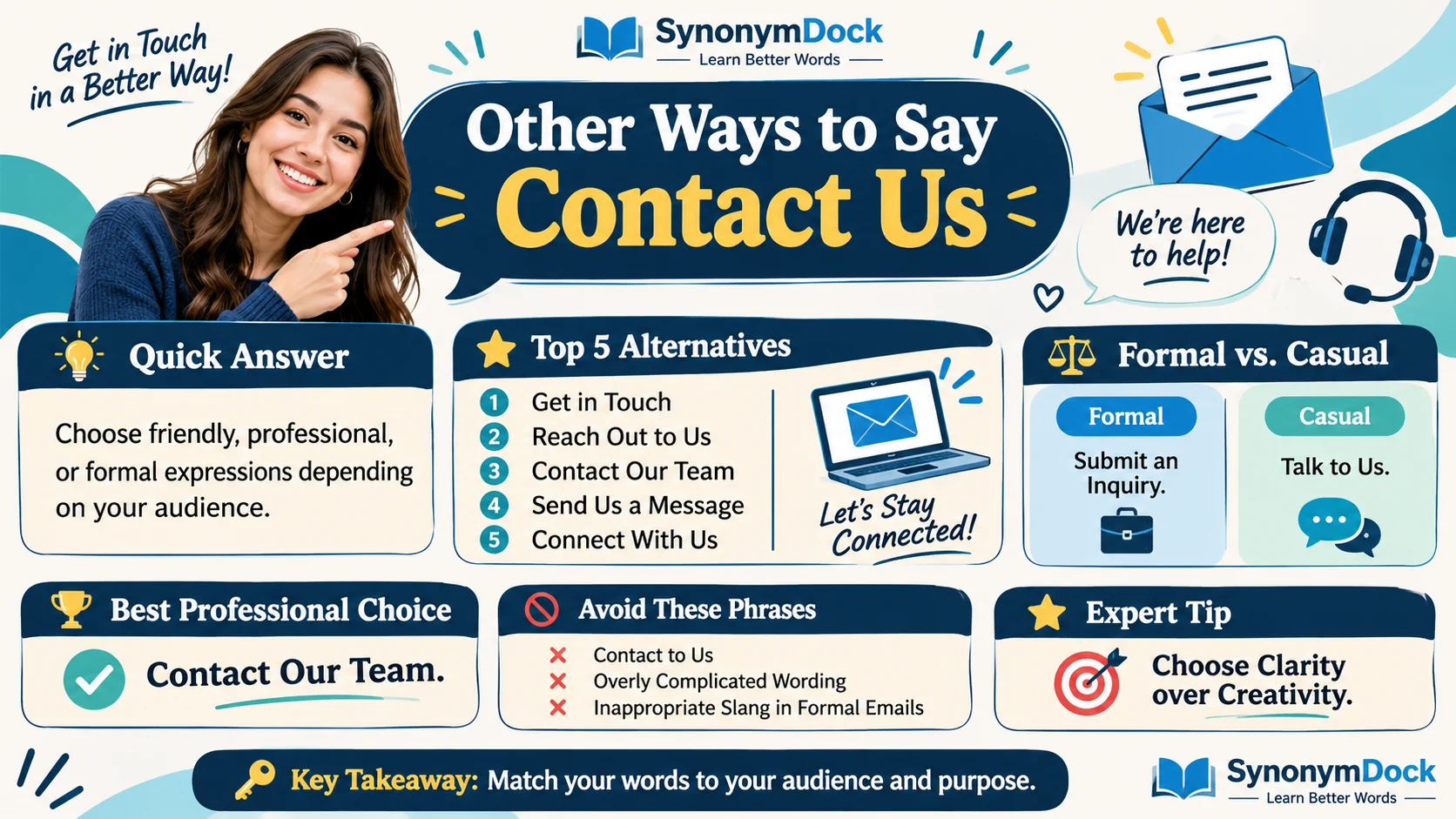
Other ways to say contact us include get in touch, reach out to us, connect with us, send us a message, and speak with our team. Choose an expression that matches your audience, purpose, and communication tone.
The phrase Contact Us is simple, familiar, and professional. However, using the same expression repeatedly can make website content, business emails, and everyday communication feel less engaging.
Learning other ways to say contact us helps you communicate with greater confidence. You can choose formal expressions for business situations, friendly phrases for customers, or natural alternatives for everyday conversations.
Whether you’re writing an email, designing a website button, or speaking with a colleague, the right words make communication clearer and more welcoming.
Quick Categories: Contact Us Alternatives by Situation
Here are useful alternatives organized by communication style.
Formal Alternatives
- Please direct your inquiry to our office.
- Submit your inquiry.
- Contact our representatives.
- Please correspond with our department.
Pro Tip: Use formal expressions when communicating with institutions, senior professionals, or official organizations.
Professional Alternatives
- Contact our team.
- Reach out to our department.
- Speak with our specialists.
- Connect with our representatives.
Pro Tip: Professional language should sound respectful without becoming unnecessarily complicated.
Business Email Alternatives
- Please feel free to get in touch.
- Reach out if you need further information.
- Send us your questions.
- Please email our team.
Pro Tip: Make your invitation specific. Mention what information or assistance the reader can request.
Academic Alternatives
- Contact the academic department.
- Direct your questions to the instructor.
- Send an inquiry to the admissions office.
- Correspond with the research team.
Pro Tip: Academic communication benefits from precise language that identifies the appropriate person or department.
Casual Alternatives
- Get in touch.
- Talk to us.
- Send us a message.
- Let’s connect.
Pro Tip: Friendly expressions work well for personal websites, blogs, and approachable brands.
Informal Expressions
- Drop us a line.
- Say hello.
- Give us a shout.
- Send us a quick message.
Pro Tip: Save informal expressions for relaxed conversations and brands with a friendly personality.
What Does “Contact Us” Mean?
Contact Us is an expression that invites someone to communicate with a person, company, organization, or team.
Communication can happen through different channels, including:
- Telephone calls
- Online contact forms
- Social media messages
- Live chat
- In-person conversations
Grammar explanation: Contact functions as a verb, while us is its object pronoun. Together, they create an imperative expression inviting readers to initiate communication.
Simple example:
Please contact us if you have questions about your application.
In this sentence, the organization invites the reader to ask for additional information.
The expression is neutral and widely understood. Its suitability depends on the audience and the situation.
When Should You Use Alternatives to Contact Us?
Different communication situations require different expressions. Understanding the context helps you choose natural and appropriate wording.
1. Business Communication
Use professional expressions when communicating with clients, business partners, and colleagues.
Example: Please reach out to our team to discuss the project requirements.
2. Emails
Email invitations should sound helpful and respectful.
Example: Feel free to get in touch if you need additional information.
3. Meetings
Choose direct expressions that encourage discussion.
Example: Speak with our department manager after the meeting.
4. Presentations
Use welcoming language when inviting questions from an audience.
Example: Connect with our team after the presentation for further details.
5. Academic Writing
Academic communication requires clarity and appropriate formality.
Example: Please direct your questions to the course instructor.
6. Interviews
Use polite expressions when explaining how candidates can request further information.
Example: Please contact our recruitment team if you have questions about the application process.
7. Daily Conversations
Casual expressions make everyday communication feel natural.
Example: Send me a message whenever you need help.
Professional vs. Polite: What’s the Difference?
Professional, polite, formal, and natural expressions often overlap, but they serve slightly different purposes.
| Style | Meaning | Example |
|---|---|---|
| Professional | Respectful workplace language | Contact our team |
| Polite | Considerate and welcoming | Feel free to reach out |
| Formal | Official and structured | Submit your inquiry |
| Natural | Everyday conversational English | Get in touch |
Professional: Best for workplace emails, client communication, and business websites.
Polite: Best when inviting someone to ask questions without feeling pressured.
Formal: Best for academic institutions, official letters, and corporate communication.
Natural: Best for everyday conversations and approachable website content.
Pros and Cons of Using Different Contact Expressions
Pros
- Improves vocabulary: You learn expressions suitable for different communication situations.
- Creates variety: Your writing becomes less repetitive and more engaging.
- Builds a welcoming tone: Friendly expressions can make visitors feel comfortable.
- Improves clarity: Specific calls to action explain what readers should do next.
Cons
- Wrong tone: Casual expressions may seem unsuitable in official communication.
- Unclear meaning: Creative wording can confuse readers if the intended action is not obvious.
- Unnecessary complexity: Overly formal language can make simple instructions difficult.
- Inconsistent branding: Switching between formal and playful language can make a website feel less consistent.
Other Ways to Say “Contact Us” (With Examples)
Here are ten useful alternatives, arranged from widely applicable expressions to more specialized or informal choices.
1. Get in Touch
Meaning: Start communicating with someone or an organization.
Explanation: This is one of the most natural alternatives to Contact Us. It sounds friendly, approachable, and professional without being overly formal.
Usage: Formal, neutral, professional, and casual.
Example Sentence: Get in touch with our customer service team if you need assistance.
Best Use: Websites and emails.
Avoid Using In: Strict legal notices.
Tone: Warm and friendly.
Formality Level: ⭐⭐⭐⭐
Usage Frequency: Very Common.
CEFR Level: B1 (approximate).
Common Collocations:
- Get in touch with us.
- Get in touch today.
- Get in touch directly.
- Get in touch anytime.
Context Examples:
- Spoken English: Get in touch whenever you need help.
- Professional English: Please get in touch with our department regarding your application.
- Casual Conversation: Get in touch when you’re free.
2. Reach Out to Us
Meaning: Make contact to ask a question, request assistance, or start a conversation.
Explanation: This expression is particularly useful in professional communication. It sounds supportive and encourages people to communicate comfortably.
Usage: Neutral, professional, and polite.
Example Sentence: Please reach out to us if you require additional information about our services.
Best Use: Client communication.
Avoid Using In: Very concise button labels.
Tone: Helpful and professional.
Formality Level: ⭐⭐⭐⭐
Usage Frequency: Very Common.
CEFR Level: B2 (approximate).
Common Collocations:
- Reach out to our team.
- Reach out for assistance.
- Reach out directly.
- Reach out with questions.
Context Examples:
- Spoken English: Reach out if you need anything.
- Professional English: Please reach out to our support department.
- Casual Conversation: Reach out whenever you want to chat.
3. Contact Our Team
Meaning: Communicate directly with a company’s employees or representatives.
Explanation: This expression is direct and professional. It works especially well when visitors need to speak with a specific department or group.
Usage: Formal, neutral, and professional.
Example Sentence: Contact our team to discuss your requirements and available services.
Best Use: Corporate websites.
Avoid Using In: Personal chats.
Tone: Direct and professional.
Formality Level: ⭐⭐⭐⭐⭐
Usage Frequency: Very Common.
CEFR Level: B1 (approximate).
Common Collocations:
- Contact our sales team.
- Contact our support team.
- Contact our service department.
- Contact our representatives.
Context Examples:
- Spoken English: Contact our team for further assistance.
- Professional English: Please contact our team regarding your proposal.
- Casual Conversation: Contact our team if something goes wrong.
4. Send Us a Message
Meaning: Communicate by writing and sending a message.
Explanation: This phrase clearly describes a digital communication action. It is especially useful for websites, contact forms, and social media pages.
Usage: Neutral, friendly, and casual.
Example Sentence: Send us a message through our website, and our team will respond to your inquiry.
Best Use: Contact forms.
Avoid Using In: Phone-only services.
Tone: Friendly and clear.
Formality Level: ⭐⭐⭐
Usage Frequency: Very Common.
CEFR Level: B1 (approximate).
Common Collocations:
- Send us a message.
- Send a quick message.
- Send a private message.
- Send a detailed message.
Context Examples:
- Spoken English: Send us a message if you have questions.
- Professional English: Please send us a message with the relevant details.
- Casual Conversation: Send us a message later.
5. Connect With Us
Meaning: Establish communication or a relationship with an individual or organization.
Explanation: This alternative sounds modern and welcoming. It works particularly well for networking, professional communities, and brands building relationships with customers.
Usage: Neutral, professional, and casual.
Example Sentence: Connect with us to learn more about our educational programs.
Best Use: Networking websites.
Avoid Using In: Urgent support instructions.
Tone: Welcoming and modern.
Formality Level: ⭐⭐⭐⭐
Usage Frequency: Common.
CEFR Level: B2 (approximate).
Common Collocations:
- Connect with our experts.
- Connect with our team.
- Connect with us online.
- Connect with our community.
Context Examples:
- Spoken English: Connect with us after the event.
- Professional English: Connect with our representatives to explore opportunities.
- Casual Conversation: Connect with us on social media.
Native Speaker Tip:
The most natural general choices are Get in Touch and Reach Out to Us. Contact Our Team sounds more specific and professional, while Connect With Us feels especially suitable for networking and community-focused communication.
6. Speak With a Representative
Meaning: Have a conversation with an authorized person representing an organization.
Explanation: This phrase is useful when customers need personal assistance or detailed information. It suggests direct communication rather than simply sending a message.
Usage: Formal and professional.
Example Sentence: Speak with a representative to learn more about our available plans.
Best Use: Customer assistance.
Avoid Using In: Social media captions.
Tone: Respectful and official.
Formality Level: ⭐⭐⭐⭐⭐
Usage Frequency: Common.
CEFR Level: B2 (approximate).
Common Collocations:
- Speak with a representative.
- Speak with an advisor.
- Speak with our specialist.
- Speak with a customer service agent.
Context Examples:
- Spoken English: Speak with a representative if you need help.
- Professional English: Please speak with an authorized representative regarding this matter.
- Casual Conversation: Talk to someone from the team.
7. Submit an Inquiry
Meaning: Send a formal question or request for information.
Explanation: This expression is appropriate for official websites, academic institutions, and professional organizations. It emphasizes a written request rather than general conversation.
Usage: Formal and academic.
Example Sentence: Submit an inquiry to our admissions office for information about enrollment.
Best Use: Official requests.
Avoid Using In: Friendly conversations.
Tone: Formal and precise.
Formality Level: ⭐⭐⭐⭐⭐
Usage Frequency: Occasional.
CEFR Level: C1 (approximate).
Common Collocations:
- Submit an inquiry online.
- Submit a formal inquiry.
- Submit an inquiry form.
- Submit an inquiry regarding admission.
Context Examples:
- Spoken English: Send your question to the admissions office.
- Professional English: Please submit an inquiry concerning the proposed partnership.
- Casual Conversation: Send us your question.
8. Email Us
Meaning: Send an electronic message to an organization’s email address.
Explanation: This is a direct alternative when email is the preferred communication channel. It removes uncertainty by telling visitors exactly how to make contact.
Usage: Neutral and professional.
Example Sentence: Email us for additional information about our upcoming courses.
Best Use: Email support.
Avoid Using In: Phone-only communication.
Tone: Direct and helpful.
Formality Level: ⭐⭐⭐
Usage Frequency: Very Common.
CEFR Level: B1 (approximate).
Common Collocations:
- Email us directly.
- Email our support team.
- Email us for details.
- Email us with questions.
Context Examples:
- Spoken English: Email us if you need more information.
- Professional English: Please email our department with your completed application.
- Casual Conversation: Email me when you get a chance.
9. Talk to Us
Meaning: Start a conversation with a person or organization.
Explanation: This expression feels approachable and conversational. It is particularly useful for businesses that want customers to feel comfortable asking questions.
Usage: Neutral, friendly, and casual.
Example Sentence: Talk to us about your ideas, and we’ll help you explore the possibilities.
Best Use: Friendly websites.
Avoid Using In: Highly formal letters.
Tone: Warm and conversational.
Formality Level: ⭐⭐⭐
Usage Frequency: Common.
CEFR Level: B1 (approximate).
Common Collocations:
- Talk to our team.
- Talk to an expert.
- Talk to us today.
- Talk to customer support.
Context Examples:
- Spoken English: Talk to us if anything is unclear.
- Professional English: Talk to our specialists about your business requirements.
- Casual Conversation: Talk to us whenever you’re available.
10. Drop Us a Line
Meaning: Send someone a short written message.
Explanation: This is a relaxed and friendly expression, often used by approachable brands, blogs, and personal websites. It is less suitable for highly formal situations.
Usage: Casual and informal.
Example Sentence: Drop us a line if you’d like to share your thoughts or ask a question.
Best Use: Casual websites.
Avoid Using In: Official correspondence.
Tone: Relaxed and friendly.
Formality Level: ⭐⭐
Usage Frequency: Occasional.
CEFR Level: C1 (approximate).
Common Collocations:
- Drop us a line anytime.
- Drop me a line.
- Drop us a quick line.
- Drop us a line with questions.
Context Examples:
- Spoken English: Drop us a line whenever you need help.
- Professional English: Feel free to drop us a line if you need further details, provided the relationship is informal.
- Casual Conversation: Drop me a line this weekend.
Native Speaker Tip:
For most professional situations, Get in Touch and Reach Out to Us are reliable choices. Submit an Inquiry is more specialized and sounds formal. Drop Us a Line is friendly but less common in modern formal business writing.
Expert Insight: Choosing the Right Expression
The best alternative depends on what you want the reader to do.
Workplace communication: Contact Our Team is clear when directing employees, clients, or partners to a specific department.
Email writing: Reach Out to Us works naturally when inviting readers to ask questions or request assistance.
Academic English: Submit an Inquiry is suitable for formal requests to admissions offices, research departments, and institutions.
Professional tone: Get in Touch provides a useful balance between friendliness and professionalism.
One important writing principle is to choose clarity over creativity. A visitor should understand what happens after selecting your contact option.
Quick Recap: Best Contact Us Alternatives
| Category | Best Choice |
|---|---|
| Best Professional Choice | Contact Our Team |
| Best Casual Choice | Talk to Us |
| Best Formal Choice | Submit an Inquiry |
| Most Natural Choice | Get in Touch |
| Most Polite Choice | Reach Out to Us |
Comparison Table: 10 Alternatives to Contact Us
| Phrase | Tone | Formality | Best Use | Frequency |
|---|---|---|---|---|
| Get in Touch | Friendly | Medium | Websites and emails | Very Common |
| Reach Out to Us | Helpful | Medium | Client communication | Very Common |
| Contact Our Team | Professional | High | Corporate websites | Very Common |
| Send Us a Message | Friendly | Medium | Contact forms | Very Common |
| Connect With Us | Welcoming | Medium | Networking | Common |
| Speak With a Representative | Official | High | Customer service | Common |
| Submit an Inquiry | Formal | Very High | Academic requests | Occasional |
| Email Us | Direct | Medium | Email support | Very Common |
| Talk to Us | Conversational | Low | Friendly websites | Common |
| Drop Us a Line | Relaxed | Low | Casual websites | Occasional |
Formality and frequency labels are practical editorial guidance, not measured corpus statistics. CEFR estimates above are also approximate.
Best Choice: Which Alternative Should You Use?
There isn’t one perfect replacement for every situation. Here are the most useful recommendations.
- Best Overall: Get in Touch. It works naturally across websites, emails, and everyday professional communication.
- Best Professional: Contact Our Team. It sounds clear and identifies the people visitors should approach.
- Best Academic: Submit an Inquiry. It suits formal questions and institutional communication.
- Best Business Email: Reach Out to Us. It creates a helpful and respectful impression.
- Best Everyday Conversation: Talk to Us. It sounds friendly and easy to understand.
- Most Natural: Get in Touch. It is a familiar expression that fits many situations.
- Most Polite: Reach Out to Us. It encourages communication without sounding demanding.
Commonly Confused Phrases
Some contact expressions appear similar but communicate slightly different intentions.
Contact Us vs. Get in Touch
Both invite communication. Contact Us sounds direct and neutral, while Get in Touch feels warmer and more conversational.
Reach Out vs. Connect With Us
Reach Out usually emphasizes starting communication or asking for assistance. Connect With Us can suggest building a relationship or professional connection.
Send Us a Message vs. Email Us
Send Us a Message can refer to different digital messaging channels. Email Us specifically tells the reader to use email.
Submit an Inquiry vs. Contact Our Team
Submit an Inquiry suggests sending a formal question or request. Contact Our Team is broader and may involve calls, messages, or meetings.
Talk to Us vs. Drop Us a Line
Talk to Us suggests a conversation, often spoken or through live chat. Drop Us a Line generally means sending a short written message.
Common Mistakes When Using Contact Us Alternatives
Choosing an alternative is not just about finding similar words. Grammar, tone, and context matter too.
Mistake 1: Adding an Unnecessary Preposition
Wrong: Please contact to us for assistance.
Why incorrect: Contact is a transitive verb and does not require to before its object.
Correct: Please contact us for assistance.
Mistake 2: Using Casual Language in Formal Emails
Wrong: Hit us up if you need additional documentation.
Why incorrect: Hit us up is very informal and may sound unsuitable in official correspondence.
Correct: Please contact our department if you require additional documentation.
Mistake 3: Choosing an Unclear Button Label
Wrong: Click Here.
Why incorrect: Readers cannot immediately understand what action the button performs.
Correct: Send Us a Message.
Mistake 4: Confusing Contact With Follow-Up
Wrong: Follow up with us before making your first inquiry.
Why incorrect: Follow up generally means continuing communication after an earlier interaction.
Correct: Contact us to make your initial inquiry.
Mistake 5: Using Overly Complicated Expressions
Wrong: Kindly initiate correspondence with our organizational representatives.
Why incorrect: The wording sounds unnecessarily complicated for a simple invitation.
Correct: Please get in touch with our team.
Scenario Practice: Choose the Right Expression
Test your understanding with five realistic communication situations.
Situation 1: Business Meeting
You want a potential client to discuss project requirements with your company.
Which phrase would you choose?
Answer: Contact Our Team.
Explanation: It sounds professional and directs the client toward the appropriate people.
Situation 2: Job Interview
A recruiter wants applicants to ask questions about the hiring process.
Which phrase would you choose?
Answer: Reach Out to Us.
Explanation: It sounds polite and professional without creating unnecessary distance.
Situation 3: Presentation
A speaker invites attendees to explore additional information after a presentation.
Which phrase would you choose?
Answer: Connect With Us.
Explanation: It creates a welcoming invitation and encourages further communication.
Situation 4: Classroom Discussion
A teacher invites students to ask questions about an assignment.
Which phrase would you choose?
Answer: Talk to Me.
Explanation: This is a natural, approachable expression for a classroom setting.
Situation 5: Email Reply
A business wants customers to request additional details through email.
Which phrase would you choose?
Answer: Email Us.
Explanation: It clearly identifies the communication channel and tells readers exactly what action to take.
Mini Quiz: Test Your Vocabulary
Choose the most appropriate expression for each situation.
1. Which expression sounds most suitable for a formal academic request?
A. Drop Us a Line
B. Submit an Inquiry
C. Talk to Us
D. Say Hello
2. Which alternative sounds friendly and professional in most business emails?
A. Get in Touch
B. Hit Us Up
C. Give Us a Shout
D. Hang Out With Us
3. Which expression specifically asks someone to send an email?
A. Connect With Us
B. Talk to Us
C. Email Us
D. Drop By
4. Which phrase is most suitable for a relaxed personal website?
A. Submit an Inquiry
B. Drop Us a Line
C. Speak With an Authorized Representative
D. Direct Your Correspondence
5. Which sentence uses the verb contact correctly?
A. Please contact to us tomorrow.
B. Please contact us tomorrow.
C. Please contact with us tomorrow.
D. Please contact at us tomorrow.
Answer Key
- B. Submit an Inquiry – Appropriate for formal academic communication.
- A. Get in Touch – Friendly and professional.
- C. Email Us – Clearly identifies the communication channel.
- B. Drop Us a Line – Relaxed and conversational.
- B. Please contact us tomorrow. – Contact takes a direct object without an additional preposition.
FAQs
1. What are the best other ways to say contact us?
The best alternatives include Get in Touch, Reach Out to Us, Contact Our Team, Send Us a Message, and Connect With Us. Choose based on your audience, communication purpose, and preferred level of formality.
2. How do you say contact us professionally?
Professional alternatives include Contact Our Team, Reach Out to Our Department, and Speak With a Representative. These expressions work well in business emails, corporate websites, customer service messages, and communication with professional partners.
3. What is a polite alternative to contact us?
Reach Out to Us and Feel Free to Get in Touch are polite alternatives. Both expressions invite communication without sounding demanding, making them useful for customer service, professional emails, and friendly business websites.
4. What can I write instead of contact us on a website?
You can use Get in Touch, Send Us a Message, Connect With Us, Talk to Us, or We Would Love to Hear From You. Choose a label that clearly explains the action visitors should take.
5. Is get in touch more professional than contact us?
Both expressions are appropriate for professional communication. Get in Touch sounds warmer and more conversational, while Contact Us feels direct and neutral. The better choice depends on your audience and brand voice.
Conclusion
Learning other ways to say contact us helps you communicate more naturally in professional, academic, and everyday situations. Expressions such as Get in Touch, Reach Out to Us, and Contact Our Team add variety while keeping your message clear and respectful. The key is understanding the tone and purpose behind each phrase.
Practice these alternatives in emails, conversations, and website content. Start with familiar expressions, then experiment with more formal or casual choices as your vocabulary grows. With consistent practice, you’ll develop greater confidence and communicate your ideas more effectively.