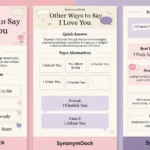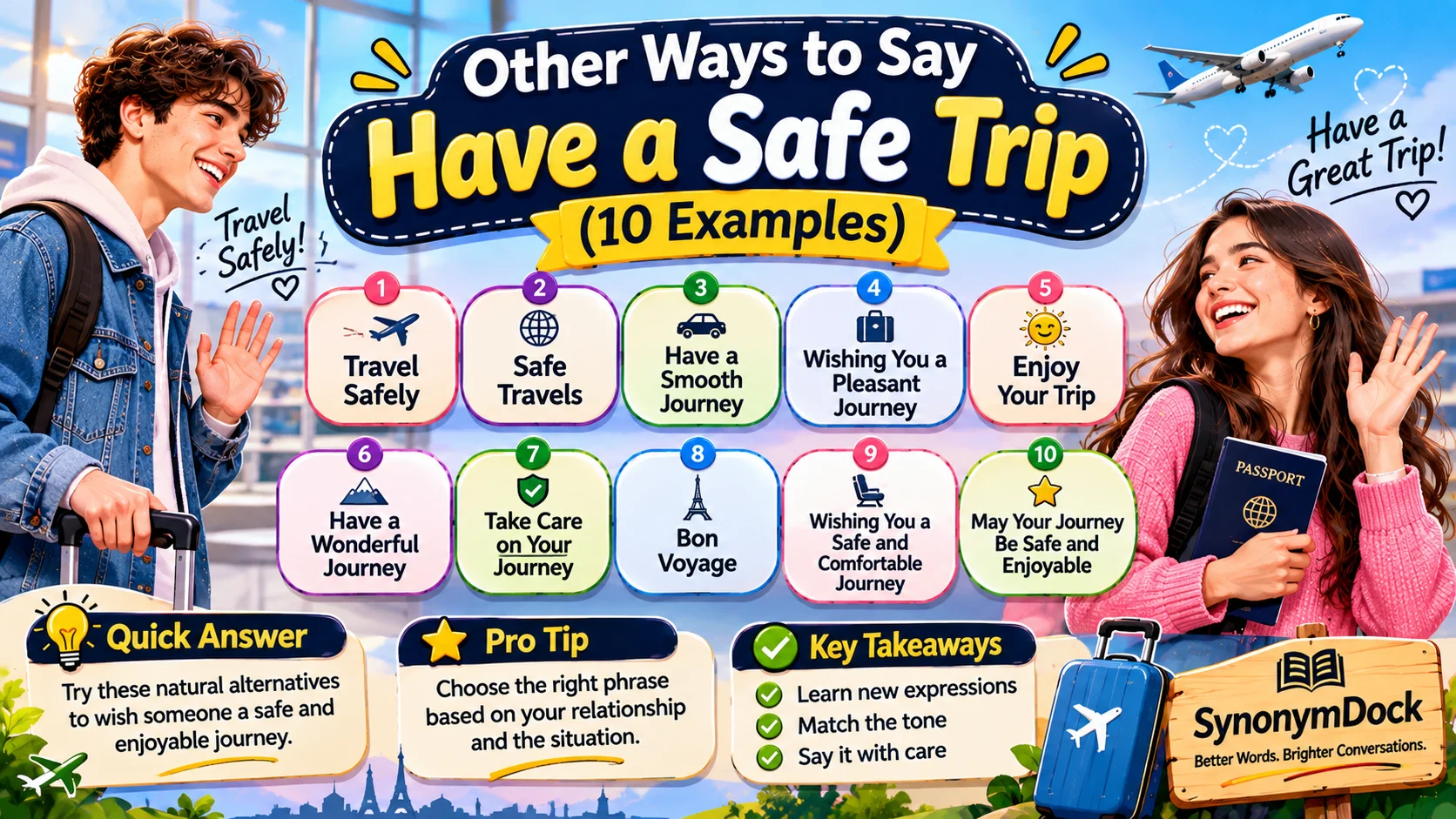
Other ways to say have a safe trip include safe travels, travel safely, have a safe journey, wishing you a smooth trip, and take care on your journey. These expressions suit professional emails, friendly conversations, and formal goodbyes.
Saying have a safe trip is a thoughtful way to wish someone well before they travel. However, using the same expression repeatedly can make your conversations and messages sound predictable.
Learning different ways to express this sentiment helps you communicate more naturally. Whether you’re writing a business email, speaking with a colleague, or saying goodbye to a friend, choosing the right words makes your message more meaningful.
In this guide, SynonymDock explores 10 useful alternatives, their meanings, tones, and real-life applications. You’ll also discover formal expressions, professional phrases, common mistakes, and practical examples to improve your English vocabulary.
QUICK CATEGORIES: DIFFERENT WAYS TO WISH SOMEONE A SAFE TRIP
Choosing an appropriate expression depends on your relationship with the traveler and the situation.
Formal Alternatives
Use these expressions when addressing clients, senior colleagues, teachers, or people you don’t know well.
- I wish you a safe and pleasant journey.
- May your journey be safe and comfortable.
- Wishing you a smooth and successful trip.
- Please travel safely and take care.
Pro Tip: Complete sentences beginning with “I wish” or “I hope” generally sound polished in formal correspondence.
Professional Alternatives
These phrases work well when colleagues or business contacts are traveling for work.
- Wishing you safe travels.
- Have a safe and productive trip.
- I hope your journey goes smoothly.
- Best wishes for a successful journey.
Pro Tip: Connect your travel wish with the purpose of the trip when appropriate.
Business Email Alternatives
Use these expressions to close professional messages politely.
- Wishing you a safe journey to the conference.
- I hope you have a pleasant trip.
- Safe travels, and I look forward to reconnecting.
- Best wishes for a smooth journey.
Pro Tip: Keep email closings concise, warm, and relevant to the recipient’s travel plans.
Academic Alternatives
These expressions are suitable for communicating with teachers, professors, classmates, and academic visitors.
- I wish you a pleasant journey.
- Have a safe journey to the university.
- Wishing you a comfortable trip.
- I hope you arrive safely.
Pro Tip: Use complete, respectful sentences in formal academic communication.
Casual Alternatives
These expressions sound natural when speaking with friends, relatives, and familiar colleagues.
- Safe travels!
- Travel safely!
- Have a great trip!
- Take care on your journey.
Pro Tip: Short expressions often sound more natural in everyday conversations.
Informal Expressions
These options add warmth and personality to personal messages.
- Get there safely!
- Enjoy your trip and stay safe!
- Text me when you arrive.
- Have fun and take care!
Pro Tip: Personalize your message with a friendly detail instead of relying on a generic farewell.
WHAT DOES “HAVE A SAFE TRIP” MEAN?
“Have a safe trip” is a common English expression used to wish someone a journey without accidents, unnecessary difficulties, or unexpected problems.
It communicates two simple feelings:
- Safety: You hope the traveler reaches their destination safely.
- Goodwill: You want them to enjoy a comfortable and pleasant journey.
Grammar Explanation
The expression is an imperative sentence used as a friendly wish rather than a strict instruction.
Its structure is:
Have + a + adjective + noun
For example:
- Have a wonderful day.
- Have a pleasant journey.
- Have a safe trip.
The word “safe” describes the noun “trip.”
Example: Your flight leaves early tomorrow. Have a safe trip, and enjoy your vacation!
In simple English, it means: I hope everything goes well while you are traveling.
WHEN SHOULD YOU USE ALTERNATIVES TO “HAVE A SAFE TRIP”?
Different situations require different communication styles. Here is how to choose an appropriate expression.
Business Communication
When a colleague travels for work, use a polished expression.
Example: “Wishing you safe travels and a successful business meeting.”
Professional Emails
A complete, courteous sentence works well when writing to clients or managers.
Example: “I hope you have a safe and pleasant journey to London.”
Meetings
When a colleague announces an upcoming business trip, respond naturally.
Example: “Safe travels! I hope everything goes smoothly.”
Presentations
If a speaker or guest is traveling to an event, acknowledge their effort.
Example: “We wish you a pleasant journey and look forward to welcoming you.”
Academic Writing
Use respectful expressions when addressing visiting professors or academic guests.
Example: “We wish you a comfortable journey to the university.”
Interviews
When an interview candidate or interviewer is traveling to an in-person meeting, use a courteous expression.
Example: “I hope you have a smooth journey to our office.”
Daily Conversations
For friends and family, shorter expressions are usually more natural.
Example: “Travel safely! Let me know when you get there.”
PROFESSIONAL VS. POLITE VS. FORMAL VS. NATURAL
These communication styles overlap, but they aren’t identical.
| Style | Meaning | Example |
|---|---|---|
| Polite | Shows consideration | I hope you have a pleasant journey. |
| Professional | Suitable for workplace communication | Wishing you safe travels for your business trip. |
| Formal | Respectful and carefully worded | I wish you a safe and comfortable journey. |
| Natural | Sounds conversational and effortless | Safe travels! |
Important distinction: A phrase can be professional and polite without sounding extremely formal. For example, “Wishing you safe travels” is suitable for most workplace emails.
PROS AND CONS OF USING ALTERNATIVE EXPRESSIONS
Pros
- Improved vocabulary: You learn different ways to communicate the same general message.
- Better communication: You can adjust your wording to suit different relationships.
- Professional confidence: Appropriate expressions help make workplace emails sound polished.
- More personal messages: Specific wishes can communicate genuine interest and consideration.
Cons
- Wrong tone: An overly formal expression may sound unnatural in a casual conversation.
- Different meanings: Some alternatives emphasize enjoyment rather than safety.
- Overcomplication: Long expressions can make simple messages unnecessarily wordy.
- Unusual wording: Rare expressions may sound awkward in everyday communication.
The solution is simple: choose clarity and context over complicated vocabulary.
OTHER WAYS TO SAY “HAVE A SAFE TRIP” (WITH EXAMPLES)
Here are 10 useful alternatives, arranged from versatile everyday expressions to more specialized farewells.
Phrase: Safe Travels!
Meaning: A short wish for someone’s safety throughout their journey.
Explanation: This is one of the most versatile alternatives. It sounds friendly, natural, and appropriate for many situations.
- Formal: Acceptable in friendly professional correspondence.
- Neutral: Works with acquaintances and colleagues.
- Professional: Suitable for workplace messages.
- Casual: Excellent for friends and family.
Example Sentence: Safe travels! I hope you enjoy your conference and have a wonderful experience.
Best Use: Everyday goodbyes
Avoid Using In: Academic essays
Tone: Warm, friendly
Formality Level: ⭐⭐⭐
Usage Frequency: Very Common
CEFR Level: B1
Common Collocations:
- Safe travels home
- Wishing you safe travels
- Safe travels ahead
- Safe travels and enjoy
- Safe travels everyone
Context Examples:
- Spoken English: “Safe travels! See you next week.”
- Professional English: “Safe travels, and I look forward to our next meeting.”
- Casual Conversation: “Safe travels! Send me some pictures.”
Phrase: Travel Safely!
Meaning: A direct wish that someone travels without problems or harm.
Explanation: This expression is simple and clear. It works in spoken English, personal messages, and professional communication.
- Formal: Suitable in polite messages.
- Neutral: A straightforward alternative.
- Professional: Appropriate for colleagues.
- Casual: Natural in everyday conversations.
Example Sentence: Travel safely, and let us know when you arrive at your destination.
Best Use: General travel wishes
Avoid Using In: Formal academic prose
Tone: Caring, direct
Formality Level: ⭐⭐⭐⭐
Usage Frequency: Very Common
CEFR Level: B1
Common Collocations:
- Travel safely home
- Travel safely abroad
- Travel safely today
- Travel safely and comfortably
Context Examples:
- Spoken English: “Travel safely! The weather looks unpredictable.”
- Professional English: “Please travel safely during your business visit.”
- Casual Conversation: “Travel safely and have fun!”
Phrase: Have a Safe Journey.
Meaning: A polite wish for someone to complete their journey safely.
Explanation: This expression is slightly more traditional and formal than “Safe travels.” It is particularly suitable for longer journeys and professional goodbyes.
- Formal: Excellent for respectful communication.
- Neutral: Suitable for general use.
- Professional: Works in business emails.
- Casual: Appropriate with friends and family.
Example Sentence: Have a safe journey to the university, and we look forward to seeing you.
Best Use: Polite farewells
Avoid Using In: Casual slang
Tone: Respectful, warm
Formality Level: ⭐⭐⭐⭐
Usage Frequency: Common
CEFR Level: B1
Common Collocations:
- Safe journey home
- Have a pleasant journey
- Long journey ahead
- Enjoy your journey
- Wishing you a safe journey
Context Examples:
- Spoken English: “Have a safe journey home!”
- Professional English: “I wish you a safe journey to the conference.”
- Casual Conversation: “Have a safe journey and enjoy your holiday!”
Phrase: Wishing You a Smooth Trip.
Meaning: A wish that someone’s journey goes easily and comfortably.
Explanation: The word “smooth” suggests minimal delays, complications, or travel difficulties. It is especially useful in workplace communication.
- Formal: Suitable for courteous correspondence.
- Neutral: Friendly and clear.
- Professional: Excellent for business messages.
- Casual: Works in personal texts.
Example Sentence: Wishing you a smooth trip to Singapore and a successful week of meetings.
Best Use: Business travel
Avoid Using In: Academic reports
Tone: Polished, positive
Formality Level: ⭐⭐⭐⭐
Usage Frequency: Common
CEFR Level: B2
Common Collocations:
- Smooth trip ahead
- Smooth journey home
- Smooth flight
- Smooth travel experience
- Smooth business trip
Context Examples:
- Spoken English: “Hope you have a smooth trip!”
- Professional English: “Wishing you a smooth trip and productive meetings.”
- Casual Conversation: “Have a smooth trip! See you soon.”
Phrase: Take Care on Your Journey.
Meaning: A caring reminder to look after yourself while traveling.
Explanation: This expression focuses on the traveler’s well-being. It sounds thoughtful without being overly formal.
- Formal: Suitable for polite farewells.
- Neutral: Appropriate in everyday communication.
- Professional: Works with familiar colleagues.
- Casual: Especially natural with friends and relatives.
Example Sentence: Take care on your journey, and I hope everything goes according to plan.
Best Use: Personal goodbyes
Avoid Using In: Formal reports
Tone: Caring, thoughtful
Formality Level: ⭐⭐⭐
Usage Frequency: Common
CEFR Level: B1
Common Collocations:
- Take care while traveling
- Take care on the road
- Take good care
- Take care and travel safely
Context Examples:
- Spoken English: “Take care on your journey!”
- Professional English: “Please take care during your travels.”
- Casual Conversation: “Take care and message me when you arrive.”
NATIVE SPEAKER TIP: ALTERNATIVES 1–5
For everyday English, Safe travels! is a particularly natural and versatile choice. For workplace communication, Wishing you a smooth trip sounds polished without becoming stiff.
“Take care on your journey” is warmer and more personal. Choose it when you want to emphasize concern rather than simply offer a standard farewell.
Phrase: Have a Safe and Pleasant Journey.
Meaning: A wish for both safety and an enjoyable travel experience.
Explanation: This is a more complete and courteous expression. It works particularly well in formal messages, invitations, and professional correspondence.
- Formal: Excellent for formal communication.
- Neutral: Understandable but slightly polished.
- Professional: Suitable for clients and visitors.
- Casual: May sound overly formal with close friends.
Example Sentence: We wish you a safe and pleasant journey to our annual conference.
Best Use: Formal correspondence
Avoid Using In: Casual texting
Tone: Courteous, polished
Formality Level: ⭐⭐⭐⭐⭐
Usage Frequency: Occasional
CEFR Level: B2
Common Collocations:
- Safe and pleasant journey
- Comfortable journey ahead
- Pleasant journey home
- Safe and comfortable travels
Context Examples:
- Spoken English: “Have a safe and pleasant journey!”
- Professional English: “We wish you a safe and pleasant journey to our headquarters.”
- Casual Conversation: “Have a lovely trip and stay safe!”
Phrase: Have a Safe and Productive Trip.
Meaning: A wish for safe travel and successful work-related activities.
Explanation: This phrase is designed for business travel. The word “productive” adds a professional purpose, making it more specific than a general travel wish.
- Formal: Suitable for professional settings.
- Neutral: Less natural for vacations.
- Professional: Excellent for business trips.
- Casual: Works with coworkers.
Example Sentence: Have a safe and productive trip to the international sales conference.
Best Use: Business journeys
Avoid Using In: Holiday greetings
Tone: Professional, encouraging
Formality Level: ⭐⭐⭐⭐
Usage Frequency: Business Only
CEFR Level: B2
Common Collocations:
- Productive business trip
- Successful business journey
- Productive meetings
- Safe and successful travels
Context Examples:
- Spoken English: “Have a safe and productive trip!”
- Professional English: “Wishing you a safe and productive trip to our regional office.”
- Casual Conversation: “Good luck with the meetings, and travel safely!”
Phrase: I Hope You Arrive Safely.
Meaning: An expression of hope that someone reaches their destination without problems.
Explanation: This phrase focuses on the destination rather than the entire journey. It is useful when someone is already traveling or approaching their destination.
- Formal: Appropriate in polite correspondence.
- Neutral: Natural and understandable.
- Professional: Suitable for colleagues.
- Casual: Warm and conversational.
Example Sentence: I hope you arrive safely and have enough time to prepare for the event.
Best Use: Arrival wishes
Avoid Using In: Farewell speeches
Tone: Thoughtful, reassuring
Formality Level: ⭐⭐⭐⭐
Usage Frequency: Common
CEFR Level: B1
Common Collocations:
- Arrive safely home
- Arrive safely at your destination
- Hope you arrive safely
- Reach your destination safely
Context Examples:
- Spoken English: “I hope you arrive safely!”
- Professional English: “I hope you arrive safely before the scheduled meeting.”
- Casual Conversation: “Hope you get there safely. See you soon!”
Phrase: Enjoy Your Trip and Stay Safe!
Meaning: A friendly wish for someone to enjoy traveling while remaining careful.
Explanation: This expression combines excitement and concern. It is particularly suitable for vacations, holidays, and personal travel.
- Formal: Less suitable for highly formal letters.
- Neutral: Friendly and understandable.
- Professional: Suitable for familiar colleagues.
- Casual: Excellent for personal conversations.
Example Sentence: Enjoy your trip and stay safe! I hope you discover some wonderful places.
Best Use: Vacation wishes
Avoid Using In: Official letters
Tone: Cheerful, caring
Formality Level: ⭐⭐⭐
Usage Frequency: Very Common
CEFR Level: B1
Common Collocations:
- Enjoy your vacation
- Stay safe abroad
- Enjoy your travels
- Have fun and stay safe
Context Examples:
- Spoken English: “Enjoy your trip and stay safe!”
- Professional English: “Enjoy your travels, and I wish you a pleasant experience.”
- Casual Conversation: “Have fun, take pictures, and stay safe!”
Phrase: Bon Voyage!
Meaning: A French expression used in English to wish someone a good journey.
Explanation: Bon voyage is a recognizable travel farewell. It sounds celebratory and slightly stylish, making it popular for vacations and special occasions.
- Formal: Possible in suitable social correspondence.
- Neutral: Understandable to most English speakers.
- Professional: Less common in business emails.
- Casual: Fun for friendly goodbyes.
Example Sentence: Bon voyage! I hope your international adventure is full of wonderful experiences.
Best Use: Celebratory farewells
Avoid Using In: Routine work emails
Tone: Cheerful, celebratory
Formality Level: ⭐⭐⭐
Usage Frequency: Occasional
CEFR Level: C1
Common Collocations:
- Bon voyage wishes
- Bon voyage message
- Bon voyage party
- Bon voyage greeting
Context Examples:
- Spoken English: “Bon voyage! Have an amazing holiday.”
- Professional English: “Bon voyage, and best wishes for your international assignment.”
- Casual Conversation: “Bon voyage! Bring back some great stories.”
NATIVE SPEAKER TIP: ALTERNATIVES 6–10
For formal communication, Have a safe and pleasant journey is a strong choice. For business travel, Have a safe and productive trip communicates the purpose clearly.
“I hope you arrive safely” is useful when someone is already on the way. “Bon voyage” is less common in routine workplace conversations, so use it when a celebratory tone feels appropriate.
EXPERT INSIGHT: HOW TO CHOOSE THE RIGHT EXPRESSION
English speakers generally choose travel wishes based on familiarity, purpose, and context rather than formality alone.
Workplace Communication
For colleagues and business partners, “Safe travels” and “Wishing you a smooth trip” are versatile choices. When the journey involves work, adding “productive” makes the message more relevant.
Email Writing
A good business email should sound respectful without becoming unnecessarily complicated.
Example:
“Thank you for the update. Wishing you safe travels to the conference. I look forward to discussing the project when you return.”
Academic English
When addressing professors, visiting researchers, or university guests, choose complete and respectful expressions.
Example: “We wish you a safe and pleasant journey and look forward to welcoming you.”
Professional Tone
Avoid expressions that sound overly dramatic or too personal when writing to someone you don’t know well. A short, sincere message usually works better than complicated vocabulary.
Teacher’s Tip: Natural communication is not about using the longest expression. It is about selecting words that fit the relationship and situation.
QUICK RECAP: WHICH EXPRESSION SHOULD YOU CHOOSE?
| Category | Best Expression |
|---|---|
| Best Professional Choice | Wishing you a smooth trip. |
| Best Casual Choice | Safe travels! |
| Best Formal Choice | Have a safe and pleasant journey. |
| Most Natural Choice | Safe travels! |
| Most Polite Choice | I wish you a safe and pleasant journey. |
COMPARISON TABLE: 10 ALTERNATIVES AT A GLANCE
| Phrase | Tone | Formality | Best Use | Frequency |
|---|---|---|---|---|
| Safe travels! | Friendly | Neutral | Everyday goodbyes | Very Common |
| Travel safely! | Caring | Neutral | General wishes | Very Common |
| Have a safe journey. | Respectful | Moderate | Polite farewells | Common |
| Wishing you a smooth trip. | Polished | Professional | Business travel | Common |
| Take care on your journey. | Warm | Neutral | Personal messages | Common |
| Have a safe and pleasant journey. | Courteous | Formal | Official messages | Occasional |
| Have a safe and productive trip. | Professional | Formal | Business trips | Business Only |
| I hope you arrive safely. | Thoughtful | Neutral | Arrival wishes | Common |
| Enjoy your trip and stay safe! | Cheerful | Casual | Vacations | Very Common |
| Bon voyage! | Celebratory | Neutral | Special occasions | Occasional |
BEST CHOICE: WHICH ALTERNATIVE WORKS IN EACH SITUATION?
Not every expression is suitable for every conversation. Use these recommendations to make your choice easier.
Best Overall: Safe Travels!
It is short, recognizable, and appropriate for friends, coworkers, and acquaintances. It works in both spoken and written English.
Best Professional: Wishing You a Smooth Trip.
This expression is polished without sounding overly formal. It works particularly well for colleagues and business contacts.
Best Academic: Have a Safe and Pleasant Journey.
This complete expression sounds respectful when addressing professors, visiting lecturers, and academic guests.
Best Business Email: Wishing You Safe Travels.
It creates a friendly but professional impression. You can add the destination or purpose to make it more personal.
Best Everyday Conversation: Travel Safely!
It is direct, easy to understand, and suitable for everyday goodbyes.
Most Natural: Safe Travels!
This expression is an easy choice when you don’t know which alternative fits best.
Most Polite: I Wish You a Safe and Pleasant Journey.
Its complete sentence structure makes it especially suitable for formal correspondence.
COMMONLY CONFUSED PHRASES
Some travel expressions sound similar but communicate slightly different meanings.
| Expression | Main Meaning | Best Context |
|---|---|---|
| Have a safe trip | Travel without problems | General travel |
| Have a good trip | Enjoy the experience | Vacations |
| Safe travels | General safety wish | Everyday communication |
| Travel safely | Focus on safe travel | Spoken and written English |
| Have a smooth trip | Avoid delays and difficulties | Professional travel |
| Have a safe flight | Safe air travel | Airports and flights |
| Drive safely | Careful driving | Road journeys |
| Have a safe journey home | Safe return home | Returning from somewhere |
Safe Travels vs. Travel Safely
“Safe travels” is a short farewell expression, while “travel safely” is a direct wish or instruction.
Both are natural, but the first sounds more conversational.
Have a Good Trip vs. Have a Safe Trip
“Have a good trip” focuses on enjoyment. “Have a safe trip” emphasizes the traveler’s safety.
You can combine both: “Have a great trip and travel safely!”
Travel Safe vs. Travel Safely
“Travel safely” is the standard grammatically precise form because “safely” is an adverb modifying the verb “travel.”
“Travel safe” is common in informal conversation, but learners should prefer “travel safely” in formal writing.
Have a Safe Flight vs. Have a Safe Journey
“Have a safe flight” specifically refers to air travel. “Have a safe journey” works for different modes of transportation.
COMMON MISTAKES WHEN WISHING SOMEONE A SAFE TRIP
English learners sometimes use travel expressions incorrectly. These five mistakes are easy to avoid.
1. Saying “Have Safe Trip”
Wrong usage: Have safe trip!
Why incorrect: The singular countable noun “trip” normally needs an article.
Correct phrase: Have a safe trip!
Example: Have a safe trip to Canada!
2. Using “Travel Safe” in Formal Writing
Wrong usage: Please travel safe during your business visit.
Why incorrect: “Safely” is the standard adverb form required in formal, grammatically precise English.
Correct phrase: Please travel safely during your business visit.
Example: We hope you travel safely and arrive on time.
3. Confusing Safety with Enjoyment
Wrong usage: Enjoy your trip! (When specifically expressing concern about safety.)
Why incorrect: The expression focuses on enjoyment rather than safe travel.
Correct phrase: Enjoy your trip and stay safe!
Example: Enjoy your vacation and travel safely!
4. Using “Bon Voyage” in Every Situation
Wrong usage: Bon voyage! (In a routine, formal client email.)
Why incorrect: Although understandable, this expression can sound unnecessarily playful or theatrical in routine professional correspondence.
Correct phrase: Wishing you safe travels.
Example: Wishing you safe travels to the conference.
5. Forgetting the Destination Context
Wrong usage: Have a safe flight! (When someone is driving.)
Why incorrect: The expression refers specifically to air travel.
Correct phrase: Drive safely!
Example: Drive safely, and let me know when you arrive.
SCENARIO PRACTICE: WHICH PHRASE WOULD YOU CHOOSE?
Test your understanding with these five everyday situations.
Situation 1: Business Meeting
Your manager is traveling to another city for an important client meeting.
Question: Which phrase would you choose?
Answer: Have a safe and productive trip.
Explanation: This expression combines a travel wish with encouragement for professional success.
Situation 2: Interview
A university guest is traveling to your institution for an interview.
Question: Which phrase would you choose?
Answer: I wish you a safe and pleasant journey.
Explanation: The complete expression sounds respectful and appropriate for a formal academic setting.
Situation 3: Presentation
Your colleague is flying abroad to deliver a presentation.
Question: Which phrase would you choose?
Answer: Wishing you safe travels and a successful presentation.
Explanation: It acknowledges both the journey and the professional purpose of the visit.
Situation 4: Classroom Discussion
Your classmate is going abroad for an educational exchange program.
Question: Which phrase would you choose?
Answer: Have a safe journey!
Explanation: It is simple, friendly, and appropriate for a classmate.
Situation 5: Email Reply
A business partner informs you that they are leaving for an international conference.
Question: Which phrase would you choose?
Answer: Wishing you a smooth trip to the conference.
Explanation: This expression sounds professional, polite, and relevant to the situation.
MINI QUIZ: TEST YOUR ENGLISH VOCABULARY
Choose the most appropriate answer for each question.
1. Which expression is most suitable for a professional business email?
A. What’s up, travel buddy?
B. Wishing you safe travels.
C. Catch you later!
D. Have loads of fun!
2. Which phrase specifically refers to air travel?
A. Drive safely.
B. Have a safe journey home.
C. Have a safe flight.
D. Take care on your journey.
3. Which sentence uses the standard adverb correctly?
A. Travel safe to London.
B. Travel safely to London.
C. Travel safety to London.
D. Travel safeness to London.
4. Which expression is most appropriate for a close friend going on vacation?
A. Please accept my formal regards.
B. Have fun and stay safe!
C. I wish to acknowledge your departure.
D. Best wishes for your official assignment.
5. What does “Have a smooth trip” mainly communicate?
A. The person should travel faster.
B. The journey should be easy and without unnecessary problems.
C. The person should cancel the journey.
D. The trip must be short.
QUIZ ANSWER KEY
- B — Wishing you safe travels is professional and friendly.
- C — A safe flight specifically refers to air travel.
- B — Safely is the standard adverb.
- B — This expression is cheerful and suitable for friends.
- B — Smooth describes a journey without unnecessary difficulties.
FAQs
1. What Are the Best Other Ways to Say Have a Safe Trip?
The best alternatives include Safe travels, Travel safely, Have a safe journey, and Wishing you a smooth trip. Each expression communicates goodwill while offering a slightly different tone for personal or professional situations.
2. How Do You Say Have a Safe Trip Professionally?
For professional communication, use Wishing you safe travels, Have a safe and productive trip, or I hope your journey goes smoothly. These expressions work well in business emails, workplace conversations, and messages to clients.
3. What Is a More Formal Way to Say Have a Safe Trip?
A more formal expression is I wish you a safe and pleasant journey. You can also say May your journey be safe and comfortable when addressing academic guests or respected professional contacts.
4. Is Safe Travels More Natural Than Have a Safe Trip?
Both expressions sound natural in everyday English. Safe travels is shorter and works well as a friendly farewell, while Have a safe trip is a complete, straightforward expression suitable for nearly everyone.
5. What Should I Say Instead of Have a Safe Trip in an Email?
In an email, try Wishing you safe travels or I hope you have a pleasant journey. For business travel, adding a reference to the meeting or conference makes your message more thoughtful.
CONCLUSION
Learning other ways to say have a safe trip helps you communicate with greater confidence and vocabulary variety. From friendly expressions like Safe travels to polished alternatives like Wishing you a smooth trip, each phrase has its own purpose. The right choice depends on your audience, relationship, and communication setting.
Practice these expressions in conversations, classroom activities, and professional emails. Pay attention to how context changes the tone of a message. With regular practice, you’ll find it easier to choose natural English expressions and communicate your thoughts clearly. Keep learning with SynonymDock!